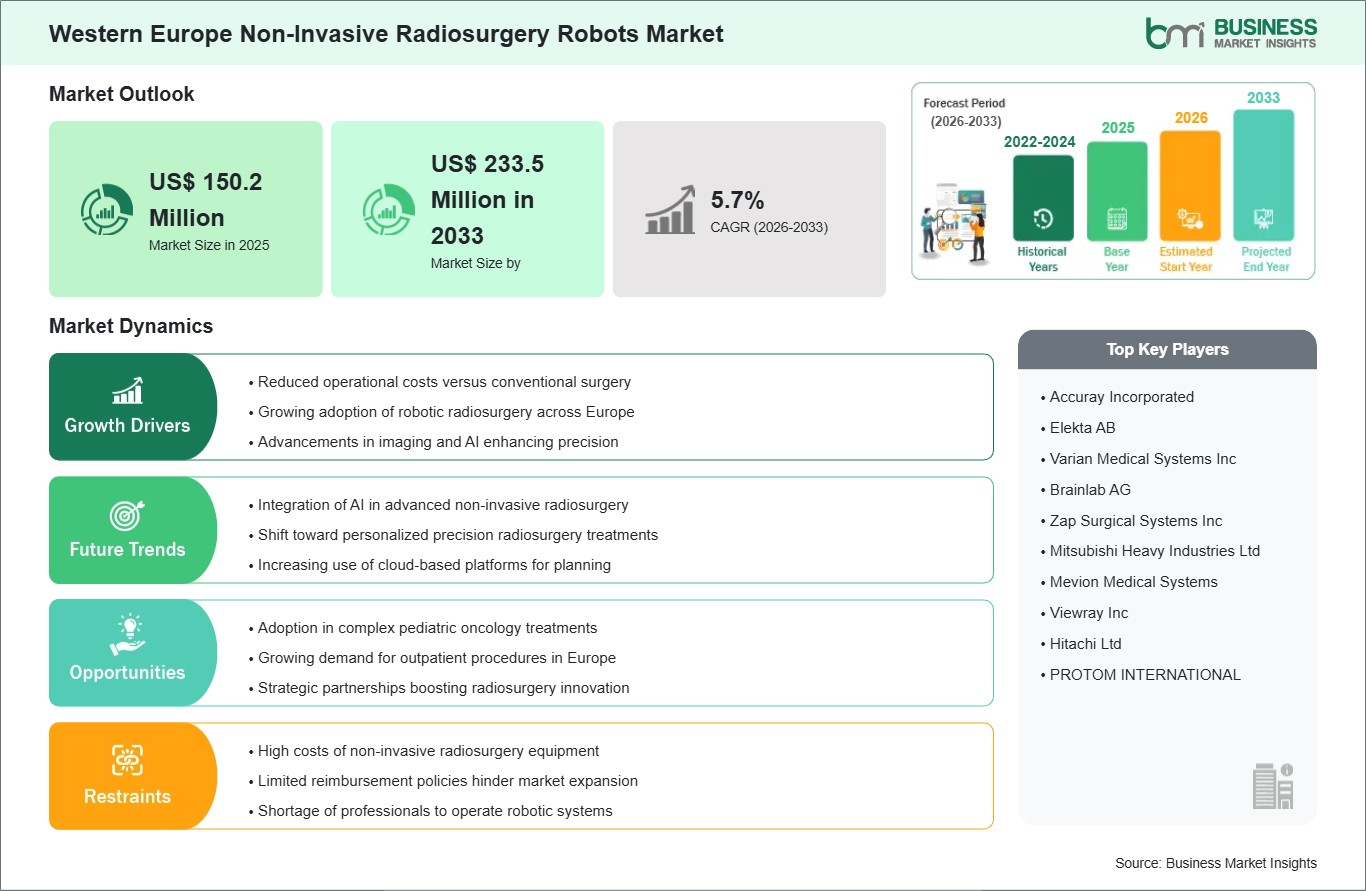
The Western Europe non-invasive radiosurgery robots market size is expected to reach US$233.5 million by 2033 from US$150.2 million in 2025. The market is estimated to record a CAGR of 5.7% from 2026 to 2033.
The Western Europe non-invasive radiosurgery robots market is experiencing steady growth as hospitals and specialized treatment centers increasingly prioritize precision oncology and minimally invasive neurosurgical interventions. Robotic radiosurgery systems provide highly targeted radiation therapy for complex tumors, spinal lesions, and neurological disorders, enabling clinicians to reduce procedural risk while improving patient recovery outcomes. Market dynamics are shaped by competition among global robotics manufacturers and regional technology integrators, who differentiate products based on precision, integration with advanced imaging, AI-assisted treatment planning, and automation capabilities. Adoption is concentrated in urban tertiary hospitals and high-volume oncology centers with advanced imaging infrastructure and skilled personnel.
Private healthcare facilities often drive initial adoption to differentiate services and attract domestic and international patients, while public hospitals implement systems through structured procurement programs and modernization initiatives. Key growth drivers include increasing awareness of minimally invasive therapies, growing prevalence of cancer and neurological conditions, and emphasis on improving operational efficiency. Challenges include high upfront capital requirements, the need for highly trained specialists, and complex regulatory frameworks that require alignment with regional healthcare standards. Additionally, hospitals must ensure seamless integration into clinical workflows and maintain ongoing technical support. Despite these barriers, the benefits of robotic radiosurgery—enhanced treatment precision, reduced complications, and optimized clinical workflows—make it a strategic investment for healthcare providers.

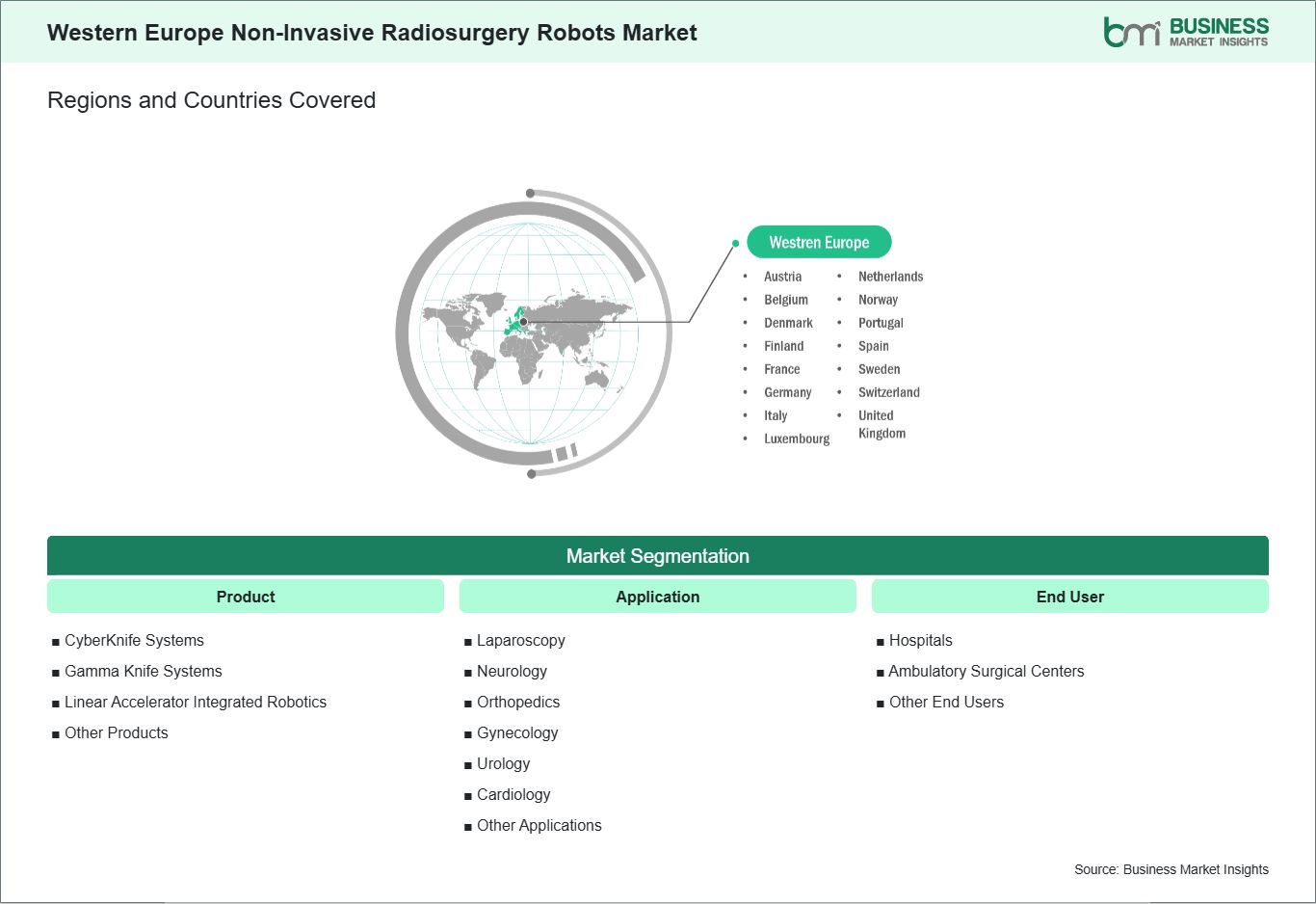
Key segments that contributed to the derivation of the Western Europe non-invasive radiosurgery robots market analysis are product, application, and end user.
Traditional surgical interventions commonly require longer lengths of hospitalization, higher levels of post-surgical care, and a higher risk of complications, which all contribute to a greater overall operational cost for hospitals. Non-invasive radiosurgery robots are capable of delivering precise radiation treatment through the use of a small, low-volume radiation dose in a manner that eliminates the need for large incisions or openings, thereby providing shorter recovery periods and less use of hospital resources. For instance, German hospitals are utilizing these efficiencies to better manage the treatment capacity required for patient treatment, while controlling the associated costs, through a reduction in the average length of stay for the patients' hospitalization, as well as through a decrease in the amount of time required for the post-surgical monitoring of patients.
Reduced patient length of stay and shorter post-surgical follow-up periods enable hospitals to increase patient throughput, optimize oncology resource utilization, and lower overall care costs by reducing complications and readmissions. Clinics are also experiencing reduced staffing requirements because of the automating labor-intensive functions performed during a robotic procedure. Such automation of procedures enables a greater level of clinical oversight. The cost efficiency of robotic radiosurgery compared with traditional surgery, combined with its demonstrated safety and efficacy, provides hospitals with a cost-effective approach to delivering high-quality patient care.
Some unique challenges in the treatment of pediatric tumors include small anatomical structures, sensitivity of nearby tissues, and a higher sensitivity to radiation compared to adults. Robotic radiosurgery systems allow doctors to target tumors with sub-millimeter precision, so they can treat tumors with minimal exposure to healthy surrounding tissue. Radiation therapy using these technologies is being integrated into hospital pediatric oncology departments throughout Western Europe, providing an overall safer and more effective method for treating numerous types of pediatric brain tumors, spinal tumors, and other critical malignant diseases in children. These robotic radiosurgeons are being used at many specialized pediatric cancer treatment facilities throughout Western Europe to enhance the efficacy of standard therapy approaches and as an alternative treatment for pediatric patients whose surgery will be extremely risky or have significant long-term effects on their growth and development.
In addition, pediatric patients receive less trauma from minimally invasive procedures performed by robotic systems, which results in a quicker recovery time, which is crucial when needing to continue subsequent treatment or to rehabilitate very young patients on time. Robotic radiosurgery also allows for multiple procedures when necessary due to an accurate and precise targeting of tumor cells, which minimizes cumulative tissue damage. Collaborative partnerships among academic institutions, hospitals, and students to support clinical trials and data collection, aimed at improving radiosurgical treatment methods for pediatric patients, are expected to further promote the adoption of robotic radiosurgery.
The Western Europe non-invasive radiosurgery robots market demonstrates steady growth, with size and share analysis highlighting evolving trends and competitive dynamics among key players. The report examines subsegments categorized within product, application, and end user, offering insights into their contribution to overall market performance.
By product, the medication cyberknife systems segment dominated the market in 2025, driven by strong clinical adoption in precision radiosurgery due to its real‑time motion tracking and sub‑millimeter accuracy that improve outcomes in complex tumor treatments, making it a preferred product in advanced oncology centers in Western Europe.
In terms of application, the laparoscopy subsegment dominated the market in 2025, driven by the increasing preference for minimally invasive surgical procedures in Western Europe, where laparoscopy's faster recovery times, reduced complications, and patient demand have expanded its application as a key segment in robotic surgical interventions.
Based on end user, the hospitals subsegment dominated the market in 2025, driven by their comprehensive healthcare infrastructure, ability to invest in high‑end robotic systems, and established oncology and surgical programs that support the deployment and utilization of non‑invasive radiosurgery robots across the region.
| Report Attribute | Details |
|---|---|
| Market size in 2025 | US$ 150.2 Million |
| Market Size by | US$ 233.5 Million in 2033 |
| CAGR (2026 - 2033) | 5.7% |
| Historical Data | 2022-2024 |
| Forecast period | 2026-2033 |
| Segments Covered | By Product
|
|
Regions and Countries Covered
| |
| Western Europe | Belgium, the Netherlands, Luxembourg, Germany, France, Italy, Spain, Switzerland, Sweden, Austria, the United Kingdom, Denmark, Portugal, Norway, Finland |
| Market leaders and key company profiles |
|
The "Western Europe Non-Invasive Radiosurgery Robots Market Size and Forecast (2022–2033)" report provides a detailed analysis of the market covering below areas:
The geographical scope of the Western Europe Non-Invasive Radiosurgery Robots Market report is divided into Belgium, the Netherlands, Luxembourg, Germany, France, Italy, Spain, Switzerland, Sweden, Austria, the UK, Denmark, Portugal, Norway, and Finland. Germany held the largest share in 2025.
The Non-Invasive Radiosurgery Robots Market in Western Europe has many varied country-specific deployment patterns. Within the same Western Europe market of Non-Invasive Robots for Radiosurgery, there are also many different levels of deployment between countries. This has occurred due to the variable strength of each country's health care system, hospital specializations, and the level of investment each country has in the area of medical robotics.
Germany has emerged as the largest non-invasive radiosurgery robots market. A majority of hospitals in Germany have deployed these systems to increase the accuracy of their treatment, to create more streamlined clinical workflows, and to positively impact patient outcomes. These factors have established Germany as a regional center for high-precision oncology care, driven by the rapid adoption of advanced technologies in large tertiary hospitals, the presence of specialized oncology and neurosurgery centers, and numerous public–private partnerships, including joint ventures and collaborative projects. France, the UK, and Italy are viewed as the next major markets for growth as urban tertiary hospitals and specialty centers for the treatment of cancer continue to adopt non-invasive robotics to enhance their overall capabilities in oncology and neurosurgery. Achieving clinical accuracy, improving workflow, and ensuring patient safety are top priorities for hospitals in these three countries, many of which have deployed or are in the process of deploying these systems through pilot programs, partnerships with equipment manufacturers, and government support. Spain, Switzerland, the Netherlands, and Austria represent moderate levels of deployment, with most of these systems deployed in centers of excellence that possess the necessary infrastructure and specialized clinical teams. Sweden, Denmark, Norway, Portugal, and Luxembourg represent an area that is adopting non-invasive robotic systems selectively, with some countries only partially deploying.

The Western Europe Non-Invasive Radiosurgery Robots Market is evaluated by gathering qualitative and quantitative data post primary and secondary research, which includes important corporate publications, association data, and databases. A few of the key developments in the Western Europe non-invasive radiosurgery robots market are:
The Western Europe Non-Invasive Radiosurgery Robots Market is valued at US$ 150.2 Million in 2025, it is projected to reach US$ 233.5 Million in 2033 by .
As per our report Western Europe Non-Invasive Radiosurgery Robots Market, the market size is valued at US$ 150.2 Million in 2025, projecting it to reach US$ 233.5 Million in 2033 by . This translates to a CAGR of approximately 5.7% during the forecast period.
The Western Europe Non-Invasive Radiosurgery Robots Market report typically cover these key segments-
The historic period, base year, and forecast period can vary slightly depending on the specific market research report. However, for the Western Europe Non-Invasive Radiosurgery Robots Market report:
The Western Europe Non-Invasive Radiosurgery Robots Market is populated by several key players, each contributing to its growth and innovation. Some of the major players include:
The Western Europe Non-Invasive Radiosurgery Robots Market report is valuable for diverse stakeholders, including:
Essentially, anyone involved in or considering involvement in the Western Europe Non-Invasive Radiosurgery Robots Market value chain can benefit from the information contained in a comprehensive market report.
Please tell us your area of interest
(Market Segments/ Regions and Countries/ Companies)