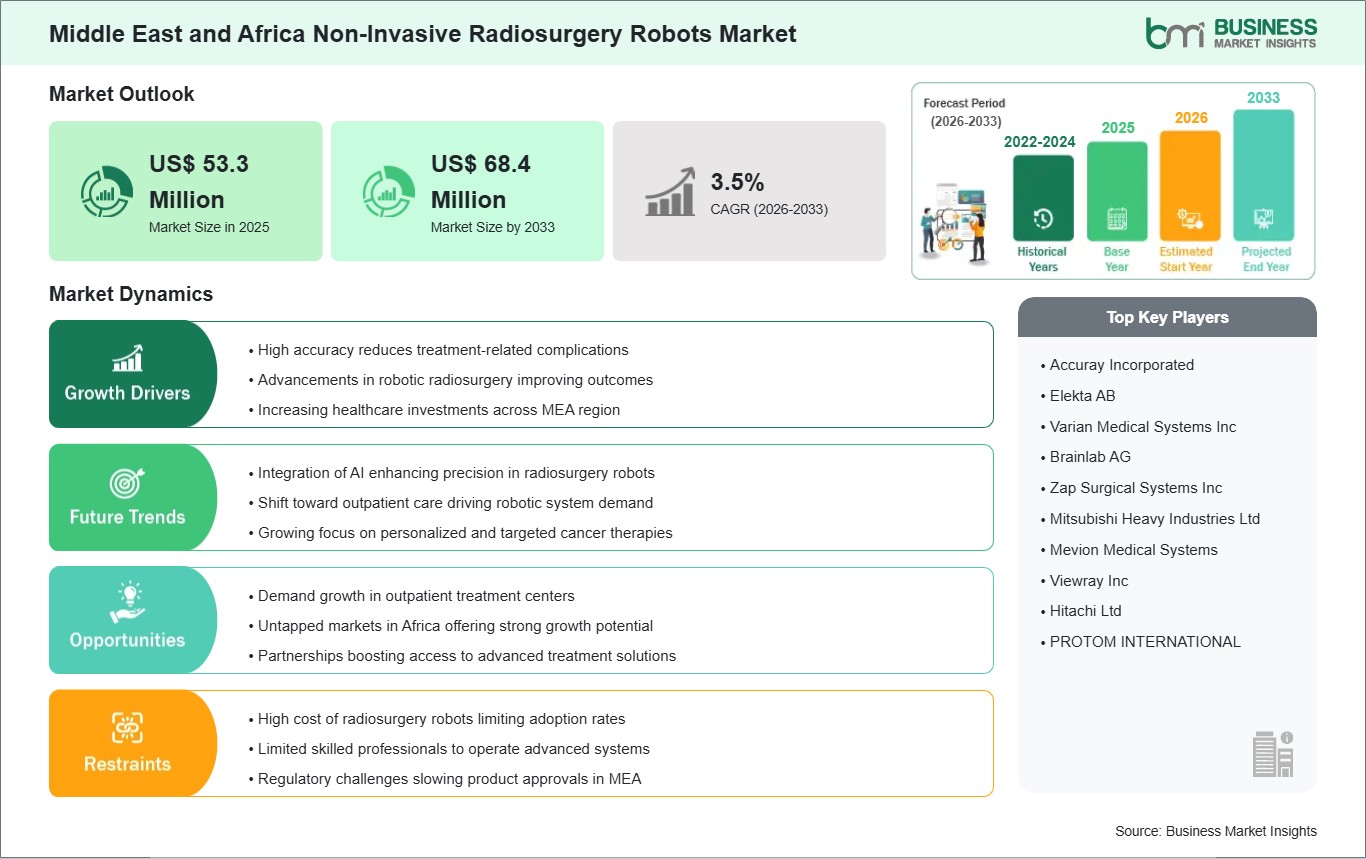
The Middle East and Africa non-invasive radiosurgery robots market size is expected to reach US$68.4 million by 2033 from US$53.3 million in 2025. The market is estimated to record a CAGR of 3.5% from 2026 to 2033.
The Middle East and Africa Non-Invasive Radiosurgery Robots market is emerging as a strategic component of regional healthcare modernization, driven by rising demand for precision oncology and minimally invasive neurosurgical treatments. Hospitals and specialty centers across the region are increasingly deploying robotic radiosurgery platforms to improve treatment accuracy, operational efficiency, and patient outcomes. These systems provide high precision in managing complex tumors, spinal lesions, and neurological disorders, while reducing the risks associated with conventional surgery and shortening recovery periods. The market is shaped by international medical robotics manufacturers collaborating with local hospitals and healthcare groups to provide integrated solutions, often combining advanced imaging, AI-assisted treatment planning, and automated motion management. Adoption is concentrated in urban tertiary hospitals and private healthcare networks that serve both domestic patients and international medical tourists. Key drivers include increasing cancer prevalence, heightened awareness of minimally invasive treatment benefits, and government-led initiatives to modernize healthcare infrastructure. However, challenges persist in the form of high capital expenditure, limited availability of trained specialists, and uneven infrastructure across rural and urban regions. Regulatory variations, procurement delays, and the need to align with both national and international healthcare standards further complicate adoption. Despite these hurdles, hospitals recognize that robotic radiosurgery systems enhance institutional reputation, streamline clinical workflows, and improve patient safety. As a result, the MEA market is characterized by cautious but steady adoption, with early deployments in leading hospitals setting benchmarks for clinical precision, operational efficiency, and patient-centered care. Overall, the market presents a significant opportunity for technology providers offering scalable solutions, training programs, and integrated service models to support regional expansion and improve advanced oncology treatment access.

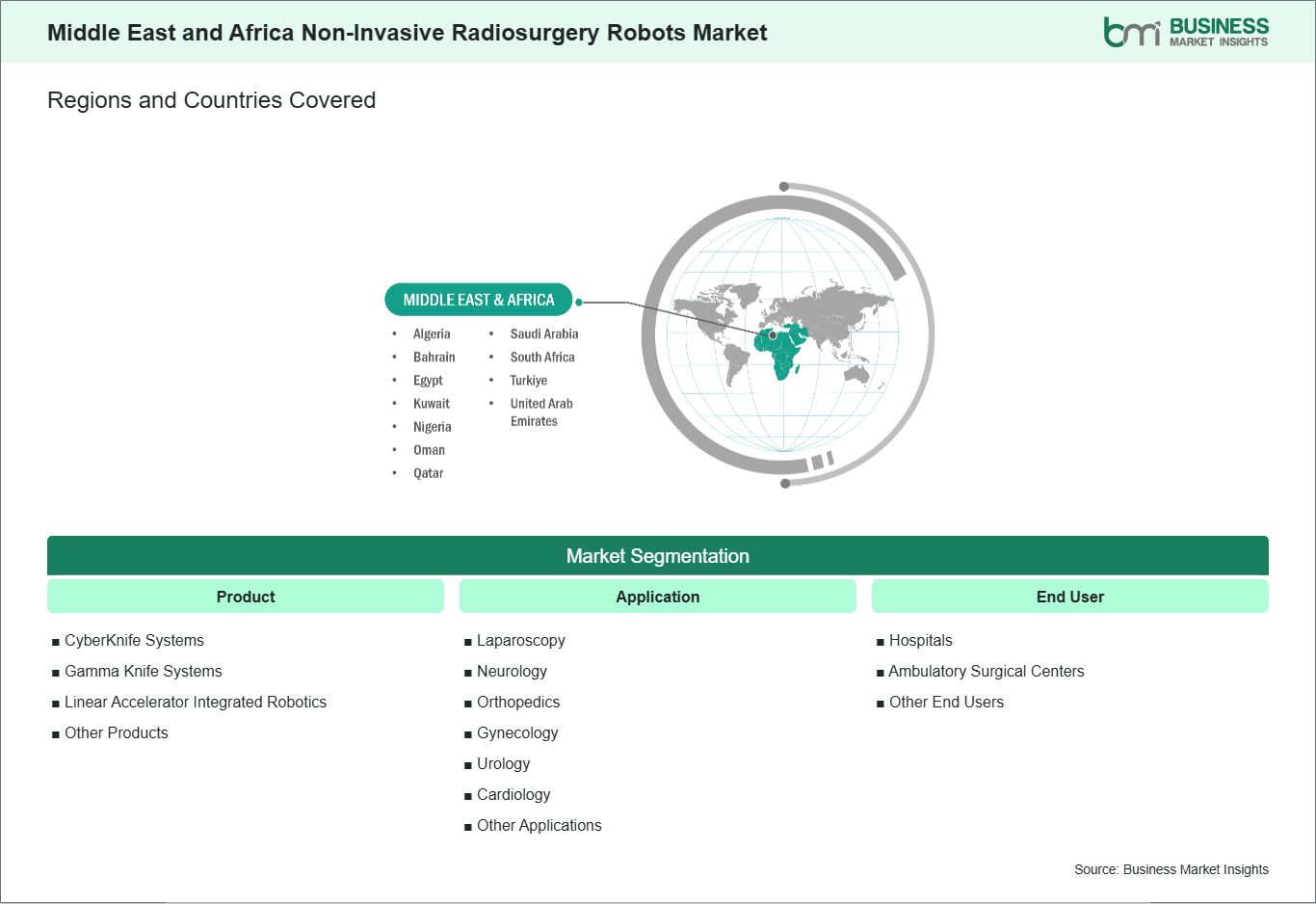
Key segments that contributed to the derivation of the Middle East and Africa non-invasive radiosurgery robots market analysis are product, application, and end user.
The Middle East and Africa (MEA) non-invasive radiosurgery robots market is witnessing growth due to the increasing importance placed on precision and safety in oncology treatments. High-accuracy robotic systems allow clinicians to deliver targeted radiation therapy to tumors while minimizing exposure to surrounding healthy tissues. This precision is particularly valuable in complex cases involving critical anatomical regions such as the brain, spine, and head and neck areas, where conventional radiotherapy carries higher risks of complications. By ensuring precise radiation delivery, radiosurgery robots reduce the likelihood of adverse effects, improve patient outcomes, and enhance clinical confidence among healthcare providers across the MEA region. Hospitals and specialized cancer centers in the region are increasingly investing in advanced radiosurgery robots to address rising patient volumes and the complexity of cancer cases. These systems allow treatment of tumors that were previously difficult to approach surgically or that posed significant risk with traditional therapies. High accuracy also contributes to reducing treatment errors and improving reproducibility across sessions, which is crucial in maintaining consistent patient care standards. Healthcare providers are leveraging this advantage to offer safer, minimally invasive therapies, making radiosurgery a preferred option for patients who may not be suitable candidates for conventional surgery. The focus on reducing treatment-related complications also aligns with broader healthcare initiatives in the MEA region to improve service quality and patient safety. Investment in precision robotic systems is seen as a strategic measure to enhance hospital reputation, attract skilled clinicians, and deliver modern oncology care. Academic collaborations and professional training programs complement these efforts, ensuring that clinical staff are proficient in operating high-precision radiosurgery robots. Collectively, these factors underscore the growing significance of accuracy-driven technologies in the MEA non-invasive radiosurgery market, reinforcing their role in improving clinical outcomes and patient safety.
The MEA non-invasive radiosurgery robots market is also being driven by increasing demand for outpatient treatment centers that provide advanced oncology services. Patients in the region are seeking treatment options that are minimally invasive, reduce hospital stays, and allow for faster recovery. Radiosurgery robots support these requirements by enabling procedures that often do not require extended hospitalization, making them ideal for outpatient settings. Hospitals and cancer care providers are establishing dedicated outpatient units equipped with robotic systems to meet patient expectations for efficient, high-quality care while optimizing clinical workflows. Outpatient adoption of radiosurgery robots is particularly relevant in regions where healthcare facilities face high patient loads and limited bed availability. By offering same-day or short-stay treatments, outpatient centers can increase patient throughput and reduce the strain on inpatient resources. This operational efficiency allows clinics to treat a larger number of patients without compromising the quality of care. Additionally, outpatient facilities equipped with robotic systems can provide patients with a more comfortable and convenient experience, improving treatment compliance and overall satisfaction in a market where patient-centered care is increasingly emphasized. The growth of outpatient treatment centers is supported by regional healthcare strategies that prioritize modern, accessible, and cost-efficient care. Investments in robotic technology are complemented by staff training programs and workflow optimization to ensure smooth integration of advanced systems into outpatient operations. As cancer awareness increases and demand for minimally invasive therapies rises, the deployment of non-invasive radiosurgery robots in outpatient centers is expected to expand, contributing to the overall development of the MEA market while improving access to precise and efficient oncology care.
The Middle East and Africa non-invasive radiosurgery robots market demonstrates steady growth, with size and share analysis highlighting evolving trends and competitive dynamics among key players. The report examines subsegments categorized within product, application, and end user, offering insights into their contribution to overall market performance.
By product, the medication cyberknife systems segment dominated the market in 2025, driven by increasing demand for advanced, precise, and non‑invasive radiosurgery solutions that improve tumor targeting while minimizing damage to surrounding healthy tissues.
In terms of application, the laparoscopy subsegment dominated the market in 2025, driven by rising adoption of minimally invasive procedures that offer faster recovery, reduced complications, and better patient outcomes.
Based on end user, the hospitals subsegment dominated the market in 2025, driven by expanding healthcare infrastructure and investments in advanced oncology technologies that support acquisition and use of robotic radiosurgery systems.
| Report Attribute | Details |
|---|---|
| Market size in 2025 | US$ 53.3 Million |
| Market Size by 2033 | US$ 68.4 Million |
| CAGR (2026 - 2033) | 3.5% |
| Historical Data | 2022-2024 |
| Forecast period | 2026-2033 |
| Segments Covered | By Product
|
|
Regions and Countries Covered
| |
| Middle East and Africa | Turkiye, the UAE, Saudi Arabia, Bahrain, Oman, Egypt, South Africa, Algeria, Nigeria, Kuwait, Qatar |
| Market leaders and key company profiles |
|
The "Middle East and Africa Non-Invasive Radiosurgery Robots Market Size and Forecast (2022–2033)" report provides a detailed analysis of the market covering below areas:
The geographical scope of the Middle East and Africa Non-Invasive Radiosurgery Robots Market report is divided Turkiye, the UAE, Saudi Arabia, Bahrain, Oman, Egypt, South Africa and Africa, Algeria, Nigeria, Kuwait, and Qatar. Turkiye held the largest share in 2025.
The Middle East and Africa Non-Invasive Radiosurgery Robots market exhibits diverse adoption patterns across Turkiye, the UAE, Saudi Arabia, Bahrain, Oman, Egypt, South Africa, Algeria, Nigeria, Kuwait, and Qatar, reflecting significant differences in healthcare infrastructure, investment capacity, and clinical specialization. Turkiye emerges as the dominant market, driven by a combination of advanced tertiary hospitals, specialized oncology and neurosurgery centers, and a growing private healthcare sector concentrated in Istanbul, Ankara, and Izmir. Hospitals in Turkiye are increasingly deploying robotic radiosurgery systems to enhance treatment accuracy, optimize operational efficiency, and expand access to minimally invasive procedures. Strong government support for healthcare modernization, integration of robotic technologies into academic medical centers, and well-established training programs for radiation oncologists and neurosurgeons further accelerate adoption, positioning Turkiye as a regional hub for high-precision oncology and neurosurgical care. The UAE and Saudi Arabia are secondary growth markets in the MEA region, with urban hospitals in Dubai, Abu Dhabi, Riyadh, and Jeddah prioritizing robotic radiosurgery to strengthen specialized oncology services and attract medical tourists. Qatar, Kuwait, Oman, and Bahrain demonstrate selective adoption, mainly in tertiary care hospitals with advanced imaging infrastructure and skilled clinical staff. In Africa, South Africa serves as a key hub for private hospitals and academic medical centers implementing robotic radiosurgery to improve oncology and neurology treatment capabilities, while Egypt, Nigeria, and Algeria are emerging markets where adoption is concentrated in major urban hospitals, often through pilot programs or shared-service models. Across all these countries, market penetration is strongly influenced by vendor strategies offering flexible financing options, comprehensive training, and ongoing technical support. High-volume urban hospitals and specialized centers drive adoption, while smaller institutions often rely on referral networks to provide patients access to robotic radiosurgery technologies. Turkiye’s dominance reflects its larger healthcare infrastructure, higher investment capacity, and concentrated adoption in leading hospitals, making it the primary growth driver in the Middle East and Africa region, while other countries offer incremental opportunities for expansion as healthcare modernization and technology awareness continue to advance..

The Middle East and Africa Non-Invasive Radiosurgery Robots Market is evaluated by gathering qualitative and quantitative data post primary and secondary research, which includes important corporate publications, association data, and databases. A few of the key developments in the Middle East and Africa non-invasive radiosurgery robots market are:
The Middle East and Africa Non-Invasive Radiosurgery Robots Market is valued at US$ 53.3 Million in 2025, it is projected to reach US$ 68.4 Million by 2033.
As per our report Middle East and Africa Non-Invasive Radiosurgery Robots Market, the market size is valued at US$ 53.3 Million in 2025, projecting it to reach US$ 68.4 Million by 2033. This translates to a CAGR of approximately 3.5% during the forecast period.
The Middle East and Africa Non-Invasive Radiosurgery Robots Market report typically cover these key segments-
The historic period, base year, and forecast period can vary slightly depending on the specific market research report. However, for the Middle East and Africa Non-Invasive Radiosurgery Robots Market report:
The Middle East and Africa Non-Invasive Radiosurgery Robots Market is populated by several key players, each contributing to its growth and innovation. Some of the major players include:
The Middle East and Africa Non-Invasive Radiosurgery Robots Market report is valuable for diverse stakeholders, including:
Essentially, anyone involved in or considering involvement in the Middle East and Africa Non-Invasive Radiosurgery Robots Market value chain can benefit from the information contained in a comprehensive market report.
Please tell us your area of interest
(Market Segments/ Regions and Countries/ Companies)