Market Summary
Executive Summary and Market Analysis
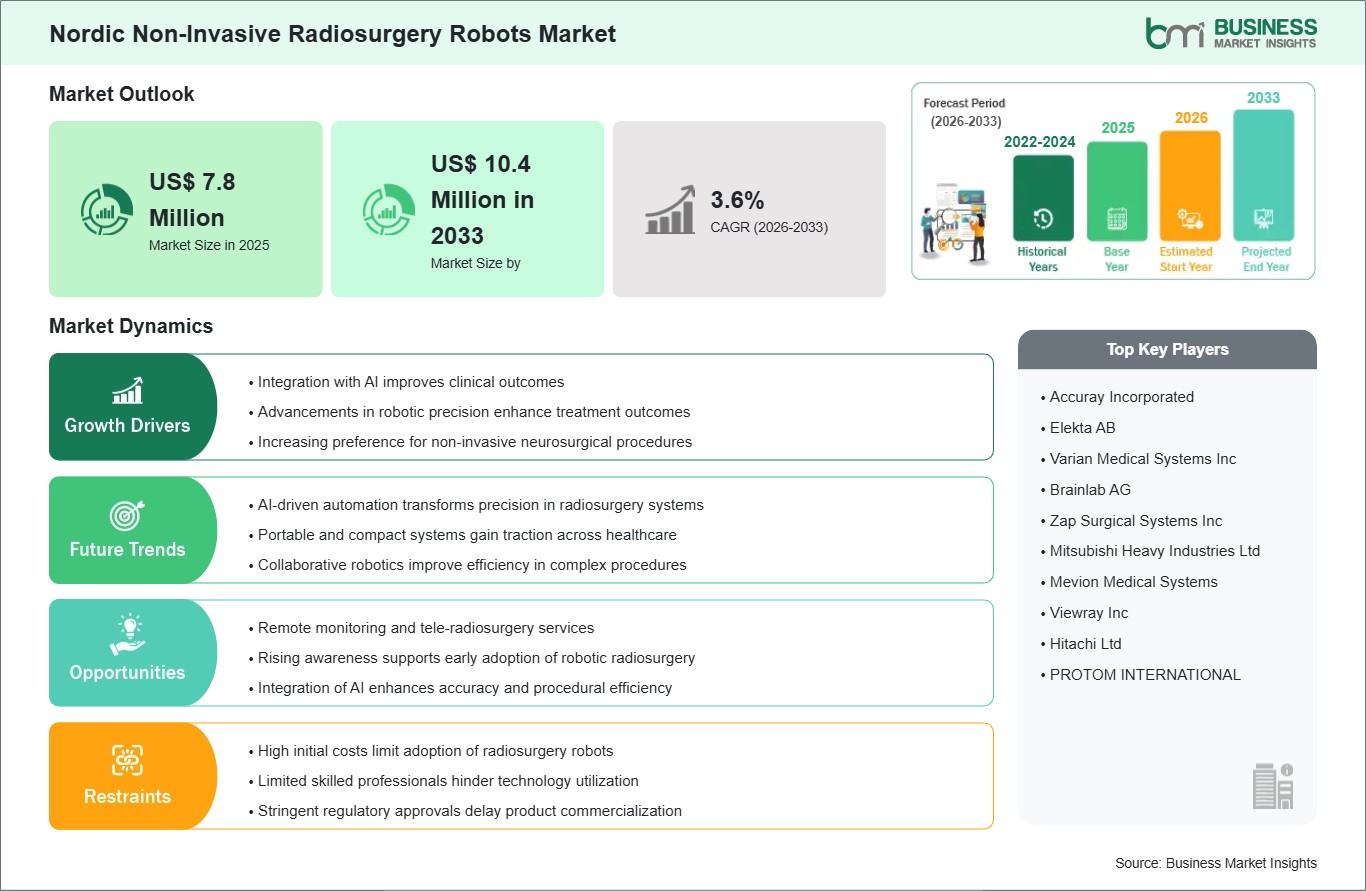
The Nordic Non-Invasive Radiosurgery Robots market is experiencing progressive growth as healthcare providers in Sweden, Norway, Finland, Denmark, and Iceland increasingly prioritize precision oncology and neurosurgical treatments. Hospitals and specialized medical centers are adopting robotic radiosurgery systems to improve procedural accuracy, enhance patient safety, and minimize invasiveness, particularly for complex tumor and neurological interventions. The market is shaped by a combination of international robotics manufacturers and regional medical technology integrators, with competition largely focused on system precision, imaging integration, and advanced treatment planning capabilities. Adoption is concentrated in urban tertiary hospitals and high-volume oncology centers with established imaging infrastructure and skilled clinical personnel. Private hospitals and specialized centers leverage robotic radiosurgery to differentiate services, attract patients from both domestic and international sources, and support medical tourism in the region. Public hospitals are adopting systems through structured procurement programs and government-supported modernization initiatives, reflecting the Nordic commitment to advanced healthcare delivery. Despite strong growth potential, challenges such as high initial capital investment, limited trained workforce, and integration complexities persist, especially in smaller regional hospitals. Additionally, regulatory approval processes and alignment with national healthcare standards influence deployment timelines. Nevertheless, the clinical and operational benefits—such as reduced procedure times, higher precision, and improved patient outcomes—position robotic radiosurgery as a strategic investment for healthcare institutions seeking to lead in minimally invasive cancer and neurological care. Overall, the Nordic market represents a technologically mature and strategically attractive environment where early adoption by leading hospitals sets benchmarks for quality, efficiency, and patient-centered care.
Segment Analysis
Nordic Non-Invasive Radiosurgery Robots Market Segmentation
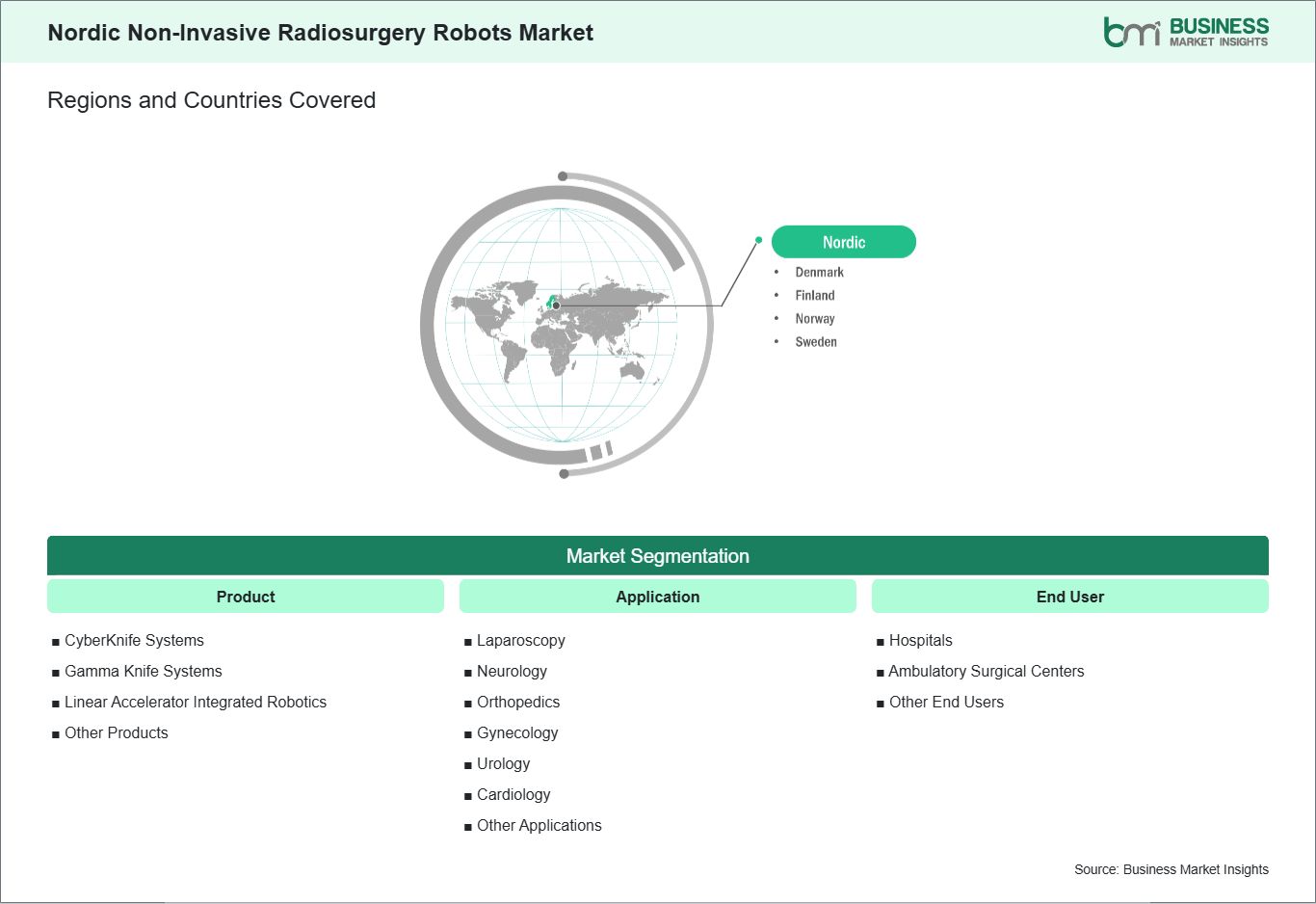
Key segments that contributed to the derivation of the Nordic non-invasive radiosurgery robots market analysis are product, application, and end user.
- By product, the non-invasive radiosurgery robots market is segmented into cyberknife systems, gamma knife systems, linear accelerator (linac) integrated robotics and other products. The medication cyberknife systems segment dominated the market in 2025.
- In terms of application, the non-invasive radiosurgery robots market is categorized into laparoscopy, neurology, orthopedics, gynecology, urology, cardiology and other applications. The laparoscopy segment dominated the market in 2025.
- Based on end user, the market is classified into hospitals, ambulatory surgical centers and other end users. The hospitals segment dominated the market in 2025.
Market Forces
Nordic Non-Invasive Radiosurgery Robots Market Drivers and Opportunities
Integration with AI improves clinical outcomes
The Nordic non-invasive radiosurgery robots market is experiencing steady growth due to the integration of artificial intelligence (AI) into robotic systems, which enhances precision and clinical outcomes. Hospitals and specialized oncology centers in countries such as Sweden, Norway, Denmark, and Finland are increasingly adopting AI-driven platforms that optimize treatment planning and delivery. AI algorithms assist clinicians in identifying tumor boundaries with higher accuracy, calculating optimal radiation doses, and predicting tissue response, thereby reducing the risk of treatment-related complications. This integration enables healthcare providers to offer more personalized therapy, improving patient safety and overall effectiveness of radiosurgery procedures. AI-enabled radiosurgery robots are also transforming workflow efficiency in Nordic hospitals. Automated imaging analysis and adaptive treatment planning reduce manual intervention and minimize errors, allowing clinicians to focus on complex decision-making and patient care. These systems continuously learn from clinical data, refining targeting strategies and supporting evidence-based treatment adjustments. Hospitals in the Nordic region benefit from these capabilities by achieving higher precision in tumor targeting while minimizing radiation exposure to surrounding healthy tissue, a critical consideration in neurosurgery and other sensitive applications. The use of AI thus not only improves outcomes but also enhances clinician confidence in delivering complex radiosurgery procedures. Furthermore, integration with AI supports broader healthcare goals in the Nordic region, including improving access to high-quality oncology care and reducing treatment variability across hospitals. By leveraging predictive analytics and machine learning, Nordic healthcare providers can optimize patient-specific therapy schedules, anticipate complications, and enhance follow-up care. Academic and research collaborations also play a key role, with hospitals working alongside universities to validate AI models and develop region-specific treatment protocols. Overall, AI integration is reinforcing the role of non-invasive radiosurgery robots as a reliable, precision-driven solution for advanced cancer care in the Nordic healthcare landscape.
Remote monitoring and tele-radiosurgery services
Remote monitoring and tele-radiosurgery services are emerging as critical growth drivers in the Nordic non-invasive radiosurgery robots market. Healthcare providers across the region are leveraging connected robotic systems to enable remote supervision of treatment delivery, real-time imaging review, and teleconsultations between hospitals. This approach is particularly beneficial in Nordic countries, where population density is low and access to specialized oncology centers may be limited in rural or remote areas. Tele-radiosurgery allows expert clinicians to guide procedures from central hubs, ensuring patients receive high-quality care regardless of geographic location. The adoption of remote monitoring technology also supports operational efficiency in Nordic hospitals. Robotic systems equipped with secure connectivity enable centralized tracking of treatment parameters, performance metrics, and patient data, facilitating timely intervention if adjustments are needed. This reduces the need for multiple in-person visits and allows for more streamlined management of complex cases. Hospitals can also use tele-radiosurgery platforms to coordinate multidisciplinary teams across locations, enhancing collaboration between oncologists, radiologists, and technical staff, which ultimately improves the quality and consistency of care. Tele-radiosurgery services contribute to knowledge sharing and professional development within the Nordic healthcare ecosystem. Smaller hospitals and clinics can access guidance from specialized centers of excellence, enhancing local expertise and building regional capacity for advanced oncology care. The integration of remote capabilities also supports research and clinical trials by enabling standardized treatment protocols and centralized monitoring of outcomes. As healthcare systems in the Nordic region continue to prioritize digital innovation and equitable access, remote monitoring and tele-radiosurgery services are expected to play an increasingly pivotal role in expanding the reach and impact of non-invasive radiosurgery robots.
Size and Share Analysis
Nordic Non-Invasive Radiosurgery Robots Market Size and Share Analysis
The Nordic non-invasive radiosurgery robots market demonstrates steady growth, with size and share analysis highlighting evolving trends and competitive dynamics among key players. The report examines subsegments categorized within product, application, and end user, offering insights into their contribution to overall market performance.
By product, the medication cyberknife systems segment dominated the market in 2025, driven by strong clinical preference for highly precise, image‑guided radiosurgery that improves tumor targeting accuracy while minimizing exposure to healthy tissue.
In terms of application, the laparoscopy subsegment dominated the market in 2025, driven by increasing adoption of minimally invasive procedures that reduce patient recovery time and postoperative complications.
Based on end user, the hospitals subsegment dominated the market in 2025, driven by well‑established healthcare infrastructure and funding that support the acquisition and use of advanced radiosurgery robotic systems.
Report Coverage
Nordic Non-Invasive Radiosurgery Robots Market Report Coverage and Deliverables
The "Nordic Non-Invasive Radiosurgery Robots Market Size and Forecast (2022–2033)" report provides a detailed analysis of the market covering below areas:
- Nordic Non-Invasive Radiosurgery Robots Market size and forecast at regional and country levels for all segments covered under the scope
- Nordic Non-Invasive Radiosurgery Robots Market trends, as well as drivers, restraints, and opportunities
- Nordic Non-Invasive Radiosurgery Robots Market analysis covering key trends, regional framework, major players, regulations, and recent developments
- Industry landscape and competition analysis covering market concentration, heat map analysis, prominent players, and recent developments for the Nordic Non-Invasive Radiosurgery Robots Market
- Detailed company profiles, including SWOT analysis
Geographic Insights
Nordic Non-Invasive Radiosurgery Robots Market Geographic Insights
The geographical scope of the Nordic Non-Invasive Radiosurgery Robots Market report is divided into Sweden, Denmark, Norway, and Finland. Sweden held the largest share in 2025.
The Nordic Non-Invasive Radiosurgery Robots market demonstrates distinct adoption patterns across Sweden, Denmark, Norway, and Finland, driven by differences in healthcare infrastructure, hospital specialization, and investment in advanced medical technologies. Sweden emerges as the dominant market, supported by a robust network of tertiary hospitals, specialized oncology and neurosurgery centers, and a strong private healthcare sector concentrated in Stockholm, Gothenburg, and Malmö. Hospitals in Sweden are rapidly integrating robotic radiosurgery systems to enhance treatment precision, improve operational efficiency, and expand access to minimally invasive procedures. Government healthcare modernization initiatives, public-private partnerships, and comprehensive professional training programs for radiation oncologists and neurosurgeons further accelerate adoption, positioning Sweden as a regional hub for advanced oncology and neurosurgical care. Denmark serves as a secondary growth market, with hospitals in Copenhagen and Aarhus implementing robotic radiosurgery systems to strengthen high-precision oncology services, optimize patient workflows, and enhance medical tourism offerings. Norway and Finland demonstrate more selective adoption, with systems deployed primarily in urban tertiary hospitals and specialized cancer centers capable of supporting the infrastructure and workforce requirements of complex robotic procedures. Hospitals in these countries emphasize treatment accuracy, patient safety, and workflow efficiency while gradually expanding adoption through pilot programs and vendor-supported initiatives. Across all four countries, successful market penetration is heavily influenced by vendor strategies that provide flexible financing solutions, structured clinical training, and ongoing technical support. High-volume hospitals and specialized centers act as primary adoption hubs, while smaller institutions often rely on referral networks or shared-service models to provide patient access. Sweden’s dominance reflects its larger healthcare infrastructure, higher investment capacity, and concentration of advanced tertiary hospitals, establishing it as the primary driver of growth in the Nordic region. Denmark, Norway, and Finland represent incremental opportunities for expansion as healthcare modernization and awareness of minimally invasive radiosurgery solutions continue to advance across the Nordics.
Industry Activity
Recent Developments
The Nordic Non-Invasive Radiosurgery Robots Market is evaluated by gathering qualitative and quantitative data post primary and secondary research, which includes important corporate publications, association data, and databases. A few of the key developments in the Nordic non-invasive radiosurgery robots market are:
- In July 2025, Elekta’s Leksell Gamma Knife radiosurgery system received U.S. FDA 510(k) clearance for a new indication to treat drug‑resistant mesial temporal lobe epilepsy in adults, broadening the range of clinical uses for this non‑invasive intracranial radiosurgery platform. This regulatory milestone enhances the system’s global profile and supports downstream approvals or clinical registrations in Europe and Nordic health systems. While the clearance was issued by the FDA, such approvals often influence European and Nordic regulatory pathways and hospital adoption decisions. The expanded indication reinforces Gamma Knife’s role as a precision non‑invasive option beyond traditional tumour treatments.
- In September 2025, Elekta reported that the Leksell Gamma Knife system surpassed two million patients treated globally, with the milestone treatment performed at Karolinska University Hospital in Stockholm, Sweden—underscoring continued Nordic clinical adoption of this radiosurgery technology. Although not a new product launch, this event highlights sustained deployment and utilisation of advanced non‑invasive radiosurgery robots in the region. The achievement reflects ongoing commitment by Nordic oncology centres to offer state‑of‑the‑art radiosurgery care without open surgery. This global milestone enhances confidence in the technology’s clinical value.
Trust & Transparency
Research Methodology
The market analysis combines proprietary research with secondary data from government agencies, company disclosures, regulatory filings, industry databases and expert interviews. Market estimates are validated through data triangulation, cross-market benchmarking and analyst
review.
View Full Research Methodology
Key Sources Referred:
World Health Organization (WHO)Organisation for Economic Cooperation and Development (OECD)The World Bank GroupWorldometerThe LancetInternational Bar AssociationInternational Trade Administration