Middle East and Africa Wooden Decking Market Outlook: Size, Share, Trends, Growth Analysis, Competitive Landscape & Forecast, 2022-2033

Historic Data: 2022-2024   |   Base Year: 2025   |   Forecast Period: 2026-2033
Report Content: Market Scope, Market Segmentation, Market Dynamics, and Competitive Analysis

Report Coverage:
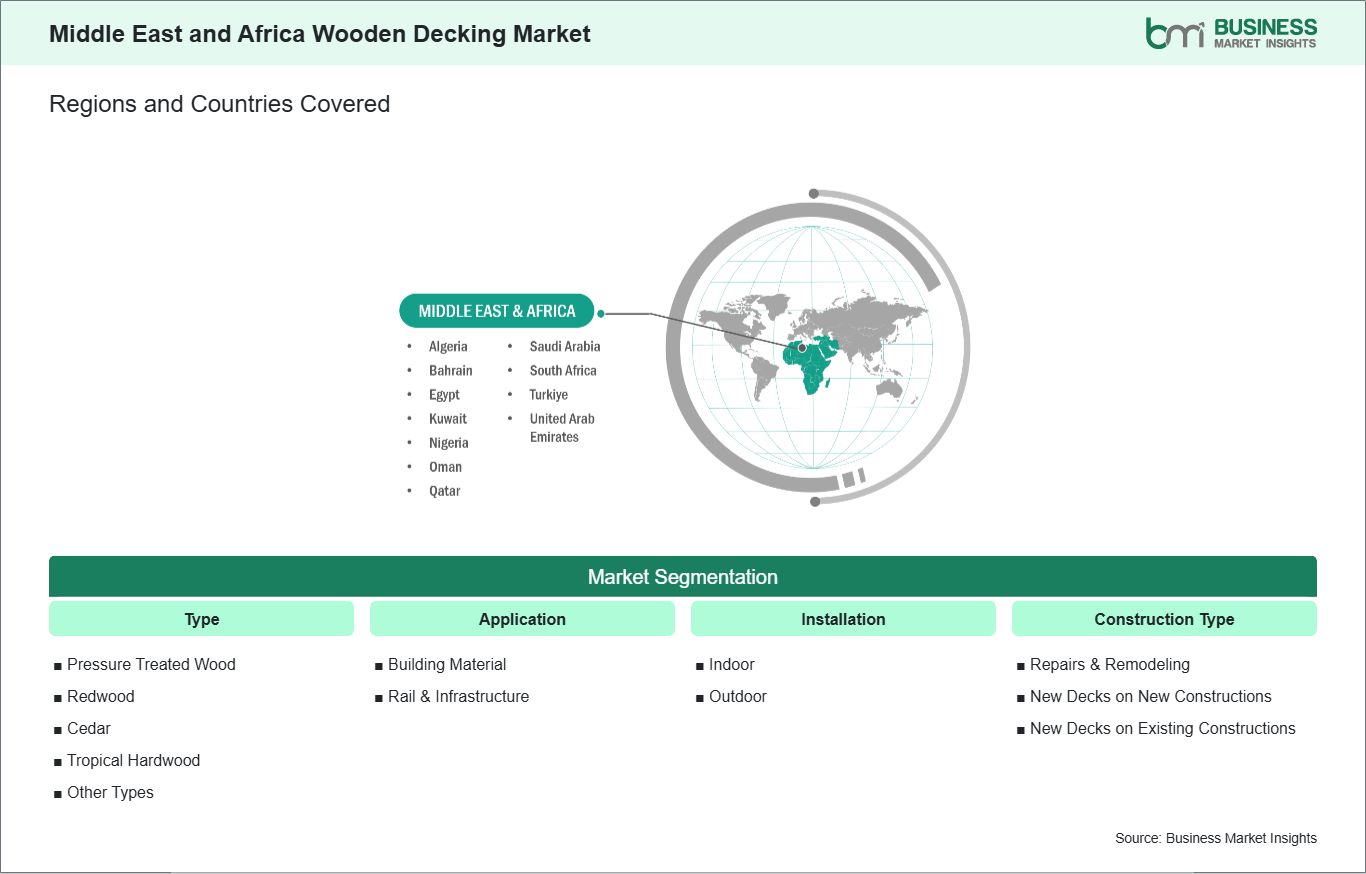
  • Type (Pressure Treated Wood, Redwood, Cedar, Tropical Hardwood, Other Types)
  • Application (Building Material, Rail & Infrastructure)
  • Installation (Indoor, Outdoor)
  • Construction Type (Repairs & Remodeling, New Decks on New Constructions, New Decks on Existing Constructions)

No. of Pages: 150
Report Code: BMIPUB00035886
Category: Manufacturing and Construction
Middle East and Africa Wooden Decking Market

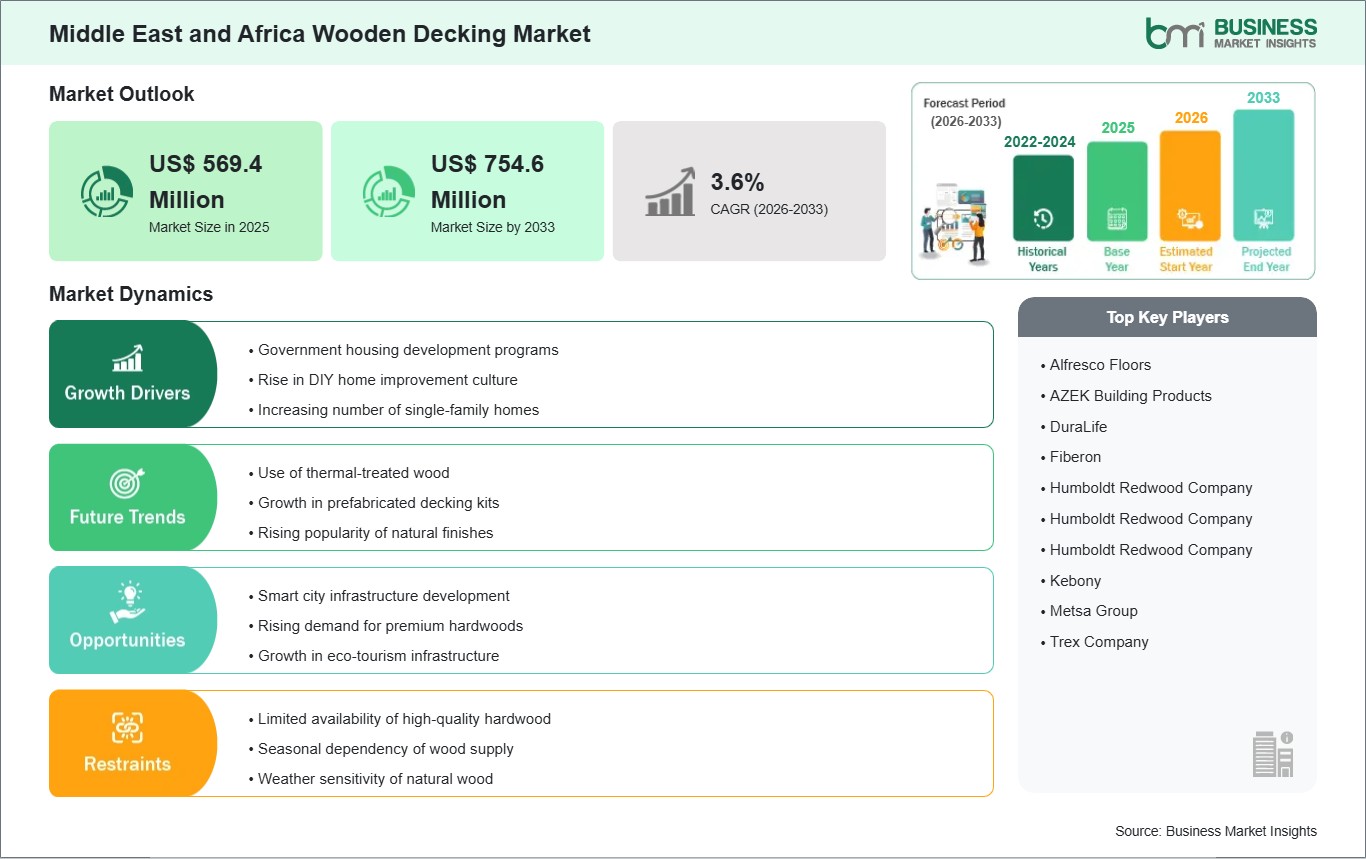
The Middle East and Africa wooden decking market size is expected to reach US$ 754.6 million by 2033 from US$ 569.4 million in 2025. The market is estimated to record a CAGR of 3.6% from 2026 to 2033.

Executive Summary and Middle East and Africa Wooden Decking Market Analysis:

The wooden decking market in the Middle East and Africa regions is growing steadily owing to the rising focus on developing outdoor lifestyle facilities and high-end architectural designs by governments, hotels, and real estate players. The demand for wooden decking products in the Middle East and Africa regions has been driven by large-scale tourism development projects, luxury residential developments, coastal real estate projects, and hotel extensions. Decking solutions have been extensively used in the Gulf nations such as the United Arab Emirates and Saudi Arabia in their resort complexes, rooftop leisure spaces, marina facilities, and dining spaces requiring natural-looking materials that suit their high-end real estate designs.

One of the key growth drivers is the quick rise in the number of outdoor themed hospitality and mixed-use projects that have been developed recently. Resorts, coastal developments, desert locations, and entertainment hubs are focusing more on attractive exterior flooring surfaces, thereby promoting hardwood and heat-treated decks. The local preference for luxurious structures coupled with an emphasis on developing aesthetically pleasing outdoor areas is likely to boost demand for innovative decking solutions that can withstand weather elements for a relatively longer period of time.

However, climate conditions pose one of the primary barriers in the region. Extremes in temperature, exposure to sand and changes in humidity, as well as elevated levels of ultraviolet rays present in multiple Middle Eastern countries, result in increased maintenance costs and reduced shelf life of non-treated wooden decks. Lack of stable distribution networks, shortage of timber resources, and lack of awareness about new deck materials are also holding back faster growth in certain parts of Africa.

Middle East and Africa Wooden Decking Market - Strategic Insights:

global-market-strategic-framework
Get more information on this report

Middle East and Africa Wooden Decking Market Segmentation Analysis:

Key segments that contributed to the derivation of the Middle East and Africa wooden decking market analysis are types, application, installation, construction type, and distribution channel.

  • By types, the wooden decking market is segmented into pressure treated wood, redwood, cedar, tropical hardwood, and other types. The pressure treated wood segment dominated the market in 2025.
  • Based on application, the wooden decking market is segmented into building material and rail & infrastructure. The building material segment dominated the market in 2025.
  • On the basis of installation, the wooden decking market is classified as indoor and outdoor. The outdoor segment dominated the market in 2025.
  • In terms of construction type, the wooden decking market is segmented into repairs & remodeling, new decks on new constructions, and new decks on existing constructions. The repairs & remodeling segment dominated the market in 2025.
  • By distribution channel, the wooden decking market is segmented into Indirect sales and direct sales. The indirect sales segment dominated the market in 2025.

Middle East and Africa Wooden Decking Market Drivers and Opportunities:

Government Housing Development Program

There is an increasing demand for wood deck materials in many parts of the Middle East and Africa owing to the government-driven residential development projects. The increase in the construction of villas and low-rise structures in the Gulf nations with the help of housing expansion schemes is generating demand for composite wooden decking. The housing development plans of Saudi Arabia and UAE include development of residential townships, which is leading to increased use of pressure-treated wooden decks on roof gardens and terraces. There have been consistent advancements in residential outdoor living spaces within the Gulf nations, thus boosting the sales of decking materials.

Wood deck installation in Africa is also being promoted in the region by various housing schemes that are being undertaken in the nations like South Africa, Egypt, Kenya, and Morocco. Due to urbanization and growth in the population with a rising middle class, the demand for more affordable housing facilities and satellite towns is on the rise. The government in South Africa is focusing heavily on upgrading its social housing infrastructure through large budget allocations, while new communities in Egypt have become pedestrian-friendly by incorporating wood deck systems in their designs.

Material usage trends have been further impacted by sustainability measures. Governments have started to encourage environmentally certified building materials through the green buildings concept, especially in the UAE, Qatar, and South Africa. Consequently, manufacturers of recyclable composite decking and timber materials are enjoying increasing market penetration. This trend is additionally being fueled by manufacturing operations within the market, which will help reduce the use of expensive imports such as tropical hardwoods.

Smart City Infrastructure Development

The development of smart city infrastructure in the Middle East and Africa region is set to emerge as one of the key drivers of the wooden decking market, particularly for commercial landscaping, recreational areas, waterside projects, and tourism-focused infrastructure developments. Urban renovation projects in Saudi Arabia, UAE, and Qatar include pedestrian-friendly walkways, outdoor entertainment centers, and sustainable mobility pathways involving decking systems. The development of tourism-based giga-projects in Saudi Arabia is expected to drive the demand for advanced wood composite deck systems, which are resistant to heat and sand. Expenditure on regional infrastructure for smart urban projects is projected to be expanding at over 9% CAGR, positively impacting the demand for outdoor building materials.

In Africa, smart cities are emerging trends in countries such as Kenya, Rwanda, Nigeria, and Egypt that have spurred modernization efforts in terms of infrastructure and recreation areas within cities. There is an increasing trend to develop waterfronts, parks, transport stations, and urban business districts which need deck materials that offer good aesthetics and resistance to weather elements. The development of the New Kigali urban plan in Rwanda and the New Administrative Capital in Egypt are some cases where landscape design and walkways have prompted demand for engineered wood products.

Procurement trends are being determined by technological and sustainable development within smart cities. Municipal governments have started to focus on durable, maintenance-free materials for achieving their sustainable goals and minimizing costs throughout the product's life cycle. Composite wooden decking has become increasingly popular due to its ability to resist water, ultraviolet light, and termites. This type of material is preferred in humid and tropical conditions of Africa. Moreover, the emergence of smart tourism projects in the Red Sea, Dubai waterfronts, and resort locations in North Africa boosts the demand for high-quality decking solutions.

Middle East and Africa Wooden Decking Market Size and Share Analysis:

The Middle East and Africa wooden decking market is experiencing steady growth, with market size and share analysis reflecting evolving treatment preferences and competitive dynamics among key players. The report evaluates important subsegments categorized within types, application, installation, construction type, and distribution channel, highlighting their respective contributions to overall market performance.

By types, the pressure treated wood subsegment dominated the market in 2025, because it is highly affordable, durable, and resistant to moisture, termites, and decay, making it suitable for long-term outdoor use. Due to its low maintenance requirements and wide availability, homeowners and contractors prefer pressure-treated wood over other decking materials.

Based on application, the building material subsegment dominated the market in 2025 because wooden decking is extensively used in residential and commercial construction projects such as patios, balconies, gardens, and outdoor flooring. Due to increasing urbanization and rising investments in housing and infrastructure development, the demand for wooden decking as a building material continues to grow.

On the basis of installation, the outdoor subsegment dominated the market in 2025, because wooden decking is mainly designed for outdoor recreational and landscaping purposes. The consumers are increasingly focusing on outdoor living spaces, gardens, rooftop seating areas, and poolside decks, outdoor installation has witnessed significant demand globally.

In terms of construction type, the repairs and remodeling subsegment dominated the market in 2025, because many old decks require renovation, replacement, and maintenance over time. Due to the growing trend of home improvement and remodeling activities, especially in developed countries, consumers are investing more in upgrading existing outdoor structures instead of undertaking new construction projects.

By distribution channel, the indirect sales subsegment dominated the market in 2025, because manufacturers mainly distribute wooden decking products through wholesalers, dealers, and retail home improvement stores. Due to the wider market reach, better product accessibility, and convenience offered by indirect sales channels, contractors and customers prefer purchasing decking materials through established distributors.

Middle East and Africa Wooden Decking Market Report Highlights:

Report Attribute Details
Market size in 2025 US$ 569.4 Million
Market Size by 2033 US$ 754.6 Million
CAGR (2026 - 2033)3.6%
Historical Data 2022-2024
Forecast period 2026-2033
Segments Covered By Type
  • Pressure Treated Wood
  • Redwood
  • Cedar
  • Tropical Hardwood
  • Other Types
By Application
  • Building Material
  • Rail & Infrastructure
By Installation
  • Indoor
  • Outdoor
By Construction Type
  • Repairs & Remodeling
  • New Decks on New Constructions
  • New Decks on Existing Constructions
Regions and Countries Covered
Middle East and Africa Saudi Arabia, United Arab Emirates, Kuwait, Bahrain, Qatar, Oman, Turkiye, South Africa, Egypt, Nigeria, Algeria
Market leaders and key company profiles
  • Alfresco Floors
  • AZEK Building Products
  • DuraLife
  • Fiberon
  • Humboldt Redwood Company
  • Humboldt Redwood Company
  • Humboldt Redwood Company
  • Kebony
  • Metsa Group
  • Trex Company
Get more information on this report

Middle East and Africa Wooden Decking Market Report Coverage and Deliverables:

The "Middle East and Africa Wooden Decking Market Size and Forecast (2022-2033)" report provides a detailed analysis of the market covering below areas:

  • Market size and forecast at the regional and country levels for market segments covered under the scope
  • Market trends, as well as drivers, restraints, and opportunities
  • Market analysis covering key trends, regional framework, major players, regulations, and recent developments
  • Market concentration, heat map analysis, prominent players, and recent developments for the Market
  • Detailed company profiles, including SWOT analysis

Middle East and Africa Wooden Decking Market Geographic Insights:

The geographical scope of the Middle East and Africa wooden decking market report is divided into: Saudi Arabia, the United Arab Emirates, Kuwait, Bahrain, Qatar, Oman, Turkey, South Africa, Egypt, Nigeria, Algeria, and the Rest of MEA. Turkiye held the largest share in 2025.

Turkey has become a leading player in the Middle East and Africa wooden decking market owing to its geographical location and established construction and tourism sectors. It serves as a connection between Europe and the Middle East and shapes architectural preferences, favoring not only contemporary design but also the concept of the outdoor lifestyle. Thus, there is growing popularity of wooden decking in urban and coastal areas. wooden deckings are used extensively in residences as a material for adding deckings on villas, suburban housing projects, and luxurious flats where balconies and terraces are planned to be added as outdoor leisure spaces for families. The hospitality industry plays a significant role in driving the demand for decking materials. In particular, coastal tourism locations such as the Mediterranean and Aegean regions represent prime examples. wooden deckings are often used in beach clubs, restaurants, hotels, and resorts to add outdoor space for dining tables or swimming pools. This trend can be linked to the fact that Turkey is one of the world’s most important countries in terms of tourism. The Turkish economy is also helped by having a fairly good home-grown lumber and construction material industry, making them competitive relative to their neighbors. Nevertheless, because of the different weather conditions in terms of humidity and temperature changes, there are maintenance problems that affect their longevity.

global-market-geography
Get more information on this report

Middle East and Africa Wooden Decking Market Research Report Guidance:

  • The report includes qualitative and quantitative data in the Middle East and Africa wooden decking market across types, application, installation, construction type, distribution channel, and geography.
  • The report starts with the key takeaways (chapter 2), highlighting the key trends and outlook of the Middle East and Africa wooden decking market.
  • Chapter 3 focuses on the research methodology of the study.
  • Chapter 4 includes ecosystem analysis.
  • Chapter 5 highlights the major industry dynamics in the Middle East and Africa wooden decking market, including factors that are driving the market, prevailing deterrents, potential opportunities, as well as future trends. Impact analysis of these drivers and restraints is also covered in this section.
  • Chapter 6 discusses the Middle East and Africa wooden decking market scenario, in terms of historical market revenues, and forecast till the year 2033.
  • Chapters 7 to 12 cover the Middle East and Africa wooden decking market segments by types, application, installation, construction type, distribution channel, and geography across Saudi Arabia, the UAE, Kuwait, Bahrain, Qatar, Oman, Turkiye, South Africa, Egypt, Nigeria, Algeria, and the Rest of MEA. They cover the market revenue, forecast, and factors driving the market.
  • Chapter 13 describes the competitive analysis along with the heat map analysis for the key players operating in the market.
  • Chapter 14 describes the industry landscape analysis. It provides detailed descriptions of business activities such as market initiatives, new developments, mergers, and joint ventures globally, along with a competitive landscape.
  • Chapter 15 provides detailed profiles of the major companies operating in the Middle East and Africa wooden decking market. Companies have been profiled on the basis of their key facts, business descriptions, products, financial overview, SWOT analysis, and key developments.
  • Chapter 16, i.e., the appendix, is inclusive of a brief overview of the company, list of abbreviations, and disclaimer.

Middle East and Africa Wooden Decking Market News and Key Development:

The Middle East and Africa wooden decking market is evaluated by gathering qualitative and quantitative data post primary and secondary research, which includes important corporate publications, association data, and databases. A few of the key developments in the Middle East and Africa wooden decking market are:

  • In February 2024, Global Surfaces announced the commissioning of a new manufacturing facility in Jebel Ali Free Zone (UAE) with an investment of approximately US$ 27.2 million (AED 100 million), aimed at expanding production of engineered surface materials used in architectural applications, including outdoor decking-related installations across the Middle East.
  • In September 2023, Kebony announced the appointment of a Middle East General Manager to strengthen its regional expansion strategy, supporting increased adoption of its modified wooden decking and cladding solutions across major projects in the UAE, Saudi Arabia, and Qatar, including landmark infrastructure and hospitality developments in the region.

Key Sources Referred:

Environmental Protection Agency (EPA)Food and Drug Administration (FDA)European Chemicals Agency (ECHA)United Nations Environment Programme (UNEP)Occupational Safety and Health Administration (OSHA)Central Pollution Control Board (CPCB)S. Energy Information Administration (EIA)European Chemical Industry Council (Cefic)Medicines and Healthcare products Regulatory Agency (MHRA)Company WebsitesCompany Annual ReportsCompany Investor Presentation
The List of Companies - Middle East and Africa Wooden Decking Market
  • Alfresco Floors
  • AZEK Building Products
  • DuraLife
  • Fiberon
  • Humboldt Redwood Company
  • Humboldt Redwood Company
  • Humboldt Redwood Company
  • Kebony
  • Metsa Group
  • Trex Company
About Author — Manufacturing and Construction Research Team
Shivani Singh
Consultant, Research & Consulting
View Profile

Shivani Singh is a market research professional with expertise in secondary research, competitive intelligence, and industry analysis. She contributes to developing comprehensive market insights and business intelligence that support strategic decision-making across diverse industries.

With a strong analytical mindset and attention to detail, she specializes in data interpretation, market trend evaluation, and report development. Her ability to synthesize complex information into actionable insights, combined with effective communication and research execution, enables the delivery of high-quality, client-focused market research so.. Show More

Frequently Asked Questions
How big is the Middle East and Africa Wooden Decking Market?

The Middle East and Africa Wooden Decking Market is valued at US$ 569.4 Million in 2025, it is projected to reach US$ 754.6 Million by 2033.

What is the CAGR for Middle East and Africa Wooden Decking Market by (2026 - 2033)?

As per our report Middle East and Africa Wooden Decking Market, the market size is valued at US$ 569.4 Million in 2025, projecting it to reach US$ 754.6 Million by 2033. This translates to a CAGR of approximately 3.6% during the forecast period.

What segments are covered in this report?

The Middle East and Africa Wooden Decking Market report typically cover these key segments-

  • Type (Pressure Treated Wood, Redwood, Cedar, Tropical Hardwood, Other Types)
  • Application (Building Material, Rail & Infrastructure)
  • Installation (Indoor, Outdoor)
  • Construction Type (Repairs & Remodeling, New Decks on New Constructions, New Decks on Existing Constructions)

What is the historic period, base year, and forecast period taken for Middle East and Africa Wooden Decking Market?

The historic period, base year, and forecast period can vary slightly depending on the specific market research report. However, for the Middle East and Africa Wooden Decking Market report:

  • Historic Period : 2022-2024
  • Base Year : 2025
  • Forecast Period : 2026-2033
  • Who are the major players in Middle East and Africa Wooden Decking Market?

    The Middle East and Africa Wooden Decking Market is populated by several key players, each contributing to its growth and innovation. Some of the major players include:

  • Alfresco Floors
  • AZEK Building Products
  • DuraLife
  • Fiberon
  • Humboldt Redwood Company
  • Humboldt Redwood Company
  • Humboldt Redwood Company
  • Kebony
  • Metsa Group
  • Trex Company
  • Who should buy this report?

    The Middle East and Africa Wooden Decking Market report is valuable for diverse stakeholders, including:

    • Investors: Provides insights for investment decisions pertaining to market growth, companies, or industry insights. Helps assess market attractiveness and potential returns.
    • Industry Players: Offers competitive intelligence, market sizing, and trend analysis to inform strategic planning, product development, and sales strategies.
    • Suppliers and Manufacturers: Helps understand market demand for components, materials, and services related to concerned industry.
    • Researchers and Consultants: Provides data and analysis for academic research, consulting projects, and market studies.
    • Financial Institutions: Helps assess risks and opportunities associated with financing or investing in the concerned market.

    Essentially, anyone involved in or considering involvement in the Middle East and Africa Wooden Decking Market value chain can benefit from the information contained in a comprehensive market report.

    Available Report Formats

    pdf-format excel-format pptx-format
    Buy Now
    Sales Assistance
    +1 646 791 7070 (US & UK)
    Customization Form

    Please tell us your area of interest
    (Market Segments/ Regions and Countries/ Companies)