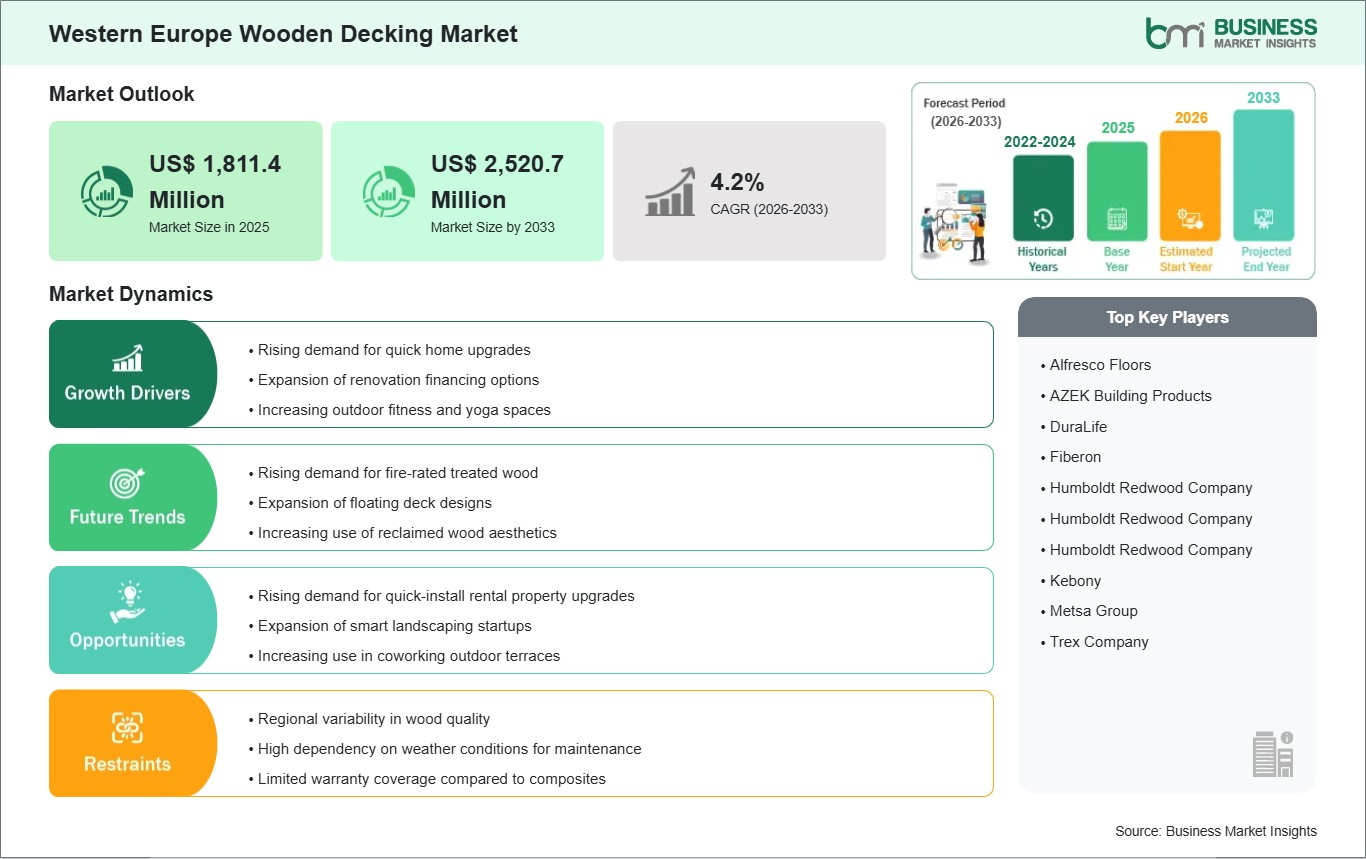
The Western Europe wooden decking market size is expected to reach US$ 2,520.7 million by 2033 from US$ 1,811.4 million in 2025. The market is estimated to register a CAGR of 4.2% from 2026 to 2033.
Wood deckings have become part of garden designs, terraces, hotel facilities, and urban landscaping projects across Western Europe. Natural construction materials are considered important by consumers, and as such, there will be increasing use of certified wood deckings. Another influence in the industry will come from architectural innovations emphasizing open-air recreational areas in residential and commercial buildings. There is growing importance placed on improving outdoor living conditions, especially after the rise in spending on home improvement projects and personal recreational areas. Timber deck flooring is valued for its natural look and suitability for landscaping styles in Europe. There is a high demand for thermally modified wood, hardwood deck floorings, and sustainable timber products that meet environmental requirements in various regions. Hospitality players and urban planners incorporate wood decking into cafes, waterfront constructions, walkways, and other recreational facilities to create a pleasant environment. However, the market is constrained by tough environmental legislation regulating the timber harvesting process and issues related to maintenance needs. Moisture resistance, decay from fungus, and wear and tear from the elements need to be considered in regions with high precipitation levels and climatic fluctuations. Another challenge comes from the growing presence of composite deck flooring products.

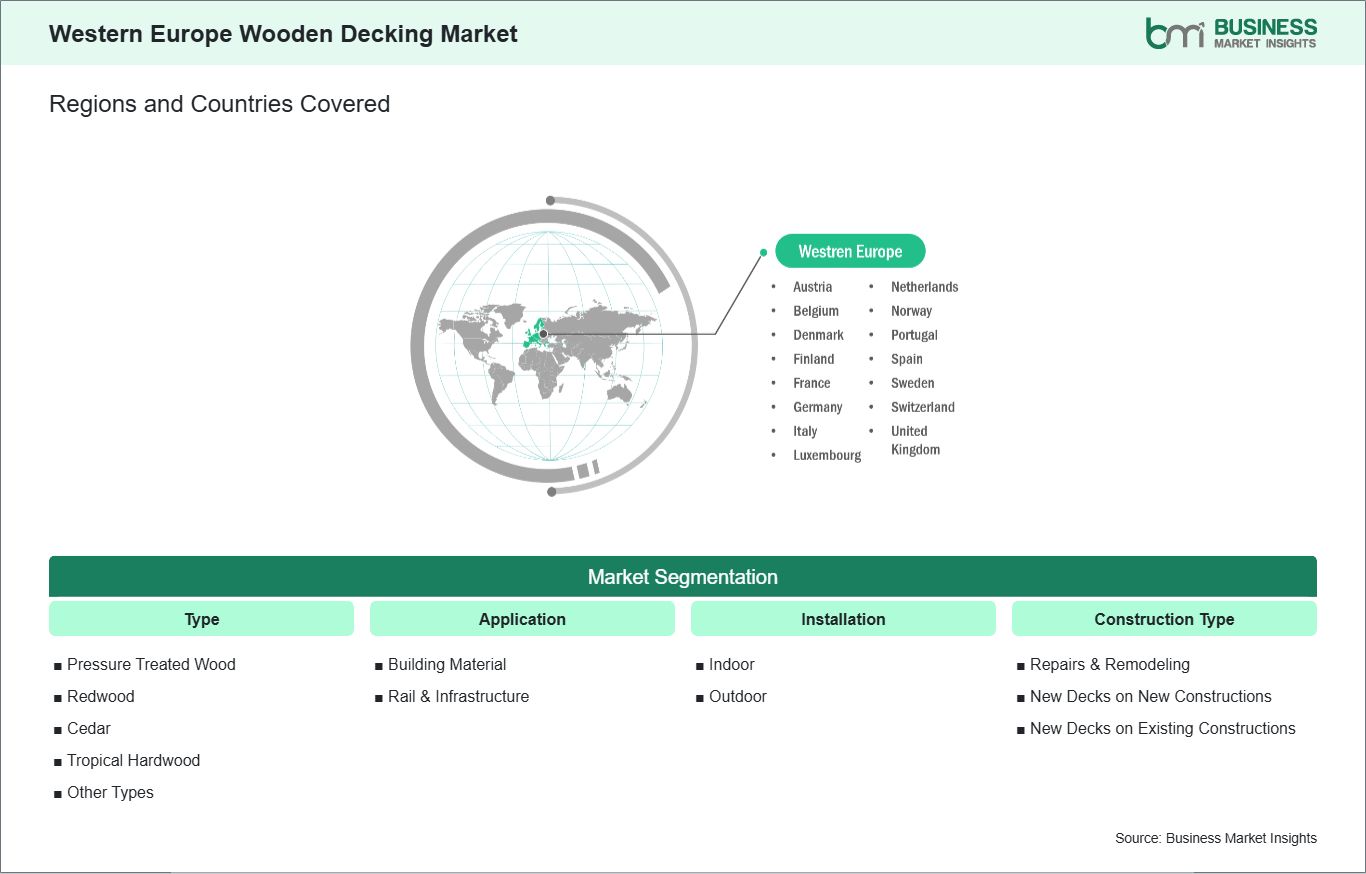
Key segments that contributed to the derivation of the Western Europe wooden decking market analysis are types, application, installation, construction type, and distribution channel.
People in this part of the world prefer renovations that involve improved outdoor aesthetics but minimal construction efforts and less complex processes. Wood decking has been gaining widespread acceptance for balcony and garden decoration because of its ability to provide a natural look and a relatively easy installation process.
New lifestyles are contributing to changes in the preferences of people, who tend to spend their leisure time outdoors, having dinner parties, etc. Due to overcrowded conditions in cities, there is an increasing trend of adding decks on rooftops or expanding the existing decks on private gardens, in order to get more usable space. Thermally modified wood, softwood, and sustainable timber products are becoming popular among consumers because of their durability and eco-friendly manufacturing processes. There is a growing popularity of prefabricated decks due to the easy installation process and low labor costs.
Consumers will have increased access to various customizable decks and DIY decking materials, which are available online. Home improvement trends on a seasonal basis, especially during the summer season, will contribute to higher expenses on deck building materials and renovation products. Growth of demand from consumers for convenient outdoor home improvement projects will drive the wooden decking market in the region in the coming years.
Residential developers and property owners are seeking out ways of improving their outdoor living spaces to make them more appealing and competitive in the rental property market. This includes terraced wooden deck installations, shared courtyard wooden seats, and smaller-scale garden wooden decks. The use of wooden decks is common because it brings together aesthetic beauty and quick installation.
Fast-track deck systems are appealing to landlords and property management companies looking for solutions that offer quick modernization without causing too much inconvenience to their tenants. Prefab decks and pressure-treated wood products facilitate quick renovations, ensuring shorter vacancies and downtimes. These systems have become widely accepted in apartments and other types of buildings where aesthetic exteriors help improve performance. The versatility of modular deck systems makes them suitable for renovations in cramped urban areas where construction access is limited.
Increasing demand for luxury rental services has stimulated investments in the enhancement of outdoor spaces within the region. It includes the installation of trendy wooden decks in rooftop bars, private terraces, and recreational zones. Sustainability concerns have become a major factor in material choice, which has resulted in the greater popularity of responsibly harvested wood and eco-friendly deck materials. The emphasis among rental property owners on quick and inexpensive modifications of their exteriors will fuel the demand for economical wood deck installation services in Western Europe.
The Western Europe wooden decking market is experiencing steady growth, with market size and share analysis reflecting evolving treatment preferences and competitive dynamics among key players. The report evaluates important subsegments categorized within type, application, installation, construction type, and distribution channel, highlighting their respective contributions to overall market performance.
By types, the pressure-treated wood subsegment dominated the market in 2025, because it is affordable, durable, and resistant to moisture, termites, and decay, making it suitable for long-term outdoor use. Due to its low maintenance requirements and wide availability, homeowners and contractors prefer pressure-treated wood over other decking materials.
Based on applications, the building material subsegment dominated the market in 2025 because wooden decking is extensively used in residential and commercial construction projects such as patios, balconies, gardens, and outdoor flooring. Due to increasing urbanization and rising investments in housing and infrastructure development, the demand for wooden decking as a building material continues to grow.
On the basis of installation, the outdoor subsegment dominated the market in 2025, because wooden decking is mainly designed for outdoor recreational and landscaping purposes. Consumers are focusing on outdoor living spaces, gardens, rooftop seating areas, and poolside decks. Outdoor installation has witnessed significant demand.
In terms of construction type, the repairs and remodeling subsegment dominated the market in 2025, because old decks require renovation, replacement, and maintenance over time. Due to the growing trend of home improvement and remodeling activities, especially in developed countries, consumers are investing more in upgrading existing outdoor structures instead of undertaking new construction projects.
By distribution channel, the indirect sales subsegment dominated the market in 2025, because manufacturers mainly distribute wooden decking products through wholesalers, dealers, and retail home improvement stores. Due to the wider market reach, better product accessibility, and convenience offered by indirect sales channels, contractors and customers prefer purchasing decking materials through established distributors.

| Report Attribute | Details |
|---|---|
| Market size in 2025 | US$ 1,811.4 Million |
| Market Size by 2033 | US$ 2,520.7 Million |
| CAGR (2026 - 2033) | 4.2% |
| Historical Data | 2022-2024 |
| Forecast period | 2026-2033 |
| Segments Covered | By Type
|
|
Regions and Countries Covered
| |
| Western Europe | Belgium, Netherlands, Luxembourg, Germany, France, Italy, Spain, Switzerland, Sweden, Austria, United Kingdom, Denmark, Portugal, Norway, Finland |
| Market leaders and key company profiles |
|
The "Western Europe Wooden Decking Market Size and Forecast (2022-2033)" report provides a detailed analysis of the market covering below areas:
The geographical scope of the Western Europe wooden decking market report is divided into: Belgium, the Netherlands, Luxembourg, Germany, France, Italy, Spain, Switzerland, Sweden, Austria, the UK, Denmark, Portugal, Norway, and Finland. Germany held the largest share in 2025.
Germany is known for its sophisticated construction industry, a strong tradition of home renovation among its residents, and the high level of environmental awareness of its customers. There has been a rising trend of using wood decking in residential gardens, on balconies, and rooftops, driven by an increasing focus on the development of aesthetic and functional architecture outside. The demand for decking is affected by stringent sustainability practices, which prefer timber products that come from sustainable sources. The high demand is in thermally treated wood as well as hardwood that can survive under different seasonal climatic conditions. Customers place emphasis on the quality, durability, and environmental impact of these products, leading manufacturers to develop better decks. The other driving factor for the increase in decking demand in urban areas is the increased demand for space. In urban development projects, there is little space for large decks, which calls for the creation of decks on rooftops and balconies. It includes terraces, which are becoming functional spaces in many buildings. While there is a growing use of composite decks and other substitutes, wood continues to hold high value due to its naturally pleasing appearance, recyclable nature, and eco-friendly qualities in building construction. Germany leads regional usage due to innovations in sustainable wood processing, superior installation techniques, and high consumer interest in environmentally friendly outdoor construction materials.

The Western Europe wooden decking market is evaluated by gathering qualitative and quantitative data post primary and secondary research, which includes important corporate publications, association data, and databases. A few of the key developments in the Western Europe wooden decking market are:
The Western Europe Wooden Decking Market is valued at US$ 1,811.4 Million in 2025, it is projected to reach US$ 2,520.7 Million by 2033.
As per our report Western Europe Wooden Decking Market, the market size is valued at US$ 1,811.4 Million in 2025, projecting it to reach US$ 2,520.7 Million by 2033. This translates to a CAGR of approximately 4.2% during the forecast period.
The Western Europe Wooden Decking Market report typically cover these key segments-
The historic period, base year, and forecast period can vary slightly depending on the specific market research report. However, for the Western Europe Wooden Decking Market report:
The Western Europe Wooden Decking Market is populated by several key players, each contributing to its growth and innovation. Some of the major players include:
The Western Europe Wooden Decking Market report is valuable for diverse stakeholders, including:
Essentially, anyone involved in or considering involvement in the Western Europe Wooden Decking Market value chain can benefit from the information contained in a comprehensive market report.
Please tell us your area of interest
(Market Segments/ Regions and Countries/ Companies)