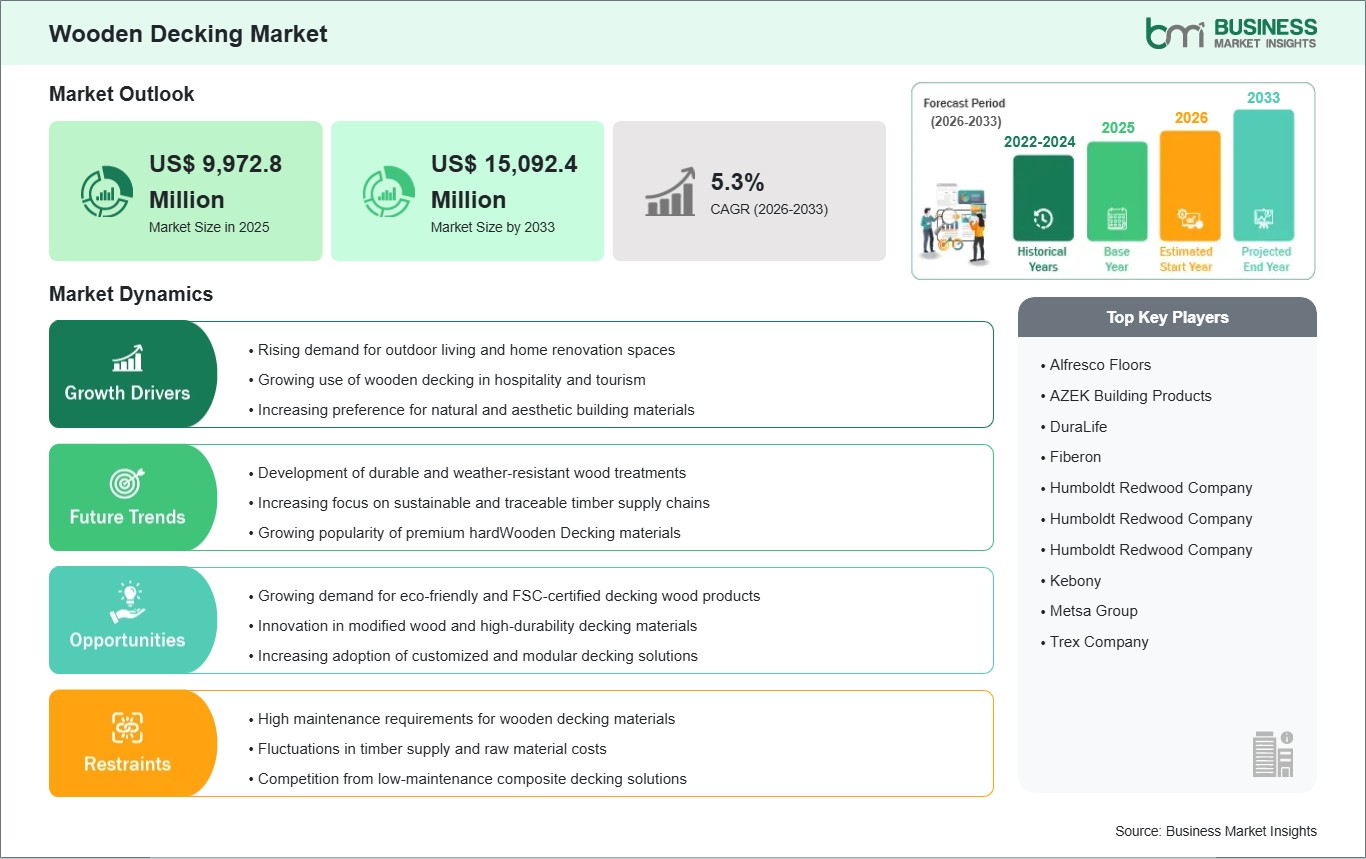
The wooden decking market size is expected to reach US$ 9,972.8 million by 2033 from US$ 15,092.4 million in 2025. The market is estimated to record a CAGR of 5.3% from 2026 to 2033.
Wooden decks provide aesthetic value that can help improve and accentuate outdoor spaces such as gardens, patios, terraces, resorts, and hospitality sites. Lifestyle trends favoring more leisurely outdoor living spaces have driven the demand for wood decks as residents perceive outdoor spaces as extensions of indoor spaces. Lifestyle shifts toward having more leisure-oriented outside living areas in urban and suburban housing areas, where outdoor spaces are perceived as an extension of the interior living area, are a major contributor to demand. There is an increasing number of home renovations where old wood decks are changed to new ones due to the wear-and-tear nature of wood. Hotels and resorts, restaurants, and recreation centers use wood decking to add to their outside ambiance. The growth of the market is limited by the rising number of restrictions on logging due to increased environmental consciousness, concerns about deforestation, and the growing inclination toward materials with low maintenance requirements, such as composite and PVC. Wood decking needs regular maintenance involving sealing and staining to prevent moisture, sun rays, and pests.

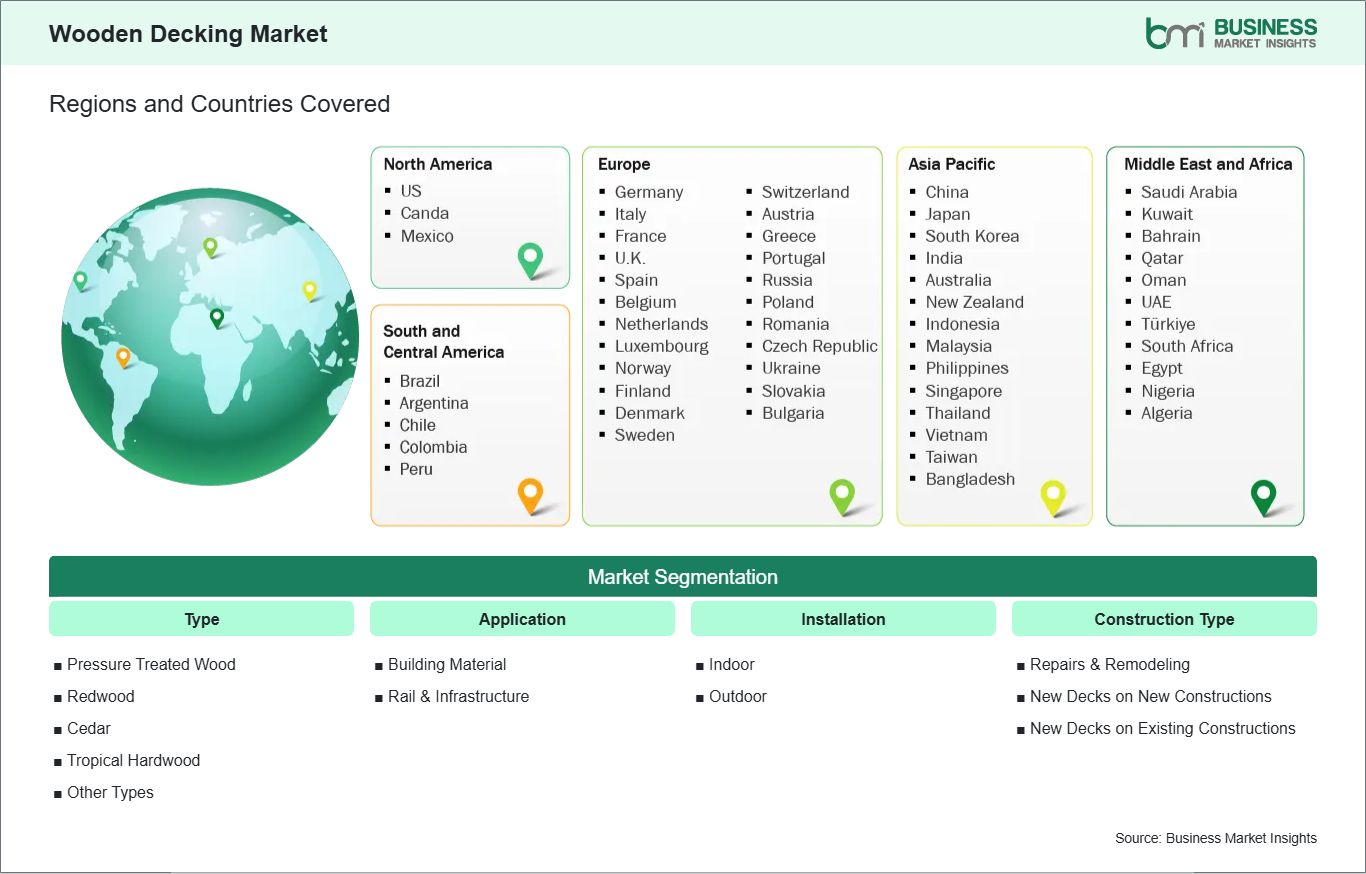
Key segments that contributed to the derivation of the wooden decking market analysis are types, application, installation, construction type, and distribution channel.
In developed and developing countries, customers are viewing their outdoor spaces as an extension of the indoor space. This development means that there is an increasing demand for wood decking materials for use in gardens, terraces, patios, and roof decks where people relax, entertain, dine, and interact outdoors. The wood decking material has the advantage of having a natural look, being highly versatile, and adding value to the appearance of the whole property.
With urban space becoming more and more limited, customers have started paying attention to outdoor renovations as a means of expanding available living space. Wooden decks are installed in urban apartments, villas, and suburban houses to create additional outdoor living space where people can unwind and entertain themselves. Pressure-treated wood, engineered wood, and composite wood have started gaining popularity due to their better durability and lower maintenance costs.
Homeowners can get easy access to design ideas, decking kits, and ready-to-install decking products, thus making the renovation procedure easier for them. Demand rises on a seasonal basis, with higher demand experienced during warm months due to increased outdoor construction activity. With an emphasis on comfort, aesthetics, and enhancing property value, global demand for wood decking is set to remain robust.
Environmental consciousness is driving the demand for wood products that are sustainably sourced. FSC-certified woods are popular for their environmentally friendly nature and assurance of good forest management practices, thus becoming a preferred choice for domestic and commercial purposes.
Government policies and green building rating programs are contributing to the trend toward eco-friendly construction materials. Sustainability requirements have been introduced in construction projects; hence, more wood decking projects are using certified wood as an important factor. Sustainable architecture trends are increasing as more development companies try to ensure that they meet environmental requirements while enhancing the competitiveness of their projects.
There is increasing awareness about the impact on lifecycle, durability, and recyclability amongst consumers when buying wood for decking purposes. It has led to an increase in the demand for responsibly harvested wood, thermally treated wood, and low-emission treated wood products. In response to the increasing trend toward sustainability, producers are expanding their range of sustainable products and developing supply chains that are certified with respect to sustainability practices. Eco-friendly and FSC-certified wood decking are anticipated to be significant opportunities in the market.
The global wooden decking market is experiencing steady growth, with market size and share analysis reflecting evolving treatment preferences and competitive dynamics among key players. The report evaluates important subsegments categorized by type, application, installation, construction type, and distribution channel, highlighting their respective contributions to overall market performance.
By types, the pressure-treated wood subsegment dominated the market in 2025, because it is affordable, durable, and resistant to moisture, termites, and decay, making it suitable for long-term outdoor use. Due to its low maintenance requirements and wide availability, homeowners and contractors prefer pressure-treated wood over other decking materials.
Based on application, the building material subsegment dominated the market in 2025 because wood decking is extensively used in residential and commercial construction projects such as patios, balconies, gardens, and outdoor flooring. Due to increasing urbanization and rising investments in housing and infrastructure development, the demand for wood decking as a building material continues to grow.
On the basis of installation, the outdoor subsegment dominated the market in 2025, because wood decking is mainly designed for outdoor recreational and landscaping purposes. Consumers are focusing on outdoor living spaces, gardens, rooftop seating areas, and poolside decks. Outdoor installation has witnessed significant demand globally.
In terms of construction type, the repairs and remodeling subsegment dominated the market in 2025, because old decks require renovation, replacement, and maintenance over time. Due to the growing trend of home improvement and remodeling activities, especially in developed countries, consumers are investing more in upgrading existing outdoor structures instead of undertaking new construction projects.
By distribution channel, the indirect sales subsegment dominated the market in 2025, because manufacturers distribute wood decking products through wholesalers, dealers, and retail home improvement stores. Due to the wider market reach, better product accessibility, and convenience offered by indirect sales channels, contractors and customers prefer purchasing decking materials through established distributors.

| Report Attribute | Details |
|---|---|
| Market size in 2025 | US$ 9,972.8 Million |
| Market Size by 2033 | US$ 15,092.4 Million |
| Global CAGR (2026 - 2033) | 5.3% |
| Historical Data | 2022-2024 |
| Forecast period | 2026-2033 |
| Segments Covered | By Type
|
|
Regions and Countries Covered
| |
| North America | US, Canada, Mexico |
| Europe | Germany, Italy, France, U.K., Spain, Belgium, Netherlands, Luxembourg, Norway, Finland, Denmark, Sweden, Switzerland, Austria, Greece, Portugal, Russia, Poland, Romania, Czech Republic, Ukraine, Slovakia, Bulgaria |
| Asia-Pacific | China, Japan, South Korea, India, Australia, New Zealand, Indonesia, Malaysia, Philippines, Singapore, Thailand, Vietnam, Taiwan, Bangladesh |
| South and Central America | Brazil, Argentina, Chile, Colombia, Peru |
| Middle East and Africa | Saudi Arabia, United Arab Emirates, Kuwait, Bahrain, Qatar, Oman, Turkiye, South Africa, Egypt, Nigeria, Algeria |
| Market leaders and key company profiles |
|
The "Wooden Decking Market Size and Forecast (2022-2033)" Report provides a detailed analysis of the market covering below areas:
The geographical scope of the wooden decking market report is divided into: North America, Asia Pacific, Europe, the Middle East & Africa, and South & Central America. North America held the largest share in 2025.
The US dominates the market because of the huge amount of residential constructions and a strong cultural inclination toward outdoor spaces in the country. In the suburbs, decks have become an integral part of single-family houses, resulting in wood decking being widely used in new constructions and renovations. The market depends on the homeowner's interest in having an outdoor space utilized for leisure purposes. In the US, demand is dictated by the life cycle of renovation, whereby old wooden decks are refurbished or substituted for enhanced security, beauty, and increased market value. Wood continues to be favored since it has a naturally appealing texture, can be customized easily, and fits into various architectural designs, from classical suburban houses to sophisticated outdoor living arrangements. Wood decking products tend to be readily available, affordable, and easy to install as opposed to other materials in mass residential projects. The varied climate across the country determines the kind of material used. Humid or coastal locations may use treated wood types to survive the harsh environment. Dryer locations opt for aesthetically pleasing finishes. Another industry that plays a vital role in demand is the hospitality industry, which includes hotels, resort facilities, entertainment centers, etc.

The wooden decking market is evaluated by gathering qualitative and quantitative data post primary and secondary research, which includes important corporate publications, association data, and databases. A few of the key developments in the Wooden decking market are:
The Wooden Decking Market is valued at US$ 9,972.8 Million in 2025, it is projected to reach US$ 15,092.4 Million by 2033.
As per our report Wooden Decking Market, the market size is valued at US$ 9,972.8 Million in 2025, projecting it to reach US$ 15,092.4 Million by 2033. This translates to a CAGR of approximately 5.3% during the forecast period.
The Wooden Decking Market report typically cover these key segments-
The historic period, base year, and forecast period can vary slightly depending on the specific market research report. However, for the Wooden Decking Market report:
The Wooden Decking Market is populated by several key players, each contributing to its growth and innovation. Some of the major players include:
The Wooden Decking Market report is valuable for diverse stakeholders, including:
Essentially, anyone involved in or considering involvement in the Wooden Decking Market value chain can benefit from the information contained in a comprehensive market report.
Please tell us your area of interest
(Market Segments/ Regions and Countries/ Companies)