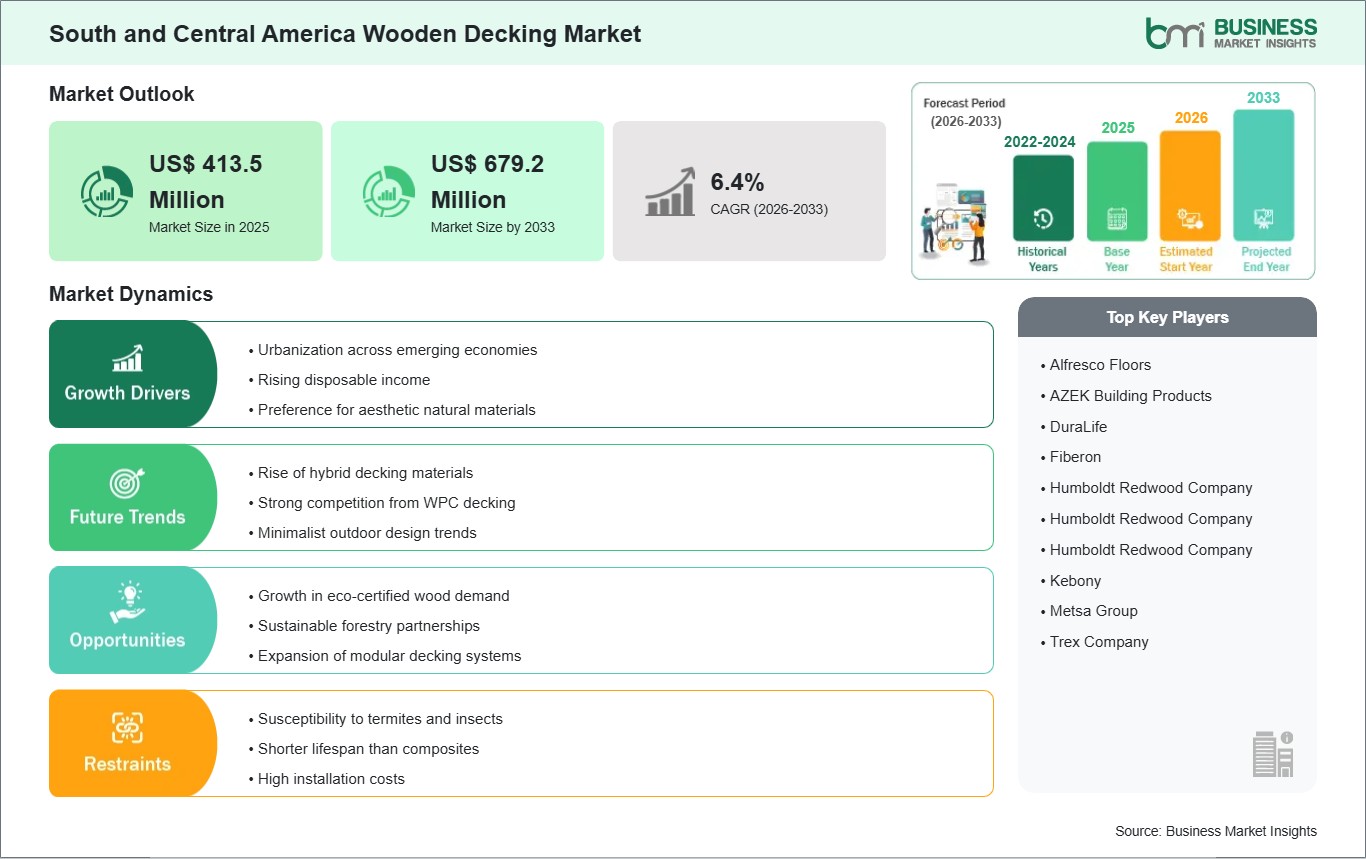
The South and Central America wooden decking market size is expected to reach US$ 679.2 million by 2033 from US$ 413.5 million in 2025. The market is estimated to record a CAGR of 6.4% from 2026 to 2033.
The market for wooden decking in South and Central America continues to grow steadily due to increased urbanization, investments in tourism-related infrastructure development, and the popularity of outdoor leisure residential concepts. wooden decking materials are used mainly in high-end residential buildings, hotels, eco-tourist destinations, and recreational premises. The close association between South and Central America and natural landscapes has been another contributing factor behind the preference for wood materials that complement the tropical and seaside environment of the region. The primary factors behind market growth include an increase in the number of buildings constructed as a part of the growing tourism sector, especially in locations that have a lot of natural scenery like the rainforests and beaches. Wood decks are commonly being installed in such regions as a way to build terraces and boardwalks as well as poolsides. There is also an increasing trend among urban middle classes to earn higher incomes, allowing for better lifestyles with more demand for the improvement of patios and other outdoor spaces through decks. Some restraints to the market include inconsistent regulation of the process of harvesting timbers, illegal logging, and differences in sustainable wood procurement methods by different countries. The problem with maintenance in wetter countries is that wooden decks are susceptible to fungus, moisture damage, insects, and other environmental elements. Another potential issue lies in economic fluctuations in some countries that hinder the adoption of wood decks in non-high-end construction segments.

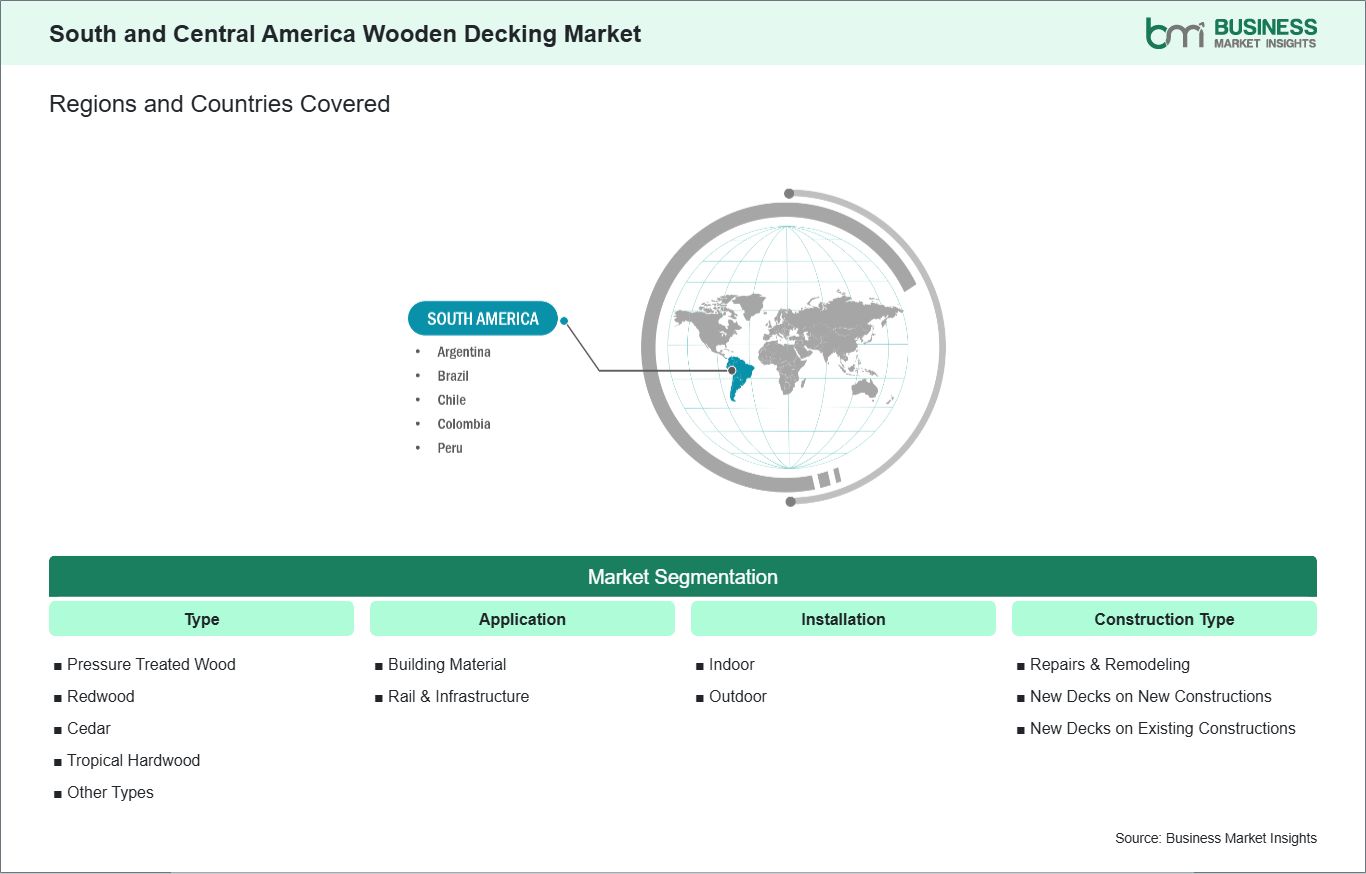
Key segments that contributed to the derivation of the South and Central America wooden decking market analysis are types, application, installation, construction type, and distribution channel.
The wooden decking industry of the Southern and Central American region is growing as a result of the fast pace of urbanization being experienced in the increasing numbers of urban and peri-urban areas. With people settling into more densely packed cities and towns in the form of apartment buildings and other forms of developments, wooden decking is being adopted more and more to help create outdoor spaces within the limited land spaces. The creation of balconies, terraces, and small courtyards by means of wooden decking helps increase usable space without expanding the available land area.
Changes in trends of housing construction projects have also impacted architectural design choices. Builders are now adopting the incorporation of wooden outdoor platforms to increase aesthetic appeal and value addition to residential buildings. Most modernly constructed urban centers are characterized by a significant level of lifestyle-oriented housing, in which the construction of outdoor entertainment platforms has become a mandatory requirement. There has been a trend in the adoption of modular and prefabricated wooden decks for easy installation within densely populated spaces.
Moreover, improvements in the state of the economy in major urban cities are boosting investments in interior and exterior home renovations and additions. There has been an upsurge in the demand for home owners to upgrade their old homes with wooden decks as a way of improving their social space usability and comfort. Other factors increasing the demand for wood include favorable climatic conditions.
wooden decking in South and Central America offers immense potential due to increased consumer interest in environment-friendly and sustainable wood products. Growing awareness regarding the environment among customers is promoting the use of responsibly obtained wood. Environmentally certified wood products have gained much popularity owing to their ability to provide sustainable management of forests, which in turn, helps decrease the negative impact on the environment linked with deforestation worries in the region.
Construction techniques focused on sustainability have also gained prominence recently when it comes to new development projects. It is becoming increasingly common for builders to utilize eco-certified wooden deck materials in order to fit in with green building strategies and attract environmentally conscious buyers and investors. This trend is particularly evident in cases of hotels and eco-tourism ventures. Lodges and resorts commonly use decking material from certified hard and treated wood.
Furthermore, there is a growing trend towards environmentally friendly options in consumer choices when carrying out renovations and making upgrades to existing properties. Consumers show a strong preference for environmentally sound building materials that also provide good performance results. Thus, manufacturers continue to add products to their catalogues and expand sustainable practices in sourcing their resources. With increasing regulations and greater environmental consciousness, eco-certified wood deck is likely to be one of the key opportunities in the market.
The South and Central America wooden decking market is experiencing steady growth, with market size and share analysis reflecting evolving treatment preferences and competitive dynamics among key players. The report evaluates important subsegments categorized within types, application, installation, construction type, and distribution channel highlighting their respective contributions to overall market performance.
By types, the pressure treated wood subsegment dominated the market in 2025, because it is highly affordable, durable, and resistant to moisture, termites, and decay, making it suitable for long-term outdoor use. Due to its low maintenance requirements and wide availability, homeowners and contractors prefer pressure-treated wood over other decking materials.
Based on application, the building material subsegment dominated the market in 2025 because wooden decking is extensively used in residential and commercial construction projects such as patios, balconies, gardens, and outdoor flooring. Due to increasing urbanization and rising investments in housing and infrastructure development, the demand for wooden decking as a building material continues to grow.
On the basis of installation, the outdoor subsegment dominated the market in 2025, because wooden decking is mainly designed for outdoor recreational and landscaping purposes. The consumers are increasingly focusing on outdoor living spaces, gardens, rooftop seating areas, and poolside decks, outdoor installation has witnessed significant demand globally.
In terms of construction type, the repairs and remodeling subsegment dominated the market in 2025, because many old decks require renovation, replacement, and maintenance over time. Due to the growing trend of home improvement and remodeling activities, especially in developed countries, consumers are investing more in upgrading existing outdoor structures instead of undertaking new construction projects.
By distribution channel, the indirect sales subsegment dominated the market in 2025, because manufacturers mainly distribute wooden decking products through wholesalers, dealers, and retail home improvement stores. Due to the wider market reach, better product accessibility, and convenience offered by indirect sales channels, contractors and customers prefer purchasing decking materials through established distributors.

| Report Attribute | Details |
|---|---|
| Market size in 2025 | US$ 413.5 Million |
| Market Size by 2033 | US$ 679.2 Million |
| CAGR (2026 - 2033) | 6.4% |
| Historical Data | 2022-2024 |
| Forecast period | 2026-2033 |
| Segments Covered | By Type
|
|
Regions and Countries Covered
| |
| South and Central America | Brazil, Argentina, Chile, Colombia, Peru |
| Market leaders and key company profiles |
|
The "South and Central America Wooden Decking Market Size and Forecast (2022-2033)" report provides a detailed analysis of the market covering below areas:
The geographical scope of the South and Central America wooden decking market report is divided into: Brazil, Argentina, Chile, Colombia, Peru, and the Rest of South and Central America. Brazil held the largest share in 2025.
Brazil is the dominating player in the South and Central American wooden decking industry owing to its abundance of timber resources, high rate of construction activity, and booming hospitality and urban development industries. Brazil's wide array of tropical timber species makes it well suited to the application of wooden decking, especially in outdoor areas that demand durability and weather resistance. Wood decks are popularly used in Brazilian landscapes and in luxurious real estate developments as well as resorts and beach houses and leisure projects in Brazil. Popular cities known for their tourist attractions and beaches like Rio de Janeiro, Bahia, and parts of São Paulo along the coast have an increased demand for wooden decks as the outdoor living area is a common feature of their architecture. The hospitality and eco-tourism industry is a significant factor in generating consumer demand; resort establishments in rainforests and coastal regions make use of wooden walkways, viewing stations, and elevated decks to improve the visitor experience without compromising the natural environment. In addition, urban residential projects are now featuring landscaped gardens as part of their development, contributing to the consistent rise in the number of decking applications. The Brazilian market, meanwhile, is affected not only by sustainability but also by regulation regarding the logging process. Issues related to certification and legality are becoming increasingly important in ensuring that the right materials are used. Humid and rainy conditions pose additional risks concerning maintenance of wooden products.

The South and Central America wooden decking market is evaluated by gathering qualitative and quantitative data post primary and secondary research, which includes important corporate publications, association data, and databases. A few of the key developments in the South and Central America wooden decking market are:
The South and Central America Wooden Decking Market is valued at US$ 413.5 Million in 2025, it is projected to reach US$ 679.2 Million by 2033.
As per our report South and Central America Wooden Decking Market, the market size is valued at US$ 413.5 Million in 2025, projecting it to reach US$ 679.2 Million by 2033. This translates to a CAGR of approximately 6.4% during the forecast period.
The South and Central America Wooden Decking Market report typically cover these key segments-
The historic period, base year, and forecast period can vary slightly depending on the specific market research report. However, for the South and Central America Wooden Decking Market report:
The South and Central America Wooden Decking Market is populated by several key players, each contributing to its growth and innovation. Some of the major players include:
The South and Central America Wooden Decking Market report is valuable for diverse stakeholders, including:
Essentially, anyone involved in or considering involvement in the South and Central America Wooden Decking Market value chain can benefit from the information contained in a comprehensive market report.
Please tell us your area of interest
(Market Segments/ Regions and Countries/ Companies)