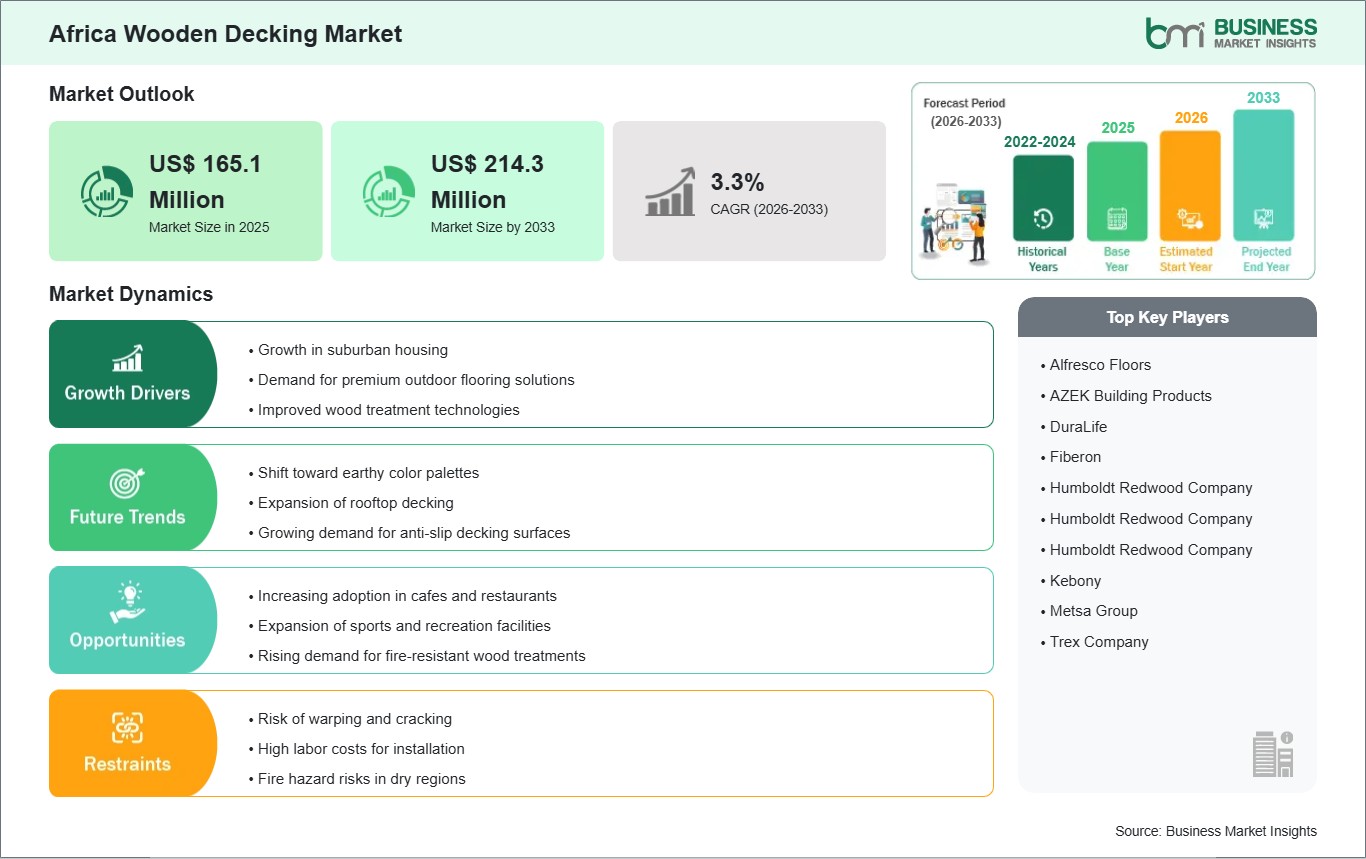
The Africa wooden decking market size is expected to reach US$ 214.3 million by 2033 from US$ 165.1 million in 2025. The market is estimated to register a CAGR of 3.3% from 2026 to 2033.
In terms of demand, wood decking in Africa is mainly used in high-end housing complexes, tourism facilities, resorts, and recreational facilities. With the onset of urbanization, modern developers have been including landscaped terraces, pool decks, walkways in gardens, and recreational spaces in the design plans of buildings. In the tourism and hospitality industry, resort and lodge construction involves the use of timber decking due to its capability of creating a picturesque environment around them. Timber decks can be used because they complement scenic beauty and luxurious architectural styles. Investment made in high-income residential areas is another factor driving growth in this industry. Market growth is restricted by the limited supply of high-quality treated wood, varying prices of the raw materials used, and reliance on wood that is imported from abroad, which can affect the supply and the stability of prices. High humidity levels, harsh sun rays, and seasonal rains can pose maintenance issues, thus requiring treatment of the wood for protection purposes. Awareness about the use of composite decks is on the rise.

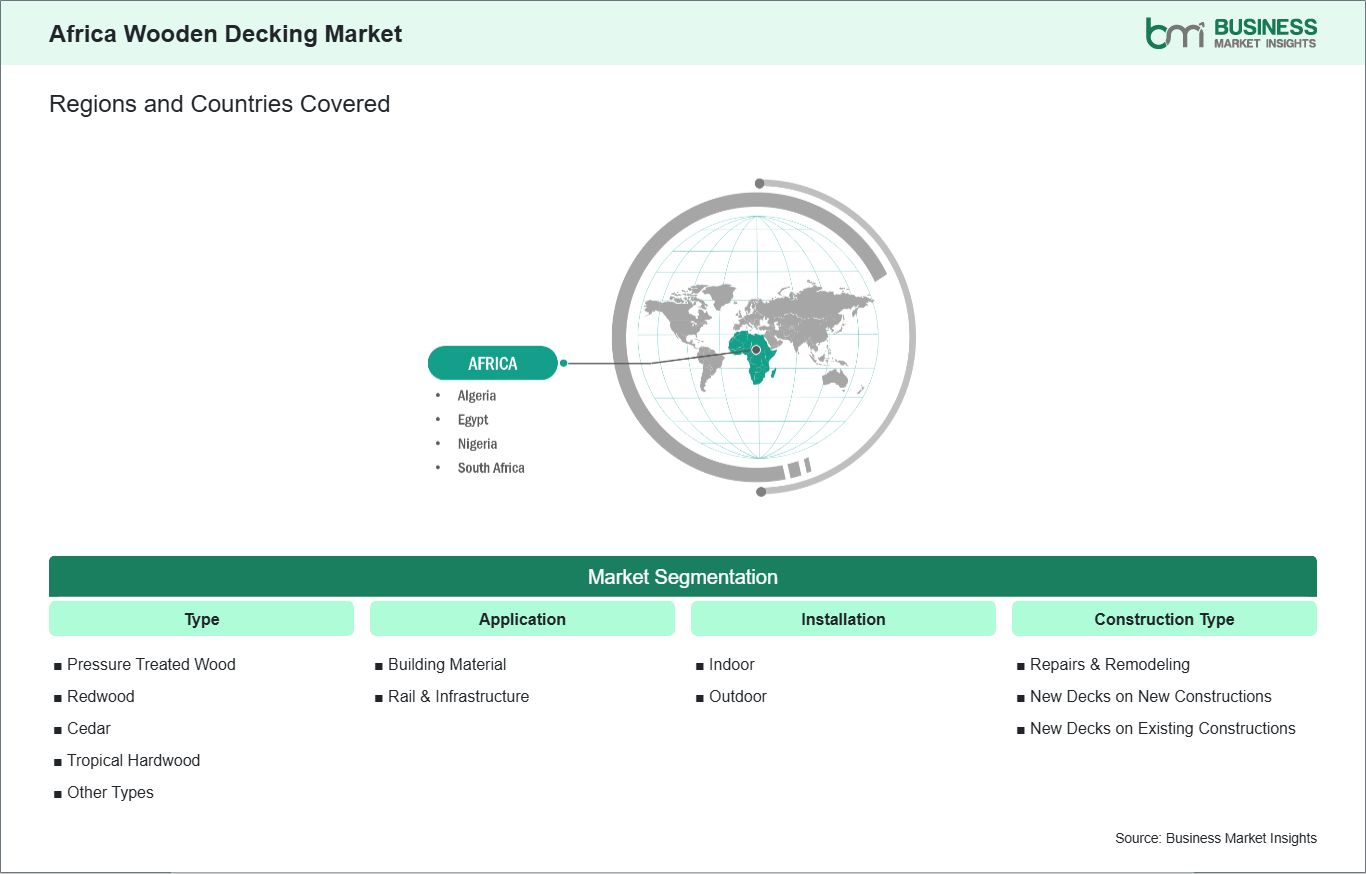
Key segments that contributed to the derivation of the Africa wooden decking market analysis are types, application, installation, construction type, and distribution channel.
Residential constructions around big metropolitan centers are contributing towards the need for outdoor facilities that improve functionality as well as provide aesthetic value to their properties. Wood decks are being added in new suburban developments owing to the fact that they create aesthetically appealing outdoor areas where homeowners can meet up, dine, and enjoy other leisure activities with their families.
Low-density housing is prompting the increase in use of decking within private gardens and patios, and in courtyard designs. There has been an increased development of detached and semi-detached houses in suburban neighborhoods, which has increased the need for landscaping techniques to maximize the use of outdoor spaces. The most popular types of materials used include pressure-treated timber and hardwood timber due to their longevity and ability to withstand different climatic conditions. These types of wood are preferred for their aesthetic appeal in residential areas.
There is increasing recognition of the importance of housing designs that are lifestyle-oriented, thus driving the growth in the usage of wood decking products. There is an increasing preference for having outdoor living areas where individuals can relax and socialize, particularly in places that experience warm weather and have all-year-round outdoor activity opportunities. Increased construction capacity in localities, together with readily available wood decks in prefab forms, is making installations much easier. The trend of increased growth in the building of suburban houses is likely to boost wood deck demand.
The rising industry of hospitality and food services in Africa is presenting opportunities for deck construction using wood in cafes, restaurants, and other open-air areas. The establishments within the hospitality sector are becoming more inclined toward creating attractive outdoor surroundings as a means of attracting clients in search of open-air dining and recreational areas. Wood decks are proving to be a popular selection in terrace, garden, roof-top, and waterfront dining areas due to their aesthetically pleasing nature.
Outdoor seating zones have become a trend among hospitality businesses looking to increase capacity and design unique dining experiences. The use of wood decks helps hospitality establishments come up with creative designs that will fit their needs for affordable and upscale dining concepts. Hardwoods used in decking are the best choice for such applications, since they are able to withstand the constant weight and exposure to different elements. Modular decking has become popular due to its ease of installation and flexibility when renovating existing facilities.
There is growing interest in developments and commercial buildings catering to tourists and lifestyle requirements. Outdoor wooden flooring is becoming a common sight at restaurants and cafes set up in shopping centers, beach areas, and entertainment centers. Consumers have started demanding outdoor spaces that are more visually appealing and enhance socializing. Since hospitality businesses will keep trying to improve consumer experience by creating more outdoor seating space, the demand for wood decks is expected to grow.
The wooden decking market in Africa is experiencing steady growth, with market size and share analysis reflecting evolving treatment preferences and competitive dynamics among key players. The report evaluates important subsegments categorized within type, application, installation, construction type, and distribution channel, highlighting their respective contributions to market performance.
By types, the pressure-treated wood subsegment dominated the market in 2025, because it is highly affordable, durable, and resistant to moisture, termites, and decay, making it suitable for long-term outdoor use. Due to its low maintenance requirements and wide availability, homeowners and contractors prefer pressure-treated wood over other decking materials.
Based on application, the building material subsegment dominated the market in 2025 because wood decking is extensively used in residential and commercial construction projects such as patios, balconies, gardens, and outdoor flooring. Due to increasing urbanization and rising investments in housing and infrastructure development, the demand for wood decking as a building material continues to grow.
On the basis of installation, the outdoor subsegment dominated the market in 2025, because wood decking is mainly designed for outdoor recreational and landscaping purposes. The consumers are focusing on outdoor living spaces, gardens, rooftop seating areas, and poolside decks. Outdoor installation has witnessed significant demand.
In terms of construction type, the repairs and remodeling subsegment dominated the market in 2025, because many old decks require renovation, replacement, and maintenance over time. Due to the growing trend of home improvement and remodeling activities, especially in developed countries, consumers are investing more in upgrading existing outdoor structures instead of undertaking new construction projects.
By distribution channel, the indirect sales dominated the market in 2025, because manufacturers distribute wood decking products through wholesalers, dealers, and retail home improvement stores. Due to the wider market reach, better product accessibility, and convenience offered by indirect sales channels, contractors and customers prefer purchasing decking materials through established distributors.

| Report Attribute | Details |
|---|---|
| Market size in 2025 | US$ 165.1 Million |
| Market Size by 2033 | US$ 214.3 Million |
| CAGR (2026 - 2033) | 3.3% |
| Historical Data | 2022-2024 |
| Forecast period | 2026-2033 |
| Segments Covered | By Type
|
|
Regions and Countries Covered
| |
| Africa | Egypt, South Africa, Nigeria, Algeria |
| Market leaders and key company profiles |
|
The "Africa Wooden Decking Market Size and Forecast (2022-2033)" report provides a detailed analysis of the market covering below areas:
The geographical scope of the Africa wooden decking market report is divided into: Nigeria, Egypt, South Africa, and Algeria. South Africa held the largest share in 2025.
South Africa has an advanced market for landscaping and exterior home improvement projects, resulting in a steady flow of wood deck applications for personal and commercial purposes. Outdoor wood decks are common in coastal homes, luxurious villa constructions, restaurants, hotels, and even wine estates, wherein entertainment areas are important architectural components. The good climatic conditions present in the country make decking projects common among the various outdoor applications, such as patios, poolside decks, balcony decks, and garden expansion areas. The demand for this product is usually high in wealthy suburbs and tourism-oriented provinces, where the consumers favor natural-looking finishes and excellent outdoor designs. Consumers prefer hardwood deck material because of its ability to withstand weather conditions, especially along the coast, where there is high humidity and salty air. The timber sector in South Africa has relatively well-structured distribution channels compared to most other nations in Africa. This enables easier availability and knowledge on how to use the product in construction. There is the aspect of challenges from issues related to maintenance with regard to the long hours under the sun and water damage, as well as decay brought about by pests. Composite material is steadily making an entry into the upper-class segment, especially among people who want reduced maintenance levels. Despite this, wooden decking still has a significant share of the market in South Africa.

The Africa Wooden decking market is evaluated by gathering qualitative and quantitative data post primary and secondary research, which includes important corporate publications, association data, and databases. A few of the key developments in the Africa Wooden decking market are:
The Africa Wooden Decking Market is valued at US$ 165.1 Million in 2025, it is projected to reach US$ 214.3 Million by 2033.
As per our report Africa Wooden Decking Market, the market size is valued at US$ 165.1 Million in 2025, projecting it to reach US$ 214.3 Million by 2033. This translates to a CAGR of approximately 3.3% during the forecast period.
The Africa Wooden Decking Market report typically cover these key segments-
The historic period, base year, and forecast period can vary slightly depending on the specific market research report. However, for the Africa Wooden Decking Market report:
The Africa Wooden Decking Market is populated by several key players, each contributing to its growth and innovation. Some of the major players include:
The Africa Wooden Decking Market report is valuable for diverse stakeholders, including:
Essentially, anyone involved in or considering involvement in the Africa Wooden Decking Market value chain can benefit from the information contained in a comprehensive market report.
Please tell us your area of interest
(Market Segments/ Regions and Countries/ Companies)