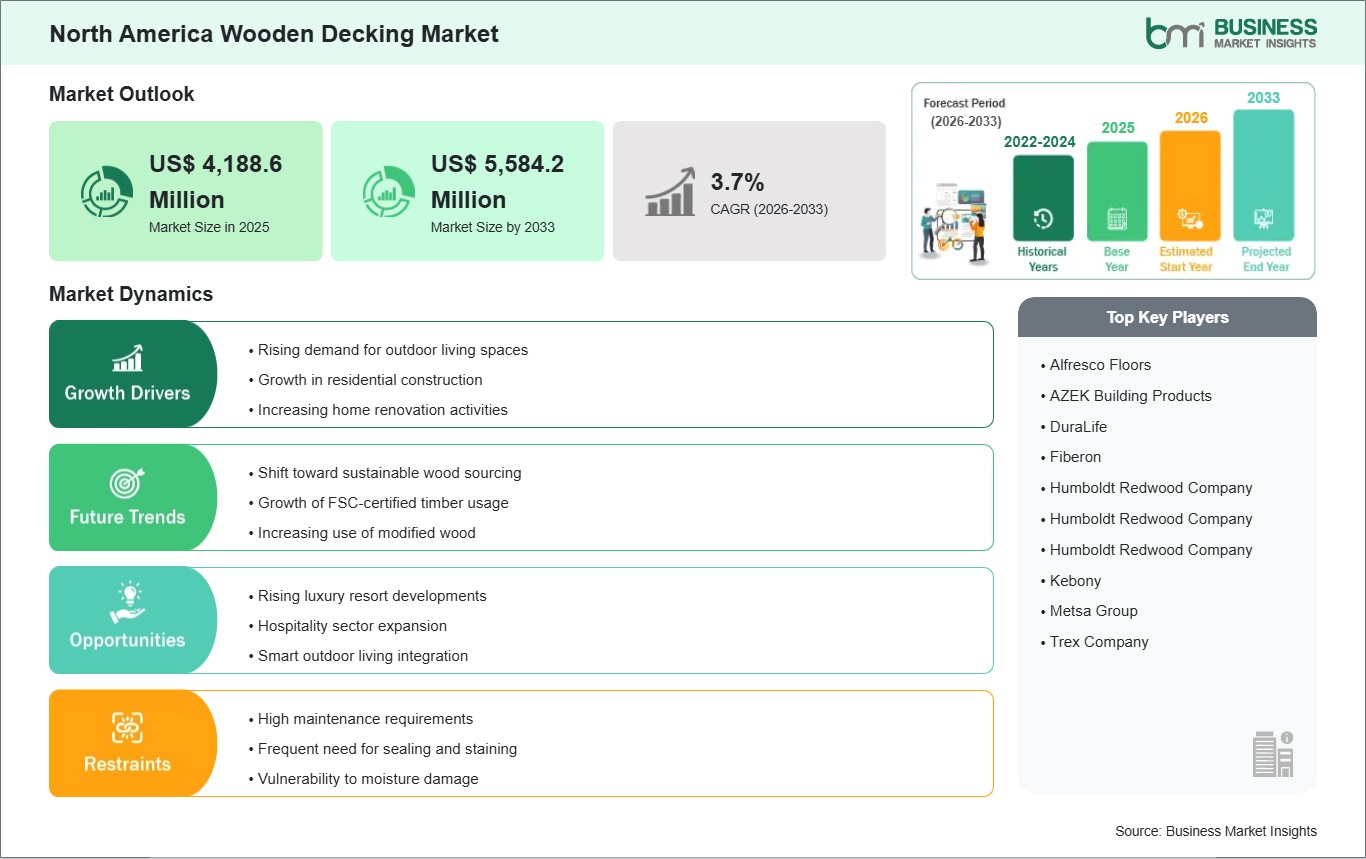
The North America wooden decking market size is expected to reach US$ 5,584.2 million by 2033 from US$ 4,188.6 million in 2025. The market is estimated to record a CAGR of 3.7% from 2026 to 2033.
The North American wooden decking market is defined by high renovation activity, a preference for outdoor lifestyles, and a well-established construction landscape that ensures consistent demand. Across this continent, wooden deckings have become increasingly popular as they reflect modern homes and lifestyles that consider outdoors as part of the home. With the trend of renovating or replacing old houses in the region, wood decks are favored as they offer aesthetic appeal and are easy to integrate into most architectural designs. Renovation and replacement are crucial factors that contribute to market growth, as wood decks in older properties need replacement after a while. The outdoor lifestyle culture and the focus on backyard landscaping in residential areas make wood decks attractive, and they are more affordable than other composite wood options. Both pressure-treated lumber and hardwoods continue to be used extensively because of their accessibility and efficiency. However, there are some limitations associated with the market. For instance, there is an increased consumer preference for composite materials that require less maintenance than wood. Another limitation is that wooden deckings need regular maintenance, such as application of stains and sealants. Furthermore, wooden deckings are environmentally sensitive, given the increasing pressure on forest depletion. Nonetheless, wooden decking has maintained its dominance in the market due to its traditional popularity and readily available sources.

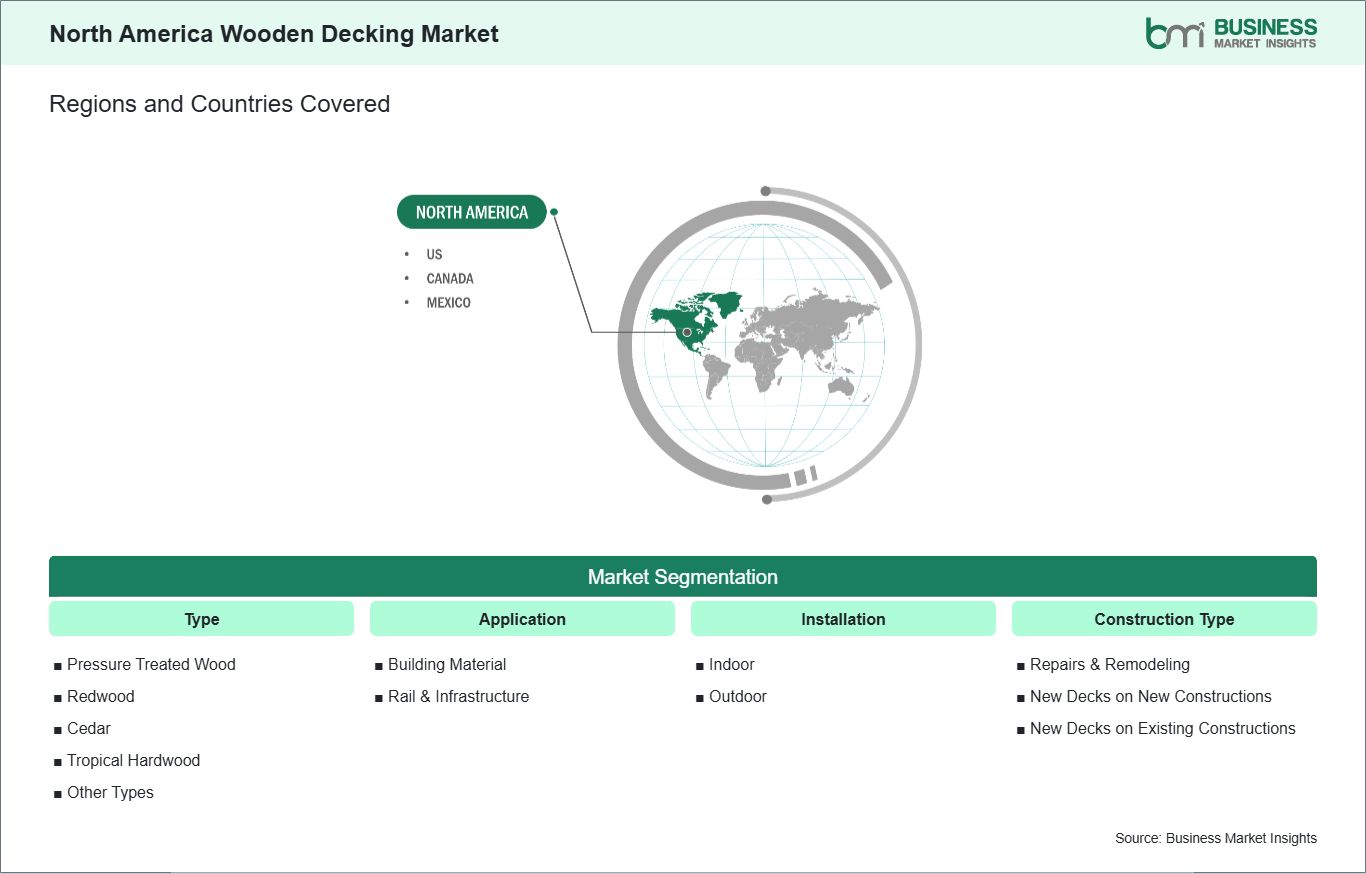
Key segments that contributed to the derivation of the North America wooden decking market analysis are types, application, installation, construction type, and distribution channel.
The North American wooden decking industry is highly affected by the increase in consumers' demand for better outdoor living spaces. An upsurge in disposable income along with changing lifestyles after the COVID-19 pandemic is driving people to create outdoor living spaces with wooden deck constructions. In the U.S., nearly 58-62% of homeowners with single-family residences have upgraded their outdoor living spaces with wooden decking constructions.
The first is the rising preference for multi-purpose outdoor areas that act as extensions of indoor living rooms. For colder states like Minnesota and Ontario, pressure treated pine and cedar decking are commonly used because of their resistance to extreme temperatures. On the other hand, warm states like California and Texas prefer redwood and ipe deckings because of their resistance to UV light and frequent use.
The second trend that is contributing to the rise of decking is the do-it-yourself (DIY) movement among American households. Sales statistics reveal that more than 35% of decking sales are from DIY buyers of modular and finished wood decks. The younger generation is especially drawn towards DIY projects, since outdoor beauty helps to hold social gatherings as well as adds to the property's aesthetic appeal.
There is growing demand for premium wooden decking as a result of the increasing presence of luxury tourism infrastructure throughout North America. Resort establishments located in the coastal parts of the country, such as Florida, Hawaii, as well as the U.S. territories of the Caribbean, have been using premium quality deck boards in the construction of villas and pools. The current estimations claim that over 40% of all upcoming luxury resorts projects from 2023 to 2026 will involve the use of hardwood or engineered wooden decking.
There is also growing demand for premium quality decking materials in Canadian regions, such as British Columbia and Alberta, where luxurious eco-resorts are being built. Cedar and thermally modified wood are particularly popular since these materials combine both aesthetic features and durability against mold and moisture. This characteristic proves to be extremely important in resort buildings located within forest and lakeside settings.
Moreover, luxury hospitality projects in locations like Aspen, Napa Valley, and Hamptons are creating an increased requirement for custom deck design ideas that will work with the high-end architectural aesthetics of the project. More developers are working with their landscape architects to design multilevel decks that will include features like fire pits, spa decks, and infinity edge pools. This growing trend of experiential luxury will continue to fuel demand for luxury wood decks in North America.
The North America wooden decking market is experiencing steady growth, with market size and share analysis reflecting evolving treatment preferences and competitive dynamics among key players. The report evaluates important subsegments categorized within types, application, installation, construction type, and distribution channel, highlighting their respective contributions to overall market performance.
By types, the pressure treated wood subsegment dominated the market in 2025, because it is highly affordable, durable, and resistant to moisture, termites, and decay, making it suitable for long-term outdoor use. Due to its low maintenance requirements and wide availability, homeowners and contractors prefer pressure-treated wood over other decking materials.
Based on application, the building material subsegment dominated the market in 2025 because wooden decking is extensively used in residential and commercial construction projects such as patios, balconies, gardens, and outdoor flooring. Due to increasing urbanization and rising investments in housing and infrastructure development, the demand for wooden decking as a building material continues to grow.
On the basis of installation, the outdoor subsegment dominated the market in 2025, because wooden decking is mainly designed for outdoor recreational and landscaping purposes. The consumers are increasingly focusing on outdoor living spaces, gardens, rooftop seating areas, and poolside decks, outdoor installation has witnessed significant demand globally.
In terms of construction type, the repairs and remodeling subsegment dominated the market in 2025, because many old decks require renovation, replacement, and maintenance over time. Due to the growing trend of home improvement and remodeling activities, especially in developed countries, consumers are investing more in upgrading existing outdoor structures instead of undertaking new construction projects.
By distribution channel, the indirect sales subsegment dominated the market in 2025, because manufacturers mainly distribute wooden decking products through wholesalers, dealers, and retail home improvement stores. Due to the wider market reach, better product accessibility, and convenience offered by indirect sales channels, contractors and customers prefer purchasing decking materials through established distributors.

| Report Attribute | Details |
|---|---|
| Market size in 2025 | US$ 4,188.6 Million |
| Market Size by 2033 | US$ 5,584.2 Million |
| CAGR (2026 - 2033) | 3.7% |
| Historical Data | 2022-2024 |
| Forecast period | 2026-2033 |
| Segments Covered | By Type
|
|
Regions and Countries Covered
| |
| North America | US, Canada, Mexico |
| Market leaders and key company profiles |
|
The "North America Wooden Decking Market Size and Forecast (2022-2033)" report provides a detailed analysis of the market covering below areas:
The geographical scope of the North America wooden decking market report is divided into: The US, Canada, and Mexico. The US held the largest share in 2025.
In North America, the United States leads the market share for wooden decking because of the large number of single-family homes and an outdoor residential lifestyle embedded in the country. Decking at one's back is common among many suburban houses, especially those located in warm or moderate climates whereby outdoor functionality spans throughout several seasons. The demand is highly linked to renovation cycles whereby homeowners choose to renovate their current decks for aesthetic and safety purposes. Another key factor influencing the U.S. market trend in wooden deck products is the growing architectural preference of having seamless transitions between indoors and outdoors spaces through open patio designs, multi-level decks, and outdoor recreational areas. Wood continues to be preferred because of its aesthetically appealing nature and suitability when constructing custom decks. Builders find wood decks easy to construct, readily available, and adaptable to different building styles. Regional differences within the country are evident. The southern parts, which experience warmer climate, register high consumption since outdoor conditions occur for extended periods of time, whereas northern areas concentrate on weatherproof wooden deckings. Coastal regions add to the demand by requiring wood that can withstand humid conditions. Although there are many substitutes competing with traditional wooden decking, the latter still enjoys great popularity wherever natural appearance is essential. As far as the United States leads in innovations and trends within the field, North American regions largely depend on the U.S. market regarding their regional demand.

The North America wooden decking market is evaluated by gathering qualitative and quantitative data post primary and secondary research, which includes important corporate publications, association data, and databases. A few of the key developments in the North America wooden decking market are:
The North America Wooden Decking Market is valued at US$ 4,188.6 Million in 2025, it is projected to reach US$ 5,584.2 Million by 2033.
As per our report North America Wooden Decking Market, the market size is valued at US$ 4,188.6 Million in 2025, projecting it to reach US$ 5,584.2 Million by 2033. This translates to a CAGR of approximately 3.7% during the forecast period.
The North America Wooden Decking Market report typically cover these key segments-
The historic period, base year, and forecast period can vary slightly depending on the specific market research report. However, for the North America Wooden Decking Market report:
The North America Wooden Decking Market is populated by several key players, each contributing to its growth and innovation. Some of the major players include:
The North America Wooden Decking Market report is valuable for diverse stakeholders, including:
Essentially, anyone involved in or considering involvement in the North America Wooden Decking Market value chain can benefit from the information contained in a comprehensive market report.
Please tell us your area of interest
(Market Segments/ Regions and Countries/ Companies)