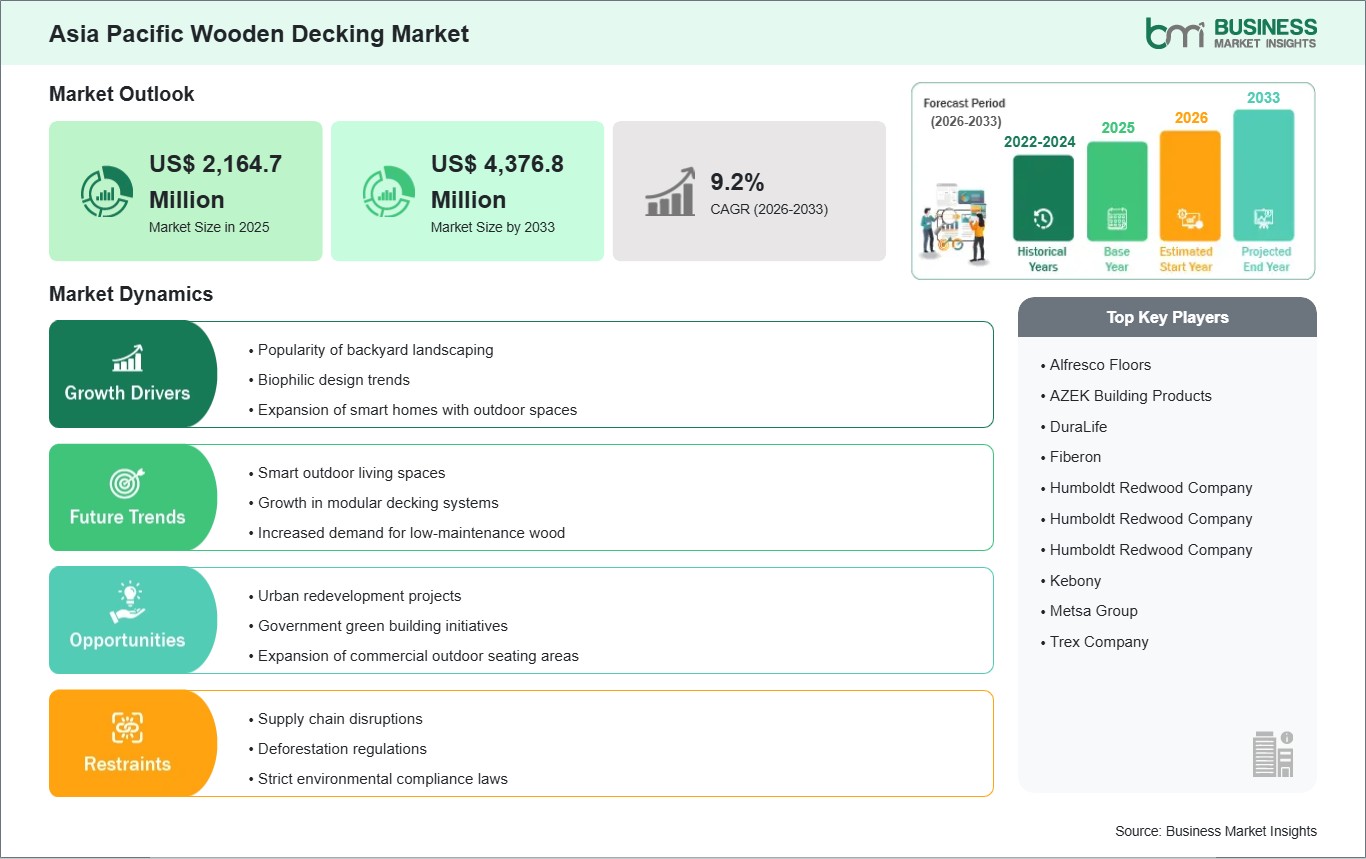
The Asia Pacific wooden decking market size is expected to reach US$ 4,376.8 million by 2033 from US$ 2,164.7 million in 2025. The market is estimated to record a CAGR of 9.2% from 2026 to 2033.
The Asia-Pacific region's wood deck market is witnessing stable growth, backed up by the rapid pace of urbanization, growing construction of residences, and investments in hotel and recreation amenities. Wood decks are finding application in exclusive housing, resorts, commercial facilities, and urban landscaping projects where outdoor appearances and functional spaces for leisure purposes play a significant role in the design. Growing population and changing lifestyles of the middle-class residents of the region are encouraging people to give emphasis to outdoor living spaces like terraces, gardens, and balconies. The development and use of wooden decking in tourism and hospitality sectors at coastal and scenic locations is another major growth driver, with the construction material being utilized in various facilities, including resorts, boardwalks, outdoor eating areas, and pool decks. It is favored for its natural look and compatibility with various environments and architectures. Furthermore, the growing concern regarding sustainable building methods is contributing to the adoption of responsibly harvested lumber and engineered wood in some developed nations in Asia Pacific. However, there are limitations associated with the wooden decking market, which include irregular availability of quality lumber, differing regulations from one country to the other, and stiff competition from composite materials and alternatives. Tropical or humid regions need to invest in the maintenance of wooden decks due to concerns of moisture buildup, decay, and infestations.

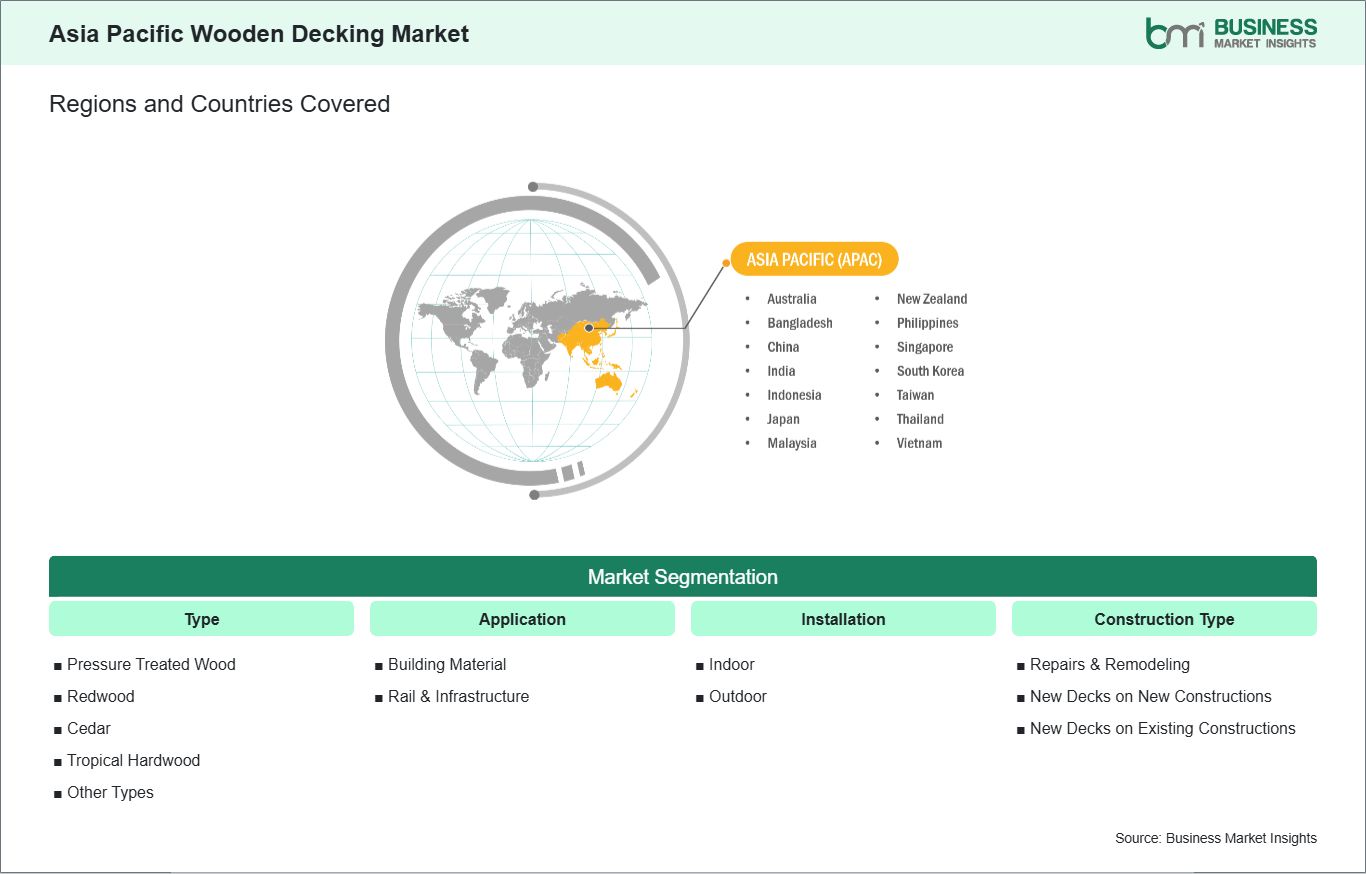
Key segments that contributed to the derivation of the Asia Pacific wooden decking market analysis are types, application, installation, construction type, and distribution channel.
The Asia wooden decking market is expected to witness healthy growth in the coming years owing to rising awareness about backyard landscaping and outdoor home improvement projects. The changing lifestyles of consumers with higher disposable incomes have resulted in the increased spending on home improvement projects, including backyard decoration. The use of wooden decking has been found to be more suitable for the purpose of decorating the garden and other backyard spaces such as terrace decks.
The new trends in house design are making a significant contribution to the growth of deck installation. Contemporary house designs focus on seamless transitions between interiors and exteriors, creating a connection between balconies, patios, and even small gardens, making them an extension of the interior space of the house. Many contemporary housing projects are incorporating wooden decks in fast-developing cities to enhance aesthetic value and create a useful outdoor space. Pressure treated and engineered wood have become popular due to greater durability and adaptability in different climates.
Furthermore, the increased awareness of lifestyle-based improvements is boosting market growth. Consumers are becoming more interested in home design ideas, which are promoted on different platforms via social media. This has created a rising demand for aesthetic solutions that can be installed quickly and affordably. With the increase in the affordability of deck construction and easier installation process, people are investing in backyard landscape designing projects. Rising importance of outdoor spaces in residential buildings has boosted the demand for wooden decking in landscaping.
Asia's wooden decking industry is showing potential due to significant developments in urban redevelopment and modernization programs. With old urban settlements being revamped into new urban areas with residential and commercial developments, there is an increase in the need for functional and aesthetically pleasing designs in the outdoors. wooden decking is commonly seen as one of the building materials utilized during urban redevelopment for creating terraces, pedestrian zones, rooftop amenities, and landscaping areas.
Renovation of residential areas has been an additional driving factor behind the increasing use of wood structures outside the modern housing units being built. The emphasis nowadays is on designing communities with recreational amenities, gardens, and other outdoor spaces. Wood is commonly used for such purposes because of its adaptability, rapid installation properties, and compatibility with the modern architectural styles. The modular design of wood decks is especially important for areas under urban renovation.
The development of commercial properties is providing yet another platform for the application of wood decks. Outdoor seating areas, rooftop decks, and walking paths in shopping malls, business hubs, and mixed-used projects are among the new areas where wooden decking will be employed. The idea here is to enhance customer experience and increase traffic to such places. The trend will keep growing alongside redevelopment trends in cities.
The Asia Pacific wooden decking market is experiencing steady growth, with market size and share analysis reflecting evolving treatment preferences and competitive dynamics among key players. The report evaluates important subsegments categorized within types, application, installation, construction type, and distribution channel, highlighting their respective contributions to market performance.
By types, the pressure-treated wood subsegment dominated the market in 2025, because it is highly affordable, durable, and resistant to moisture, termites, and decay, making it suitable for long-term outdoor use. Due to its low maintenance requirements and wide availability, homeowners and contractors prefer pressure-treated wood over other decking materials.
Based on application, the building material subsegment dominated the market in 2025 because wooden decking is extensively used in residential and commercial construction projects such as patios, balconies, gardens, and outdoor flooring. Due to increasing urbanization and rising investments in housing and infrastructure development, the demand for wooden decking as a building material continues to grow.
On the basis of installation, the outdoor subsegment dominated the market in 2025, because wooden decking is mainly designed for outdoor recreational and landscaping purposes. The consumers are increasingly focusing on outdoor living spaces, gardens, rooftop seating areas, and poolside decks, outdoor installation has witnessed significant demand globally.
In terms of construction type, the repairs and remodeling subsegment dominated the market in 2025, because many old decks require renovation, replacement, and maintenance over time. Due to the growing trend of home improvement and remodeling activities, especially in developed countries, consumers are investing more in upgrading existing outdoor structures instead of undertaking new construction projects.
By distribution channel, the indirect sales subsegment dominated the market in 2025, because manufacturers mainly distribute wooden decking products through wholesalers, dealers, and retail home improvement stores. Due to the wider market reach, better product accessibility, and convenience offered by indirect sales channels, contractors and customers prefer purchasing decking materials through established distributors.

| Report Attribute | Details |
|---|---|
| Market size in 2025 | US$ 2,164.7 Million |
| Market Size by 2033 | US$ 4,376.8 Million |
| CAGR (2026 - 2033) | 9.2% |
| Historical Data | 2022-2024 |
| Forecast period | 2026-2033 |
| Segments Covered | By Type
|
|
Regions and Countries Covered
| |
| Asia Pacific | China, Japan, South Korea, India, Australia, New Zealand, Indonesia, Malaysia, Philippines, Singapore, Thailand, Vietnam, Taiwan, Bangladesh |
| Market leaders and key company profiles |
|
The "Asia Pacific Wooden Decking Market Size And Forecast (2022-2033)" report provides a detailed analysis of the market covering below areas:
The geographical scope of the Asia Pacific wooden decking market report is divided into: China, Japan, South Korea, India, Australia, New Zealand, Indonesia, Malaysia, the Philippines, Singapore, Thailand, Vietnam, Taiwan, Bangladesh, and the Rest of Asia. China held the largest share in 2025.
China dominates the Asia Pacific market for wooden decking because of the extensive size of its construction industry, its fast urbanization pace, and increasing tourism infrastructures in the region. The continued urbanization process in China has resulted in a high level of demand for outdoor architecture products such as wood deck products that can be found within residential complexes, commercial areas, recreational places, and parks among others. The common use of wood deck includes residential areas where deck construction takes place in high-rise housing societies, villas, and luxury apartments where the decks will be used for leisure purposes such as parties, social gatherings, and other events. The deck structures are now being built in residential areas by developers as part of their efforts to make the building more attractive according to new customer demands. In commercial and infrastructure construction, the deck construction is taking place in parks, waterfront promenades, and other exhibition areas. Demand also comes from the hospitality industry, especially in regions that have large tourism activities, where there is use of deck boards in restaurants and other entertainment places along resorts and hotels to add aesthetic value to their pools and scenic walking spots. This can be attributed to the rise of domestic tourism and investment in such infrastructures. Nevertheless, the deck boards market is faced with strong environmental policies as well as increased adoption of sustainable timber. In addition to that, there is competition from engineered wood boards and composite board decks.

The Asia Pacific wooden decking market is evaluated by gathering qualitative and quantitative data post primary and secondary research, which includes important corporate publications, association data, and databases. A few of the key developments in the Asia Pacific wooden decking market are:
The Asia Pacific Wooden Decking Market is valued at US$ 2,164.7 Million in 2025, it is projected to reach US$ 4,376.8 Million by 2033.
As per our report Asia Pacific Wooden Decking Market, the market size is valued at US$ 2,164.7 Million in 2025, projecting it to reach US$ 4,376.8 Million by 2033. This translates to a CAGR of approximately 9.2% during the forecast period.
The Asia Pacific Wooden Decking Market report typically cover these key segments-
The historic period, base year, and forecast period can vary slightly depending on the specific market research report. However, for the Asia Pacific Wooden Decking Market report:
The Asia Pacific Wooden Decking Market is populated by several key players, each contributing to its growth and innovation. Some of the major players include:
The Asia Pacific Wooden Decking Market report is valuable for diverse stakeholders, including:
Essentially, anyone involved in or considering involvement in the Asia Pacific Wooden Decking Market value chain can benefit from the information contained in a comprehensive market report.
Please tell us your area of interest
(Market Segments/ Regions and Countries/ Companies)