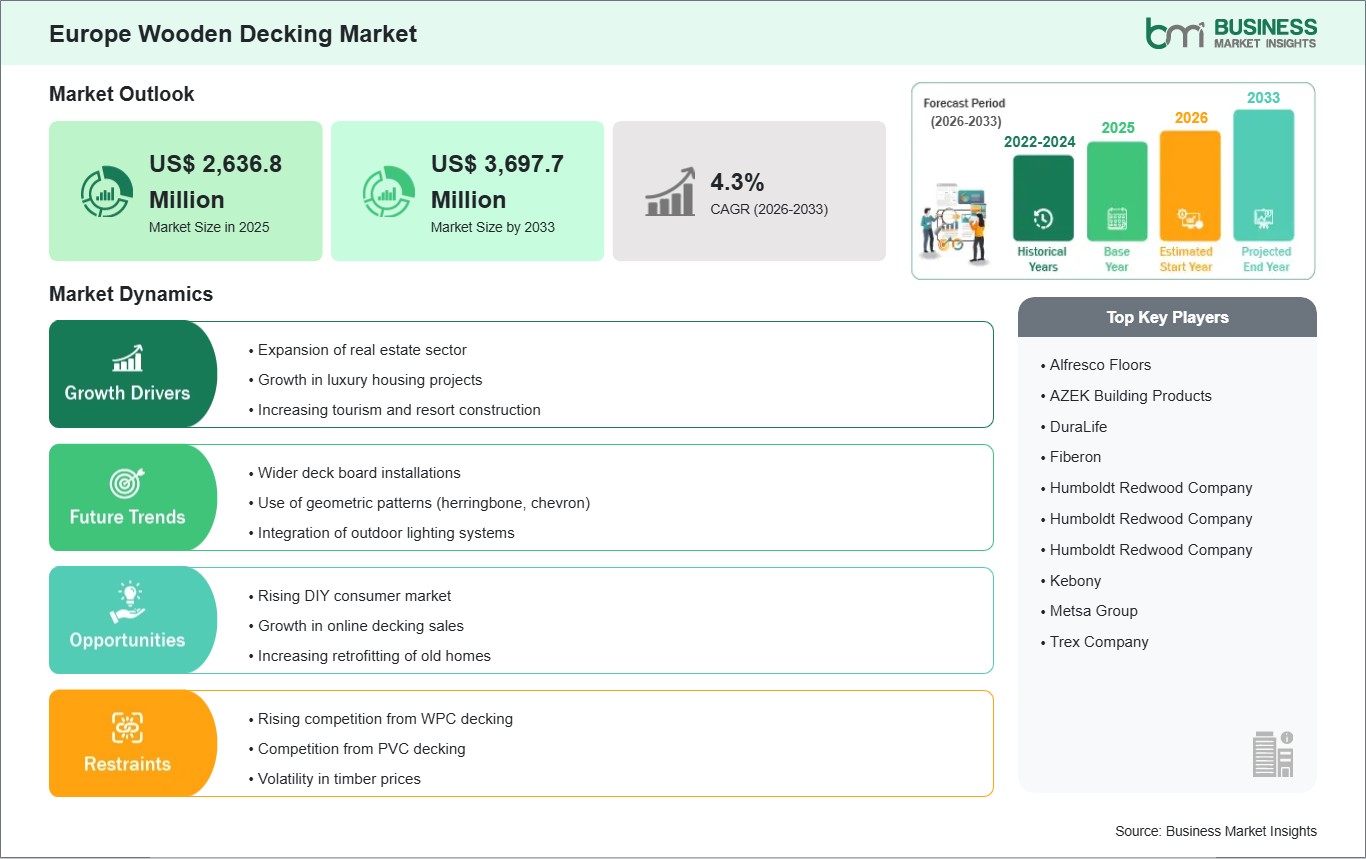
The Europe wooden decking market size is expected to reach US$ 3,697.7million by 2033 from US$ 2,636.8 million in 2025. The market is estimated to record a CAGR of 4.3% from 2026 to 2033.
Europe's wooden decking industry is dominated by sustainable construction practices, rising demand for luxury outdoors, and an established tradition of renovation activities within both residential and commercial infrastructure. wooden decking is extensively used in personal gardens, terraces, balconies, parks, hospitality facilities, and city renewal initiatives where sustainability is a primary consideration. In Europe, there is a considerable emphasis on sustainably sourced material, and the use of certified wood products has increased accordingly within the scope of outdoor furniture and architecture. The growth of the market is driven by the rising trend towards integrating outdoors into the living spaces of homes, especially in urban and suburban settings, where exterior space availability is a major consideration. Decking made of wood is preferred due to its aesthetics, flexibility of design, and compatibility with both traditional European and contemporary minimalist building concepts. The hospitality and tourism industry also plays an important role, as decked areas are created at eateries, resorts, and entertainment venues. However, there are limitations posed by environmental laws, increased demands on timber imports, and increased rivalry between composite decks. Furthermore, varying weather patterns in Europe, which include the wetter north and the temperate central zones, pose technical difficulties in terms of moisture, durability, and maintenance needs.

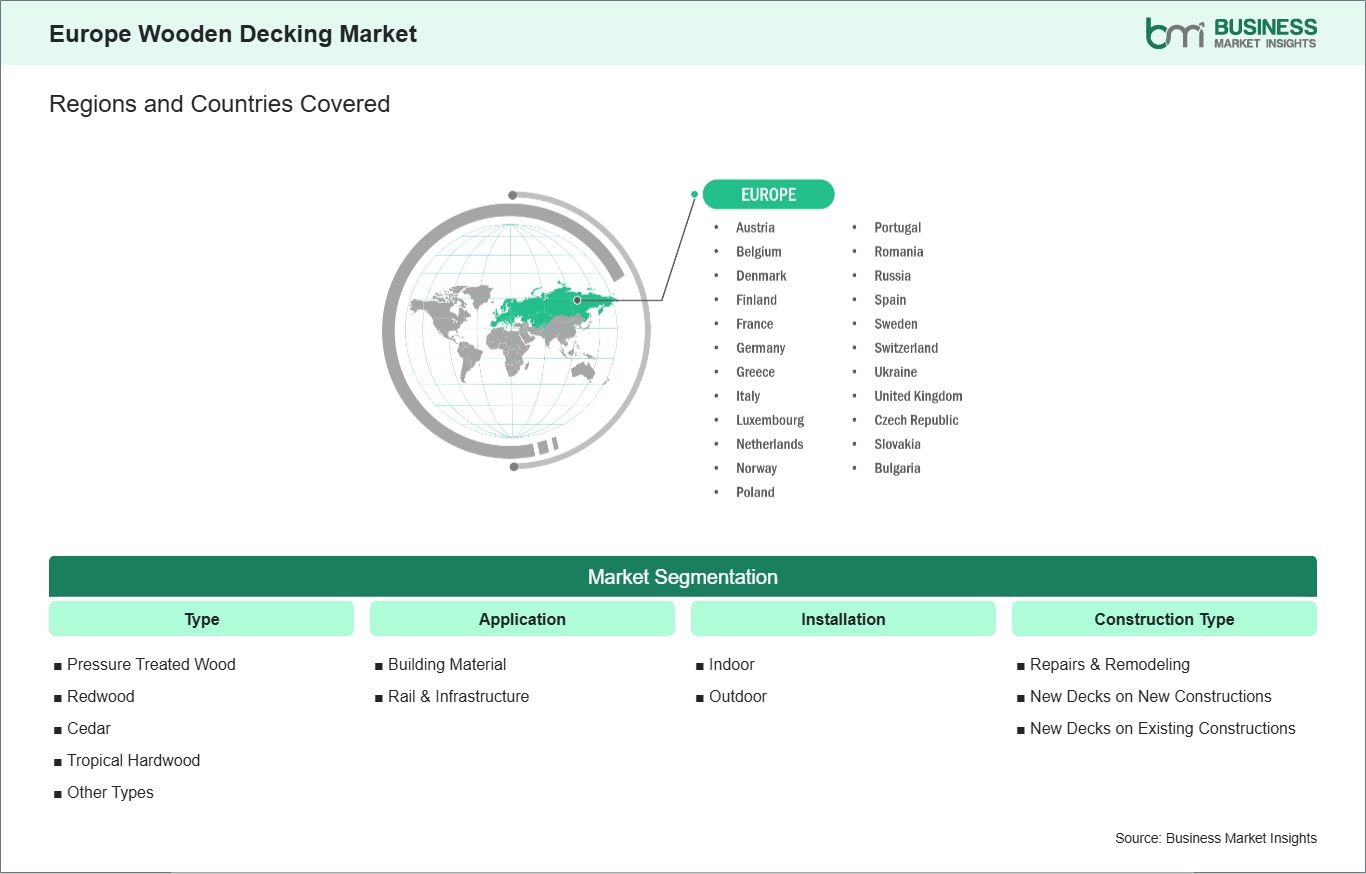
Key segments that contributed to the derivation of the Europe wooden decking market analysis are types, application, installation, construction type, and distribution channel.
The development of the European wood deck industry is highly influenced by growth and renovation within the real estate industry. Construction activities, renovations within the real estate industry, and the renovation of existing homes have been boosting the usage of wood decks as part of home improvement activities. Wood deck products are extensively used within the design of new homes, especially within apartments, villas, and mixed developments, whereby outdoor spaces form part of added values. Decking products are often used within property developments to create value-added propositions among many competing developments.
Renovation and updating of existing housing infrastructure is another significant contributor to the rise in demand for deck building services. In many cases, old homes and buildings are being refurbished with modernized living areas outside of the house, using wooden decks as an affordable and good-looking way to achieve this. People are making efforts to improve their exteriors and boost their property values, especially in areas where there is a well-established tradition of leisurely spending time outdoors.
In addition, real estate developments have also been promoting market growth. For instance, hotels, office buildings, and retail spaces have been using outdoor wooden decks and rooftops for users to relax outdoors. The use of outdoor elements in property development is part of the general lifestyle-based design concept in which ease of access to the outside environment is paramount. With evolving trends in sustainable and more livable property development, the demand for wooden decking will likely continue to be high.
The market for wooden decking in Europe is experiencing some lucrative prospects because of the emergence of the do-it-yourself (DIY) consumer demographic. The number of individuals involved in independent renovation work within their homes has grown over time owing to an increase in home customization and cost-effective renovation options. wooden deckings offer one of the most ideal materials for DIY use since they have a ready-made format for simple installation.
More retailers and home improvement websites are providing an increasing number of convenient options for deck construction, including guides, tools, and kits that allow customers to build their own decks. Consequently, people have become more active in building their gardens and patios independently, as well as making alterations and improvements to their balconies. Furthermore, DIY projects are becoming increasingly popular because of the high level of inspiration available on various Internet sites.
The demand for versatile and affordable options for home improvement projects has been on the increase, and DIY projects fit the bill perfectly, since most customers would like to achieve noticeable results quickly, as well as gain the ability to use their outdoor area. Treated softwoods and lightweight composite decking materials are gaining popularity in this market sector because of their ease of handling and relatively low prices. It can be expected that DIY customers will continue to seek inspiration and ideas from various Internet sites.
The Europe wooden decking marketis experiencing steady growth, with market size and share analysis reflecting evolving treatment preferences and competitive dynamics among key players. The report evaluates important subsegments categorized within types, application, installation, construction type, and distribution channel, highlighting their respective contributions to overall market performance.
By types, the pressure-treated wood subsegment dominated the market in 2025, because it is highly affordable, durable, and resistant to moisture, termites, and decay, making it suitable for long-term outdoor use. Due to its low maintenance requirements and wide availability, homeowners and contractors prefer pressure-treated wood over other decking materials.
Based on application, the building material subsegment dominated the market in 2025 because wooden decking is extensively used in residential and commercial construction projects such as patios, balconies, gardens, and outdoor flooring. Due to increasing urbanization and rising investments in housing and infrastructure development, the demand for wooden decking as a building material continues to grow.
On the basis of installation, the outdoor subsegment dominated the market in 2025, because wooden decking is mainly designed for outdoor recreational and landscaping purposes. The consumers are increasingly focusing on outdoor living spaces, gardens, rooftop seating areas, and poolside decks, outdoor installation has witnessed significant demand globally.
In terms of construction type, the repairs and remodeling subsegment dominated the market in 2025, because many old decks require renovation, replacement, and maintenance over time. Due to the growing trend of home improvement and remodeling activities, especially in developed countries, consumers are investing more in upgrading existing outdoor structures instead of undertaking new construction projects.
By distribution channel, the indiect sales subsegment dominated the market in 2025, because manufacturers mainly distribute wooden decking products through wholesalers, dealers, and retail home improvement stores. Due to the wider market reach, better product accessibility, and convenience offered by indirect sales channels, contractors and customers prefer purchasing decking materials through established distributors.

| Report Attribute | Details |
|---|---|
| Market size in 2025 | US$ 2,636.8 Million |
| Market Size by 2033 | US$ 3,697.7 Million |
| CAGR (2026 - 2033) | 4.3% |
| Historical Data | 2022-2024 |
| Forecast period | 2026-2033 |
| Segments Covered | By Type
|
|
Regions and Countries Covered
| |
| Europe | Germany, Italy, France, U.K., Spain, Belgium, Netherlands, Luxembourg, Norway, Finland, Denmark, Sweden, Switzerland, Austria, Greece, Portugal, Russia, Poland, Romania, Czech Republic, Ukraine, Slovakia, Bulgaria |
| Market leaders and key company profiles |
|
The "Europe Wooden Decking Market Size And Forecast (2022-2033)" report provides a detailed analysis of the market covering below areas:
The geographical scope of the Europe wooden decking marketreport is divided into: Germany, Italy, France, the UK, Spain, Belgium, the Netherlands, Luxembourg, Norway, Finland, Denmark, Sweden, Austria, Switzerland, Russia, Romania, Greece, the Czech Republic, Portugal, Ukraine, Poland, Slovakia, and Bulgaria. Germany held the largest share in 2025.
Germany is considered as the major market for wood decks within Europe because of its progressive construction sector, high standards of environmental protection, and established culture of renovations. In Germany, there is an ongoing demand for improving the outdoor area, which includes gardens, terraces, balconies, etc. wooden decking is commonly applied as part of modern landscaping architecture. One of the distinguishing characteristics of the German market environment is the importance attached to sustainable sourcing and certification of timber used. It is evident that both customers and developers place high value on wood products that are sourced environmentally. This has seen the increased use of thermally treated wood, hardwooden decking, and engineered wood that is more durable. Wood decks are often found in suburbs and urban areas with residential structures wherein the exterior area serves recreational purposes such as entertaining guests and relaxing. As for the commercial sector, more use of decking material can be observed in cafe establishments, wellness spas, parks, and hotel lobbies. The design culture in Germany tends to favor neat and durable outdoor designs, which is one of the reasons why the demand for decks remains consistent. The climatic conditions in specific locations can determine the choice of decking materials since materials that repel water or have undergone weathering should be installed in places where there is regular rainfall and change in seasons. Overall, Germany continues to anchor the European wooden decking market through its combination of sustainability leadership, strong renovation activity, and consistent preference for premium outdoor construction materials.

The Europe wooden decking marketis evaluated by gathering qualitative and quantitative data post primary and secondary research, which includes important corporate publications, association data, and databases. A few of the key developments in the Europe wooden decking marketare:
The Europe Wooden Decking Market is valued at US$ 2,636.8 Million in 2025, it is projected to reach US$ 3,697.7 Million by 2033.
As per our report Europe Wooden Decking Market, the market size is valued at US$ 2,636.8 Million in 2025, projecting it to reach US$ 3,697.7 Million by 2033. This translates to a CAGR of approximately 4.3% during the forecast period.
The Europe Wooden Decking Market report typically cover these key segments-
The historic period, base year, and forecast period can vary slightly depending on the specific market research report. However, for the Europe Wooden Decking Market report:
The Europe Wooden Decking Market is populated by several key players, each contributing to its growth and innovation. Some of the major players include:
The Europe Wooden Decking Market report is valuable for diverse stakeholders, including:
Essentially, anyone involved in or considering involvement in the Europe Wooden Decking Market value chain can benefit from the information contained in a comprehensive market report.
Please tell us your area of interest
(Market Segments/ Regions and Countries/ Companies)