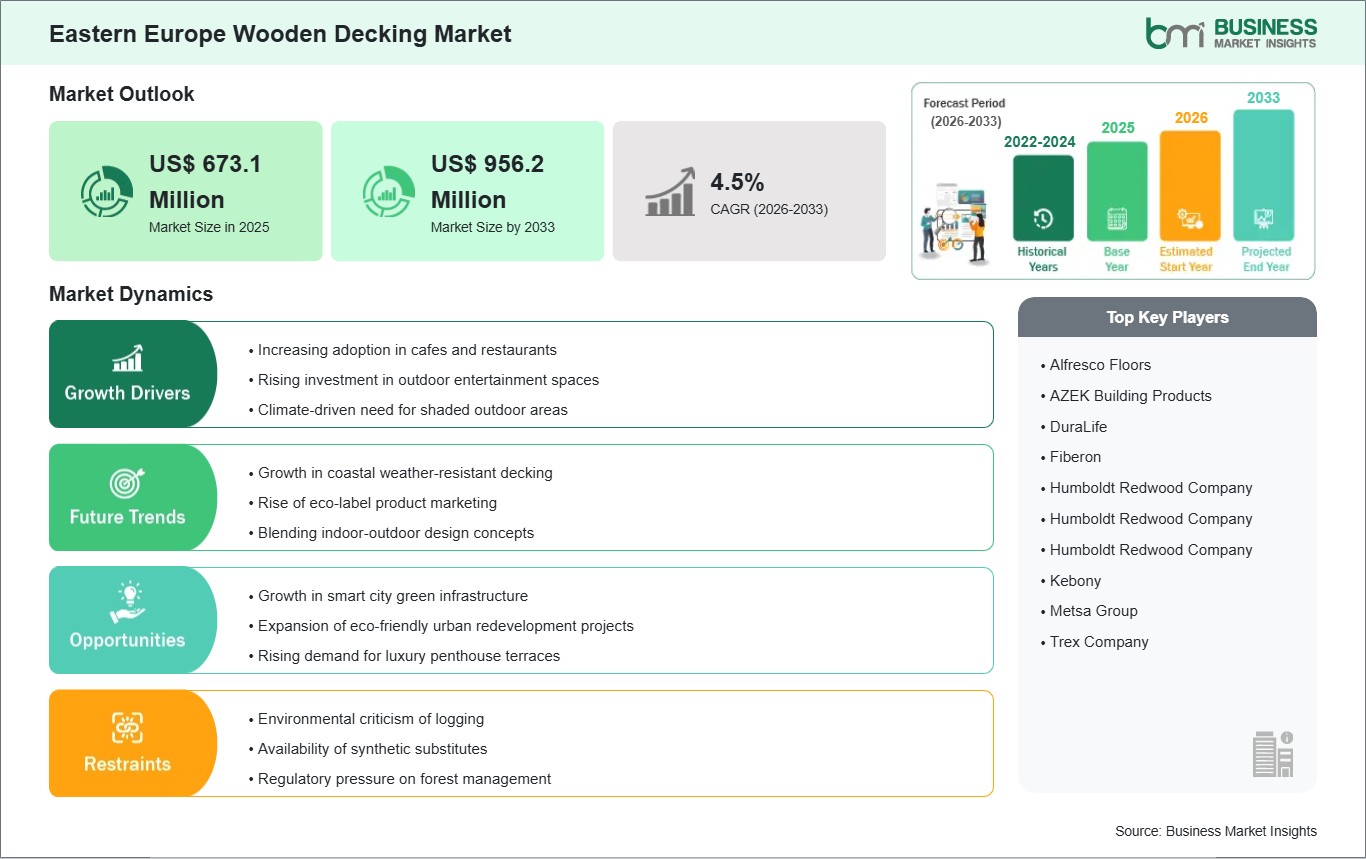
The Eastern Europe wooden decking market size is expected to reach US$ 956.2 million by 2033 from US$ 673.1 million in 2025. The market is estimated to record a CAGR of 4.5% from 2026 to 2033.
The market for wooden decking in Eastern Europe is expanding progressively on account of factors like the growing trend of residential construction, increasing expenditure in building hotels, and increased awareness of enhancing one’s outdoor living space. More countries in the region, such as Poland, Czech Republic, Hungary, Romania, and the Baltic states, are increasingly incorporating wood decks in residential gardens, suburban housing complexes, vacation cottages, and other leisure areas. This expansion of the market is also aided by the general preference for natural construction materials and the impact of Western European architectural trends. The construction of suburban neighborhoods and gated communities is a major factor driving the growth of this market. wooden decking has extensive applications within terraces, patios, balconies, and additions to gardens, thus making up an important part of construction in such residential zones. Another important contributor is the hotel industry where decking finds applications on account of the growing popularity of tourism and old historic cities. Additionally, increased renovation activities in old properties are likely to drive up demand for the product from existing homeowners. Nevertheless, certain limitations restrict the growth of the market within the forecast period. Seasonal weather conditions that include winter and excessive moisture may hamper the performance of wooden decking in certain cases. Issues of maintenance and durability further discourage customers from buying wooden boards. Besides, the fragmentation of the supply chain and lack of availability of quality treated timber within certain countries pose a challenge to the market in the region.

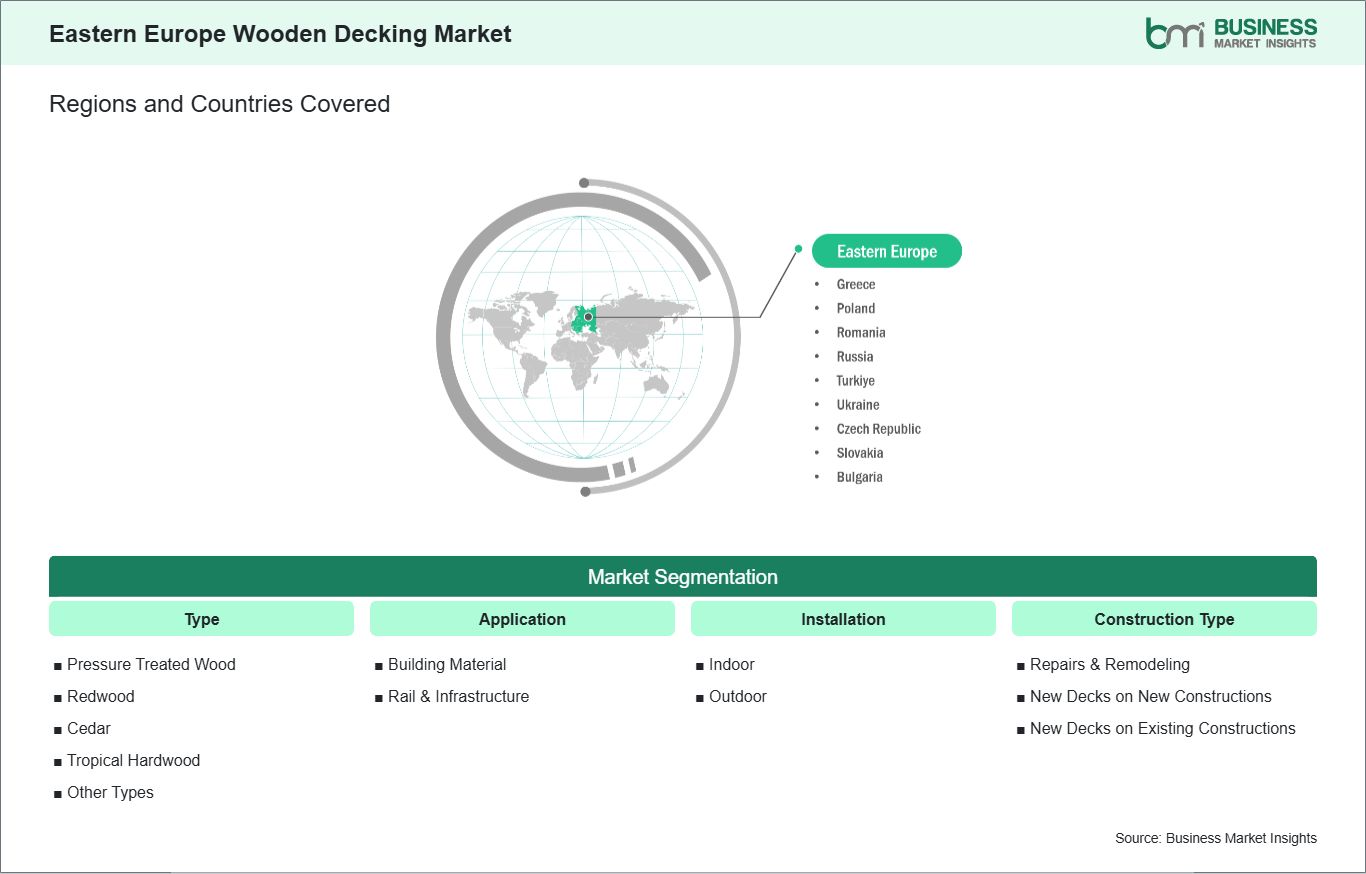
Key segments that contributed to the derivation of the Eastern Europe wooden decking market analysis are types, application, installation, construction type, and distribution channel.
There is an increasing demand for wooden decking from Eastern Europe owing to growing usage in cafes and restaurants and small commercial venues. There has been an increase in cultural movement towards outdoor dining in urban locations, including Poland, the Czech Republic, Hungary, and Romania, where restaurants are increasingly installing terrace tables. This is due to the use of wooden decking for their outdoor areas because of the cost-effectiveness and aesthetically pleasing nature of these products. According to estimates in Warsaw and Prague, more than 30% of mid-range restaurants have recently extended their outdoor seating spaces with wooden deckings.
Expansion of cafe culture within Eastern Europe is also playing a role in material selection practices. Food service operators that own small and medium-sized businesses are relying on the installation of decking solutions to provide themselves with differentiation opportunities and increase customer flows through their establishments during warm weather periods. Outdoor dining areas in heavily touristic places such as the riversides in Budapest or the historical city centers of Krakow tend to feature decks made of composite decking materials that have been designed to withstand the effects of humidity and temperature changes as well as heavy wear.
Supporting regulations and redevelopment efforts within urban spaces are further driving the implementation of decking as a structured seating solution for outdoor cafes and restaurants. Authorities throughout the region are making greater demands for proper organization of the area allocated for outdoor dining through the installation of safe and sustainable platforms that will provide sufficient comfort. Growing interest from tourists and leisure activities among residents of cities in the region are predicted to drive further growth within the market.
The evolution of smart city green infrastructure opens up a tremendous market prospect in the Eastern European wooden decking industry. Urban modernization campaigns that are being launched in the various countries within Eastern Europe have the purpose of enhancing environmental sustainability, transport, and recreation. Nations such as Poland, Estonia, and the Czech Republic are incorporating aspects such as green corridors, pedestrian zones, and eco parks into smart city concepts. wooden deckings are utilized extensively in such cities for various purposes such as footbridges, viewing stands, and outdoor public seats in various cities such as Tallinn and Warsaw.
Urban development projects supported by EU grants are becoming another driving force behind the rapid adoption of wooden decking. Urban infrastructure development projects funded by the Eastern European municipalities typically involve such tasks as park rehabilitation, riverbank revitalization, and increasing urban green areas. Being eco-friendly, aesthetically pleasing, and suitable for recycling, wooden decking is often used in such initiatives. The preference for composite decking prevails in highly frequented locations, which require durability, resistance to moisture, and vandal-proof properties. For instance, urban riverfront redevelopment projects involving Vistula River in Poland and Danube in Hungary tend to involve building boardwalks and recreational platforms made of wooden decking materials.
Moreover, technology plays a significant role in determining material choices as cities are turning towards implementing technological solutions within their urban development projects. As urbanization rates in Eastern Europe continue to increase, city administrators seek ways to ensure maintenance efficiency and reduce costs. In line with this idea, Eastern European cities prioritize engineered wood and composite wooden decking as they facilitate low-cost maintenance and comply with green construction practices. In this regard, further growth of urban areas and the expanding network of green infrastructure will likely boost the popularity of wooden decking.
The Eastern Europe wooden decking market is experiencing steady growth, with market size and share analysis reflecting evolving treatment preferences and competitive dynamics among key players. The report evaluates important subsegments categorized within types, application, installation, construction type, and distribution channel, highlighting their respective contributions to overall market performance.
By types, the pressure treated wood subsegment dominated the market in 2025, because it is highly affordable, durable, and resistant to moisture, termites, and decay, making it suitable for long-term outdoor use. Due to its low maintenance requirements and wide availability, homeowners and contractors prefer pressure-treated wood over other decking materials.
Based on application, the building material subsegment dominated the market in 2025 because wooden decking is extensively used in residential and commercial construction projects such as patios, balconies, gardens, and outdoor flooring. Due to increasing urbanization and rising investments in housing and infrastructure development, the demand for wooden decking as a building material continues to grow.
On the basis of installation, the outdoor subsegment dominated the market in 2025, because wooden decking is mainly designed for outdoor recreational and landscaping purposes. The consumers are increasingly focusing on outdoor living spaces, gardens, rooftop seating areas, and poolside decks, outdoor installation has witnessed significant demand globally.
In terms of construction type, the repairs and remodeling subsegment dominated the market in 2025, because many old decks require renovation, replacement, and maintenance over time. Due to the growing trend of home improvement and remodeling activities, especially in developed countries, consumers are investing more in upgrading existing outdoor structures instead of undertaking new construction projects.
By distribution channel, the indirect sales subsegment dominated the market in 2025, because manufacturers mainly distribute wooden decking products through wholesalers, dealers, and retail home improvement stores. Due to the wider market reach, better product accessibility, and convenience offered by indirect sales channels, contractors and customers prefer purchasing decking materials through established distributors.

| Report Attribute | Details |
|---|---|
| Market size in 2025 | US$ 673.1 Million |
| Market Size by 2033 | US$ 956.2 Million |
| CAGR (2026 - 2033) | 4.5% |
| Historical Data | 2022-2024 |
| Forecast period | 2026-2033 |
| Segments Covered | By Type
|
|
Regions and Countries Covered
| |
| Eastern Europe | Russia, Poland, Romania, Czech Republic, Greece, Ukraine, Slovakia, Bulgaria |
| Market leaders and key company profiles |
|
The "Eastern Europe Wooden Decking Market Size and Forecast (2022-2033)" report provides a detailed analysis of the market covering below areas:
The geographical scope of the Eastern Europe wooden decking market report is divided into: Russia, Poland, Romania, the Czech Republic, Ukraine, Romania, Greece, Slovakia, and Bulgaria. Russia held the largest share in 2025.
The largest market in Eastern Europe for wooden decking is Russia due to its large landmass, abundance of local timber, and rising demand for outdoor facilities around private residential premises. The demand for wooden decks is influenced by the rise of suburban residential construction, the popularity of dachas, and investments in vacation property. Wooden decking is common in private summer cottages, country houses, gardens, patios, and other recreational spaces around residential buildings, as people place significant importance on open-air living areas. An important growth driver for the industry includes the large number of forest resources available in Russia, providing an array of soft and hard wood sources that can be employed for creating decking. The presence of domestic timber enables the manufacturing of decking products, making their production cost-effective and reducing reliance on imported material. Furthermore, there is high demand for top-notch outdoor decking products within the luxury housing facilities, hotels, and restaurants situated in Moscow and St. Petersburg, where good landscape design is important. Another source of high demand for the product comes from the hospitality sector, especially in resort towns, lakesides, and recreational parks where decking products are installed for walkways, outdoor eating spaces, and lookout areas. The trend towards living in the country during certain seasons has ensured steady demand in private residences. However, Nevertheless, the Russian market is limited by extremely harsh climatic conditions, such as severe winters, freeze and thaw periods, as well as high levels of humidity fluctuations, all of which can be harmful for wood resistance and require more frequent repairs. Nevertheless, the Russian market is still the best market in the region due to availability of resources and well-developed culture of outdoor living.

The Eastern Europe wooden decking market is evaluated by gathering qualitative and quantitative data post primary and secondary research, which includes important corporate publications, association data, and databases. A few of the key developments in the Eastern Europe wooden decking market are:
The Eastern Europe Wooden Decking Market is valued at US$ 673.1 Million in 2025, it is projected to reach US$ 956.2 Million by 2033.
As per our report Eastern Europe Wooden Decking Market, the market size is valued at US$ 673.1 Million in 2025, projecting it to reach US$ 956.2 Million by 2033. This translates to a CAGR of approximately 4.5% during the forecast period.
The Eastern Europe Wooden Decking Market report typically cover these key segments-
The historic period, base year, and forecast period can vary slightly depending on the specific market research report. However, for the Eastern Europe Wooden Decking Market report:
The Eastern Europe Wooden Decking Market is populated by several key players, each contributing to its growth and innovation. Some of the major players include:
The Eastern Europe Wooden Decking Market report is valuable for diverse stakeholders, including:
Essentially, anyone involved in or considering involvement in the Eastern Europe Wooden Decking Market value chain can benefit from the information contained in a comprehensive market report.
Please tell us your area of interest
(Market Segments/ Regions and Countries/ Companies)