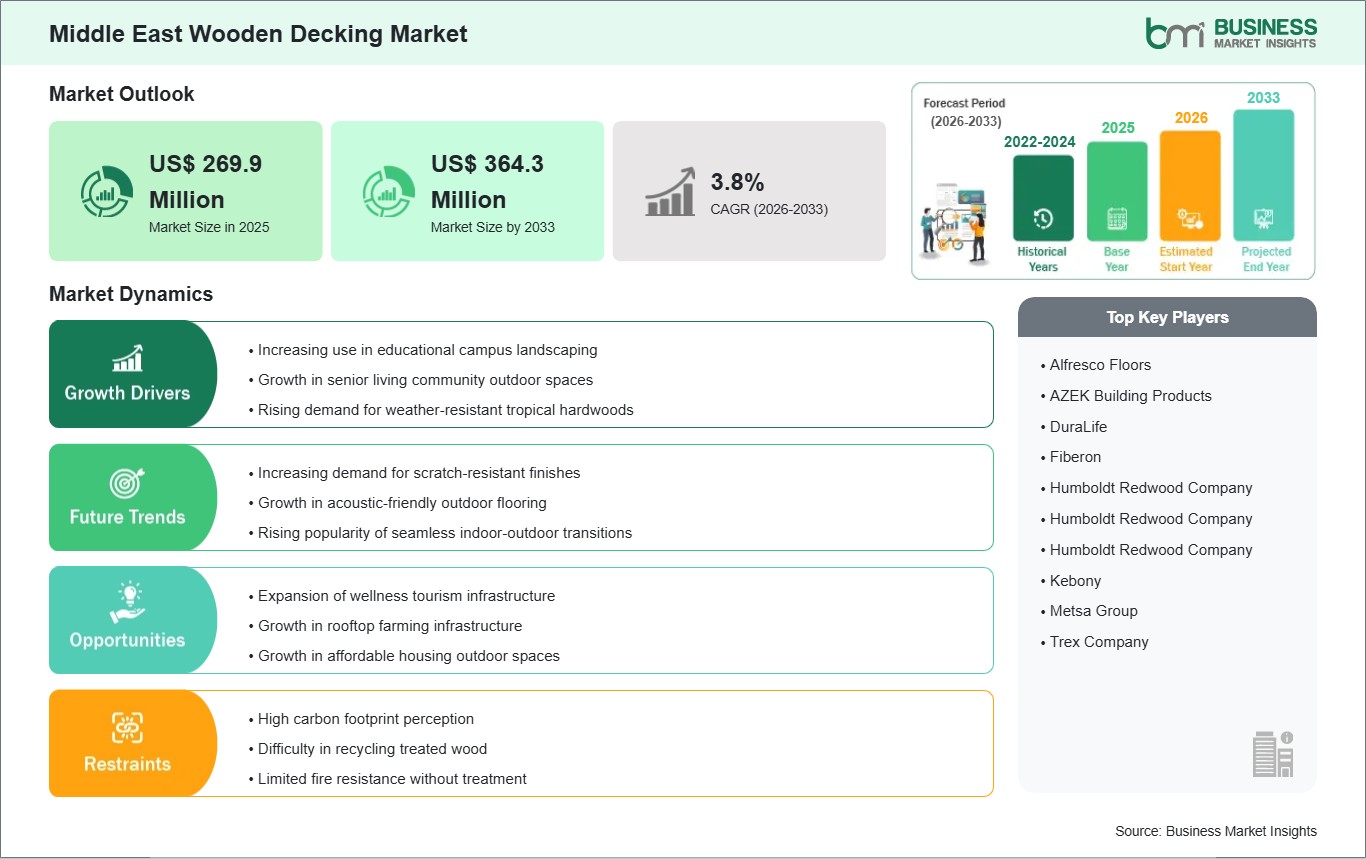
The Middle East wooden decking market size is expected to reach US$ 364.3 million by 2033 from US$ 269.9 million in 2025. The market is estimated to record a CAGR of 3.8% from 2026 to 2033.
The Middle East wooden decking industry is seeing changes driven by the region's move towards development based on lifestyle and diversity in tourism experiences, as well as massive experiential real estate projects. The application of wooden decking has grown to become an upscale material for outdoor design, which adds warmth and comfort to outdoor spaces where modern materials like stone, glass, and steel have come to dominate architecture. Applications now cover resorts, boardwalks, tourism destinations in deserts, premium residential estates, and commercial properties, where outdoor space is an essential experience rather than an addition. Another important factor affecting the market is the rapid development of the tourist and entertainment industry within the region. The emphasis made by governmental bodies and developers is put on the development of the open-air environment including beach resorts, marina complexes, cultural promenades, and entertainment centers, in which wood decks are widely used to create a comfortable and coherent outside environment. At the same time, the use of decking in the private sector is also gaining more popularity since the residents appreciate outside living space. Nevertheless, the environment plays an important role in the construction market. Intense heat, solar radiation, sand erosion, and drought create a need for frequent repair and maintenance. Treated or specially manufactured wood tends to be used more often in such cases due to the lack of resistance of untreated timber to such environmental conditions. Cost restrictions can play a limiting role in the case of some market niches.

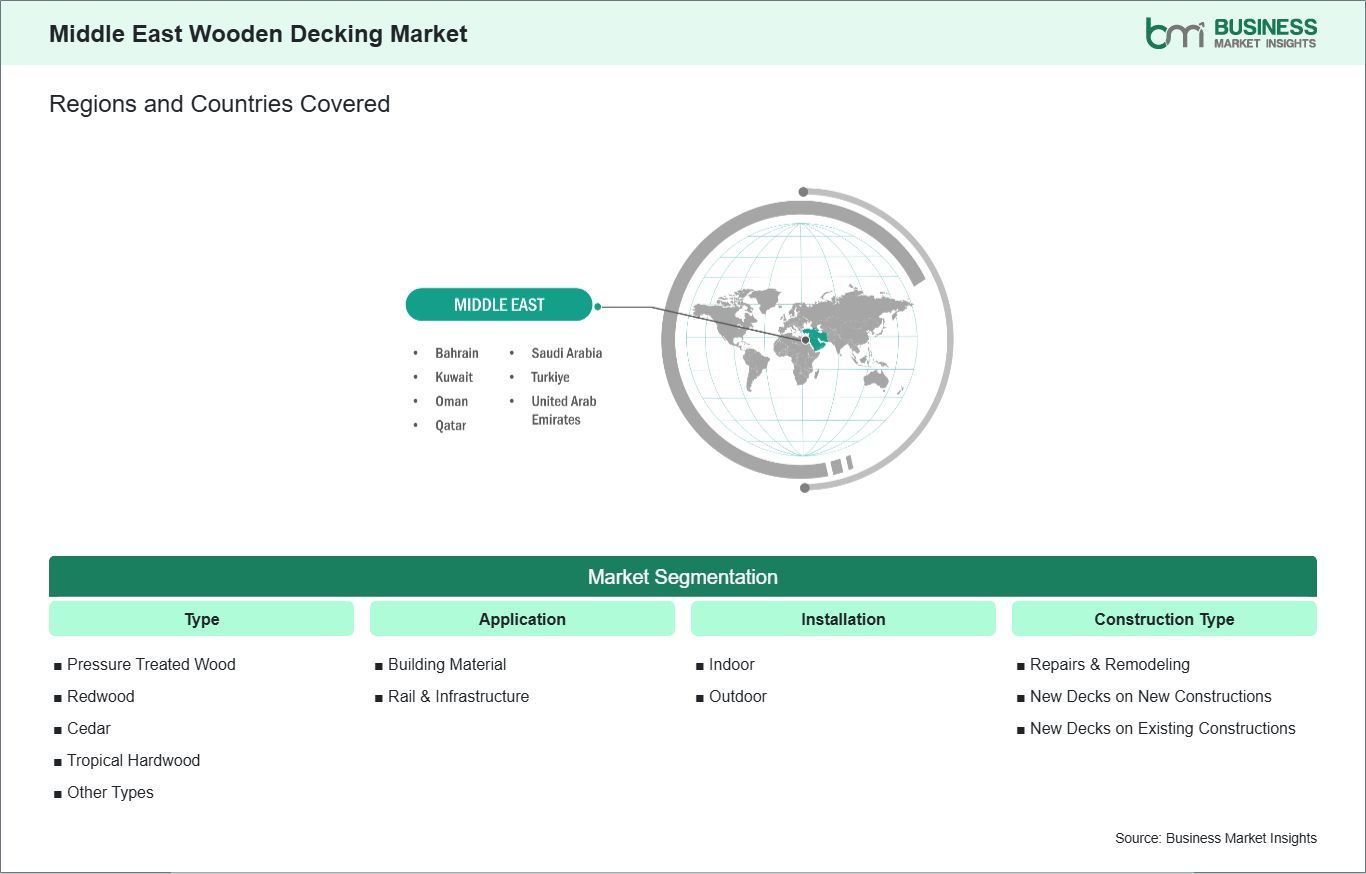
Key segments that contributed to the derivation of the Middle East wooden decking market analysis are types, application, installation, construction type, and distribution channel.
Rising demands for wooden deckings in the Middle East region have been seen owing to the increasing applications of decking material in educational campus landscaping. University, college, and international schools in countries like UAE, Saudi Arabia, Qatar, and Oman have invested considerably in developing modern campus facilities that facilitate outdoor learning and overall student welfare. Decking materials have been widely applied on campus courtyards, amphitheater areas, shaded walkways, and outdoor study areas to make them functional and attractive at the same time. For example, in the UAE, leading academic centers in Dubai Knowledge Park and Abu Dhabi have been using composite deckings in their outdoor landscaped facilities.
Additionally, the continuous building of educational infrastructures through long-term development initiatives within Saudi Arabia has further been propelling the market. Modern educational institutions such as universities are being developed with extensive greenery, pedestrian paths, and outdoor collaboration centers. Such facilities often need robust decking material that is resistant to harsh weather conditions such as intense heat and dust. Engineered woods and composite decking materials are favored here owing to their thermal stability, slip-resistance, and extended durability. In this region, annual growth rates within the range of 8%-10% have been observed in landscaping within campuses in the Gulf.
Another way in which the concept is gaining momentum is from private international schools and higher educational institutions by incorporating the principles of global campus designs that favor the outdoors. Landscape architecture designs from North America and Europe have been incorporated into Middle Eastern campuses through the use of wooden structures that offer shade and can be used as seating areas for events and informal socialization. The element of sustainability is also playing an increasingly vital role, with educational institutions preferring certified materials in line with national guidelines like Estidama and QSAS.
The development of wellness tourism infrastructure facilities in the region, the Middle East wooden decking market can capitalize on its potential to become one of the world leaders of wellness tourism. Wellness tourism infrastructure is being developed in the United Arab Emirates, Saudi Arabia, and Oman with an investment in facilities combining nature elements, luxury hotels, and therapeutic surroundings. Wooden decking is commonly used at facilities for spa decks, meditative spaces, yoga stations, relaxation areas by the sea, and trails in nature. The key examples of wellness destinations utilizing wooden decking are the Red Sea project in Saudi Arabia and wellness resorts in Ras Al Khaimah and coastal Oman.
The hospitality and tourism industry is an important factor contributing to the development of this trend, because luxury resorts are beginning to adopt a trend toward wellness-focused outdoor architecture. The resorts in such countries as Dubai, Abu Dhabi, and Doha have begun building luxurious spa areas where the wooden decks surround the pools and other treatment areas. This type of construction requires materials that would withstand tough climatic conditions, yet would still look beautiful. One of the most popular types of materials used are the engineered wood products and composite decking materials, which have high resistance to the UV rays, humidity, and salt air.
The push towards sustainability and experience-based tourism is adding to the increasing adoption. The governments are now planning wellness tourism projects in coordination with environmental protection policies, promoting the use of sustainable building materials that can be recycled. Increasingly, developers are opting for certified woods, as well as composite deckings that contain recycled material, in order to qualify for certifications like LEED and Estidama. In light of the growing significance of wellness tourism as one of the main pillars of economic diversification in the Middle East region, wooden decking is bound to become increasingly popular.

The Middle East wooden decking market is experiencing steady growth, with market size and share analysis reflecting evolving treatment preferences and competitive dynamics among key players. The report evaluates important subsegments categorized within types, application, installation, construction type, and distribution channel, highlighting their respective contributions to overall market performance.
By types, the pressure treated wood subsegment dominated the market in 2025, because it is highly affordable, durable, and resistant to moisture, termites, and decay, making it suitable for long-term outdoor use. Due to its low maintenance requirements and wide availability, homeowners and contractors prefer pressure-treated wood over other decking materials.
Based on application, the building material subsegment dominated the market in 2025 because wooden decking is extensively used in residential and commercial construction projects such as patios, balconies, gardens, and outdoor flooring. Due to increasing urbanization and rising investments in housing and infrastructure development, the demand for wooden decking as a building material continues to grow.
On the basis of installation, the outdoor subsegment dominated the market in 2025, because wooden decking is mainly designed for outdoor recreational and landscaping purposes. The consumers are increasingly focusing on outdoor living spaces, gardens, rooftop seating areas, and poolside decks, outdoor installation has witnessed significant demand globally.
In terms of construction type, the repairs and remodeling subsegment dominated the market in 2025, because many old decks require renovation, replacement, and maintenance over time. Due to the growing trend of home improvement and remodeling activities, especially in developed countries, consumers are investing more in upgrading existing outdoor structures instead of undertaking new construction projects.
By distribution channel, the indirect sales subsegment dominated the market in 2025, because manufacturers mainly distribute wooden decking products through wholesalers, dealers, and retail home improvement stores. Due to the wider market reach, better product accessibility, and convenience offered by indirect sales channels, contractors and customers prefer purchasing decking materials through established distributors.
| Report Attribute | Details |
|---|---|
| Market size in 2025 | US$ 269.9 Million |
| Market Size by 2033 | US$ 364.3 Million |
| CAGR (2026 - 2033) | 3.8% |
| Historical Data | 2022-2024 |
| Forecast period | 2026-2033 |
| Segments Covered | By Type
|
|
Regions and Countries Covered
| |
| Middle East | UAE, Saudi Arabia, Bahrain, Oman, Kuwait, Qatar, Turkiye |
| Market leaders and key company profiles |
|
The "Middle East Wooden Decking Market Size and Forecast (2022-2033)" report provides a detailed analysis of the market covering below areas:
The geographical scope of the Middle East wooden decking market report is divided into: the UAE, Saudi Arabia, Bahrain, Oman, Kuwait, Qatar, and Turkiye. Turkiye held the largest share in 2025.
Turkiye enjoys a prominent place in the Middle East wooden decking market due to the dual nature of its geographical location, which includes tourism in the Mediterranean region along with extensive construction and wood processing industry. Turkiye functions not only as an important consumer center but also an equally significant supplier center because the use of wooden decking is dictated by tourism, residential, and hospitality infrastructural developments on its coastlines. Areas like Antalya, Bodrum, Izmir, and Istanbul coastal areas are some of the consumption centers where wooden decking plays a vital role in various beachside resorts, marinas, and hotel terraces. wooden decking is preferred for its natural blending with picturesque settings and premium appearance in hospitality infrastructural development. In beach resorts, wooden decking is installed at swimming pools and leisure walkways. The demand for urban housing is on the rise especially in gated and high-end villas where outdoor areas become an essential design consideration for real estate. Decking has increasingly been incorporated into gardens, balconies, terraces, and private patios in property design to create added value in line with consumer demands. Turkiye's advantage is its relatively established timber processing industries, which manufacture treated wood and engineered decking, along with the export market for outdoor building material products. However, there is the issue of humidity and low temperatures that affect wooden decking in the region. Even with this limitation, Turkiye continues to remain the dominant country in the region because of its tourist-driven economy and the use of outdoor architecture in modern constructions.

The Middle East wooden decking market is evaluated by gathering qualitative and quantitative data post primary and secondary research, which includes important corporate publications, association data, and databases. A few of the key developments in the Middle East wooden decking market are:
The Middle East Wooden Decking Market is valued at US$ 269.9 Million in 2025, it is projected to reach US$ 364.3 Million by 2033.
As per our report Middle East Wooden Decking Market, the market size is valued at US$ 269.9 Million in 2025, projecting it to reach US$ 364.3 Million by 2033. This translates to a CAGR of approximately 3.8% during the forecast period.
The Middle East Wooden Decking Market report typically cover these key segments-
The historic period, base year, and forecast period can vary slightly depending on the specific market research report. However, for the Middle East Wooden Decking Market report:
The Middle East Wooden Decking Market is populated by several key players, each contributing to its growth and innovation. Some of the major players include:
The Middle East Wooden Decking Market report is valuable for diverse stakeholders, including:
Essentially, anyone involved in or considering involvement in the Middle East Wooden Decking Market value chain can benefit from the information contained in a comprehensive market report.
Please tell us your area of interest
(Market Segments/ Regions and Countries/ Companies)