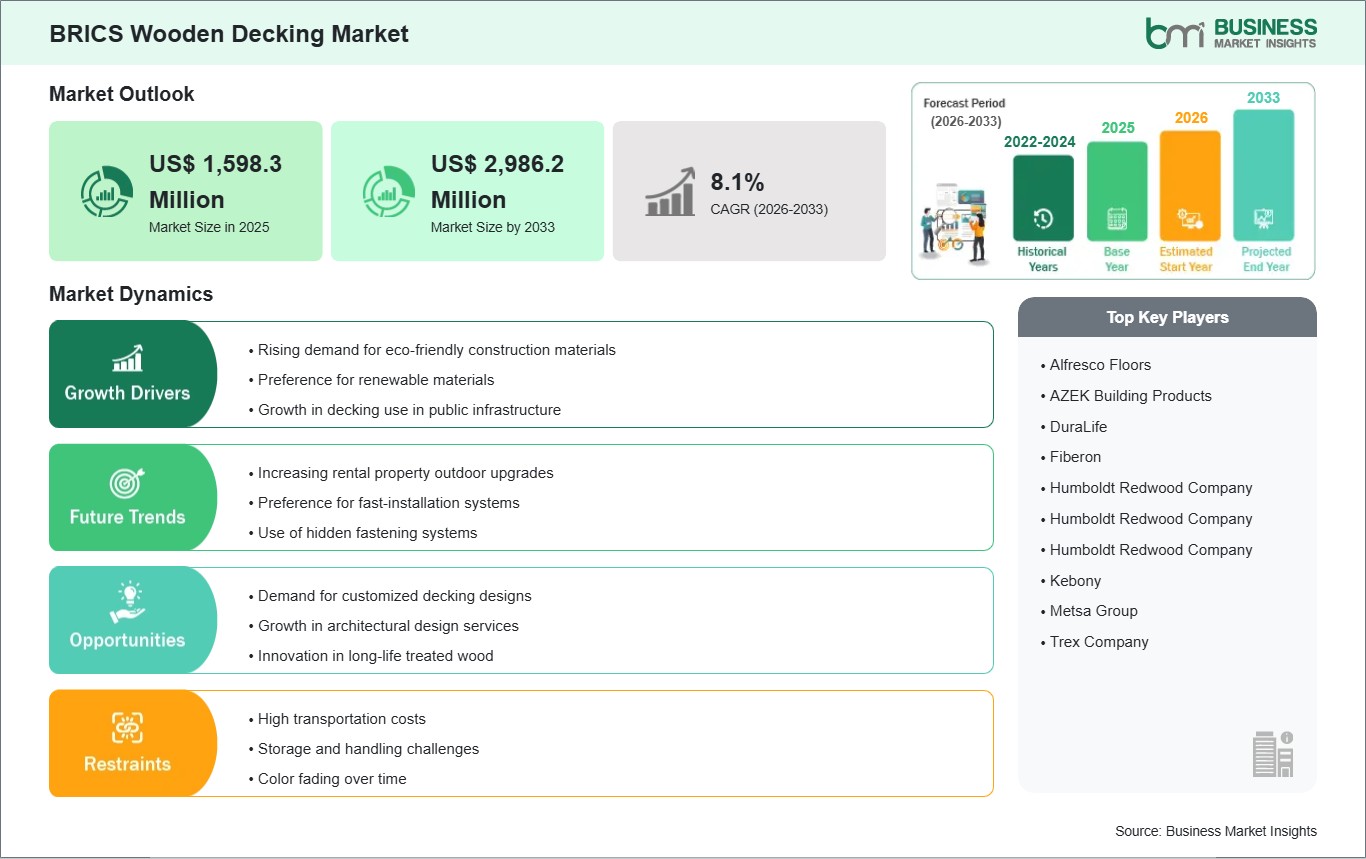
The BRICS wooden decking market size is expected to reach US$ 2,986.2 million by 2033 from US$ 1,598.3 million in 2025. The market is estimated to record a CAGR of 8.1% from 2026 to 2033.
The wooden decking industry in BRICS countries is driven by the combination of various elements, including urbanization, tourism developments, and changing attitudes towards outdoor living experiences. The overall demand for wooden decking materials is driven by the infrastructure development in new cities, investment in hospitality and leisure properties, and the growing focus on design-driven architecture, where outdoor spaces are considered a continuation of indoor areas. In this regard, the material finds its applications in a number of spheres, from residential communities and resort properties to water areas and commercial hospitality environments. The importance of outdoor-oriented projects in BRICS countries is another major factor driving development in this market, especially with regard to tourism and premium housing segments. Beaches, resorts, eco-tourism facilities, and city leisure centers are beginning to incorporate wooden decks into their walkways, poolsides, rooftops, and landscape areas to make their facilities more visually appealing and functional. In addition, growing middle classes in some of the BRICS nations are fostering greater need for outdoor enhancements like terraces, balconies, and garden decks in residential settings. There is some variation in terms of manufacturing capacity and materials, but overall, there exists an adequate supply chain, which can offer both budget and premium wood decks to the consumers. Moreover, there are some sustainability issues that have been attracting more focus among consumers and businesses alike. Despite all of the above, the industry still faces certain challenges such as climate inconsistency, which is not the same for all regions; high maintenance requirements for natural wood; and competition from composite substitutes, which can last much longer and require little maintenance compared to natural wood. However, the demand in BRICS wooden decking persists and the industry continues growing because of urbanization and tourism development.

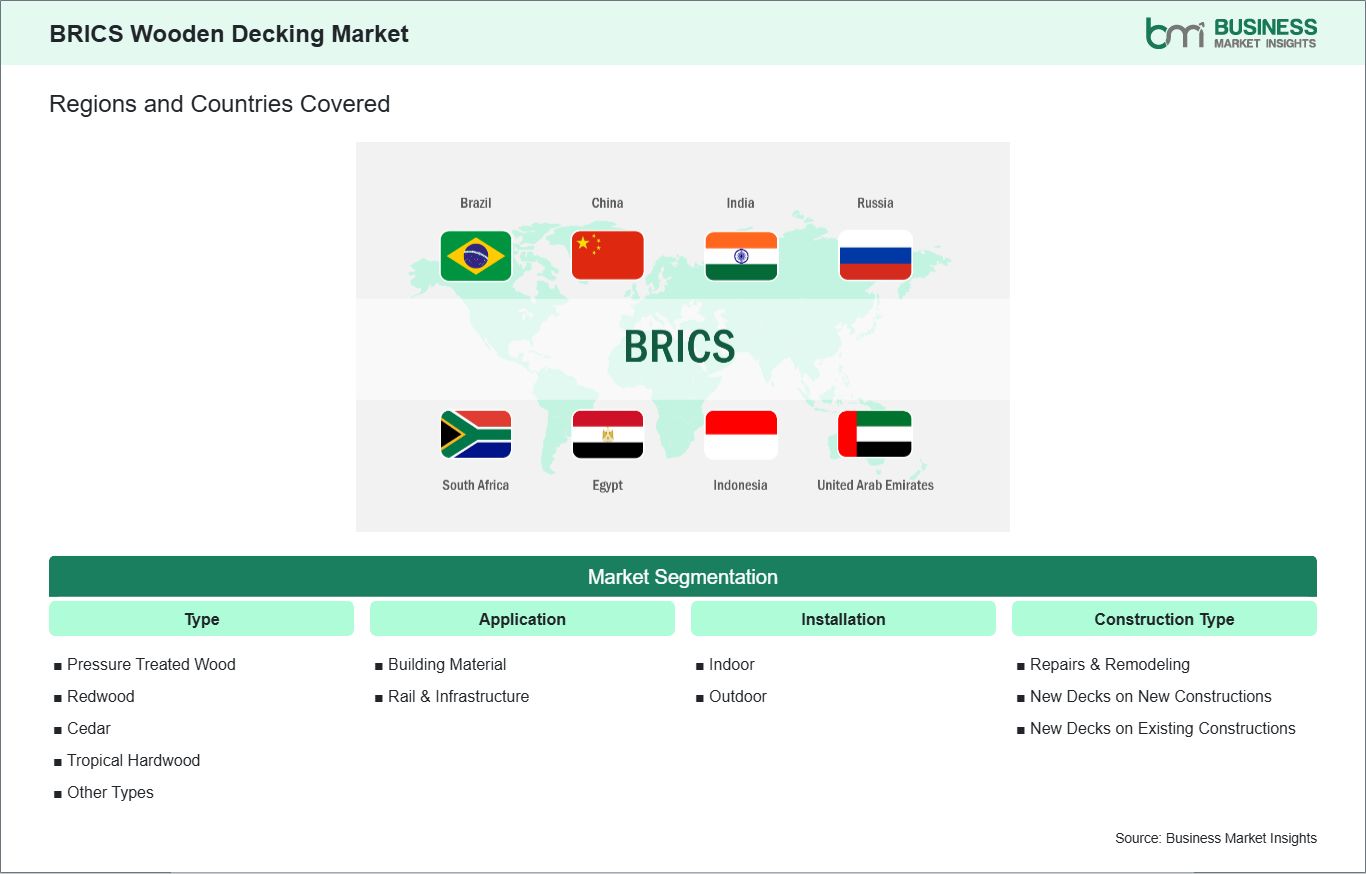
Key segments that contributed to the derivation of the BRICS wooden decking market analysis are types, application, installation, construction type, and distribution channel.
The wooden decking sector in the BRICS nations, which includes Brazil, Russia, India, China, and South Africa, is significantly influenced by the growing demand for environmentally friendly building materials. The factors like rapid urbanization, large-scale infrastructure development, and stringent regulations on emissions have forced the building industry to abandon traditional building materials that emit carbon in favor of sustainable materials like engineered wood and composite decking. In China and India, there is an increased push towards green buildings by the governments through mandatory codes, which favor the use of low emission and recyclable wood products for commercial and residential purposes.
In Brazil and South Africa, environmental concerns as well as the pressure of deforestation will impact on material preferences. For instance, Brazil's redevelopment projects in cities such as Sao Paulo and Rio de Janeiro have started using plantation timber and composite decking materials in order to decrease dependence on Amazon sourced hardwood materials. Similarly, FSC certified wood and composite decking systems are becoming increasingly popular in South African eco-friendly tourism and housing industry. The adoption rate of eco-friendly materials in the building industry in all BRICS nations is expected to increase at a rate of 7-9% per year.
This trend is being fueled by industrialization and manufacturing within each country, which enables a larger availability of eco-friendly decking solutions. China and India have increased the production rates of engineered wood materials, enabling affordable sustainable materials. This will lead to decreased costs, and enable eco-friendly decking solutions to be available not only to wealthy individuals, but also mid-income customers.
The emergence of customized deck styles offers substantial potential in the wood deck industry in the BRICS countries, based on changes in architectural trends and increased spending on top-class homes and commercial premises. The consumer base in these countries is moving towards customized outdoor areas in keeping with varied aesthetic styles, needs, and influences. Chinese and Indian architects and developers are designing custom-made deck areas for terraces, gardens, and roof decks in luxury residential buildings and villas, where wood is combined with other materials such as stone, metals, and glass.
Moreover, similar trends are evident among Brazilian and South African markets, where increasing demand for custom-made decking is seen among hospitality and leisure projects. Brazilian coastal regions feature numerous beach resorts and eco-lodges adopting custom-designed decking solutions that would accommodate the challenging topography and climatic conditions of the country. Similarly, South African projects like safari lodges and boutique hotels invest in custom-designed elevated decking constructions that serve as viewing platforms, outdoor dining decks, and entertainment spaces. Designing such decks requires adaptable engineering capabilities to ensure durability and aesthetics despite the environmental challenges.
The use of new design technologies, including software, computerized numeric control machining techniques, and modular deck construction techniques, allows suppliers to respond to this trend. Modern manufacturers provide customers in BRICS countries with modular composite decking kits and customizable substructure designs that allow for easy assembly while ensuring a high level of adaptability of projects. With the development of digital technologies and three-dimensional visualizations, the use of decking systems is becoming even more popular because of the ability to simulate custom solutions prior to installation. Thus, customized decking solutions will likely become an integral part of the wooden decking segment in BRICS countries.
The BRICS wooden decking market is experiencing steady growth, with market size and share analysis reflecting evolving treatment preferences and competitive dynamics among key players. The report evaluates important subsegments categorized within types, application, installation, construction type, and distribution channel, highlighting their respective contributions to overall market performance.
By types, the pressure treated wood subsegment dominated the market in 2025, because it is highly affordable, durable, and resistant to moisture, termites, and decay, making it suitable for long-term outdoor use. Due to its low maintenance requirements and wide availability, homeowners and contractors prefer pressure-treated wood over other decking materials.
Based on application, the building material subsegment dominated the market in 2025 because wooden decking is extensively used in residential and commercial construction projects such as patios, balconies, gardens, and outdoor flooring. Due to increasing urbanization and rising investments in housing and infrastructure development, the demand for wooden decking as a building material continues to grow.
On the basis of installation, the outdoor subsegment dominated the market in 2025, because wooden decking is mainly designed for outdoor recreational and landscaping purposes. The consumers are increasingly focusing on outdoor living spaces, gardens, rooftop seating areas, and poolside decks, outdoor installation has witnessed significant demand globally.
In terms of construction type, the repairs and remodeling subsegment dominated the market in 2025, because many old decks require renovation, replacement, and maintenance over time. Due to the growing trend of home improvement and remodeling activities, especially in developed countries, consumers are investing more in upgrading existing outdoor structures instead of undertaking new construction projects.
By distribution channel, the indirect sales wood subsegment dominated the market in 2025, because manufacturers mainly distribute wooden decking products through wholesalers, dealers, and retail home improvement stores. Due to the wider market reach, better product accessibility, and convenience offered by indirect sales channels, contractors and customers prefer purchasing decking materials through established distributors.

| Report Attribute | Details |
|---|---|
| Market size in 2025 | US$ 1,598.3 Million |
| Market Size by 2033 | US$ 2,986.2 Million |
| CAGR (2026 - 2033) | 8.1% |
| Historical Data | 2022-2024 |
| Forecast period | 2026-2033 |
| Segments Covered | By Type
|
|
Regions and Countries Covered
| |
| BRICS | Russia, Brazil, South Africa, India, China, Egypt, Indonesia, Saudi Arabia, United Arab Emirates |
| Market leaders and key company profiles |
|
The "BRICS Wooden Decking Market Size and Forecast (2022-2033)" report provides a detailed analysis of the market covering below areas:
The geographical scope of the BRICS wooden decking market report is divided into: Russia, Brazil, South Africa, India, China, Egypt, Indonesia, Saudi Arabia, and the UAE. China held the largest share in 2025.
The leading position occupied by China in the BRICS market of wooden decking is mainly due to the enormous scale of city building works and the great attention paid to the concept of development in combination with the landscape. The highest demand is found in prosperous coastal and metropolitan areas, where dense concentration of population and high living standards determine new trends in outdoor designs. The main cities consuming wooden decking includes Shanghai, Shenzhen, Guangzhou, Beijing, and Hangzhou. In terms of deck installations, they are strongly related to the construction of leisure-related infrastructure projects within coastal and tourism-focused provinces. More frequently, decking installation becomes a crucial part of various projects aimed at resort area development, creation of tourist islands, and waterfront areas development. All these applications emphasize the importance of creating a better experience for visitors through incorporating natural materials in outdoor spaces. The presence of local manufacture capabilities within China is one of the key structural strengths of this market. The presence of advanced capabilities in processing wood materials provides companies with opportunities to produce large amounts of timber, wood composite materials, and treated decking products. Moreover, it makes production highly cost-effective while also allowing a great variety of applications to be covered from massive infrastructure construction to high-quality individual developments. Overall, China remains a central force in the BRICS wooden decking market due to its construction scale, policy-driven urban greening initiatives, and expanding demand for premium outdoor lifestyle infrastructure.

The BRICS wooden decking market is evaluated by gathering qualitative and quantitative data post primary and secondary research, which includes important corporate publications, association data, and databases. A few of the key developments in the BRICS wooden decking market are:
The BRICS Wooden Decking Market is valued at US$ 1,598.3 Million in 2025, it is projected to reach US$ 2,986.2 Million by 2033.
As per our report BRICS Wooden Decking Market, the market size is valued at US$ 1,598.3 Million in 2025, projecting it to reach US$ 2,986.2 Million by 2033. This translates to a CAGR of approximately 8.1% during the forecast period.
The BRICS Wooden Decking Market report typically cover these key segments-
The historic period, base year, and forecast period can vary slightly depending on the specific market research report. However, for the BRICS Wooden Decking Market report:
The BRICS Wooden Decking Market is populated by several key players, each contributing to its growth and innovation. Some of the major players include:
The BRICS Wooden Decking Market report is valuable for diverse stakeholders, including:
Essentially, anyone involved in or considering involvement in the BRICS Wooden Decking Market value chain can benefit from the information contained in a comprehensive market report.
Please tell us your area of interest
(Market Segments/ Regions and Countries/ Companies)