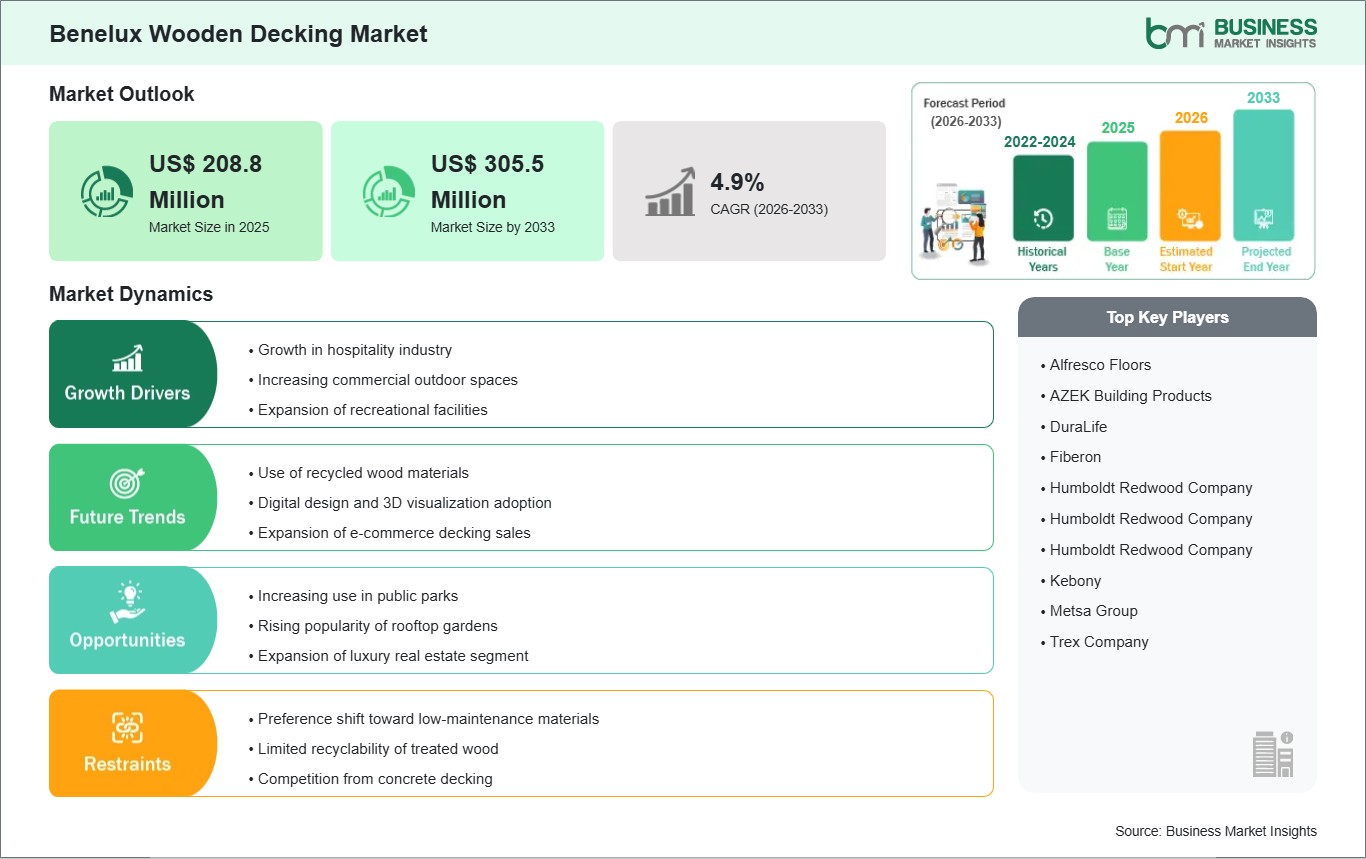
The Benelux wooden decking market size is expected to reach US$ 305.5 million by 2033 from US$ 208.8 million in 2025. The market is estimated to record a CAGR of 4.9% from 2026 to 2033.
There is steady growth in the market for wood decks in Benelux, which is being driven by the rising demand for quality outdoor facilities, eco-friendly construction materials, and the trend toward developing cities according to the principles of landscaping. In Belgium, the Netherlands, and Luxembourg, there is a growing demand for wooden decking as part of outdoor living areas such as residential gardens, rooftop terraces, hotels, waterfront constructions, and commercial entertainment areas. There is rising preference among people for more stylish and eco-friendly outdoor spaces, thus driving the demand for wood deck solutions. One of the key drivers of the wooden decking market in Benelux is the growing focus on green and eco-friendly construction within this region. Due to government policies favoring sustainable and low-carbon construction options, the use of certified wood products in outdoor construction projects is becoming increasingly widespread among architects and property owners. Urban gardening initiatives, canal-side recreational zones, and other multifunctional outdoor facilities have also fueled the need for weather-resistant wood decks. Additionally, the hospitality and commerce industries are making a notable contribution to the development of the market. The use of wooden decks is becoming popular in restaurants, hotels, cafes, and mixed developments. This is particularly true of dense urban settings. Furthermore, with the increase in home renovations and changes in the way people live their residential lives, there is an increased demand for the installation of wooden decks within domestic environments.

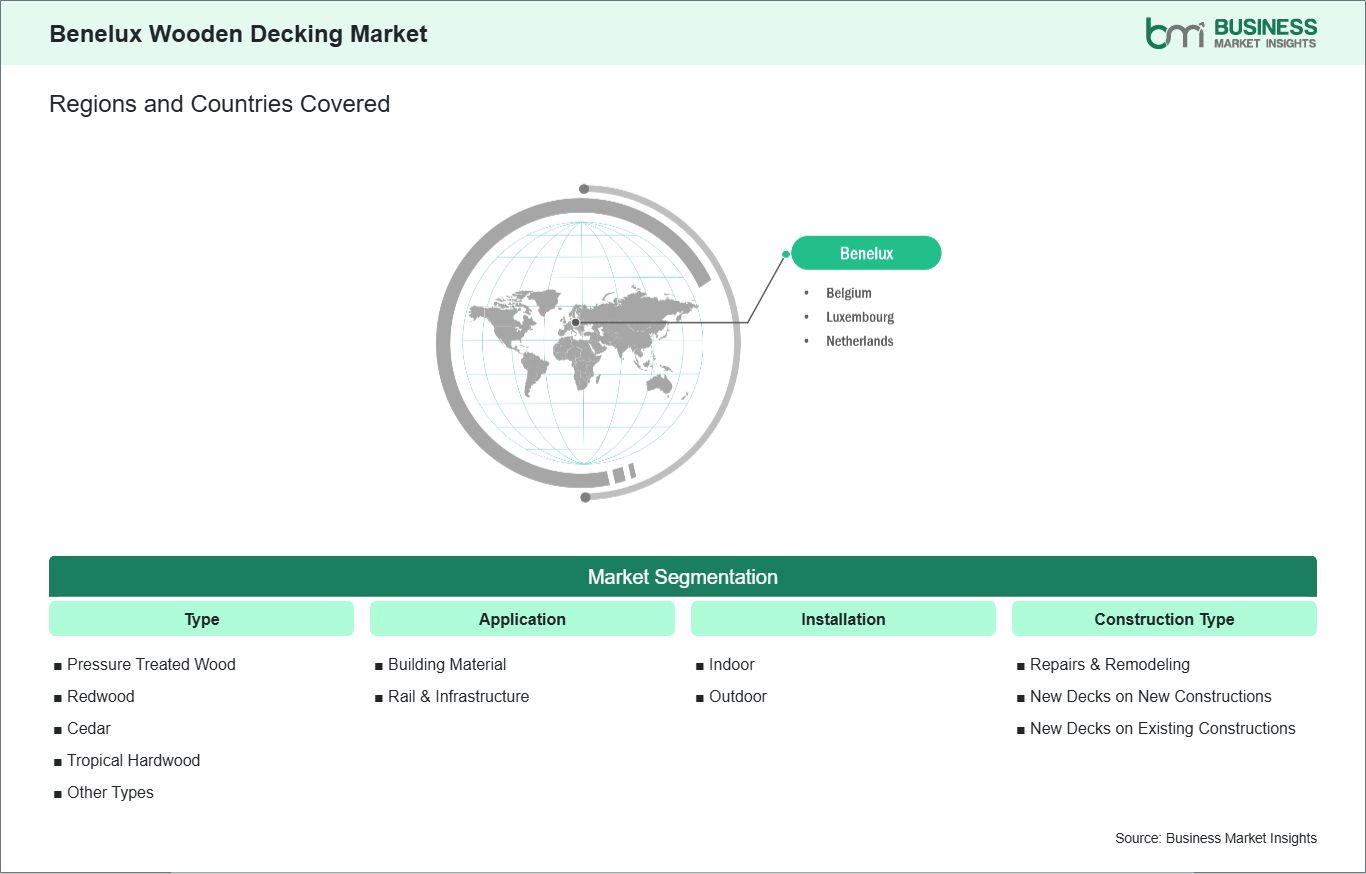
Key segments that contributed to the derivation of the Benelux wooden decking market analysis are types, application, installation, construction type, and distribution channel.
There is an improvement being witnessed in terms of Benelux wooden decking demand due to the growth of the hospitality industry in Belgium, the Netherlands, and Luxembourg. The increase in tourism, urban recreation spending, and investments in luxury accommodations is resulting in the use of wooden decking in hospitality sectors such as hotels and resorts, rooftop bars, and dining venues overlooking waterfronts. In the Netherlands, it has been noted that hoteliers and restaurateurs have been incorporating outdoor recreational areas in their design concepts, especially when seeking to enhance their operations and increase commercial space usage. Engineered wood and composite decks are favored since they are durable and low-maintenance, especially in wet environments.Outdoor renovation expenditures of the hospitality industry within the Benelux region have been rising steadily for the last several years.
The development of Belgium's cafe culture and Luxembourg's luxury hospitality market is also boosting the need for decks that are not only functional but also aesthetically pleasing. The hospitality businesses across the region are building their restaurants, hotels, and entertainment facilities with open terraces, sitting areas, and rooftop decks, which require the use of weather-resistant decking boards. Major urban centers like Amsterdam, Brussels, Antwerp, and Luxembourg are witnessing a flurry of re-development activities in their commercial complexes in which sustainable landscape architecture is being integrated into the hospitality structure.
Environmental awareness and design innovations are continuously driving buying behavior patterns in the regional hospitality industry. The developers of the hospitality business are showing interest in wood deck material options that have been certified by the FSC and that can be recycled. Moreover, new designs of wood deck materials, including slip-resistant surfaces and concealed fasteners, have been well received by architects and designers. This means that regional suppliers are launching premium outdoor decking materials, thus creating opportunities for the Benelux wooden decking market.
The growing adoption of wooden decks in public parks and recreational settings constitutes a significant source of growth for the Benelux wooden decking market. The governments in the Benelux countries have been making considerable investments in green infrastructure to enhance environmental sustainability and welfare. Wooden decks are increasingly being used on pedestrian pathways, waterfront walkways, cycle rest stops, viewing platforms, and recreational seats. In the Netherlands, climate-resilient urban projects often incorporate composite wooden decks near waterways and flood plains because of the deck's resistance to moisture and long-lasting nature.
Investment in public recreational facilities has increased in Belgium as well, due to the development of urban renewal programs and eco-friendly recreational spaces. Redevelopment schemes in Brussels, Ghent, and Antwerp have included parks and community areas with wooden decks installed in them for aesthetic improvement and convenience. The use of composite decking materials is encouraged in public infrastructure projects since they provide excellent resistance against water and mold damage, and can be easily maintained without requiring regular replacements. This trend of incorporating decking materials in public construction is being reinforced with the development of sustainability policies in the Benelux countries.
Moreover, tourism, cycling culture, and waterfront renovation projects make the Benelux nations a lucrative target market for producers of composite decking materials. For instance, Luxembourg and several Dutch municipalities have been focusing on building tourist spots that feature boardwalks, viewing decks, and eco-friendly walking paths made from durable and sustainable decking material. In response, manufacturers have developed decking materials with features like anti-slip, vandalism-proof, and recyclability which are particularly useful in public infrastructure projects. Given the increasing emphasis on sustainable urban mobility and city planning within Benelux governments, wooden decking should find an increased application in public spaces.

The Benelux wooden decking marketis experiencing steady growth, with market size and share analysis reflecting evolving treatment preferences and competitive dynamics among key players. The report evaluates important subsegments categorized within types, application, installation, construction type, and distribution channel, highlighting their respective contributions to overall market performance.
By types, the pressure-treated wood subsegment dominated the market in 2025, because it is highly affordable, durable, and resistant to moisture, termites, and decay, making it suitable for long-term outdoor use. Due to its low maintenance requirements and wide availability, homeowners and contractors prefer pressure-treated wood over other decking materials.
Based on application, the building material subsegment dominated the market in 2025 because wooden decking is extensively used in residential and commercial construction projects such as patios, balconies, gardens, and outdoor flooring. Due to increasing urbanization and rising investments in housing and infrastructure development, the demand for wooden decking as a building material continues to grow.
On the basis of installation, the outdoor subsegment dominated the market in 2025, because wooden decking is mainly designed for outdoor recreational and landscaping purposes. The consumers are increasingly focusing on outdoor living spaces, gardens, rooftop seating areas, and poolside decks, outdoor installation has witnessed significant demand globally.
In terms of construction type, the repairs and remodeling subsegment dominated the market in 2025, because many old decks require renovation, replacement, and maintenance over time. Due to the growing trend of home improvement and remodeling activities, especially in developed countries, consumers are investing more in upgrading existing outdoor structures instead of undertaking new construction projects.
By distribution channel, the indirect sales subsegment dominated the market in 2025, because manufacturers mainly distribute wooden decking products through wholesalers, dealers, and retail home improvement stores. Due to the wider market reach, better product accessibility, and convenience offered by indirect sales channels, contractors and customers prefer purchasing decking materials through established distributors.
| Report Attribute | Details |
|---|---|
| Market size in 2025 | US$ 208.8 Million |
| Market Size by 2033 | US$ 305.5 Million |
| CAGR (2026 - 2033) | 4.9% |
| Historical Data | 2022-2024 |
| Forecast period | 2026-2033 |
| Segments Covered | By Type
|
|
Regions and Countries Covered
| |
| Benelux | Belgium, Netherlands, Luxembourg |
| Market leaders and key company profiles |
|
The "Benelux Wooden Decking Market Size and Forecast (2022-2033)" report provides a detailed analysis of the market covering below areas:
The geographical scope of the Benelux wooden decking marketreport is divided into: Belgium, the Netherlands, and Luxembourg. The Netherlands held the largest share in 2025.
Netherlands is the leading player in the Benelux market for wooden decking, mainly owing to its well-developed urban structure, outdoor culture, and widespread use of landscaping options. With its compact urban structure and city layouts based on canals, decking products have found wide usage in various applications including rooftops, riverfronts, home gardens, hospitality establishments, and multi-purpose urban constructions. Cities like Amsterdam, Rotterdam, Utrecht, and The Hague are among those that serve as major demand locations, owing to their outdoor aesthetics affecting building trends. The main reason for the Dutch dominance in the market comes down to the nation's dedication to sustainable urbanization. Wooden decking finds its extensive usage in eco-friendly buildings which favor sustainable materials and green areas. City redevelopment plans nowadays involve the installation of wood walkways, seating areas, docks, marinas, and other waterfront amenities for better urban life. In housing projects, decking boards are installed in small gardens, balconies, and waterfront terraces. Imported hardwood, thermally treated wood products, and engineered decking boards all benefit from a highly developed network distribution channel in the Netherlands. Consumers in the Netherlands are highly aware about the quality, certification, and weather resistance of wood products, and this promotes suppliers to provide high-quality decking options. Furthermore, the hospitality industry in the Netherlands keeps investing in outdoor restaurant seating, rooftop lounges, and canal bar seating arrangements. The Netherlands remains the leading market within Benelux due to its sustainability-focused construction culture, urban outdoor lifestyle trends, and advanced landscape-oriented infrastructure development.

The Benelux wooden decking marketis evaluated by gathering qualitative and quantitative data post primary and secondary research, which includes important corporate publications, association data, and databases. A few of the key developments in the Benelux wooden decking marketare:
The Benelux Wooden Decking Market is valued at US$ 208.8 Million in 2025, it is projected to reach US$ 305.5 Million by 2033.
As per our report Benelux Wooden Decking Market, the market size is valued at US$ 208.8 Million in 2025, projecting it to reach US$ 305.5 Million by 2033. This translates to a CAGR of approximately 4.9% during the forecast period.
The Benelux Wooden Decking Market report typically cover these key segments-
The historic period, base year, and forecast period can vary slightly depending on the specific market research report. However, for the Benelux Wooden Decking Market report:
The Benelux Wooden Decking Market is populated by several key players, each contributing to its growth and innovation. Some of the major players include:
The Benelux Wooden Decking Market report is valuable for diverse stakeholders, including:
Essentially, anyone involved in or considering involvement in the Benelux Wooden Decking Market value chain can benefit from the information contained in a comprehensive market report.
Please tell us your area of interest
(Market Segments/ Regions and Countries/ Companies)