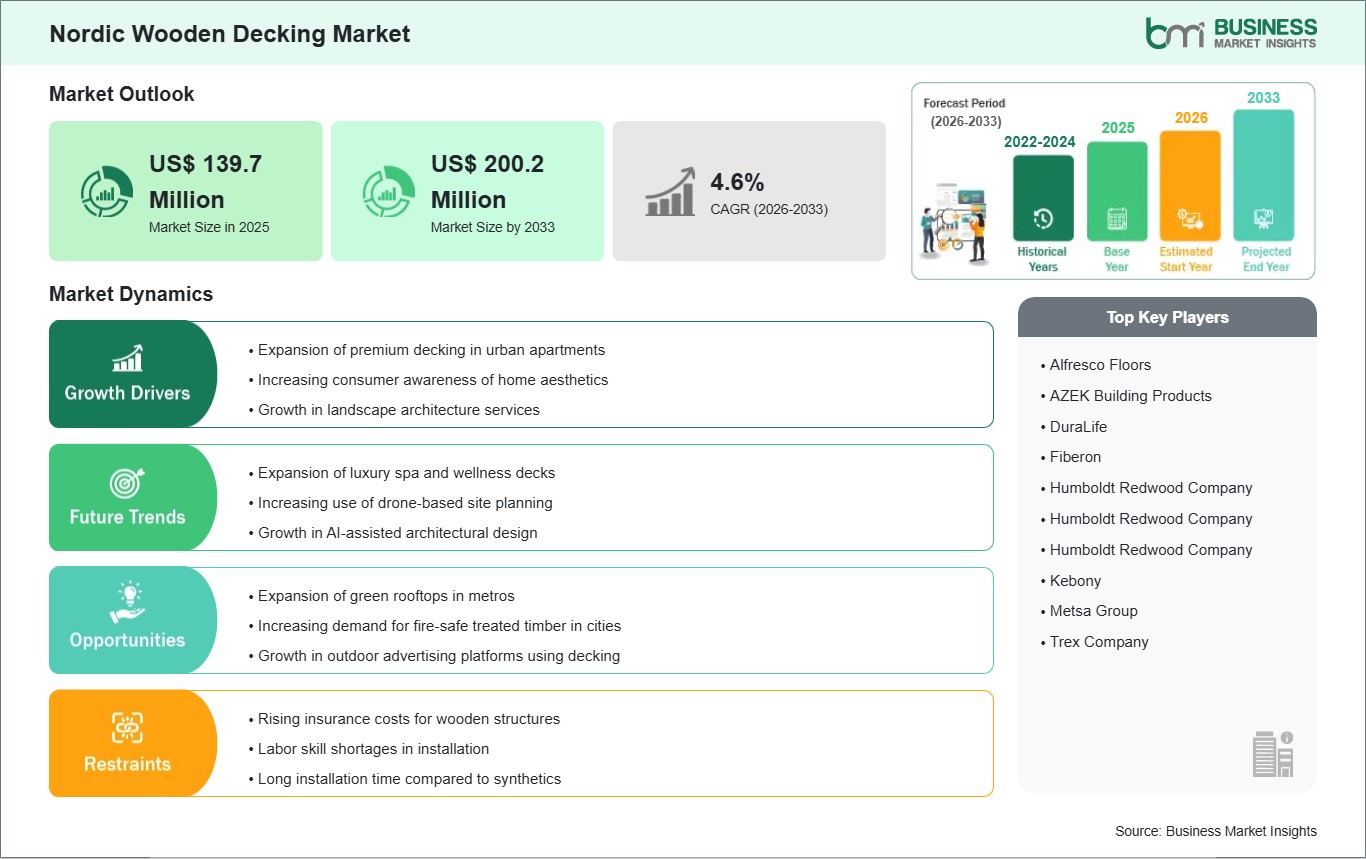
The Nordic wooden decking market size is expected to reach US$ 200.2 million by 2033 from US$ 139.7 million in 2025. The market is estimated to record a CAGR of 4.6% from 2026 to 2033.
Nordic wood deck construction is highly affected by the architectural thinking of creating harmony between man-made structures and natural surroundings in the region. In countries like Sweden, Norway, Denmark, and Finland, wood decks are commonly utilized for extending their interior environment into their exteriors, thereby indicating a significant cultural focus on creating environments that are in sync with nature. The use of wood decks continues to be highly demanded for residential buildings, infrastructure constructions, waterfront structures, and hospitality settings due to their outdoor usability features. One of the important factors driving the growth of the market is the popularity of outdoor living trends whereby private homes and residential buildings use decking materials in gardens, terraces, balconies, or lake/sea-front properties. In winter times, outdoor areas have been planned for practical use with the help of shelters, heating elements, and protection from the bad weather. Another factor that is influencing the market is investments made in public sectors including wooden walkways, nature tracks, seating areas in parks, and coastal promenades. Sustainability is an important feature of the Nordic market. Certified timber and responsibly sourced wood that conforms to strict environmental requirements are preferred. This has led to innovations in the area of thermally modified wood as well as moisture-, freeze-thaw-, and fungus-resistant decking materials. However, there are certain limitations owing to tough climatic conditions like cold winter seasons, heavy snowfall, and moisture. Moreover, the high-quality standards and tough environmental policies may restrict the availability of cheaper substitutes.

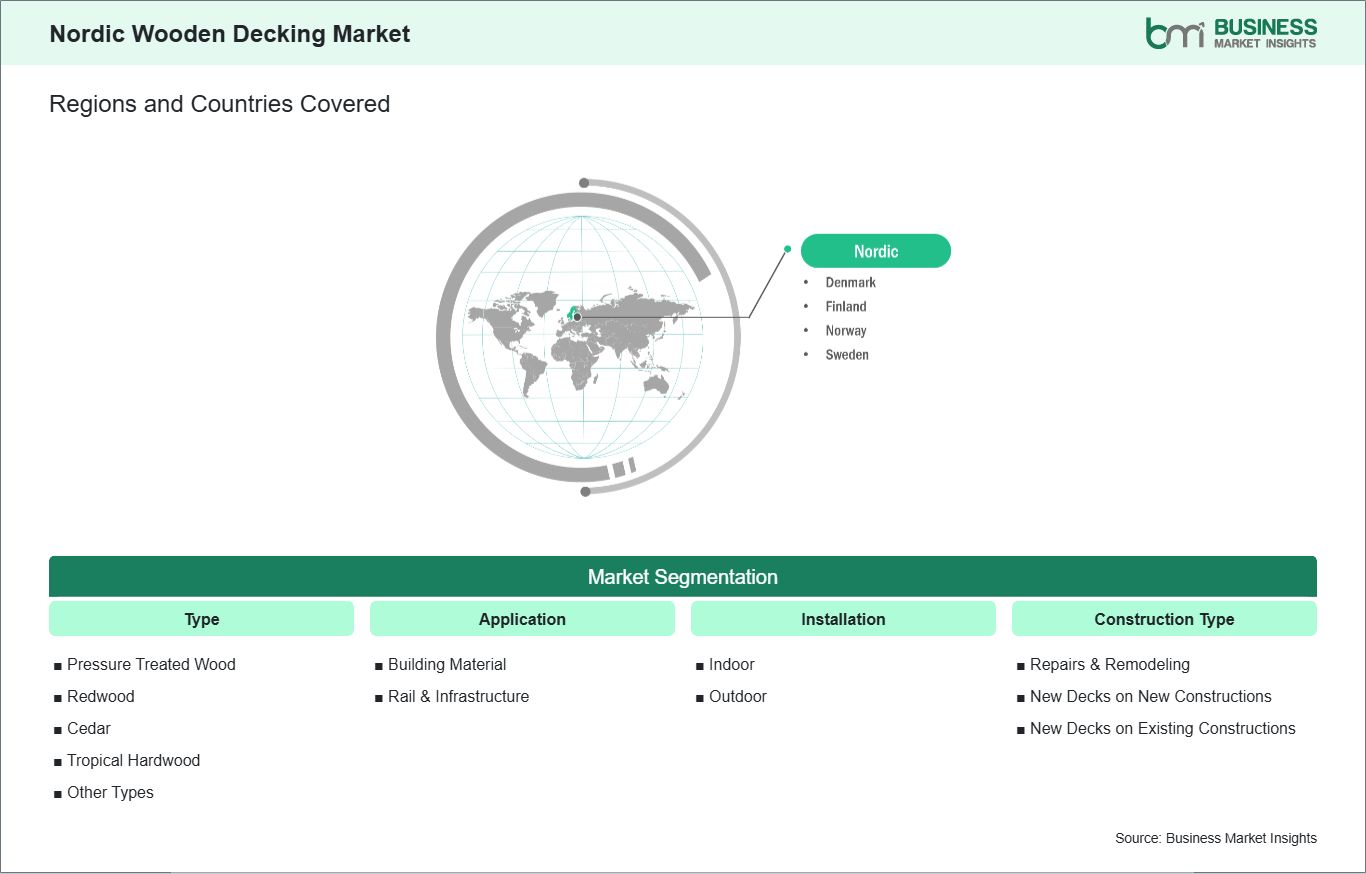
Key segments that contributed to the derivation of the Nordic wooden decking market analysis are types, application, installation, construction type, and distribution channel.
It is notable that the growth of the premium deck installation market for urban apartments in the Scandinavian countries has fueled the demand for wooden decking in recent years. This trend is particularly noticeable in major cities like Stockholm, Copenhagen, Oslo, and Helsinki, where there has been an increasing number of high-tech residential buildings constructed, despite the lack of space. The balconies, terraces, and common area decks have become standard features in new constructions of mid- to high-tiered residential areas in the Nordic countries.
Engineered wood and thermally modified timber decks are widely used in Sweden and Norway to protect houses from the severe effects of winter, like freezing and thawing, moisture, and excessive snowfall. Thermally modified wood and engineered wood provide greater stability and resistance to cracking than standard untreated softwood decks. Denmark and Finland have made the improvement of residents' outdoor living experience an essential component of their municipal house-building programs. According to industry data, up to 40% of premium new urban apartments that are constructed in Nordic capitals feature decked outdoor spaces, which indicates a preference for outdoor living in these countries.
Environmental factors are also crucial in shaping the demand for outdoor living amenities because Nordic countries implement among the most stringent requirements concerning sustainability in construction projects. FSC-certified timber is widely used by builders in Nordic capitals to meet BREEAM and Nordic Swan Ecolabel standards. In general, the culture of premium living, advanced environmental policies, and sustainable development contribute to the popularity of premium decked outdoor areas among Nordic residents.
The rise of green roofs in Nordic metropolises offers a good prospect for the wooden decking industry. There is currently an initiative being promoted in big Nordic cities like Stockholm, Oslo, Copenhagen, and Helsinki to encourage the use of green roofs. This is aimed at increasing urban biodiversity, managing storm water, and mitigating urban heat island effects. The use of wooden decking is becoming common in these urban areas to provide walkways, sitting areas, recreational decks, and landscaped terraces.
Government policies in terms of building codes and urban planning in the Nordic countries highly favor green roof projects. Some cities have enforced rules whereby new buildings need to be designed with green roof systems or at least recreational rooftops. For instance, the city of Copenhagen has introduced a number of urban sustainable approaches which promote a multi-purpose design of the rooftops using green cover and recreational facilities. The city of Oslo is another good example where efforts to adapt to climatic conditions focus on the rooftop spaces for recreation and other purposes. This includes wood decks which play a key role in these spaces all year round.
It becomes even better due to incorporation of the idea of building smart cities and premium quality real estate projects. Developers have been making their roofs into multipurpose areas, which feature gardens, cafes, fitness facilities, and lounge areas. In the creation of such an area, it is imperative to use high-quality composite deck material that is resistant to slipping and provides structural integrity in winter or rainy periods. With Nordic cities leading in sustainable urbanism worldwide, green roof areas will undoubtedly remain one of the drivers of deck innovation.
The Nordic wooden decking market is experiencing steady growth, with market size and share analysis reflecting evolving treatment preferences and competitive dynamics among key players. The report evaluates important subsegments categorized types, application, installation, construction type, and distribution channel, highlighting their respective contributions to overall market performance.
By types, the pressure treated wood subsegment dominated the market in 2025, because it is highly affordable, durable, and resistant to moisture, termites, and decay, making it suitable for long-term outdoor use. Due to its low maintenance requirements and wide availability, homeowners and contractors prefer pressure-treated wood over other decking materials.
Based on application, the building material subsegment dominated the market in 2025 because wooden decking is extensively used in residential and commercial construction projects such as patios, balconies, gardens, and outdoor flooring. Due to increasing urbanization and rising investments in housing and infrastructure development, the demand for wooden decking as a building material continues to grow.
On the basis of installation, the outdoor subsegment dominated the market in 2025, because wooden decking is mainly designed for outdoor recreational and landscaping purposes. The consumers are increasingly focusing on outdoor living spaces, gardens, rooftop seating areas, and poolside decks, outdoor installation has witnessed significant demand globally.
In terms of construction type, the repairs and remodeling subsegment dominated the market in 2025, because many old decks require renovation, replacement, and maintenance over time. Due to the growing trend of home improvement and remodeling activities, especially in developed countries, consumers are investing more in upgrading existing outdoor structures instead of undertaking new construction projects.
By distribution channel, the indirect sales subsegment dominated the market in 2025, because manufacturers mainly distribute wooden decking products through wholesalers, dealers, and retail home improvement stores. Due to the wider market reach, better product accessibility, and convenience offered by indirect sales channels, contractors and customers prefer purchasing decking materials through established distributors.

| Report Attribute | Details |
|---|---|
| Market size in 2025 | US$ 139.7 Million |
| Market Size by 2033 | US$ 200.2 Million |
| CAGR (2026 - 2033) | 4.6% |
| Historical Data | 2022-2024 |
| Forecast period | 2026-2033 |
| Segments Covered | By Type
|
|
Regions and Countries Covered
| |
| Nordic | Sweden, Denmark, Norway, Finland |
| Market leaders and key company profiles |
|
The "Nordic Wooden Decking Market Size and Forecast (2022-2033)" report provides a detailed analysis of the market covering below areas:
The geographical scope of the Nordic wooden decking market report is divided into: Sweden, Norway, Denmark, and Finland. Sweden held the largest share in 2025.
The leading country on the Nordic wooden decking market is Sweden, which has a long history of using wood as building material, highly developed woodworking industry, and close integration of outdoor activity into architecture in both residential and communal projects. Wood as the main material used for construction of decks appears to be widely implemented in the design of private gardens, lake side huts, residential buildings in suburbs, and communal recreation facilities. As far as residential usage goes, the strongest demands are in suburban and rural areas where wooden decking is seen as an inseparable part of the house, providing people with extra space for various purposes. Thus, wooden terraces and garden decks are popular choices that usually include some sort of shelter to protect users from adverse weather conditions throughout the year. For instance, in cities like Stockholm, Gothenburg, and Malmö, timber decking is widely applied for purposes such as urban waterfront restoration projects, parks, walkways, and hospitality areas. In this case, the municipal authorities attach great importance to the concept of sustainable landscape design through the application of wooden walkways, seating platforms, and deck floors. Sweden also has one of the best wood-processing infrastructures within the country itself, owing to its sustainable wood processing technology and responsible forestry operations. It allows for thermally treated wood as well as deck systems to be produced.

The Nordic wooden decking market is evaluated by gathering qualitative and quantitative data post primary and secondary research, which includes important corporate publications, association data, and databases. A few of the key developments in the Nordic wooden decking market are:
The Nordic Wooden Decking Market is valued at US$ 139.7 Million in 2025, it is projected to reach US$ 200.2 Million by 2033.
As per our report Nordic Wooden Decking Market, the market size is valued at US$ 139.7 Million in 2025, projecting it to reach US$ 200.2 Million by 2033. This translates to a CAGR of approximately 4.6% during the forecast period.
The Nordic Wooden Decking Market report typically cover these key segments-
The historic period, base year, and forecast period can vary slightly depending on the specific market research report. However, for the Nordic Wooden Decking Market report:
The Nordic Wooden Decking Market is populated by several key players, each contributing to its growth and innovation. Some of the major players include:
The Nordic Wooden Decking Market report is valuable for diverse stakeholders, including:
Essentially, anyone involved in or considering involvement in the Nordic Wooden Decking Market value chain can benefit from the information contained in a comprehensive market report.
Please tell us your area of interest
(Market Segments/ Regions and Countries/ Companies)