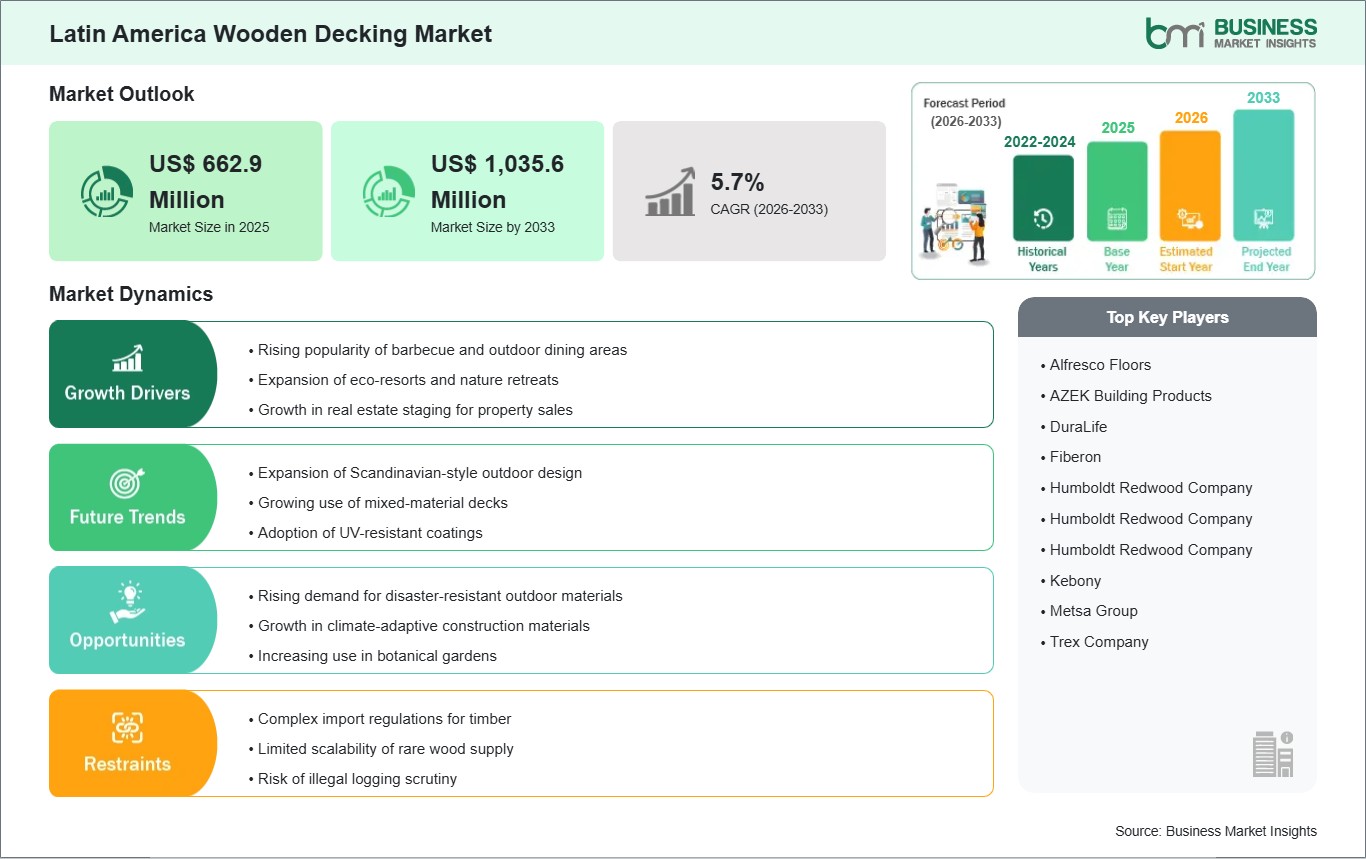
The Latin America wooden decking market size is expected to reach US$ 1,035.6 million by 2033 from US$ 662.9 million in 2025. The market is estimated to record a CAGR of 5.7% from 2026 to 2033.
The Latin American wooden decking market is distinguished by its close relationship with outdoor-based lifestyles, construction driven by tourism, and increasing preference for natural products in the construction of buildings. In Latin America, there is an increasing use of wooden decking in the designing of buildings, such that it adds to the beauty of the building as well as making it more user friendly outdoors. The Latin American wooden decking market is heavily shaped by the climate in the region and culture of open air environments. An important factor driving market growth is the growing development of tourism infrastructure, especially for coastal or tropical regions, where hospitality establishments seek to create an immersive experience in nature. Resorts, beach resorts, boutique accommodations, and entertainment centers use wooden decking in pools, boardwalks, terraces, and other outside structures to make the transition to the outdoors smooth. Simultaneously, urbanization trends lead to greater interest in using decking in residential complexes, specifically in dense urban environments, where balconies, roofs, and even small gardens become places of everyday living. The trend towards lifestyle enhancement in residences is another key factor driving market demand. Consumers residing in several Latin American countries are increasingly making improvements to their houses by creating more functional outside spaces such as gardens, patios, and terraces, moving towards a leisure-oriented approach to the residence construction. However, the decking market faces difficulties caused by high humidity, frequent rainfalls in tropical climate conditions, and temperature differences that lead to the deterioration of quality of natural wooden products.

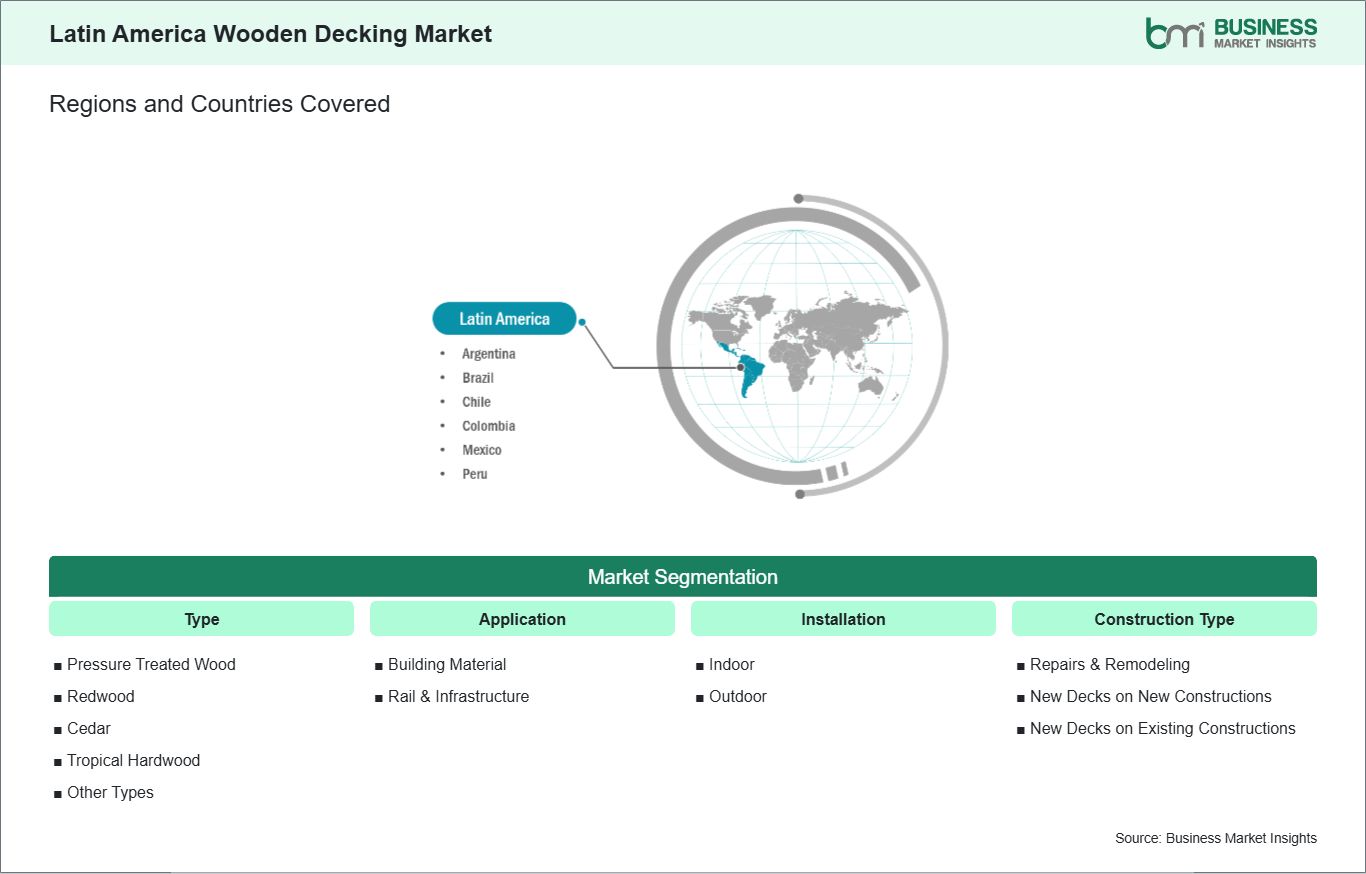
Key segments that contributed to the derivation of the Latin America wooden decking market analysis are types, application, installation, construction type, and distribution channel.
In Latin American wooden decking market, a major factor pushing up its growth is the growing appreciation of barbecue culture and the need for outdoor eating space in both private and commercial settings. Countries like Brazil, Argentina, Chile, and Mexico are known for their love of outdoor social activities involving barbecues and outdoor eating. Therefore, consumers have been motivated to create patios and terraces and garden decks for outdoor cooking and entertaining purposes. The use of wooden decking in such scenarios has increased because of the comfort associated with it. According to research, families from the urban middle class in Brazil have been increasing their outdoor living space consistently at an average pace of over 6% per year.
The hospitality industry is also contributing to this trend with the expansion of al fresco dining areas by bars, restaurants, and cafes in big Latin American cities. Alfresco dining areas have become a crucial component in drawing customers in the urban lifestyle after the pandemic where open spaces are preferred. The use of engineered wood and composite decking materials has been on the rise owing to their durability, tolerance to changes in weather, and maintenance benefits. Coastal tourism areas like Cancun, Rio de Janeiro, and Cartagena offer high potential for deck installation in beachside restaurants.
The changing trend in the urban lifestyle and real estate development will also increase the use of wooden decking. Gated communities and condominiums in Latin America are beginning to offer shared facilities that include barbecues, roof decks, and landscaped areas for entertaining purposes. Decking systems are being employed by developers to raise the value of their properties and improve the lifestyles of their residents. With the growing outdoor socializing trend, it is anticipated that the demand for wooden decking will continue to be strong.
The rise in the occurrence of natural disasters in the region makes there be a need for robust materials that can endure such calamities, and thus creates a huge market opportunity for the wooden deckings industry. Extreme climatic conditions such as hurricanes in the Caribbean countries, flooding in South American countries, and heat waves in central areas make this region highly prone to natural disasters. In order to mitigate the damages caused by such disasters, the use of resistant building materials becomes a priority. wooden deckings especially composite and engineered varieties have been favored because they can withstand various environmental conditions.
Decking products in locations such as the Caribbean coastline and other regions of Central America that are exposed to hurricanes have been developed to provide better wind resistance, better fasteners, and also resistance against water penetration. Infrastructure development initiatives involving construction of coastal boardwalks and other structures meant for tourism purposes include reinforced composites that are more durable compared to hardwood decks which usually tend to warp and deteriorate after a disaster. This is especially true during periodic increases in demand brought about by government reconstruction efforts.
Market trends are also being influenced by climate adaptation policy measures and insurance-driven building codes. Several urban planning agencies in Latin American countries have been adopting regulations that promote the use of highly resistant and easily maintainable materials in flood and coastal risk areas. Such developments are encouraging the development of durable wood treated materials, composite wood plastic products, and quick replaceable decking technologies. With increasing variations in weather conditions, the demand for disaster-proof outdoor material is set to emerge as an important growth area with engineered wooden decking finding increasing utility.
The Latin America wooden decking market is experiencing steady growth, with market size and share analysis reflecting evolving treatment preferences and competitive dynamics among key players. The report evaluates important subsegments categorized within types, application, installation, construction type, and distribution channel, highlighting their respective contributions to overall market performance.
By types, the pressure treated wood subsegment dominated the market in 2025, because it is highly affordable, durable, and resistant to moisture, termites, and decay, making it suitable for long-term outdoor use. Due to its low maintenance requirements and wide availability, homeowners and contractors prefer pressure-treated wood over other decking materials.
Based on application, the building material subsegment dominated the market in 2025 because wooden decking is extensively used in residential and commercial construction projects such as patios, balconies, gardens, and outdoor flooring. Due to increasing urbanization and rising investments in housing and infrastructure development, the demand for wooden decking as a building material continues to grow.
On the basis of installation, the outdoor subsegment dominated the market in 2025, because wooden decking is mainly designed for outdoor recreational and landscaping purposes. The consumers are increasingly focusing on outdoor living spaces, gardens, rooftop seating areas, and poolside decks, outdoor installation has witnessed significant demand globally.
In terms of construction type, the repairs and remodeling subsegment dominated the market in 2025, because many old decks require renovation, replacement, and maintenance over time. Due to the growing trend of home improvement and remodeling activities, especially in developed countries, consumers are investing more in upgrading existing outdoor structures instead of undertaking new construction projects.
By distribution channel, the indirect sales subsegment dominated the market in 2025, because manufacturers mainly distribute wooden decking products through wholesalers, dealers, and retail home improvement stores. Due to the wider market reach, better product accessibility, and convenience offered by indirect sales channels, contractors and customers prefer purchasing decking materials through established distributors.

| Report Attribute | Details |
|---|---|
| Market size in 2025 | US$ 662.9 Million |
| Market Size by 2033 | US$ 1,035.6 Million |
| CAGR (2026 - 2033) | 5.7% |
| Historical Data | 2022-2024 |
| Forecast period | 2026-2033 |
| Segments Covered | By Type
|
|
Regions and Countries Covered
| |
| Latin America | Mexico, Brazil, Argentina, Peru, Chile, Colombia |
| Market leaders and key company profiles |
|
The "Latin America Wooden Decking Market Size and Forecast (2022-2033)" report provides a detailed analysis of the market covering below areas:
The geographical scope of the Latin America wooden decking market report is divided into: Brazil, Mexico, Argentina, Colombia, Chile, and Peru. Mexico held the largest share in 2025.
Mexico has been the leader of the Latin America wooden decking market because of its advanced tourism infrastructure and climatic diversity and outdoor culture. In Mexico, the demand for wooden decking is seen more prominently along coastal tourism zones, urban cities, and expanding suburbs where the use of decking is common to improve functional and aesthetic qualities in the landscape. The use of wooden decking is critical in coastal areas including the Caribbean coast, Pacific coast areas, and peninsular tourism spots. Wooden decking becomes an important element in hospitality projects including hotels, eco-resorts, beach clubs, and recreational facilities. This is important in ensuring that the environment appears to be natural and supports heavy traffic. Other significant demand centers include urban areas like Mexico City, Monterrey, and Guadalajara. In these cities, an increase in the density of real estate has led developers to incorporate outdoor usable spaces in their designs through rooftop decks, balcony extensions, inner courtyards, and communal decks. The development in this regard is in line with the trend in modern city housing where outdoor spaces have come to be seen as an extension of indoor living spaces rather than mere decorative components. Mexico is advantaged by its fairly developed logistics system for the supply of materials, which includes imported engineered wood materials as well as locally sourced timber suitable for decking purposes. This makes it possible to cater to demands from various market segments, including mass housing needs as well as hospitality industries. Environmental exposure poses another critical issue, especially in coastal and tropical regions where excessive humidity and heat, along with seasonal storms, hasten material wear. Issues related to maintenance and material durability often dictate choices regarding the adoption of certain products.

The Latin America wooden decking market is evaluated by gathering qualitative and quantitative data post primary and secondary research, which includes important corporate publications, association data, and databases. A few of the key developments in the Latin America wooden decking market are:
The Latin America Wooden Decking Market is valued at US$ 662.9 Million in 2025, it is projected to reach US$ 1,035.6 Million by 2033.
As per our report Latin America Wooden Decking Market, the market size is valued at US$ 662.9 Million in 2025, projecting it to reach US$ 1,035.6 Million by 2033. This translates to a CAGR of approximately 5.7% during the forecast period.
The Latin America Wooden Decking Market report typically cover these key segments-
The historic period, base year, and forecast period can vary slightly depending on the specific market research report. However, for the Latin America Wooden Decking Market report:
The Latin America Wooden Decking Market is populated by several key players, each contributing to its growth and innovation. Some of the major players include:
The Latin America Wooden Decking Market report is valuable for diverse stakeholders, including:
Essentially, anyone involved in or considering involvement in the Latin America Wooden Decking Market value chain can benefit from the information contained in a comprehensive market report.
Please tell us your area of interest
(Market Segments/ Regions and Countries/ Companies)