Market Summary
Executive Summary and Global Market Analysis
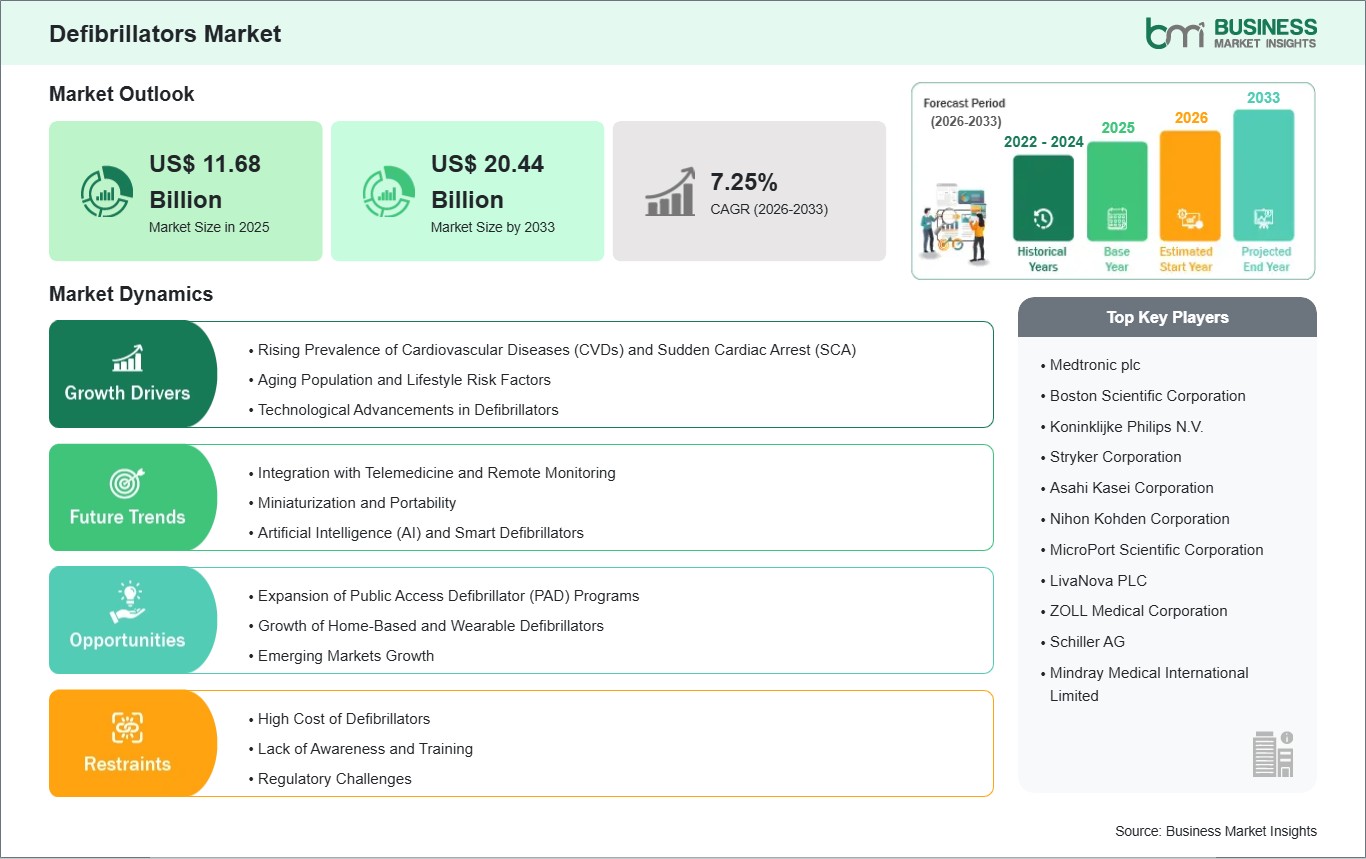
The global defibrillators market is steadily expanding. This expansion is largely due to the increasing prevalence of cardiovascular diseases (CVDs), the rising instances of sudden cardiac arrests (SCAs), and the awareness about early intervention and emergency response that has been growing recently. Defibrillators such as automated external defibrillators (AEDs), implantable cardioverter, defibrillators (ICDs), and wearable defibrillators, are the devices that can rescue a patient by stabilizing the heart rhythm in the case of ventricular fibrillation, greatly improving the chances of survival. Demand for defibrillators used in hospitals and those designed for out, of, hospital scenarios has been stimulated by the increase in cardiac emergencies as well as the expanding geriatric population and lifestyle, related risk factors such as obesity, hypertension, and diabetes. These technologies offer patients many advantages, including comfort and convenience in the use of compact and user, friendly AEDs, remote monitoring of ICDs, and the integration of mobile applications and emergency response systems. The hospital, clinic, and emergency response unit markets remain the main segments where defibrillators are used, but the use of these devices in public places, businesses, and the home care sector is on the rise as a result of the awareness campaigns and government initiatives.
North America and Europe lead the market globally due to their advanced healthcare systems and extensive use of sophisticated devices, while Asia Pacific is becoming a significant growth area because of increased healthcare spending, urbanization, and a rising trend of CVDs. The market scenario, in general, is bullish and can be attributed to factors like medical needs, innovative technology, and worldwide initiatives to enhance cardiac emergency preparedness.
Segment Analysis
Defibrillators Market Segmentation
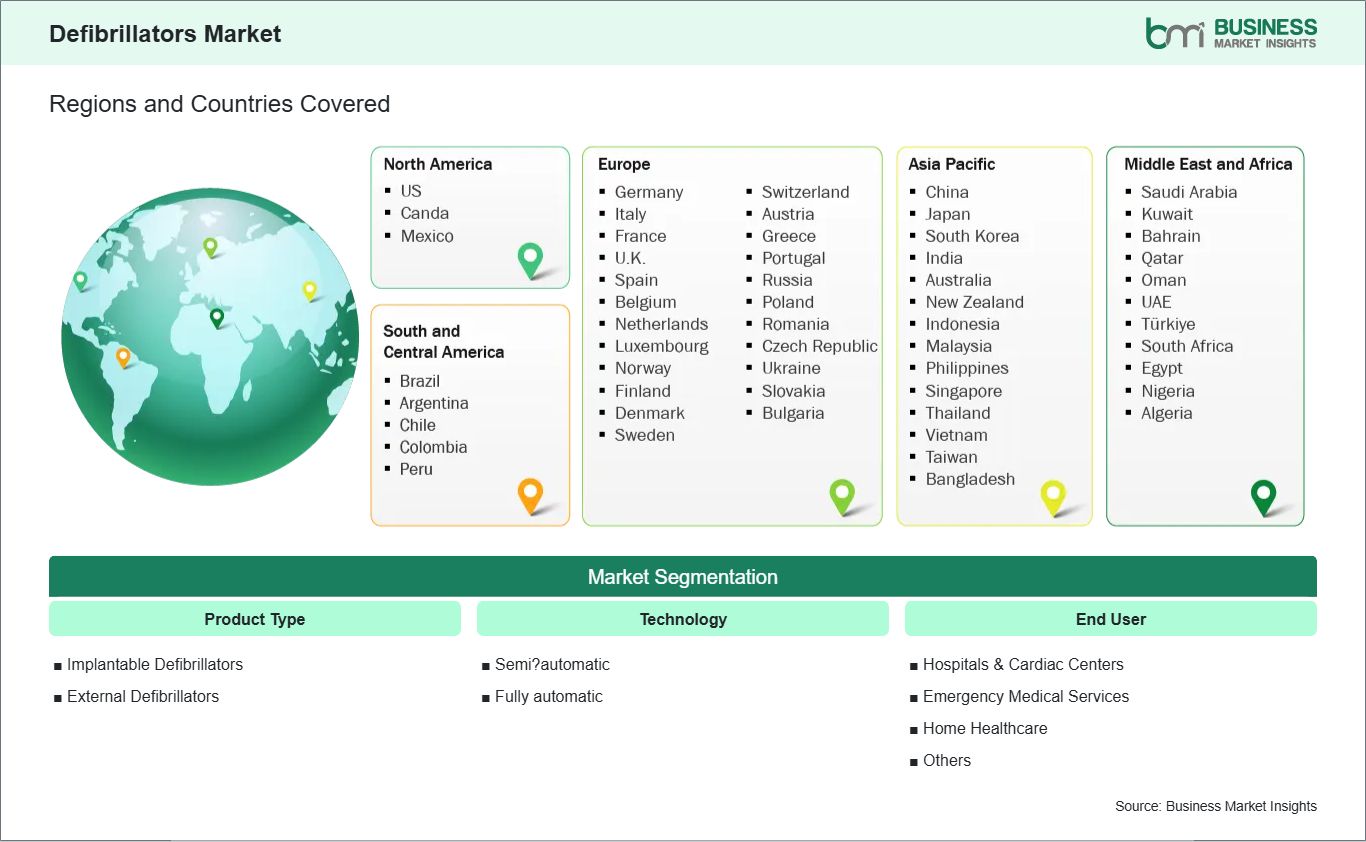
Key segments that contributed to the derivation of the Defibrillators market analysis are product type, technology, application, and end user.
- By product type, the glucose monitoring devices market is segmented into implantable defibrillators, external defibrillators. The external defibrillators devices segment dominated the market in 2024.
- By technology, the market is segmented into semi-automatic, fully automatic. The semi-automatic segment held the largest share of the market in 2024.
- By end user, the market is segmented into hospitals and cardiac centers, emergency medical services, home healthcare, and others. The hospitals and cardiac centers segment held the largest share of the market in 2024.
Market Forces
Defibrillators Market Drivers and Opportunities
Increasing Prevalence of Cardiovascular Diseases and Sudden Cardiac Arrest
The increasing prevalence of cardiovascular diseases (CVD) and sudden cardiac arrest (SCA) on a global scale are major contributing factors to the growth of the defibrillators market, since they are two of the most prevalent causes of morbidity and mortality worldwide. These cardiovascular diseases include coronary artery disease, arrhythmia, and heart failure, which are all major contributors to the global burden of disease. Due to the increasing prevalence of risk factors for CVDs, such as: Hypertension, Diabetes, Obesity, Smoking, and Sedentary Lifestyle, the incidence of cardiac emergencies requiring rapid intervention has also increased dramatically. Defibrillators (including Automated External Defibrillators - AEDs, Implantable Cardioverter Defibrillators - ICDs, and Wearable Devices) provide a means of returning the heart to a normal rhythm in cases of life-threatening arrhythmia and thereby increase survival rates significantly. As populations around the world continue to age, this is generating increased demand for defibrillators as seniors are at greater risk for suffering from a cardiac event. As the result of this increased awareness, there has been also a significant increase in the distribution of Advanced Defibrillators in hospital, EMS systems, and public access sites (PADS). Additionally, many Governments are investing in public-access AED programs and enacting regulations requiring the installation of AEDs in the workplace, schools, and airports to provide enhanced market growth. The increase in the clinical requirement for defibrillators to meet the growing rate of cardiac emergencies is therefore a key factor supporting the ongoing growth of the Global Defibrillators Market.
Expansion of Public Access and Home-Based Defibrillation
Expanding Public Access Defibrillation (PAD) programs and the adoption of home-based defibrillators is a major opportunity in the defibrillator market. Individuals now have increased awareness of how to survive sudden cardiac arrest and as a result many governments, health care organizations and private companies are encouraging the placement of automated external defibrillators (AEDs) in public locations that see a lot of foot traffic (e.g., airports/aircraft, schools, shopping malls, sports facilities, etc.). This trend allows manufacturers to address a much larger and growing market than simply what can be found in hospitals and clinics. Furthermore, home-based defibrillators and wearable cardioverter-defibrillators are becoming more popular, especially with patients who have known cardiac issues, are at risk for arrhythmias, or are recovering from surgery. The introduction of new technologies has also made it possible for home-based users to access compact, lightweight, user-friendly devices with voice prompts, as well as wireless connectivity and integration with emergency response systems. Emerging markets in Asia Pacific, Latin America and the Middle East will provide opportunities for manufacturers to reach these markets as the prevalence of cardiovascular disease continues to rise and income levels rise. By focusing on Public Access programs, remote monitoring solutions, and building patient-friendly devices to be used in the home setting, manufacturers will have the ability to reach under-penetrated segments and improve the availability of services needed to provide early response, leading to ongoing growth of the global defibrillator market.
Size and Share Analysis
Defibrillators Market Size and Share Analysis
By product type, the glucose monitoring devices market is segmented into implantable defibrillators, external defibrillators. The external defibrillators devices segment dominated the market in 2024. Increased adoption of AEDs is primarily because they are critical tools to save lives during sudden cardiac arrest (SCA), especially in public locations, within emergency response agencies and at hospitals..
By technology, the market is segmented into semi-automatic, fully automatic. The semi-automatic segment held the largest share of the market in 2024. Ease of use and a lower likelihood of accidental shocks combined with the widespread availability of training on semi-automatic defibrillator operation have contributed to the dominance of this technology.
By end user, the market is segmented hospitals and cardiac centers, emergency medical services, home healthcare, and others. The hospitals and cardiac centers segment held the largest share of the market in 2024. This growth has been largely influenced by the well-established processes; highly skilled personnel; and volume of patients treated, hospitals are the primary purchasers of external and implanted defibrillators.
Report Coverage
Defibrillators Market Report Coverage and Deliverables
The "Defibrillators Market Size and Forecast (2022–2033)" report provides a detailed analysis of the market covering below areas:
- Defibrillators market size and forecast at global, regional, and country levels for all the key market segments covered under the scope
- Defibrillators market trends, as well as market dynamics such as drivers, restraints, and key opportunities
- Defibrillators market analysis covering key market trends, global and regional framework, major players, regulations, and recent market developments
- Industry landscape and competition analysis covering market concentration, heat map analysis, prominent players, and recent developments for the Defibrillators market
- Detailed company profiles, including SWOT analysis
Geographic Insights
Defibrillators Market Geographic Insights
The geographical scope of the Defibrillators market report is divided into five regions: North America, Asia Pacific, Europe, Middle East and Africa, and South and Central America. The Defibrillators market in Asia Pacific is expected to grow significantly during the forecast period.
The Asia-Pacific Defibrillators market is segmented into China, Japan, South Korea, India, Australia, New Zealand, Indonesia, Malaysia, the Philippines, Singapore, Thailand, Vietnam, Taiwan, Bangladesh, and the Rest of Asia. The Asia Pacific defibrillator market is expanding rapidly due to the increasing incidence of CVD, SCA, and the development of the region’s healthcare infrastructure. Countries such as China, India, Japan and South Korea are seeing a rise in demand for both ICDs and external defibrillators as they have become aware of the increasing risk of heart disease associated with older populations, lifestyle changes and better understanding about early intervention with a heart attack. Increasingly, AEDs are being placed in public spaces, businesses and schools as part of government initiatives (e.g. health campaigns, emergency preparedness programs), thus driving growth in the market. Hospitals, cardiac clinics and emergency medical services are key players in this area. However, more and more patients at risk for sudden cardiac arrest are using defibrillators in the home and wearables are starting to penetrate this market as well. With the advancements in technology such as semi automatic and fully automatic AEDs, smaller portable devices, remote monitoring systems and app-based monitoring systems are making it easier to use, safer and more convenient for the user, thus providing motivation for even greater use of defibrillator products. Also, as healthcare spending increases and patient awareness rises and more facilities offer reimbursement options in emerging economies, this is creating a larger market for defibrillator products. As a result of the needs of clinical necessity, rising rates of cardiac diseases, and efforts to improve the rates of survival from a sudden cardiac event, the Asia Pacific Region provides an opportunity for healthcare manufacturers and providers to grow significantly.
Industry Activity
Recent Developments
The Defibrillators market is evaluated by gathering qualitative and quantitative data post primary and secondary research, which includes important corporate publications, association data, and databases. A few of the key developments in the glucose monitoring devices market are:
- In September 2025, ZOLL, an Asahi Kasei company announced the Zenix, the company’s most clinically advanced and easy-to-use professional monitor/defibrillator, has received premarket approval (PMA) from the US Food and Drug Administration (FDA).
- In October 2024, the PLATINIUM implantable cardioverter defibrillators (ICD)-produced by MicroPort CRM Shanghai-MicroPort Soaring CRM (Shanghai) Co., Ltd.) an associated company of MicroPort CRM, received approval from China’s National Medical Products Administration (NMPA). This marks the first ICD manufactured in China to gain approval for market launch and is set to be officially commercialized within the country.
- In March 2024, Stryker launched and showcased two new products “LIFEPAK CR2 automated external defibrillator (AED) for cardiac care” and “Evacuation Chair” for emergency patient evacuation.
Trust & Transparency
Research Methodology
The market analysis combines proprietary research with secondary data from government agencies, company disclosures, regulatory filings, industry databases and expert interviews. Market estimates are validated through data triangulation, cross-market benchmarking and analyst
review.
View Full Research Methodology
Key Sources Referred:
World Bank – Global Trade Indicators World Trade Organization (WTO) Centers for Disease Control and Prevention (CDC) World Health Organization (WHO) (International Monetary Fund )IMF International Trade Administration (ITA) Company website Company annual reports Company investor presentations