Market Summary
Executive Summary and Market Analysis
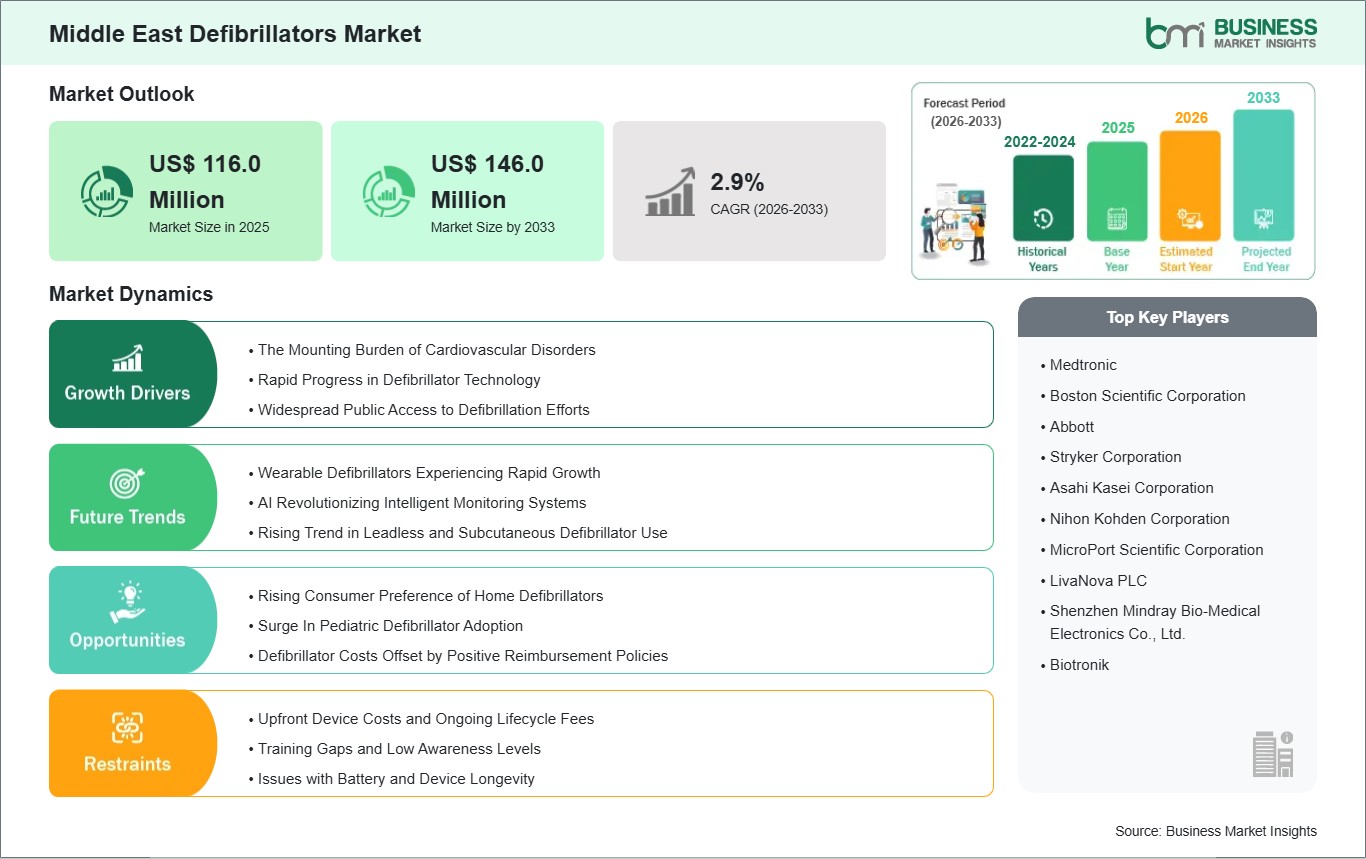
Governments and healthcare providers are working to integrate defibrillators into hospitals, clinics, and emergency response systems. Public access defibrillator programs are gaining traction in urban centers, particularly in airports, shopping malls, and corporate facilities, reflecting a regional commitment to improving survival rates from sudden cardiac arrests. Technological advancements, including portable and easy-to-use automated external defibrillators (AEDs), have enhanced the accessibility and effectiveness of life-saving interventions, allowing trained professionals and laypersons to respond quickly during emergencies.
Disparities in healthcare infrastructure across countries can limit the reach of defibrillators, especially in rural and underserved areas. Awareness and training for non-medical users are still developing, which can restrict the effectiveness of public access programs. High acquisition and maintenance costs of advanced devices create hurdles for smaller healthcare facilities. Despite these limitations, the region is showing steady progress, driven by government initiatives, private sector investment, and growing emphasis on emergency preparedness in urban and semi-urban areas.
Segment Analysis
Middle East Defibrillators Market Segmentation
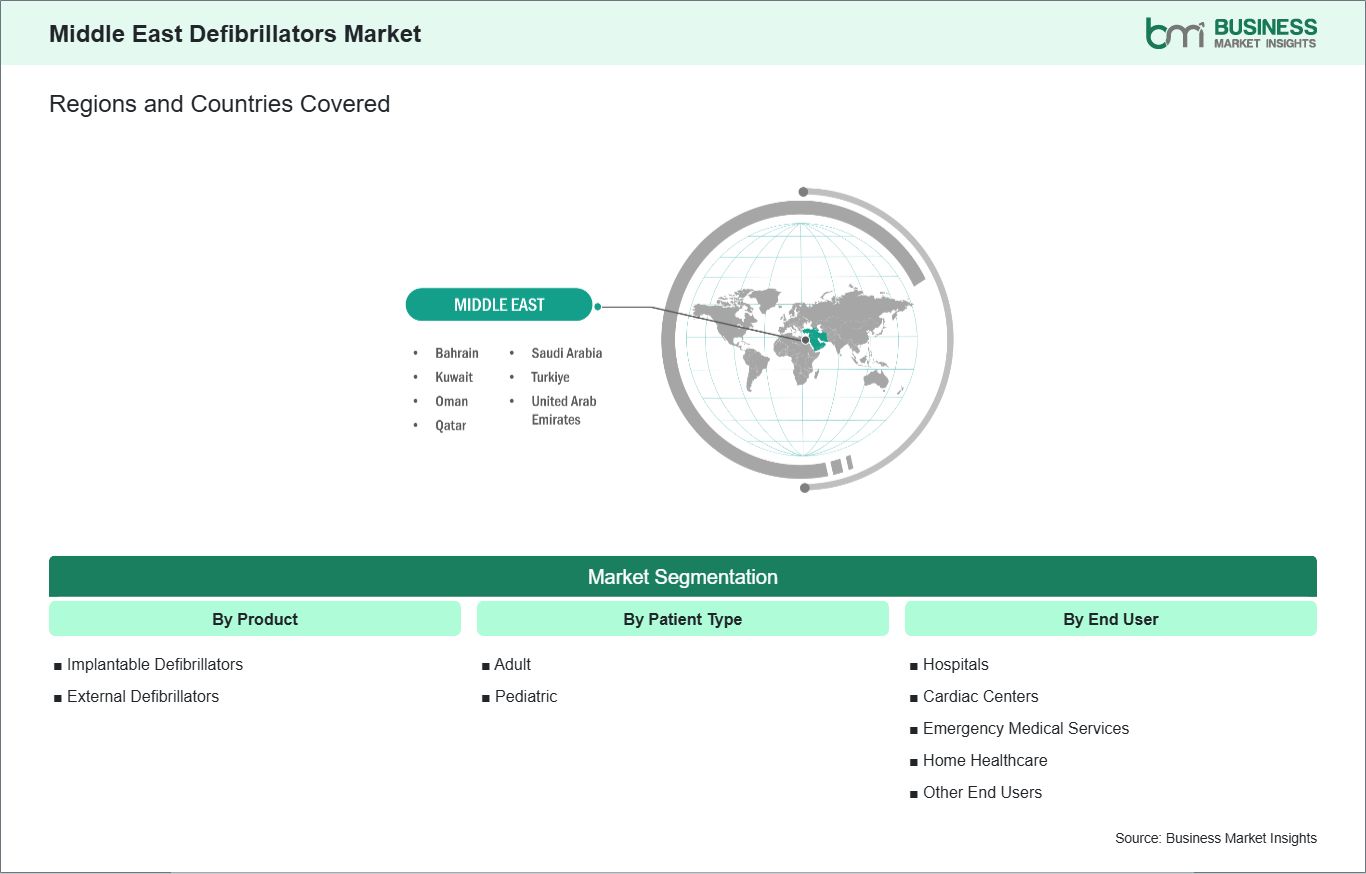
Key segments that contributed to the derivation of the Middle East Defibrillators market analysis are product type, patient type, and end user.
- By product type, the Defibrillators market is segmented into implantable defibrillators and external defibrillators. The implantable defibrillators segment dominated the market in 2025.
- Based on patient type, the Defibrillators market is classified into adult and pediatric. The adults segment dominated the market in 2025.
- In terms of end user, the Defibrillators market is categorized into hospitals, cardiac centers, emergency medical services, home healthcare, and other end users. The hospitals segment dominated the market in 2025.
Market Forces
Middle East Defibrillators Market Drivers and Opportunities
Mounting Burden of Cardiovascular Disorders
Cardiovascular disorders have become one of the foremost health challenges shaping healthcare services and technology needs across the region. Heart disease and related conditions are recognized by health authorities and care providers as leading contributors to premature mortality and chronic disability. This persistent burden is pushing governments and private providers alike to prioritize cardiac care, with defibrillators now a central component of emergency response infrastructure.
Countries are witnessing a high prevalence of heart disease risk factors, including hypertension, diabetes, and obesity, which are strongly linked to sudden cardiac events. These trends have placed renewed emphasis on equipping both clinical and public settings with defibrillation solutions that can quickly respond to cardiac arrests outside traditional hospital environments.
In parts of the Levant and the broader Middle Eastern landscape, healthcare systems are adapting to an increase in chronic cardiovascular cases by integrating early intervention technologies. Emergency medical services are expanding their use of advanced defibrillators, and hospitals are scaling up their cardiac intensive care capabilities. This mounting health burden reinforces the role of defibrillators as essential tools for rapid response and survival in urgent cardiac situations.
Rising Consumer Preference for Home Defibrillators
Alongside institutional demand, there is a growing trend of households in the Middle East considering defibrillators for home use. Families with members at higher risk of heart disease are increasingly viewing these devices as an essential safety measure, especially in urban areas where lifestyle-related risks are more pronounced.
In metropolitan centers such as Dubai, Riyadh, and Doha, private consumers are showing greater interest in user-friendly home defibrillators. This shift reflects a movement toward personal healthcare preparedness, where individuals seek tools that allow them to respond immediately in emergencies before professional help arrives.
However, adoption of home defibrillators remains uneven across the region. In smaller towns and rural areas, awareness and affordability are key barriers, and families may rely more heavily on hospitals or clinics for emergency care. As awareness grows and devices become easier to use, the home defibrillator segment is expected to expand steadily, complementing institutional demand and enhancing cardiac care readiness.
Size and Share Analysis
Middle East Defibrillators Market Size and Share Analysis
The Middle East Defibrillators market demonstrates steady growth, with size and share analysis highlighting evolving trends and competitive dynamics among key players. The report evaluates important subsegments categorized within product type, patient type, and end user, highlighting their respective contributions to overall market performance.
By product type, the implantable defibrillators subsegment dominated the market in 2025. Their adoption is driven by their proven efficacy in preventing sudden cardiac arrest, long-term reliability, and ability to continuously monitor and correct life-threatening arrhythmias, making them a cornerstone in cardiac care.
In terms of patient type, the adults subsegment dominated the market in 2025 due to the higher prevalence of cardiac disorders in the adult population, increased awareness of sudden cardiac death prevention, and greater accessibility of advanced defibrillator therapies for adult patients.
Based on end user, the hospitals subsegment dominated the market in 2025. Hospitals remain the primary distribution channel due to their comprehensive cardiac care facilities, access to trained cardiologists and specialized technicians, advanced monitoring infrastructure, and ability to provide immediate, life-saving interventions.
Report Coverage
Middle East Defibrillators Market Report Coverage and Deliverables
The "Middle East Defibrillators Market Size and Forecast (2022–2033)" report provides a detailed analysis of the market covering below areas:
- Middle East Defibrillators market size and forecast at regional and country levels for all market segments covered under the scope
- Middle East Defibrillators market trends, as well as drivers, restraints, and opportunities
- Middle East Defibrillators market analysis covering key trends, regional framework, major players, regulations, and recent developments
- Industry landscape and competition analysis covering market concentration, heat map analysis, prominent players, and recent developments for the Middle East Defibrillators market
- Detailed company profiles, including SWOT analysis
Geographic Insights
Middle East Defibrillators Market Geographic Insights
The geographical scope of the Middle East Defibrillators market report is divided into: the UAE, Saudi Arabia, Bahrain, Oman, Kuwait, Qatar, and Turkiye. Turkiye held the largest share in 2025.
Turkiye dominates the market due to its advanced healthcare infrastructure and strong focus on emergency medical services. Hospitals and cardiac care centers in major cities such as Istanbul, Ankara, and Izmir prioritize the deployment of external and implantable defibrillators as part of comprehensive emergency care protocols. Urban areas have adopted public access defibrillators in high-traffic locations. Mobile medical units extend coverage to semi-urban and rural regions, improving emergency response times across the country.
Public health campaigns emphasize CPR training and encourage community engagement with AEDs to ensure that bystanders are prepared to act in case of sudden cardiac events. Hospitals focus on regular device maintenance and staff readiness, ensuring the operational efficiency of life-saving equipment. Private healthcare providers and corporate facilities contribute by installing portable and user-friendly AEDs, reflecting a nationwide effort to enhance cardiac emergency response. While challenges remain in remote regions and cost management, Turkey’s coordinated approach between public and private sectors positions it as the regional leader in defibrillator adoption and emergency cardiac care.
Industry Activity
Recent Developments
The Middle East Defibrillators market is evaluated by gathering qualitative and quantitative data post primary and secondary research, which includes important corporate publications, association data, and databases. A few of the key developments in the Middle East Defibrillators market are:
- In October 2025, Mediana announced that it brought Saudi-approved defibrillators to Riyadh, following clearance of its AED models A15 and A16 and monitor defibrillators D100 and D700 by the Saudi Food and Drug Authority, enabling local market entry and expanded sales opportunities.
- In January 2025, Mediana announced that it participated in Arab Health 2025 in Dubai to showcase its emergency medical solutions, including AEDs and advanced monitor defibrillators, to expand its customer base and presence in the Middle East emergency medical device market.
Trust & Transparency
Research Methodology
The market analysis combines proprietary research with secondary data from government agencies, company disclosures, regulatory filings, industry databases and expert interviews. Market estimates are validated through data triangulation, cross-market benchmarking and analyst
review.
View Full Research Methodology
Key Sources Referred:
The World Bank World Health Organization (WHO) Center for Disease Control and Prevention (CDC) European Database on Medical Devices (EUDAMED) European Society of Cardiology American College of Cardiology American Heart Association Company Websites Company Annual Reports Company Investor Presentations