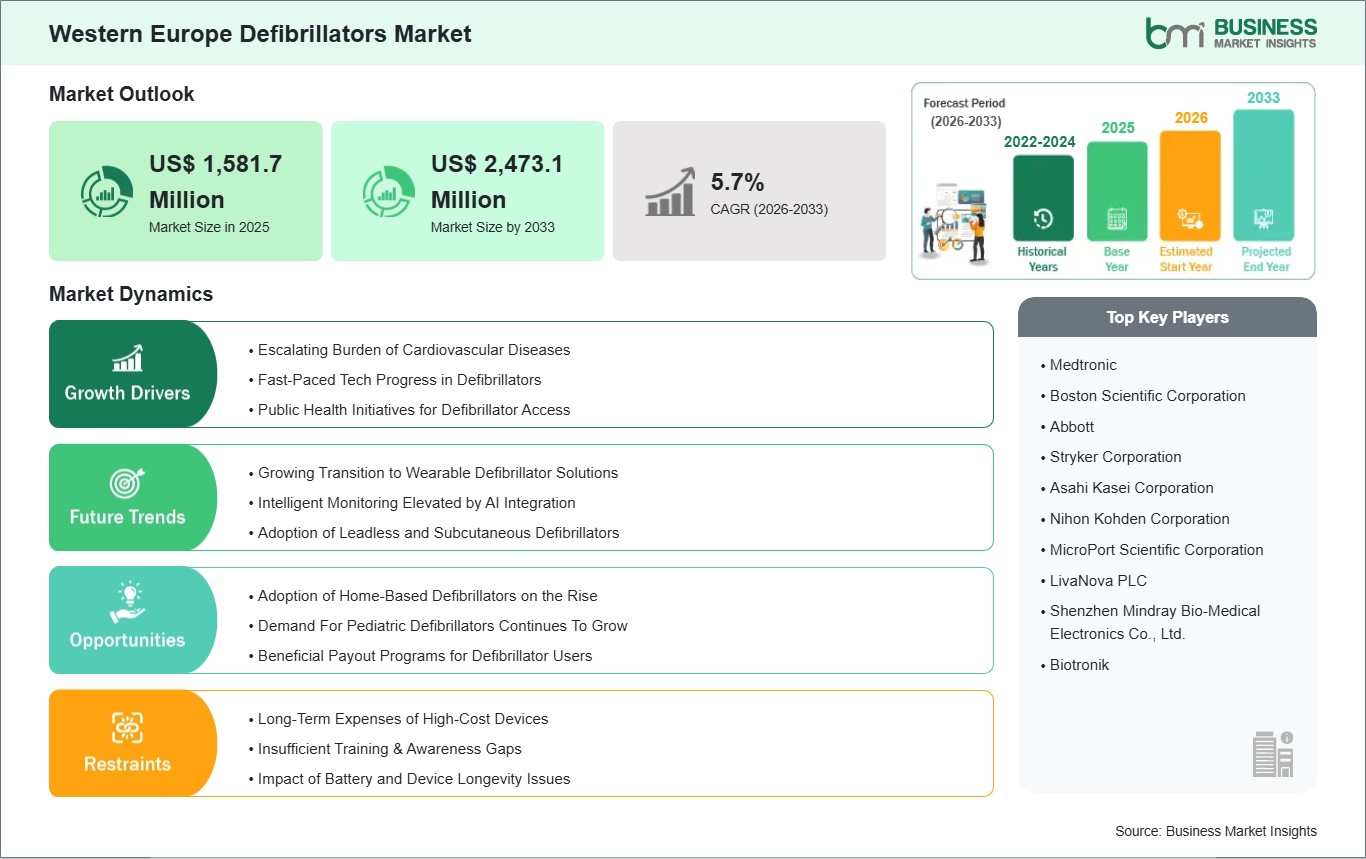
The Western Europe Defibrillators market size is expected to reach US$ 2,473.1 million by 2033 from US$ 1,581.7 million in 2025. The market is estimated to record a CAGR of 5.7% from 2026 to 2033.
Hospitals, clinics, and emergency medical services across the region prioritize rapid access to defibrillators, ensuring life-saving interventions for patients experiencing sudden cardiac arrest. Public access defibrillator programs have become a standard feature in airports, train stations, sports arenas, and other high-traffic public spaces, reflecting a regional emphasis on early intervention. Technological advancements, such as portable and automated external defibrillators (AEDs) with user-friendly interfaces, enhance accessibility, making it easier for healthcare professionals and trained civilians to respond quickly in emergencies.
The high cost of advanced defibrillation systems can be a barrier for smaller hospitals or clinics, while regulatory and compliance requirements can slow procurement and deployment of new devices. Public training and awareness remain uneven, which can limit effective use outside clinical settings. Nevertheless, strong government initiatives, collaboration between healthcare providers, and community-based training programs drive adoption, positioning Western Europe as a leading region for defibrillator integration and emergency cardiac care preparedness.

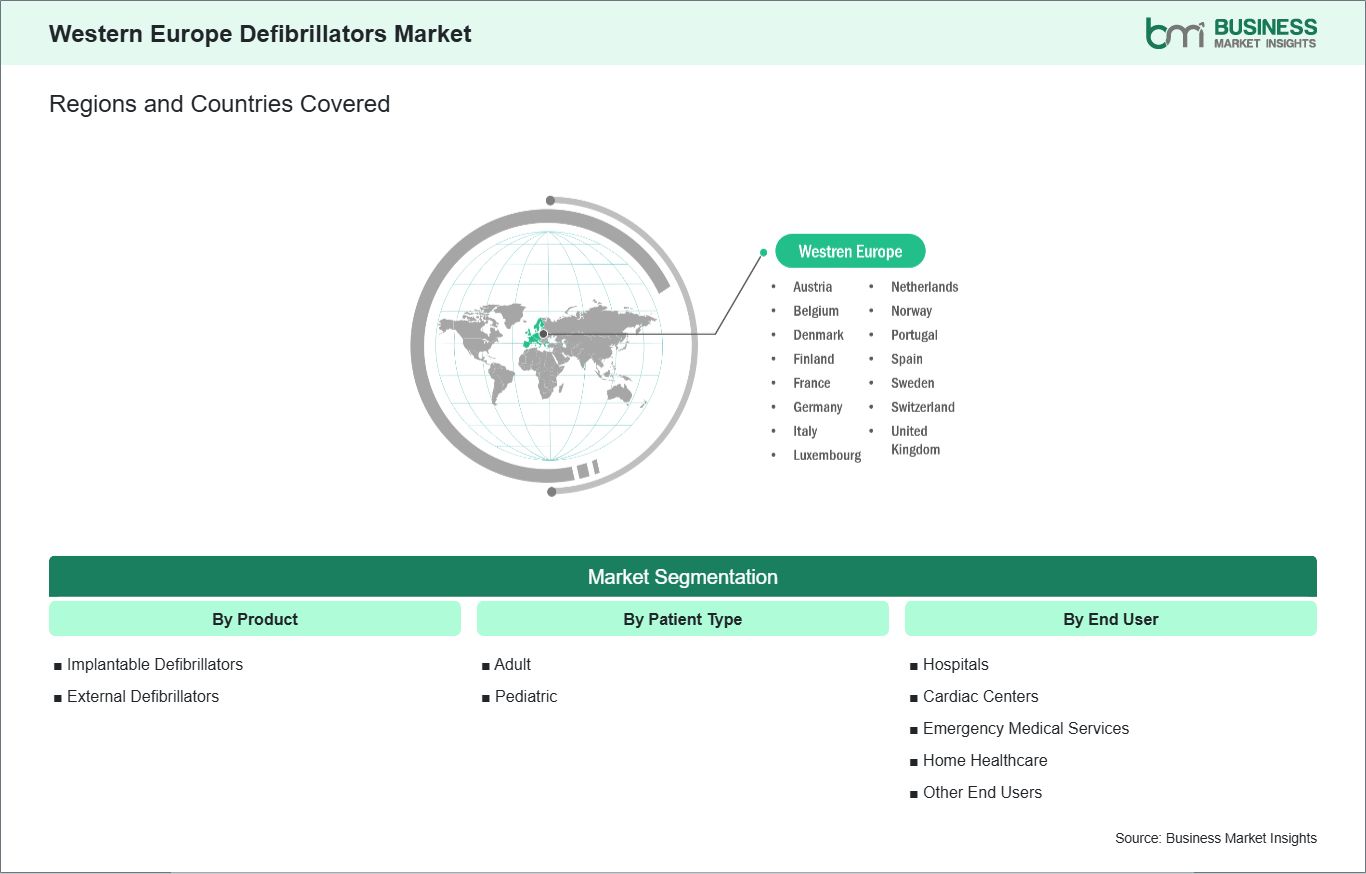
Key segments that contributed to the derivation of the Western Europe Defibrillators market analysis are product type, patient type, and end user.
Western Europe continues to experience significant pressure from cardiovascular diseases, which remain among the leading causes of illness and mortality. As health systems work to manage long‑term care and acute emergencies, demand for defibrillation technology has grown steadily, with hospitals and emergency services integrating these devices deeper into cardiac care frameworks.
Demographic shifts — notably aging populations combined with lifestyle factors including sedentary work patterns and dietary trends — have reinforced the prevalence of heart and vascular conditions. This trend has influenced how healthcare providers plan and allocate resources, with defibrillators viewed as essential tools for intensive care units and for broader emergency response networks. Cardiologists and emergency physicians emphasize the importance of rapid rhythm correction, which has helped solidify defibrillators as standard equipment in cardiac care pathways.
Healthcare infrastructure generally supports widespread access to advanced medical technology, yet there are national differences in how cardiac care is delivered. In major urban centers such as Paris, Berlin, and Madrid, state‑of‑the‑art defibrillators are a fixture in public and private hospitals. Meanwhile, regional health authorities continue to expand capabilities in more rural areas to ensure that sudden cardiac events can be addressed promptly regardless of location, driving the uptake of defibrillation solutions.
In Western Europe, the idea of placing defibrillators in home settings is gaining traction as part of a broader movement toward patient‑centered and preventative healthcare. Families with members at higher risk of cardiac incidents — including older adults or individuals with known cardiac conditions — are considering personal defibrillators as part of emergency preparedness. This shift reflects a cultural emphasis on health autonomy and proactive risk mitigation, especially in countries where home healthcare support is well established.
Manufacturers are designing devices with intuitive interfaces, clear visual and audio guidance, and simplified maintenance features that make them suitable for non‑professional users. These home‑oriented models are perceived as safe and reliable options for rapid intervention, particularly in regions where emergency medical response times can vary. In markets such as the Netherlands and Scandinavia, consumer confidence in home defibrillators has grown, in part because of local campaigns that highlight survival benefits when treatment begins before professional help arrives.
Alongside product innovation, public awareness and training efforts are accelerating acceptance of home‑use defibrillators. Community programs, voluntary first responder networks, and digital training platforms are helping ordinary citizens build familiarity and confidence with defibrillator operation. As a result, home adoption is no longer limited to clinical or high‑risk care environments; instead, it is emerging as a practical complement to formal medical services, reinforcing the role of defibrillators within personal and community health strategies throughout Western Europe.

The Western Europe Defibrillators market demonstrates steady growth, with size and share analysis highlighting evolving trends and competitive dynamics among key players. The report evaluates important subsegments categorized within product type, patient type, and end user, highlighting their respective contributions to overall market performance.
By product type, the implantable defibrillators subsegment dominated the market in 2025. Their adoption is driven by their proven efficacy in preventing sudden cardiac arrest, long-term reliability, and ability to continuously monitor and correct life-threatening arrhythmias, making them a cornerstone in cardiac care.
In terms of patient type, the adults subsegment dominated the market in 2025 due to the higher prevalence of cardiac disorders in the adult population, increased awareness of sudden cardiac death prevention, and greater accessibility of advanced defibrillator therapies for adult patients.
Based on end user, the hospitals subsegment dominated the market in 2025. Hospitals remain the primary distribution channel due to their comprehensive cardiac care facilities, access to trained cardiologists and specialized technicians, advanced monitoring infrastructure, and ability to provide immediate, life-saving interventions.
| Report Attribute | Details |
|---|---|
| Market size in 2025 | US$ 1,581.7 Million |
| Market Size by 2033 | US$ 2,473.1 Million |
| CAGR (2026 - 2033) | 5.7% |
| Historical Data | 2022-2024 |
| Forecast period | 2026-2033 |
| Segments Covered | By By Product
|
|
Regions and Countries Covered
| |
| Western Europe | Belgium, Netherlands, Luxembourg, Germany, France, Italy, Spain, Switzerland, Sweden, Austria, United Kingdom, Denmark, Portugal, Norway, Finland |
| Market leaders and key company profiles |
|
The "Western Europe Defibrillators Market Size and Forecast (2022–2033)" report provides a detailed analysis of the market covering below areas:
The geographical scope of the Western Europe Defibrillators market report is divided into: Belgium, the Netherlands, Luxembourg, Germany, France, Italy, Spain, Switzerland, Sweden, Austria, the UK, Denmark, Portugal, Norway, and Finland. Germany held the largest share in 2025.
Germany dominates the market due to its advanced healthcare infrastructure, robust emergency medical services, and proactive public health strategies. Hospitals in major cities such as Berlin, Munich, and Frankfurt integrate external and implantable defibrillators into standard cardiac care protocols, ensuring rapid treatment for at-risk patients. Public access defibrillators are widely available in airports, public transportation hubs, workplaces, and recreational centers, reflecting strong governmental and municipal support for community-level emergency preparedness.
CPR and AED programs are promoted in schools, workplaces, and community centers, helping ensure that bystanders can act confidently during sudden cardiac emergencies. Germany leads in technological innovation, with healthcare providers adopting smart defibrillators that provide real-time guidance and connectivity with emergency services. While rural and remote areas face challenges in equal access, Germany’s coordinated approach to device deployment, training, and emergency response positions it as the benchmark for defibrillator adoption and life-saving cardiac care across Western Europe.

The Western Europe Defibrillators market is evaluated by gathering qualitative and quantitative data post primary and secondary research, which includes important corporate publications, association data, and databases. A few of the key developments in the Western Europe Defibrillators market are:
The Western Europe Defibrillators Market is valued at US$ 1,581.7 Million in 2025, it is projected to reach US$ 2,473.1 Million by 2033.
As per our report Western Europe Defibrillators Market, the market size is valued at US$ 1,581.7 Million in 2025, projecting it to reach US$ 2,473.1 Million by 2033. This translates to a CAGR of approximately 5.7% during the forecast period.
The Western Europe Defibrillators Market report typically cover these key segments-
The historic period, base year, and forecast period can vary slightly depending on the specific market research report. However, for the Western Europe Defibrillators Market report:
The Western Europe Defibrillators Market is populated by several key players, each contributing to its growth and innovation. Some of the major players include:
The Western Europe Defibrillators Market report is valuable for diverse stakeholders, including:
Essentially, anyone involved in or considering involvement in the Western Europe Defibrillators Market value chain can benefit from the information contained in a comprehensive market report.
Please tell us your area of interest
(Market Segments/ Regions and Countries/ Companies)