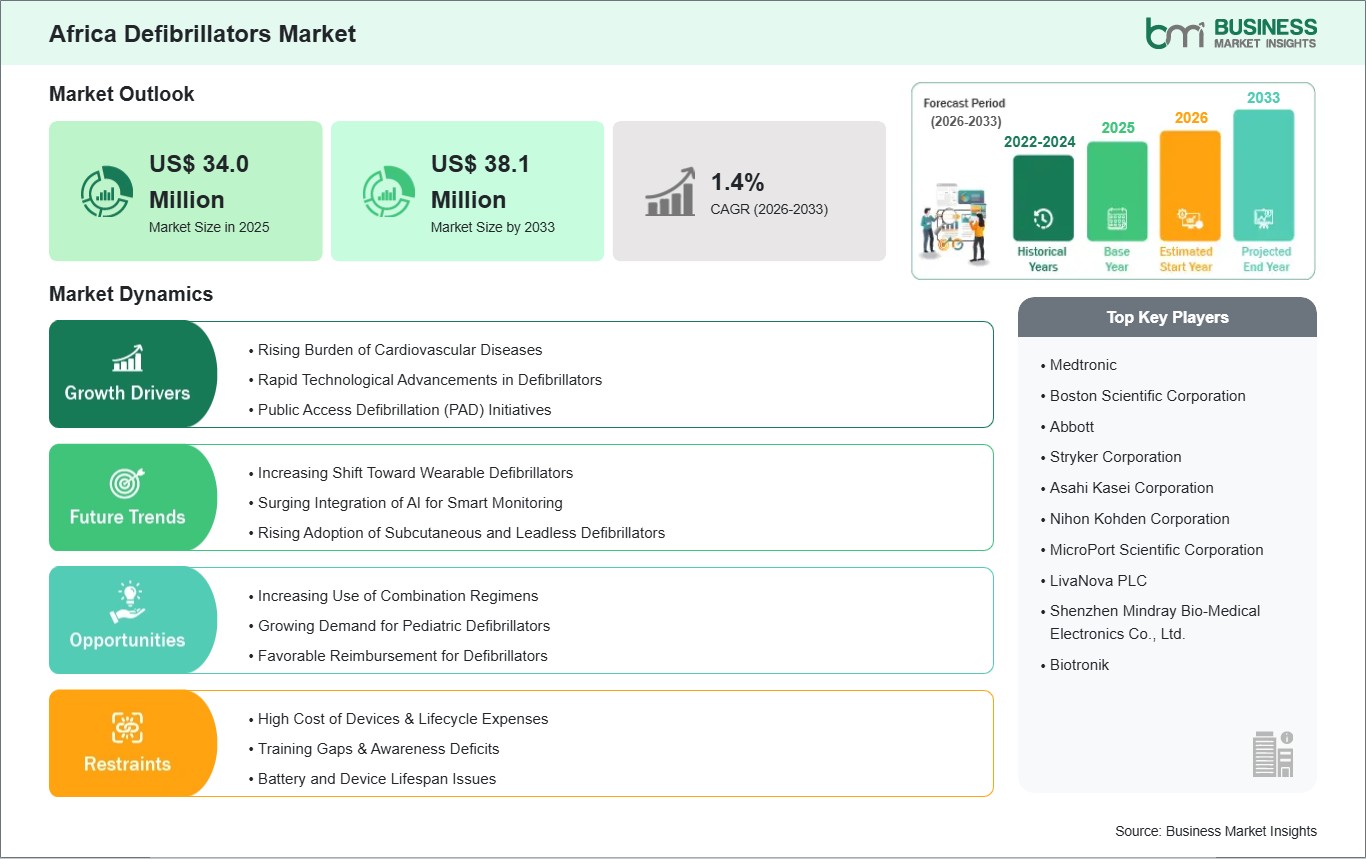
The Africa defibrillators market size is expected to reach US$ 38.1 million by 2033 from US$ 34.0 million in 2025. The market is estimated to record a CAGR of 1.4% from 2026 to 2033.
Heart-related conditions, particularly sudden cardiac arrests, are recognized as urgent health concerns, prompting healthcare providers and communities to invest in life-saving devices. Urbanization and better-equipped hospitals in major cities have contributed to more widespread adoption of automated external defibrillators (AEDs) and hospital-grade defibrillators. Public health campaigns and community initiatives are fostering awareness about rapid response to cardiac events. However, the market faces challenges, particularly in rural areas where access to medical infrastructure and trained personnel remains limited. High costs of advanced defibrillators and limited familiarity with the devices in smaller healthcare settings also restrain adoption. Despite these challenges, the region shows promise as initiatives to expand emergency response networks and public access defibrillation programs continue, signaling a positive trajectory for defibrillator availability and utilization across Africa.

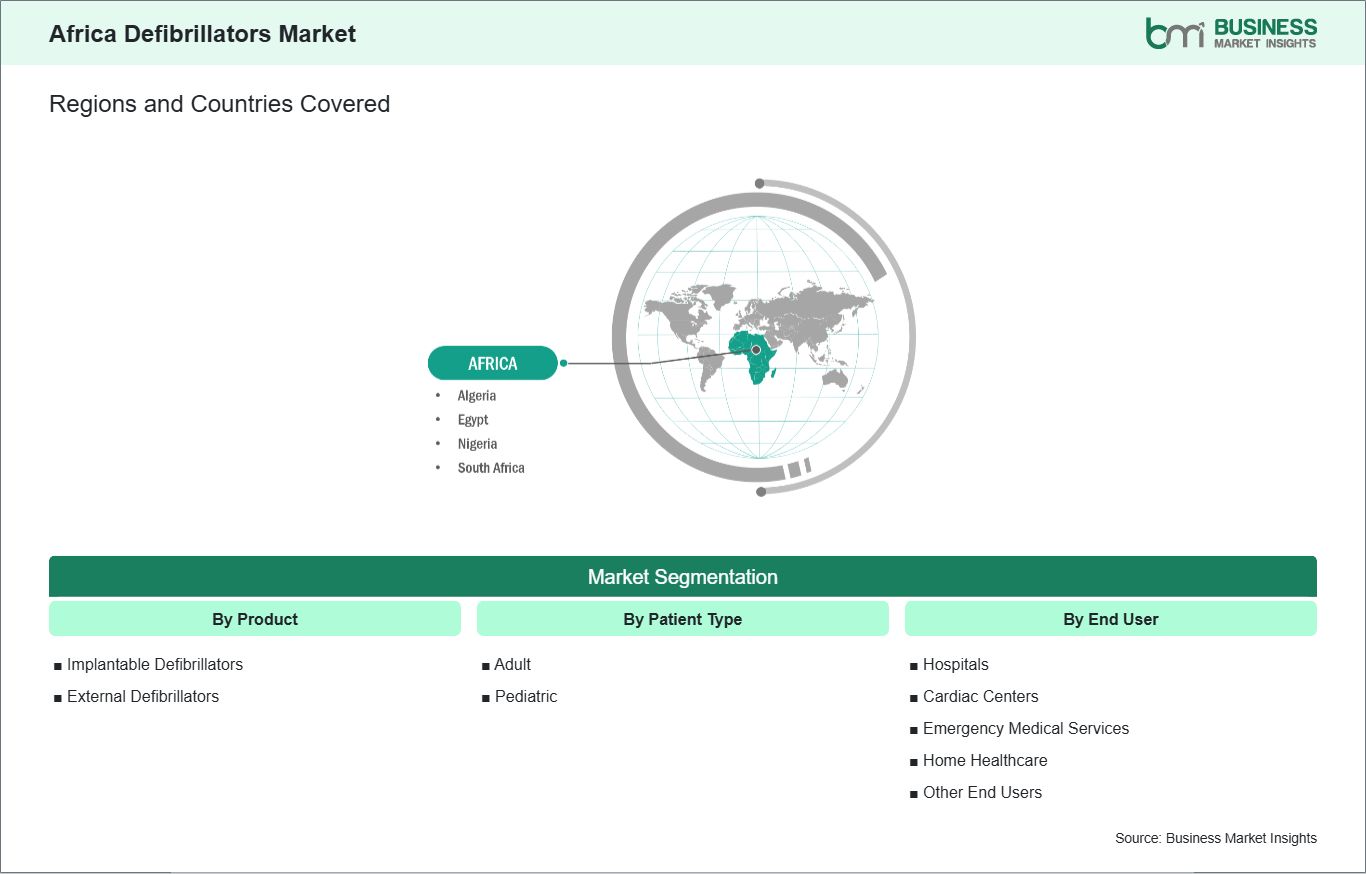
Key segments that contributed to the derivation of the Africa Defibrillators market analysis are product type, patient type, and end user.
Africa is experiencing an increase in cardiovascular diseases (CVDs) due to rapid urbanization, lifestyle changes, and aging populations. Conditions such as coronary artery disease, arrhythmias, and sudden cardiac arrest are becoming more prevalent, particularly in urban centers such as Johannesburg, Lagos, and Nairobi. This rising disease burden is driving the demand for advanced cardiac care, including defibrillators, as hospitals and emergency services work to reduce mortality from acute cardiac events.
Healthcare systems are responding by integrating defibrillators into hospital intensive care units and emergency response protocols. Urban hospitals are expanding cardiac units and training staff in advanced life support techniques, emphasizing the use of AEDs and implantable cardioverter defibrillators (ICDs). This trend reflects the recognition that timely defibrillation is critical in managing life-threatening arrhythmias.
Despite this focus, access remains uneven across the continent. Rural and low-resource areas have limited availability of emergency cardiac equipment, and the delayed presentation of patients with heart disease complicates outcomes. Initiatives to expand training, improve awareness, and equip ambulances with defibrillators are emerging as key strategies to bridge this gap and ensure more equitable access to lifesaving devices.
There is growing interest in home-based defibrillators in Africa, particularly for patients with a history of heart disease or high risk of cardiac arrest. Patients and caregivers are increasingly recognizing the importance of immediate intervention in life-threatening events, prompting the adoption of portable AEDs for home use. Public awareness campaigns and patient advocacy groups in countries such as South Africa and Kenya are driving this cultural shift.
The rise of telemedicine and home-based healthcare services is contributing to the trend. Medical professionals are advising patients on using user-friendly, portable defibrillators at home, often combined with basic CPR training for family members. This approach aims to improve survival from out-of-hospital cardiac events, especially in regions where emergency medical response times may be long due to traffic congestion or sparse ambulance networks.
However, affordability and infrastructure challenges remain barriers to widespread home adoption. Many households cannot easily purchase or maintain these devices, and power supply issues can affect device reliability. Despite these constraints, continued efforts by NGOs, healthcare providers, and government programs to improve access and training suggest that home-based defibrillators will become an important component of cardiac care across Africa in the coming years.

The Africa Defibrillators market demonstrates steady growth, with size and share analysis highlighting evolving trends and competitive dynamics among key players. The report evaluates important subsegments categorized within product type, patient type, and end user, highlighting their respective contributions to overall market performance.
By product type, the implantable defibrillators subsegment dominated the market in 2025. Their adoption is driven by their proven efficacy in preventing sudden cardiac arrest, long-term reliability, and ability to continuously monitor and correct life-threatening arrhythmias, making them a cornerstone in cardiac care.
In terms of patient type, the adults subsegment dominated the market in 2025 due to the higher prevalence of cardiac disorders in the adult population, increased awareness of sudden cardiac death prevention, and greater accessibility of advanced defibrillator therapies for adult patients.
Based on end user, the hospitals subsegment dominated the market in 2025. Hospitals remain the primary distribution channel due to their comprehensive cardiac care facilities, access to trained cardiologists and specialized technicians, advanced monitoring infrastructure, and ability to provide immediate, life-saving interventions.
| Report Attribute | Details |
|---|---|
| Market size in 2025 | US$ 34.0 Million |
| Market Size by 2033 | US$ 38.1 Million |
| CAGR (2026 - 2033) | 1.4% |
| Historical Data | 2022-2024 |
| Forecast period | 2026-2033 |
| Segments Covered | By By Product
|
|
Regions and Countries Covered
| |
| Africa | Egypt, South Africa, Nigeria, Algeria |
| Market leaders and key company profiles |
|
The "Africa Defibrillators Market Size and Forecast (2022–2033)" report provides a detailed analysis of the market covering below areas:
The geographical scope of the Africa defibrillators market report is divided into: Nigeria, Egypt, South Africa, and Algeria. South Africa held the largest share in 2025.
South Africa is the leading country in the market due to its advanced healthcare infrastructure and focus on emergency preparedness. Hospitals in major cities are modernizing cardiac care units, while public initiatives are promoting awareness of AEDs and their life-saving potential. Public spaces, workplaces, and transport hubs are adopting defibrillators, reflecting growing recognition of the importance of immediate cardiac intervention. South Africa benefits from training programs and awareness campaigns led by medical associations and non-governmental organizations, which educate the public and healthcare staff on the use of defibrillators. Despite these efforts, rural areas experience limited access, and procurement in healthcare facilities can be challenging due to cost considerations. South Africa remains the regional hub for defibrillator adoption and awareness, setting a standard for other African countries to follow.

The Africa Defibrillators market is evaluated by gathering qualitative and quantitative data post primary and secondary research, which includes important corporate publications, association data, and databases. A few of the key developments in the Africa Defibrillators market are:
The Africa Defibrillators Market is valued at US$ 34.0 Million in 2025, it is projected to reach US$ 38.1 Million by 2033.
As per our report Africa Defibrillators Market, the market size is valued at US$ 34.0 Million in 2025, projecting it to reach US$ 38.1 Million by 2033. This translates to a CAGR of approximately 1.4% during the forecast period.
The Africa Defibrillators Market report typically cover these key segments-
The historic period, base year, and forecast period can vary slightly depending on the specific market research report. However, for the Africa Defibrillators Market report:
The Africa Defibrillators Market is populated by several key players, each contributing to its growth and innovation. Some of the major players include:
The Africa Defibrillators Market report is valuable for diverse stakeholders, including:
Essentially, anyone involved in or considering involvement in the Africa Defibrillators Market value chain can benefit from the information contained in a comprehensive market report.
Please tell us your area of interest
(Market Segments/ Regions and Countries/ Companies)