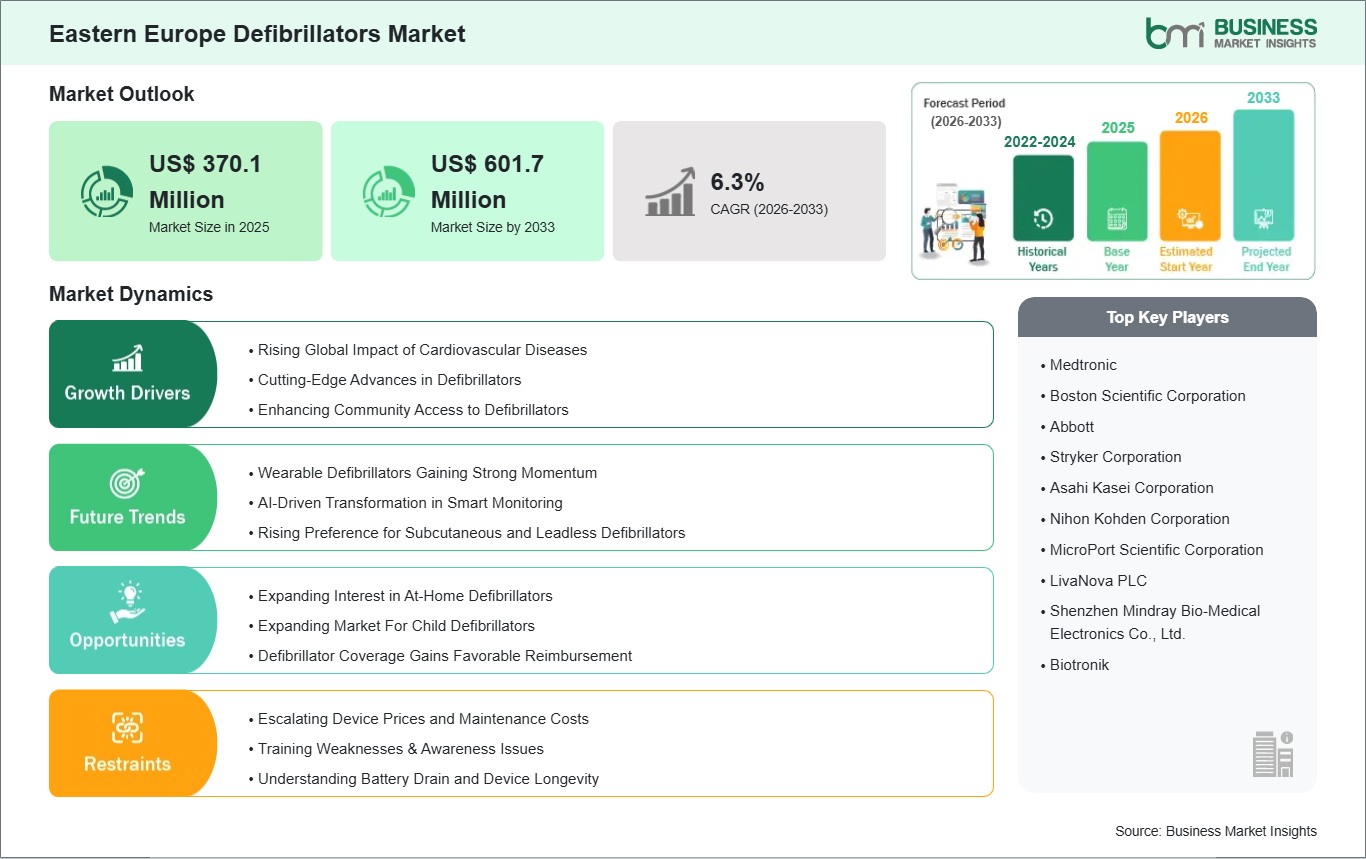
The Eastern Europe Defibrillators market size is expected to reach US$ 601.7 million by 2033 from US$ 370.1 million in 2025. The market is estimated to record a CAGR of 6.3% from 2026 to 2033.
Increased awareness of sudden cardiac arrest, coupled with a growing prevalence of cardiovascular conditions, is driving demand for automated external defibrillators (AEDs) and implantable cardioverter defibrillators (ICDs). Governments and private healthcare providers are working to strengthen pre-hospital care, promote public access defibrillation programs, and integrate modern technologies into hospitals and emergency response systems.
Market growth is fueled by expanding public health initiatives, urban emergency medical services (EMS) development, and partnerships between healthcare institutions and medical device manufacturers. Public training campaigns on CPR and AED usage are improving bystander readiness and emergency response times, particularly in urban centers. In addition, the push toward integrating advanced defibrillators with digital monitoring systems and hospital networks is enhancing device utility and patient outcomes.
In rural and remote areas, EMS infrastructure is limited, and access to defibrillation devices is uneven. Regulatory hurdles and the varying pace of healthcare modernization across Eastern European countries create barriers for rapid adoption.

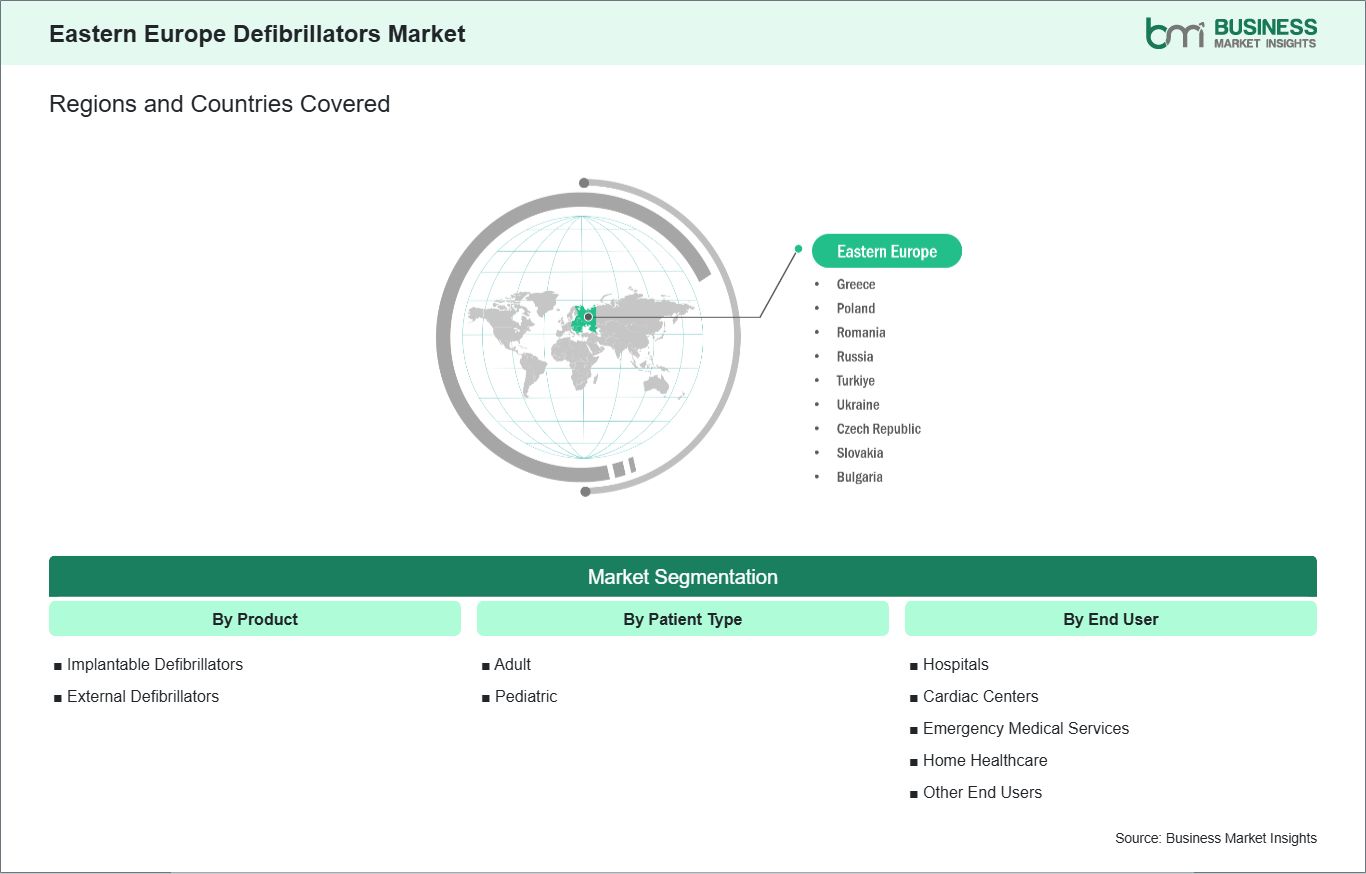
Key segments that contributed to the derivation of the Eastern Europe Defibrillators market analysis are product type, patient type, and end user.
Eastern Europe is facing a significant rise in cardiovascular diseases (CVDs) due to aging populations, lifestyle shifts, and high prevalence of risk factors such as hypertension, smoking, and poor diet. Coronary artery disease, heart failure, and sudden cardiac arrest are common in countries such as Poland, Romania, and Ukraine. Urban centers, including Warsaw, Bucharest, and Kyiv, are seeing high patient loads in cardiology departments, which is driving demand for advanced cardiac care technologies such as defibrillators.
Healthcare systems are responding by incorporating defibrillators into hospitals, emergency services, and cardiac care units. Urban hospitals are expanding intensive care capabilities and training staff in advanced life support techniques. AEDs and ICDs are being deployed more widely, reflecting a growing awareness of the importance of rapid intervention in life-threatening cardiac events. This expansion supports emergency response teams in improving survival rates from sudden cardiac arrests outside hospital settings.
Despite these efforts, access to defibrillators remains uneven across the region. Rural areas and smaller towns lack sufficient emergency equipment, and patients face delays in receiving care. Initiatives are emerging to train healthcare providers, increase public awareness, and equip ambulances with AEDs. These measures aim to reduce disparities in cardiac care access and ensure that life-saving interventions are available even in remote communities.
Interest in home-based defibrillators is growing among high-risk patients and households with a history of heart disease. Individuals and families are recognizing the critical importance of immediate intervention during cardiac emergencies, driving an increase in portable AED adoption. Awareness campaigns in countries such as Hungary and the Czech Republic are helping to educate the public about the benefits of home-based defibrillators.
The development of telemedicine and home healthcare services is supporting this trend. Medical professionals are advising patients on the use of user-friendly, portable defibrillators at home, often combined with CPR training for family members. This trend is important in regions where emergency response times can be prolonged due to geographic or infrastructure challenges. Home-based defibrillators provide a vital first line of defense, improving survival chances for cardiac events occurring outside clinical settings.
Challenges remain in expanding access to residential defibrillators across Eastern Europe. Cost and device maintenance present barriers for households, and public knowledge about device operation is limited in many areas. Nevertheless, ongoing efforts by healthcare providers, patient advocacy groups, and government programs to increase awareness and accessibility indicate that home-based defibrillators will play a central role in cardiac care across the region in the years ahead.

The Eastern Europe Defibrillators market demonstrates steady growth, with size and share analysis highlighting evolving trends and competitive dynamics among key players. The report evaluates important subsegments categorized within product type, patient type, and end user, highlighting their respective contributions to overall market performance.
By product type, the implantable defibrillators subsegment dominated the market in 2025. Their adoption is driven by their proven efficacy in preventing sudden cardiac arrest, long-term reliability, and ability to continuously monitor and correct life-threatening arrhythmias, making them a cornerstone in cardiac care.
In terms of patient type, the adults subsegment dominated the market in 2025 due to the higher prevalence of cardiac disorders in the adult population, increased awareness of sudden cardiac death prevention, and greater accessibility of advanced defibrillator therapies for adult patients.
Based on end user, the hospitals subsegment dominated the market in 2025. Hospitals remain the primary distribution channel due to their comprehensive cardiac care facilities, access to trained cardiologists and specialized technicians, advanced monitoring infrastructure, and ability to provide immediate, life-saving interventions.
| Report Attribute | Details |
|---|---|
| Market size in 2025 | US$ 370.1 Million |
| Market Size by 2033 | US$ 601.7 Million |
| CAGR (2026 - 2033) | 6.3% |
| Historical Data | 2022-2024 |
| Forecast period | 2026-2033 |
| Segments Covered | By By Product
|
|
Regions and Countries Covered
| |
| Eastern Europe | Russia, Poland, Romania, Czech Republic, Greece, Ukraine, Slovakia, Bulgaria |
| Market leaders and key company profiles |
|
The "Eastern Europe Defibrillators Market Size and Forecast (2022–2033)" report provides a detailed analysis of the market covering below areas:
The geographical scope of the Eastern Europe Defibrillators market report is divided into: Russia, Poland, Romania, the Czech Republic, Ukraine, Romania, Greece, Slovakia, and Bulgaria. Russia held the largest share in 2025.
Russia dominates the Eastern Europe defibrillators market due to its vast population, extensive urban centers, and government-led initiatives to improve emergency cardiovascular care. Hospitals, clinics, and EMS units in major cities are equipped with advanced defibrillators, both for in-hospital and pre-hospital use. AEDs are being deployed in public spaces, including airports, metro stations, shopping centers, and large workplaces, as part of national programs aimed at reducing mortality from sudden cardiac arrest.
Public awareness campaigns, coupled with nationwide CPR and AED training programs, are empowering citizens to respond during emergencies. Domestic medical device manufacturers are complementing international players by providing accessible AED solutions tailored to Russian healthcare needs. At the same time, advanced ICDs are being adopted in tertiary care hospitals to manage patients with severe cardiac conditions.
Challenges remain in extending defibrillator coverage to rural regions, where emergency response times are longer, and infrastructure is less developed. Additionally, navigating regulatory requirements for new device approvals can slow the introduction of innovative solutions. Nevertheless, Russia’s focus on modernizing EMS, public access programs, and hospital-based defibrillator adoption reinforces its leadership position within the market.

The Eastern Europe Defibrillators market is evaluated by gathering qualitative and quantitative data post primary and secondary research, which includes important corporate publications, association data, and databases. A few of the key developments in the Eastern Europe Defibrillators market are:
The Eastern Europe Defibrillators Market is valued at US$ 370.1 Million in 2025, it is projected to reach US$ 601.7 Million by 2033.
As per our report Eastern Europe Defibrillators Market, the market size is valued at US$ 370.1 Million in 2025, projecting it to reach US$ 601.7 Million by 2033. This translates to a CAGR of approximately 6.3% during the forecast period.
The Eastern Europe Defibrillators Market report typically cover these key segments-
The historic period, base year, and forecast period can vary slightly depending on the specific market research report. However, for the Eastern Europe Defibrillators Market report:
The Eastern Europe Defibrillators Market is populated by several key players, each contributing to its growth and innovation. Some of the major players include:
The Eastern Europe Defibrillators Market report is valuable for diverse stakeholders, including:
Essentially, anyone involved in or considering involvement in the Eastern Europe Defibrillators Market value chain can benefit from the information contained in a comprehensive market report.
Please tell us your area of interest
(Market Segments/ Regions and Countries/ Companies)