Market Summary
Executive Summary and Market Analysis
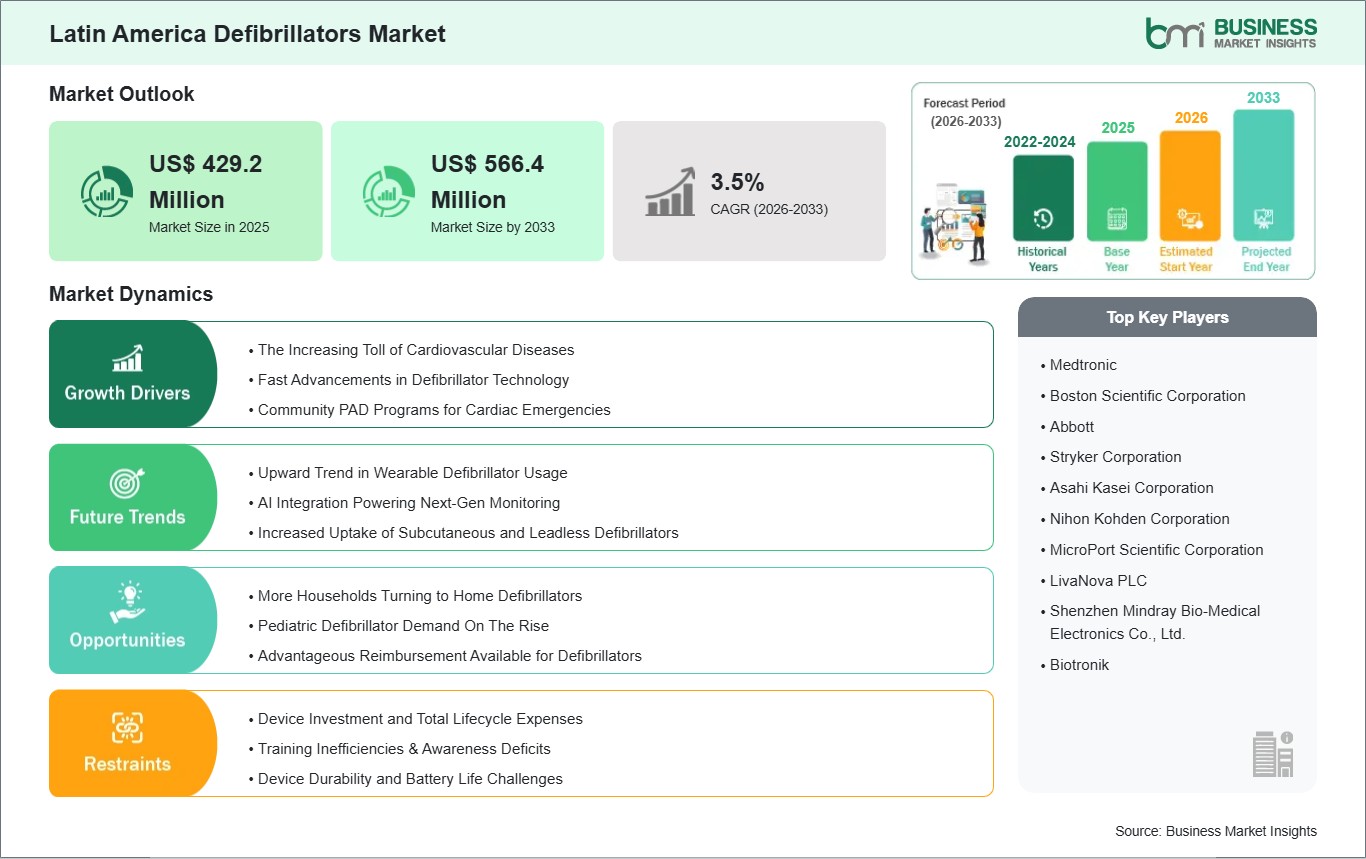
Increasing incidences of cardiovascular disease, coupled with government and private healthcare initiatives, are encouraging hospitals, clinics, and emergency response teams to expand the availability of defibrillators. Public access programs are being implemented in high-traffic areas such as airports, shopping centers, and sports facilities, reflecting a focus on timely response to cardiac emergencies. Technological advancements, particularly in portable and user-friendly automated external defibrillators (AEDs), are making these devices more accessible and easier to use, even for non-medical personnel.
Limited awareness and training among the general population restrict the use of defibrillators outside clinical settings. Additionally, disparities in healthcare infrastructure across different countries result in uneven adoption, with rural and underserved regions having fewer devices and slower implementation of public access programs. Latin America continues to prioritize emergency preparedness, with increasing collaboration between public health authorities and private healthcare providers to improve accessibility and enhance survival outcomes during cardiac events.
Segment Analysis
Latin America Defibrillators Market Segmentation
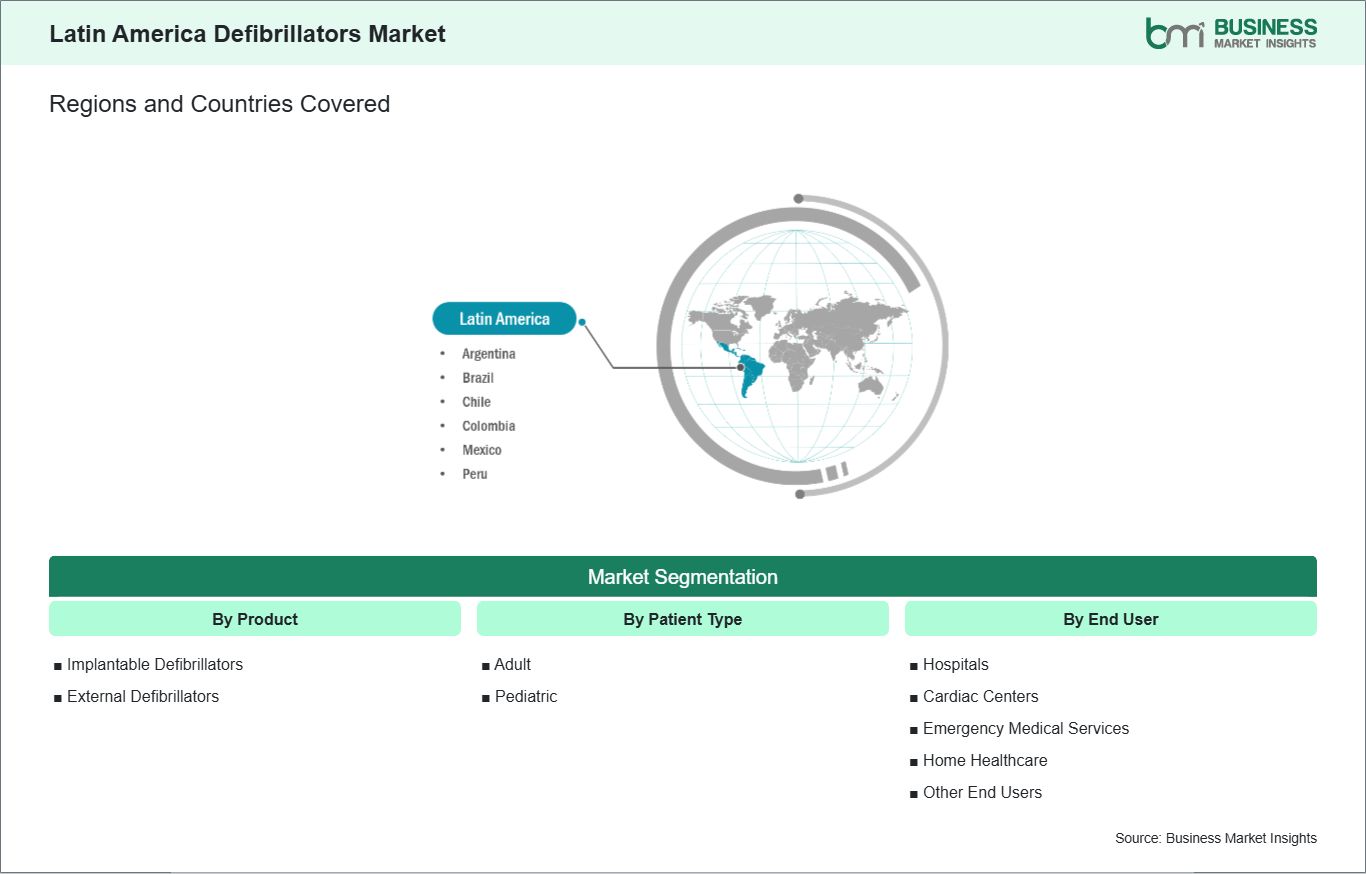
Key segments that contributed to the derivation of the Latin America Defibrillators market analysis are product type, patient type, and end user.
- By product type, the Defibrillators market is segmented into implantable defibrillators and external defibrillators. The implantable defibrillators segment dominated the market in 2025.
- Based on patient type, the Defibrillators market is classified into adult and pediatric. The adults segment dominated the market in 2025.
- In terms of end user, the Defibrillators market is categorized into hospitals, cardiac centers, emergency medical services, home healthcare, and other end users. The hospitals segment dominated the market in 2025.
Market Forces
Latin America Defibrillators Market Drivers and Opportunities
Increasing Toll of Cardiovascular Diseases
Cardiovascular diseases are shaping healthcare priorities across Latin America. Hospitals and clinics in countries such as Brazil, Mexico, and Argentina are reporting a steady rise in patients experiencing heart-related emergencies, which is prompting greater investment in life-saving technologies. The growing awareness of heart disease risks has made cardiac care a central focus for public and private healthcare providers, influencing demand for defibrillators.
The rising prevalence of cardiovascular conditions has heightened the urgency for rapid intervention tools. Emergency response teams are expanding their use of defibrillators in ambulances, hospitals, and public spaces to improve survival rates. This expansion has created a steady pipeline of demand for external and implantable defibrillators, as healthcare systems adapt to manage sudden cardiac incidents.
Hospitals and clinics are collaborating with local communities to promote heart health awareness, often highlighting the importance of immediate access to defibrillators. This collaboration positioned defibrillator manufacturers as key partners in regional health initiatives, further strengthening market opportunities.
Households Turning to Home Defibrillators
Families in urban centers are considering defibrillators as a proactive measure to manage potential cardiac emergencies. As awareness is growing, defibrillators are becoming more than just hospital equipment—they are now seen as essential components of personal health preparedness.
The shift toward home-based cardiac care is supported by evolving consumer attitudes. People are prioritizing safety and convenience, recognizing that immediate access to a defibrillator can be life-saving. This trend is visible in metropolitan areas, where households are more likely to invest in advanced healthcare technologies for family protection.
In smaller towns and rural areas, accessibility and cost remain barriers, and education on proper usage is still developing. Despite these challenges, interest in home defibrillators is rising, suggesting that manufacturers who focus on user-friendly and affordable models will find a growing market across Latin America.
Size and Share Analysis
Latin America Defibrillators Market Size and Share Analysis
The Latin America Defibrillators market demonstrates steady growth, with size and share analysis highlighting evolving trends and competitive dynamics among key players. The report evaluates important subsegments categorized within product type, patient type, and end user, highlighting their respective contributions to overall market performance.
By product type, the implantable defibrillators subsegment dominated the market in 2025. Their adoption is driven by their proven efficacy in preventing sudden cardiac arrest, long-term reliability, and ability to continuously monitor and correct life-threatening arrhythmias, making them a cornerstone in cardiac care.
In terms of patient type, the adults subsegment dominated the market in 2025 due to the higher prevalence of cardiac disorders in the adult population, increased awareness of sudden cardiac death prevention, and greater accessibility of advanced defibrillator therapies for adult patients.
Based on end user, the hospitals subsegment dominated the market in 2025. Hospitals remain the primary distribution channel due to their comprehensive cardiac care facilities, access to trained cardiologists and specialized technicians, advanced monitoring infrastructure, and ability to provide immediate, life-saving interventions.
Report Coverage
Latin America Defibrillators Market Report Coverage and Deliverables
The "Latin America Defibrillators Market Size and Forecast (2022–2033)" report provides a detailed analysis of the market covering below areas:
- Latin America Defibrillators market size and forecast at regional and country levels for all market segments covered under the scope
- Latin America Defibrillators market trends, as well as drivers, restraints, and opportunities
- Latin America Defibrillators market analysis covering key trends, regional framework, major players, regulations, and recent developments
- Industry landscape and competition analysis covering market concentration, heat map analysis, prominent players, and recent developments for the Latin America Defibrillators market
- Detailed company profiles, including SWOT analysis
Geographic Insights
Latin America Defibrillators Market Geographic Insights
The geographical scope of the Latin America Defibrillators market report is divided into: Brazil, Mexico, Argentina, Colombia, Chile, and Peru. Mexico held the largest share in 2025.
Mexico dominates the market due to its advanced healthcare infrastructure and growing emphasis on cardiac emergency preparedness. The country’s mixed public–private healthcare system plays a significant role in shaping demand patterns. Private hospitals and specialty cardiac centers are early adopters of technologically advanced defibrillation systems. Public institutions are upgrading emergency response capabilities as part of healthcare modernization efforts. Mexico’s urban centers have seen stronger momentum toward improving emergency medical services, including better-equipped ambulatory networks and hospital emergency departments. There is an increase in awareness among healthcare professionals regarding the importance of rapid defibrillation in improving survival outcomes. This trend has encouraged the procurement of automated and semi-automated external defibrillators that can be deployed in high-pressure clinical settings. However, widespread public access defibrillator placement is developing, as comprehensive national mandates for installation in public spaces remain limited. Budgetary limitations in public hospitals and reliance on imported medical devices can affect procurement cycles. Expanding private healthcare investments and training initiatives in emergency response reinforce Mexico’s leadership within the market.
Industry Activity
Recent Developments
The Latin America Defibrillators market is evaluated by gathering qualitative and quantitative data post primary and secondary research, which includes important corporate publications, association data, and databases. A few of the key developments in the Latin America Defibrillators market are:
- In January 2026, Abbott announced that it entered a collaboration with AtaCor Medical to advance a next‑generation extravascular implantable cardioverter defibrillator (EV‑ICD) system, planning a pivotal clinical evaluation of the combined investigational technology — a development that, while global, includes an ongoing clinical strategy and potential regional implications given ongoing studies in Paraguay.
- In March 2025, AtaCor Medical announced that it selected Paraguay as the site for a groundbreaking first‑in‑human clinical study of its next‑generation Extravascular Implantable Cardioverter Defibrillator (EV‑ICD) technology, reinforcing Latin America’s position as a key destination for early‑stage medtech trials and advancing its innovative defibrillator lead system designed to treat life‑threatening arrhythmias without hardware inside the heart.
Trust & Transparency
Research Methodology
The market analysis combines proprietary research with secondary data from government agencies, company disclosures, regulatory filings, industry databases and expert interviews. Market estimates are validated through data triangulation, cross-market benchmarking and analyst
review.
View Full Research Methodology
Key Sources Referred:
The World Bank World Health Organization (WHO) Center for Disease Control and Prevention (CDC) European Database on Medical Devices (EUDAMED) European Society of Cardiology American College of Cardiology American Heart Association Company Websites Company Annual Reports Company Investor Presentations