Market Summary
Executive Summary and Market Analysis
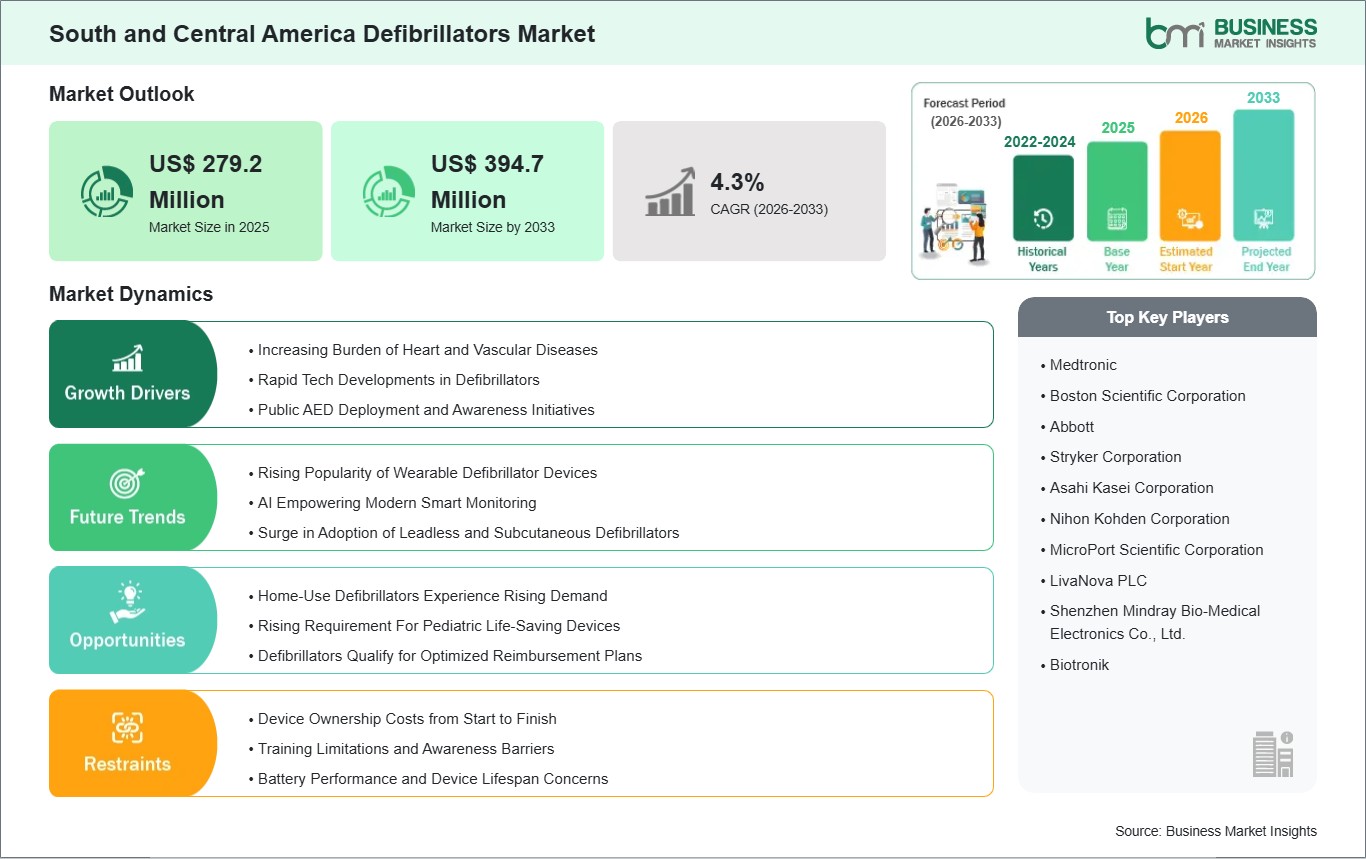
Growing awareness of cardiovascular diseases and sudden cardiac arrests is prompting governments and healthcare providers to expand the availability of defibrillators in hospitals, clinics, and ambulances. Urban centers are witnessing the introduction of public access defibrillator programs in high-traffic locations such as airports, shopping centers, sports arenas, and schools, reflecting a regional push for community-level emergency preparedness. Advancements in portable and automated external defibrillators (AEDs) are making it easier for healthcare professionals and trained civilians to respond to cardiac emergencies, improving survival outcomes.
Healthcare infrastructure remains uneven across the region, with rural and underserved areas having limited access to devices. Training and awareness programs for the general population are in development, which can affect the effectiveness of public access initiatives. High costs of advanced defibrillators and maintenance requirements restrict adoption by smaller clinics and emergency services. Nonetheless, ongoing efforts by governments, private healthcare providers, and nonprofit organizations to promote cardiac emergency preparedness are strengthening the market across South and Central America.
Segment Analysis
South and Central America Defibrillators Market Segmentation
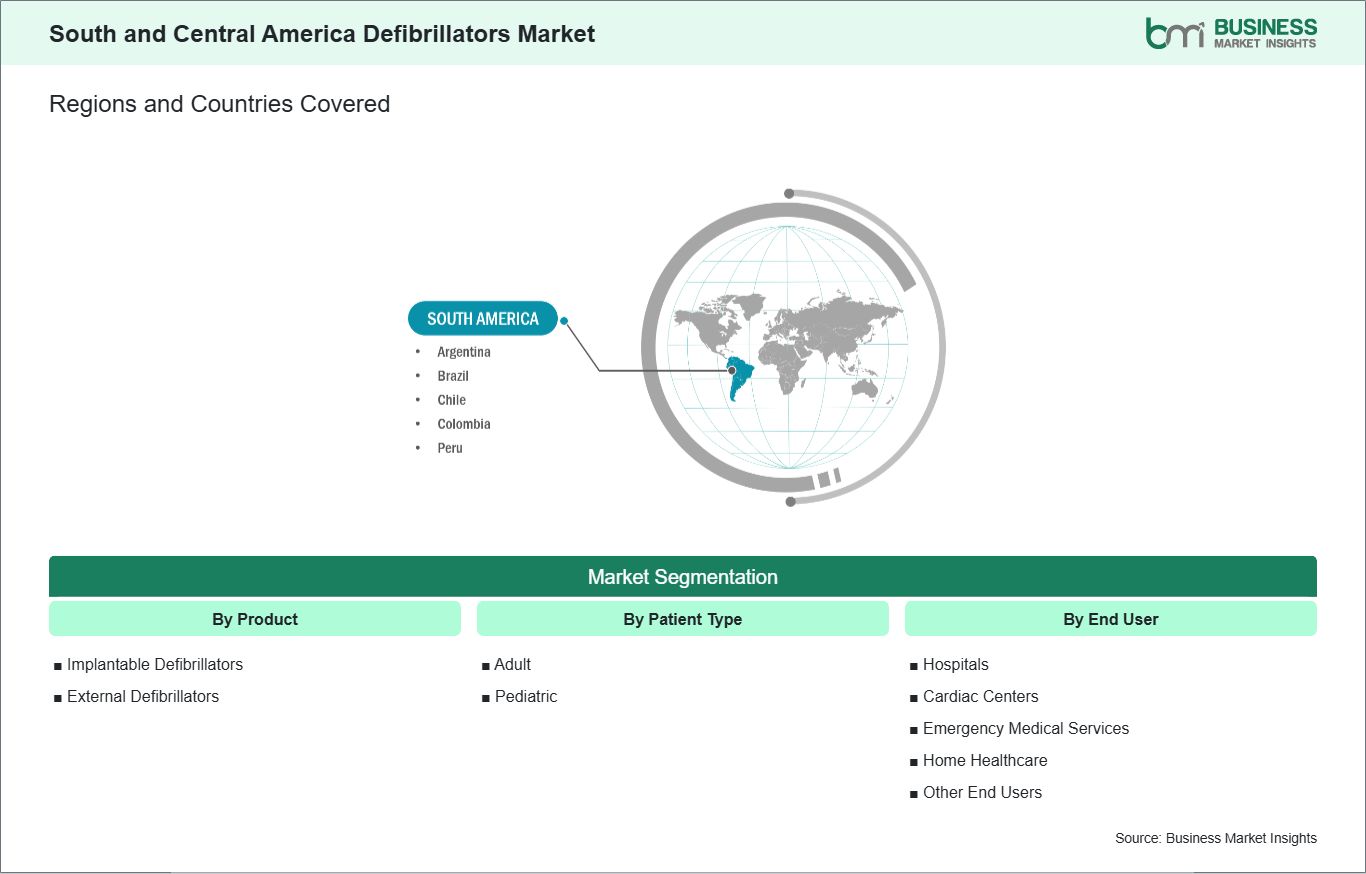
Key segments that contributed to the derivation of the South and Central America Defibrillators market analysis are product type, patient type, and end user.
- By product type, the Defibrillators market is segmented into implantable defibrillators and external defibrillators. The implantable defibrillators segment dominated the market in 2025.
- Based on patient type, the Defibrillators market is classified into adult and pediatric. The adults segment dominated the market in 2025.
- In terms of end user, the Defibrillators market is categorized into hospitals, cardiac centers, emergency medical services, home healthcare, and other end users. The hospitals segment dominated the market in 2025.
Market Forces
South and Central America Defibrillators Market Drivers and Opportunities
Increasing Burden of Heart and Vascular Diseases
In South and Central America, heart and vascular diseases remain a dominant health challenge across diverse populations, from megacities to rural communities. Countries such as Brazil, Argentina, and Colombia see heart attacks, strokes, and sudden cardiac arrests as major causes of mortality. This regional disease burden has placed defibrillators at the core of emergency cardiac care in public hospitals and specialized cardiac units.
The impact of lifestyle transitions— including urbanization, changes in diet, and rising rates of conditions like hypertension and diabetes — has amplified cardiovascular risks. Healthcare systems are working to ensure that implantable and external defibrillation technologies are available to manage acute events and potentially improve long‑term outcomes. Defibrillators are being prioritized for hospitals and for cardiology clinics that serve high‑risk patients.
Variations in access to cardiac care influence how defibrillator solutions are deployed. In larger urban centers, advanced cardiac intervention units integrate defibrillation into standard treatment protocols. In peripheral or underserved areas, basic emergency response capacities are being strengthened to ensure defibrillators are available where they can have the most impact on survival during sudden cardiac incidents.
Home-Use Defibrillators Experience Rising Demand
As awareness of sudden cardiac arrest rises, households with elderly adults or individuals with known heart conditions are exploring the adoption of personal automated external defibrillators for emergency readiness. For families, owning a device at home provides a tangible sense of preparedness when faced with life‑threatening cardiac episodes.
The increasing availability of user‑friendly defibrillators designed for non‑medical environments has made home adoption more accessible. These devices include automatic guidance and simple operation, helping family members without clinical training respond if an emergency occurs. In countries with longer emergency response times due to geographic or infrastructure constraints, home‑based defibrillators are gaining traction as a complement to formal medical support.
Community outreach and training efforts are helping demystify the use of home defibrillators. Local health programs and private initiatives are offering education on basic life‑support techniques, which builds confidence among consumers and encourages the integration of defibrillators into personal health strategies. As a result, home‑use defibrillators are emerging as a meaningful segment of the regional market — particularly among middle‑income households focused on proactive health and safety planning.
Size and Share Analysis
South and Central America Defibrillators Market Size and Share Analysis
The South and Central America Defibrillators market demonstrates steady growth, with size and share analysis highlighting evolving trends and competitive dynamics among key players. The report evaluates important subsegments categorized within product type, patient type, and end user, highlighting their respective contributions to overall market performance.
By product type, the implantable defibrillators subsegment dominated the market in 2025. Their adoption is driven by their proven efficacy in preventing sudden cardiac arrest, long-term reliability, and ability to continuously monitor and correct life-threatening arrhythmias, making them a cornerstone in cardiac care.
In terms of patient type, the adults subsegment dominated the market in 2025 due to the higher prevalence of cardiac disorders in the adult population, increased awareness of sudden cardiac death prevention, and greater accessibility of advanced defibrillator therapies for adult patients.
Based on end user, the hospitals subsegment dominated the market in 2025. Hospitals remain the primary distribution channel due to their comprehensive cardiac care facilities, access to trained cardiologists and specialized technicians, advanced monitoring infrastructure, and ability to provide immediate, life-saving interventions.
Report Coverage
South and Central America Defibrillators Market Report Coverage and Deliverables
The "South and Central America Defibrillators Market Size and Forecast (2022–2033)" report provides a detailed analysis of the market covering below areas:
- South and Central America Defibrillators market size and forecast at regional and country levels for all market segments covered under the scope
- South and Central America Defibrillators market trends, as well as drivers, restraints, and opportunities
- South and Central America Defibrillators market analysis covering key trends, regional framework, major players, regulations, and recent developments
- Industry landscape and competition analysis covering market concentration, heat map analysis, prominent players, and recent developments for the South and Central America Defibrillators market
- Detailed company profiles, including SWOT analysis
Geographic Insights
South and Central America Defibrillators Market Geographic Insights
The geographical scope of the South and Central America Defibrillators market report is divided into: Brazil, Argentina, Chile, Colombia, Peru, and the Rest of South and Central America. Brazil held the largest share in 2025.
Brazil dominates the market, supported by its relatively advanced healthcare system and proactive public health initiatives. Hospitals and emergency medical services in major cities such as São Paulo, Rio de Janeiro, and Brasília have integrated defibrillators as a standard part of cardiac care protocols, ensuring timely intervention for high-risk patients. Public access defibrillators are deployed in airports, corporate offices, sports facilities, and schools, reflecting a strong national emphasis on community-level emergency response.
Brazil has focused on public education and training programs, promoting CPR and AED awareness to increase bystander confidence and readiness during cardiac emergencies. Private hospitals and healthcare organizations are investing in portable and easy-to-use AEDs, complementing government-led initiatives. While challenges remain in expanding access to smaller towns and remote areas and managing the cost of advanced devices, Brazil’s coordinated approach between public health authorities, private healthcare providers, and community organizations positions it as the leading market in the region, setting a benchmark for defibrillator deployment and emergency preparedness across South and Central America.
Industry Activity
Recent Developments
The South and Central America Defibrillators market is evaluated by gathering qualitative and quantitative data post primary and secondary research, which includes important corporate publications, association data, and databases. A few of the key developments in the South and Central America Defibrillators market are:
- In September 2025, Fundacion Venemergencia in Venezuela announced expansion of its Program of Public Access Defibrillation (Desfibrilacion de Acceso Publico, DAP) with 28 cardioprotected zones and multiple community CPR and AED training events involving hundreds of participants, reinforcing community‑based AED usage and emergency preparedness.
- In August 2023, the Government of Colombia announced that it enacted Decree 1465 to regulate the existing AED law (Law 1831 of 2017), mandating the placement of automated external defibrillators in high‑traffic public spaces such as transport hubs and sports venues, strengthening legal AED deployment requirements across the country and advancing public access to life‑saving defibrillation devices throughout Colombia.
Trust & Transparency
Research Methodology
The market analysis combines proprietary research with secondary data from government agencies, company disclosures, regulatory filings, industry databases and expert interviews. Market estimates are validated through data triangulation, cross-market benchmarking and analyst
review.
View Full Research Methodology
Key Sources Referred:
The World Bank World Health Organization (WHO) Center for Disease Control and Prevention (CDC) European Database on Medical Devices (EUDAMED) European Society of Cardiology American College of Cardiology American Heart Association Company Websites Company Annual Reports Company Investor Presentations