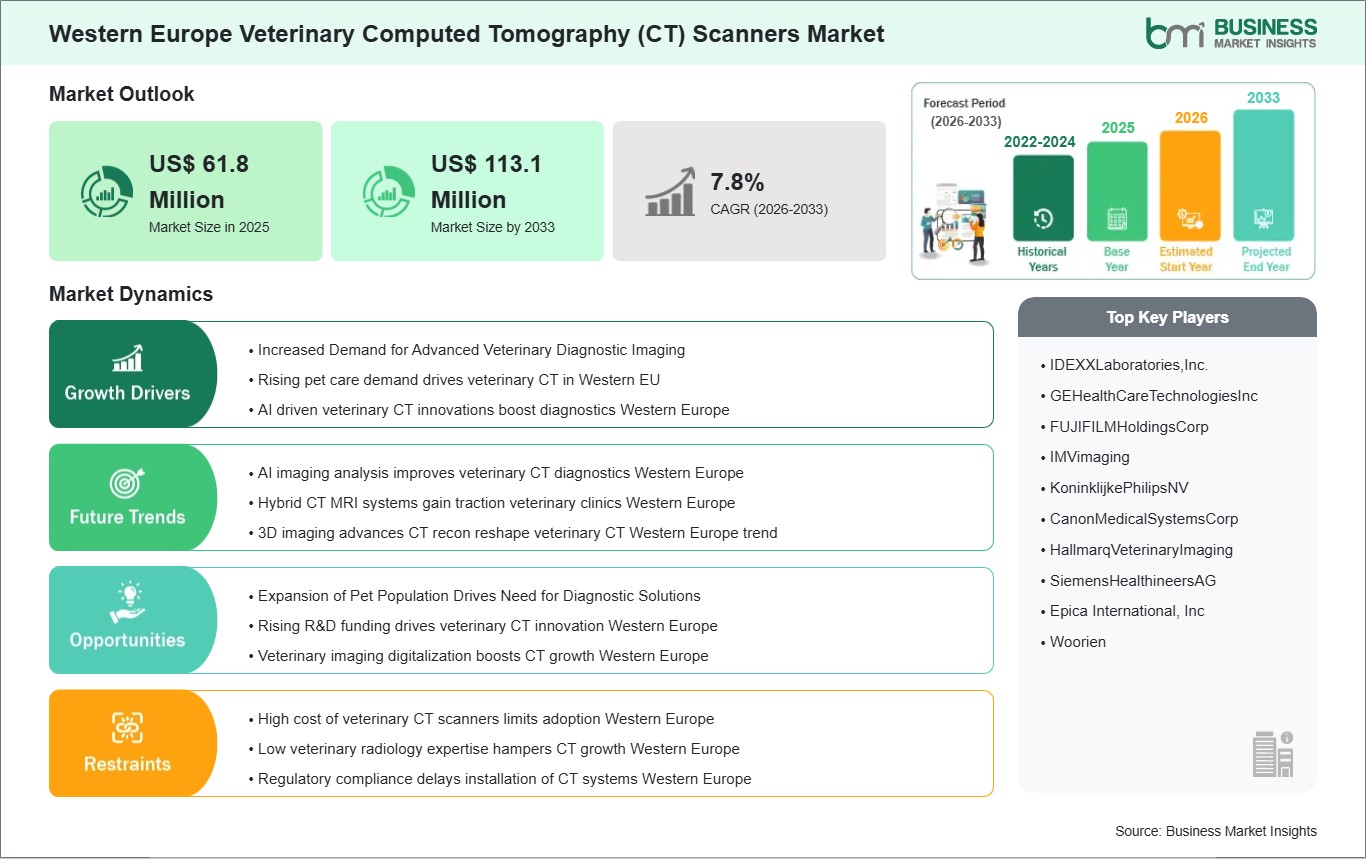
The Western Europe veterinary computed tomography (CT) scanners market size is expected to reach US$ 113.1 million by 2033 from US$ 61.8 million in 2025. The market is estimated to record a CAGR of 7.8% from 2026 to 2033.
The Western Europe veterinary CT scanner market is driven by the increasing acceptance of advanced diagnostic equipment in animal healthcare facilities. In Western Europe, increased pet ownership and expansion of specialized veterinary care centers have contributed to greater acceptance and integration of computed tomography (CT) technology. Unlike traditional imaging modalities, CT scanners provide highly detailed cross-sectional images, enabling accurate diagnosis of complex conditions in small companion animals, equine patients, and livestock. This capability has made CT systems an essential investment for progressive veterinary practices in developed markets such as Germany, the UK, France, and the Benelux countries.
One of the key factors driving the market growth in Western Europe is the strong presence of veterinary teaching hospitals and diagnostic imaging centers that prefer cutting-edge technologies for both diagnostic and research purposes. The region's strong regulatory environment, coupled with well-established animal health infrastructure, supports technology adoption. Veterinarians are increasingly relying on CT imaging to diagnose neurological disorders, orthopedic injuries, and oncological conditions, where accurate visualization is critical. Additionally, the increasing focus on preventive care and advanced therapeutics has encouraged referrals to imaging centers equipped with CT systems, increasing overall utilization rates.

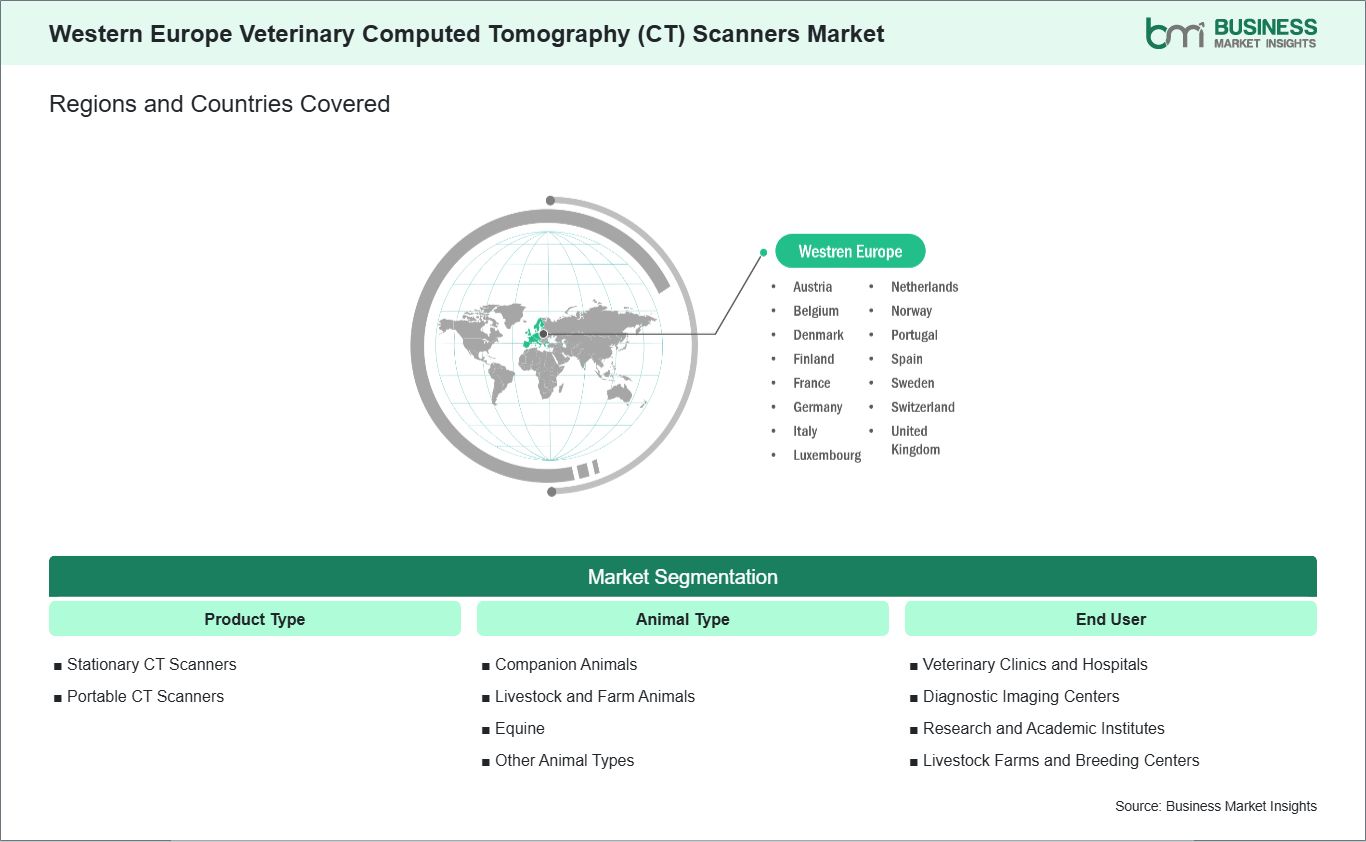
Key segments that contributed to the derivation of the Western Europe veterinary computed tomography (CT) scanners market analysis are product type, animal type, and end user.
In countries such as Germany, France, and the UK, pet ownership has reached record levels, prompting clinics to invest in advanced imaging for diagnosing complex conditions such as bone fractures and internal organ issues. This rising demand has also led smaller practices to partner with veterinary CT-equipped diagnostic centers, expanding overall regional adoption.
In Scandinavia - where animal welfare regulations are among the strictest in Europe - routine whistle use is becoming standard practice for cases involving pets and horses. The availability of government grants in countries such as Sweden and the Netherlands has further encouraged equipment acquisition, especially in rural areas where mobile CT units now service several clinics to meet demand.
Additionally, growing awareness among veterinary professionals about the advantages of CT imaging compared to traditional X-rays - particularly in oncology and neurology cases - is fueling purchases. This trend has been reinforced by academic collaboration in Western European veterinary research facilities focused on improving clinical outcomes.
Recent reports indicate that countries such as France and Italy have the highest rates of cat and dog ownership in the region, driving demand for sophisticated diagnostic tools. As pet owners in urban centers such as Paris and Milan seek specialized care, veterinary hospitals are increasingly investing in CT solutions to provide comprehensive diagnostic services.
Additionally, horse and livestock imaging is increasing in agricultural centers in Western Europe, such as Bavaria and Andalusia. Here, advanced diagnostic imaging helps veterinarians monitor complex conditions in valuable breeding animals, strengthening the case for adopting CT beyond the care of companion animals.
Investment in veterinary health care infrastructure across Western Europe presents a measurable opportunity. Clinics are upgrading facilities and integrating CT imaging with digital record systems, particularly in the UK and the Netherlands. This integration supports quick turnaround for diagnosis and better clinical decision-making.
The Western Europe veterinary computed tomography (CT) scanners market demonstrates steady growth, with size and share analysis highlighting evolving trends and competitive dynamics among key players. The report examines subsegments categorized within product type, animal type, and end user, offering insights into their contribution to overall market performance.
By product type, the stationary CT scanners subsegment dominated the market in 2025, driven by their higher imaging accuracy, comprehensive diagnostic capabilities, and greater demand from established veterinary facilities.
Based on animal type, the companion animals subsegment dominated the market in 2025, driven by the increasing pet ownership and growing demand for advanced diagnostic services for dogs and cats.
In terms of end user, the veterinary clinics and hospitals subsegment dominated the market in 2025, driven by the rising investment in advanced imaging equipment and expanding service offerings in clinical settings.
| Report Attribute | Details |
|---|---|
| Market size in 2025 | US$ 61.8 Million |
| Market Size by 2033 | US$ 113.1 Million |
| CAGR (2026 - 2033) | 7.8% |
| Historical Data | 2022-2024 |
| Forecast period | 2026-2033 |
| Segments Covered | By Product Type
|
|
Regions and Countries Covered
| |
| Western Europe | Belgium, the Netherlands, Luxembourg, Germany, France, Italy, Spain, Switzerland, Sweden, Austria, the United Kingdom, Denmark, Portugal, Norway, Finland |
| Market leaders and key company profiles |
|
The "Western Europe Veterinary Computed Tomography (CT) Scanners Market Size and Forecast (2022–2033)" report provides a detailed analysis of the market covering below areas:
The geographical scope of the Western Europe Veterinary Computed Tomography (CT) Scanners Market report is divided into Belgium, the Netherlands, Luxembourg, Germany, France, Italy, Spain, Switzerland, Sweden, Austria, the UK, Denmark, Portugal, Norway, and Finland. Germany held the largest share in 2025.
In the Western Europe veterinary computed tomography (CT) scanners market, Germany serves as the dominant region, driven by its highly developed veterinary infrastructure, widespread adoption of advanced diagnostic technologies, and significant presence of specialized veterinary hospitals and research institutes. High pet ownership and a strong focus on companion animal health further strengthen Germany's leadership, making it the largest contributor to regional demand and a center for vendor investment, service networks, and training initiatives. France and the UK represent mature markets, characterized by extensive veterinary clinic networks, increasing use of CT scanners for oncology, orthopedics, and pre-surgical planning, and a growing trend toward integrated imaging services.
The Benelux countries - Belgium, the Netherlands, and Luxembourg - are demonstrating steady growth, supported by active veterinary education, regulatory frameworks favoring advanced diagnostics, and gradual adoption of CT technology in both private and academic veterinary settings. Italy and Spain are expanding, but are comparatively emerging markets, where increasing pet health care expenditures and growing awareness of CT applications are gradually driving equipment upgrades. Adoption remains slow in these countries due to budgetary constraints in smaller practices. Switzerland maintains a stable demand trajectory, reflecting high per capita veterinary spending and well-established private and specialty clinics that actively invest in advanced imaging capabilities. Scandinavian nations - Sweden, Denmark, Norway, and Finland - are notable for strong growth potential, driven by increasing pet ownership, emphasis on early detection of complex diseases, and adoption of service-providing mobile CT solutions.

The Western Europe Veterinary Computed Tomography (CT) Scanners Market is evaluated by gathering qualitative and quantitative data post primary and secondary research, which includes important corporate publications, association data, and databases. A few of the key developments in the Western Europe veterinary computed tomography (CT) scanners market are:
The Western Europe Veterinary Computed Tomography (CT) Scanners Market is valued at US$ 61.8 Million in 2025, it is projected to reach US$ 113.1 Million by 2033.
As per our report Western Europe Veterinary Computed Tomography (CT) Scanners Market, the market size is valued at US$ 61.8 Million in 2025, projecting it to reach US$ 113.1 Million by 2033. This translates to a CAGR of approximately 7.8% during the forecast period.
The Western Europe Veterinary Computed Tomography (CT) Scanners Market report typically cover these key segments-
The historic period, base year, and forecast period can vary slightly depending on the specific market research report. However, for the Western Europe Veterinary Computed Tomography (CT) Scanners Market report:
The Western Europe Veterinary Computed Tomography (CT) Scanners Market is populated by several key players, each contributing to its growth and innovation. Some of the major players include:
The Western Europe Veterinary Computed Tomography (CT) Scanners Market report is valuable for diverse stakeholders, including:
Essentially, anyone involved in or considering involvement in the Western Europe Veterinary Computed Tomography (CT) Scanners Market value chain can benefit from the information contained in a comprehensive market report.
Please tell us your area of interest
(Market Segments/ Regions and Countries/ Companies)