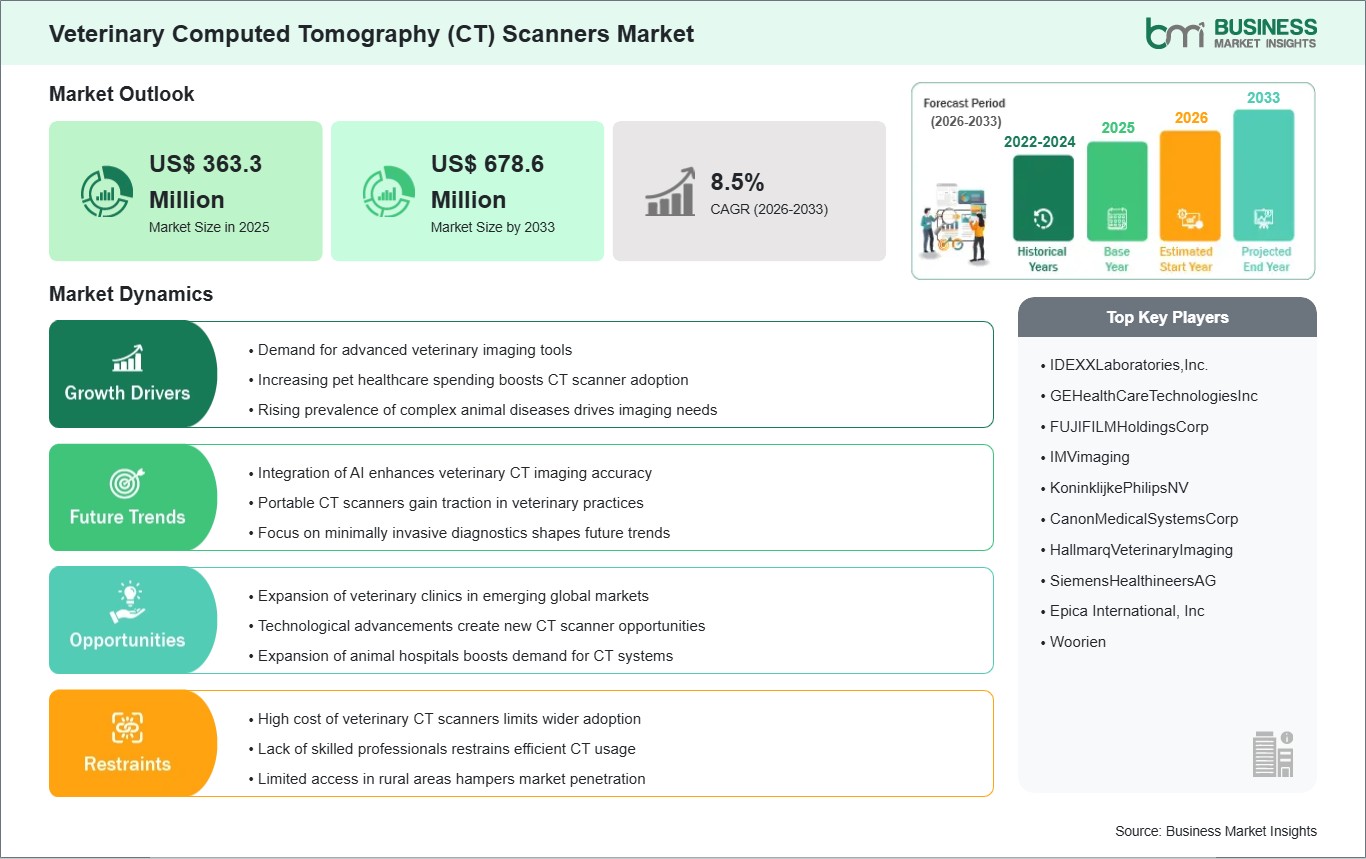
The veterinary computed tomography (CT) scanners market size is expected to reach US$ 678.6 million by 2033 from US$ 363.3 million in 2025. The market is estimated to record a CAGR of 8.5% from 2026 to 2033.
The global veterinary computed tomography (CT) scanners market is witnessing robust growth because veterinary practices now use advanced diagnostic methods that match human medical standards. Modern veterinary clinics, specialty hospitals, and research institutions are progressively integrating advanced imaging technologies to improve diagnostic accuracy for a wide range of animals, which includes companion pets, equines, and livestock. The rising awareness among pet owners and livestock producers about the benefits of early and accurate diagnosis is a key factor driving market expansion. Veterinary professionals use CT scanners to enhance their surgical planning, trauma evaluation, and disease monitoring activities, which help in better treatment outcomes. Pet owners who want their animals to receive medical treatment that matches human healthcare standards now drive the demand for veterinary CT scanners. The need for high-resolution imaging has increased because veterinary specialty services have expanded to include oncology, orthopedics, and neurology.
Technological improvements include the development of multislice scanning, portable CT units, and enhanced software systems that reconstruct images. These innovations enable veterinary practitioners to perform thorough evaluations with reduced anesthesia time, benefiting both large and small animal species. Adoption rates differ across different geographic areas. Developed regions have achieved high adoption rates of veterinary services, primarily because of their existing veterinary systems, their higher spending on animal medical treatment, and their broad network of trained professionals. Asia Pacific, Latin America, and Middle East are experiencing increased adoption rates because of their growing pet populations, their expanding livestock funding, and their upcoming veterinary diagnostic facilities. Urban areas in each region adopt advanced multislice stationary CT systems, while compact CT scanners and portable CT systems become more common in smaller clinics and rural areas to meet their diagnostic requirements.
The market shows strong growth potential, yet it encounters multiple obstacles. Small veterinary practices find it difficult to operate because they must spend substantial funds on equipment purchase, setup, and system upkeep. The limited use of CT scanners occurs because veterinary facilities require a specialized workforce that can operate the machines and evaluate the findings. The need for anesthesia during most animal scans, together with different legal requirements for veterinary imaging, creates operational difficulties that prevent widespread usage. The global market is driven by continuous technological development, increased clinical usage, and broader international market expansion. Market restraints include high costs and operational challenges. However, continuous innovation and demand for superior animal medical services are expected to boost market expansion.

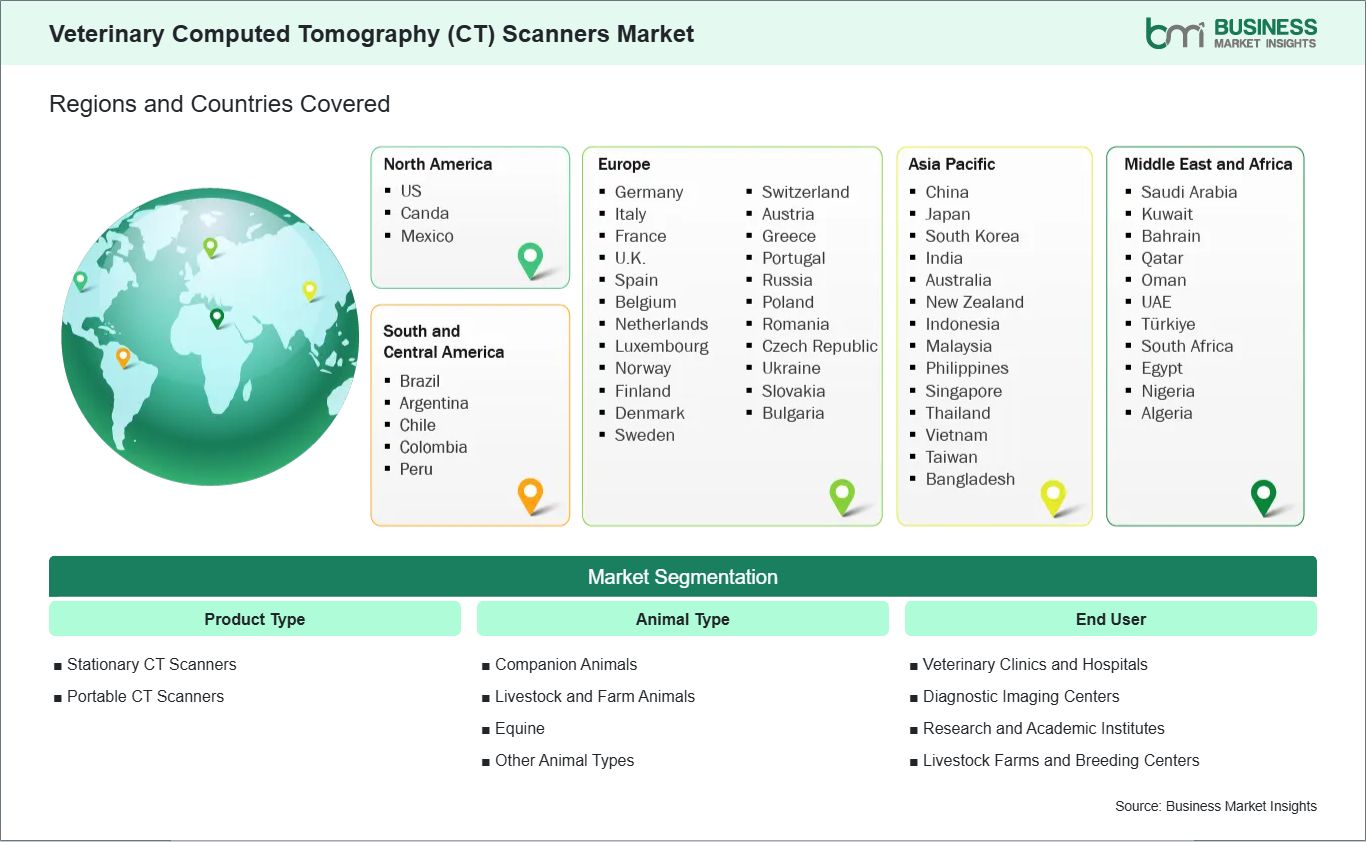
Key segments that contributed to the derivation of the veterinary computed tomography (CT) scanners market analysis are product type, animal type, and end user.
Veterinarians use CT imaging to create detailed cross-sectional and three-dimensional images, which help them identify medical problems such as tumors, fractures, and internal organ diseases. Modern imaging techniques enable practitioners to diagnose medical conditions more quickly and develop treatment strategies that result in better patient results for companion animals and livestock.
The increase in worldwide pet ownership, which is especially strong in urban areas throughout the US, Europe, and Asia, drives market expansion. Veterinary clinics use CT scanners for standard diagnostic processes because it helps them identify complicated medical conditions at an early stage and plan safe surgical procedures that decrease risks and time needed for patient recovery.
The adoption of new CT scanner technologies has increased because modern CT scanners can now produce better imaging results and conduct scans faster while providing advanced three-dimensional imaging abilities. Veterinarians can use these advancements to provide better medical assessments while increasing their operational efficiency. The combination of these elements with increased public knowledge about animal health requirements establishes CT scanners as vital instruments used in contemporary veterinary medicine throughout the world.
Countries in Asia Pacific, Latin America, and the Middle East are witnessing rapid growth in veterinary infrastructure, driven by increasing disposable incomes, rising pet ownership, and a growing focus on livestock health. New veterinary facilities are emerging in urban and semi-urban areas, creating demand for advanced diagnostic equipment to serve diverse animal populations.
Investment in veterinary healthcare is not limited to companion animals. In many emerging regions, improving the health of livestock is a priority for food security and economic development. Advanced imaging technologies—including CT scanners—are increasingly adopted in veterinary hospitals to support precise diagnosis of complex conditions, facilitate surgical planning, and monitor post-treatment recovery. This trend highlights the dual market potential in both companion animal care and livestock management.
Global manufacturers are responding by offering compact, cost-effective CT scanner models suitable for smaller clinics and hospitals, making advanced imaging more accessible. Additionally, training programs and technical support initiatives are helping veterinarians in emerging markets utilize these tools effectively. Overall, as veterinary infrastructure continues to develop, the adoption of CT scanners is expected to grow steadily.

The veterinary computed tomography (CT) scanners market demonstrates steady growth, with size and share analysis highlighting evolving trends and competitive dynamics among key players. The report examines subsegments categorized within product type, animal type, and end user, offering insights into their contribution to overall market performance.
By product type, the stationary CT scanners subsegment dominated the market in 2025, driven by their superior imaging capabilities and widespread installation in advanced veterinary facilities.
Based on animal type, the companion animals subsegment dominated the market in 2025, driven by the increasing pet ownership and rising demand for advanced diagnostic imaging for pets.
In terms of end user, the veterinary clinics and hospitals subsegment dominated the market in 2025, driven by the high volume of animal diagnostics and the availability of specialized veterinary imaging infrastructure.
| Report Attribute | Details |
|---|---|
| Market size in 2025 | US$ 363.3 Million |
| Market Size by 2033 | US$ 678.6 Million |
| Global CAGR (2026 - 2033) | 8.5% |
| Historical Data | 2022-2024 |
| Forecast period | 2026-2033 |
| Segments Covered | By Product Type
|
|
Regions and Countries Covered
| |
| North America | US, Canada, Mexico |
| Europe | Germany, Italy, France, U.K., Spain, Belgium, Netherlands, Luxembourg, Norway, Finland, Denmark, Sweden, Switzerland, Austria, Greece, Portugal, Russia, Poland, Romania, Czech Republic, Ukraine, Slovakia, Bulgaria |
| Asia-Pacific | China, Japan, South Korea, India, Australia, New Zealand, Indonesia, Malaysia, Philippines, Singapore, Thailand, Vietnam, Taiwan, Bangladesh |
| South and Central America | Brazil, Argentina, Chile, Colombia, Peru |
| Middle East and Africa | Saudi Arabia, United Arab Emirates, Kuwait, Bahrain, Qatar, Oman, Turkiye, South Africa, Egypt, Nigeria, Algeria |
| Market leaders and key company profiles |
|
The "Veterinary Computed Tomography (CT) Scanners Market Size and Forecast (2022–2033)" report provides a detailed analysis of the market covering below areas:
The geographical scope of the Veterinary Computed Tomography (CT) Scanners Market report is divided into North America, Asia Pacific, Europe, Middle East & Africa, and South & Central America. North America held the largest share in 2025.
North America leads the market, primarily because of its superior veterinary facilities, prevalent pet ownership, and strong financial support for animal healthcare technology development. Veterinarians in the US and Canada now use CT imaging to diagnose cases and plan surgeries for companion animals and large animals in their veterinary hospitals and specialty clinics, which operate with a network of certified veterinary radiologists and established referral systems. Europe shows market maturity, as countries such as Germany, the UK, and France, which possess advanced animal welfare standards and established veterinary networks, now use imaging technologies in their clinical procedures. The region benefits from its regulatory frameworks, which support the improvement of veterinary facilities through the adoption of modern diagnostic equipment.
The market in Asia Pacific experiences the most rapid growth because of rising disposable incomes, increased pet ownership, and the expansion of veterinary services into urban areas. China, India, and Japan now invest more in veterinary diagnostic equipment, as people learn about the importance of preventive care. Adoption is concentrated in urban areas and high-end veterinary facilities, resulting in a small market share in the Middle East and Africa; however, rising animal health awareness and increasing investment in premium veterinary services are expected to drive future growth. The South and Central American market is niche but growing in major cities, driven by the adoption of advanced imaging technologies in private veterinary clinics and specialty hospitals.
North America maintains the top market position, driven by technological progress and substantial industry funding. Europe shows consistent market growth, and Asia Pacific and Middle East, Africa, and South and Central America offer major market development possibilities through rising demand for sophisticated veterinary diagnostic equipment.

The Veterinary Computed Tomography (CT) Scanners Market is evaluated by gathering qualitative and quantitative data post primary and secondary research, which includes important corporate publications, association data, and databases. A few of the key developments in the veterinary computed tomography (CT) scanners market are:
The Veterinary Computed Tomography (CT) Scanners Market is valued at US$ 363.3 Million in 2025, it is projected to reach US$ 678.6 Million by 2033.
As per our report Veterinary Computed Tomography (CT) Scanners Market, the market size is valued at US$ 363.3 Million in 2025, projecting it to reach US$ 678.6 Million by 2033. This translates to a CAGR of approximately 8.5% during the forecast period.
The Veterinary Computed Tomography (CT) Scanners Market report typically cover these key segments-
The historic period, base year, and forecast period can vary slightly depending on the specific market research report. However, for the Veterinary Computed Tomography (CT) Scanners Market report:
The Veterinary Computed Tomography (CT) Scanners Market is populated by several key players, each contributing to its growth and innovation. Some of the major players include:
The Veterinary Computed Tomography (CT) Scanners Market report is valuable for diverse stakeholders, including:
Essentially, anyone involved in or considering involvement in the Veterinary Computed Tomography (CT) Scanners Market value chain can benefit from the information contained in a comprehensive market report.
Please tell us your area of interest
(Market Segments/ Regions and Countries/ Companies)