Market Summary
Executive Summary and Market Analysis
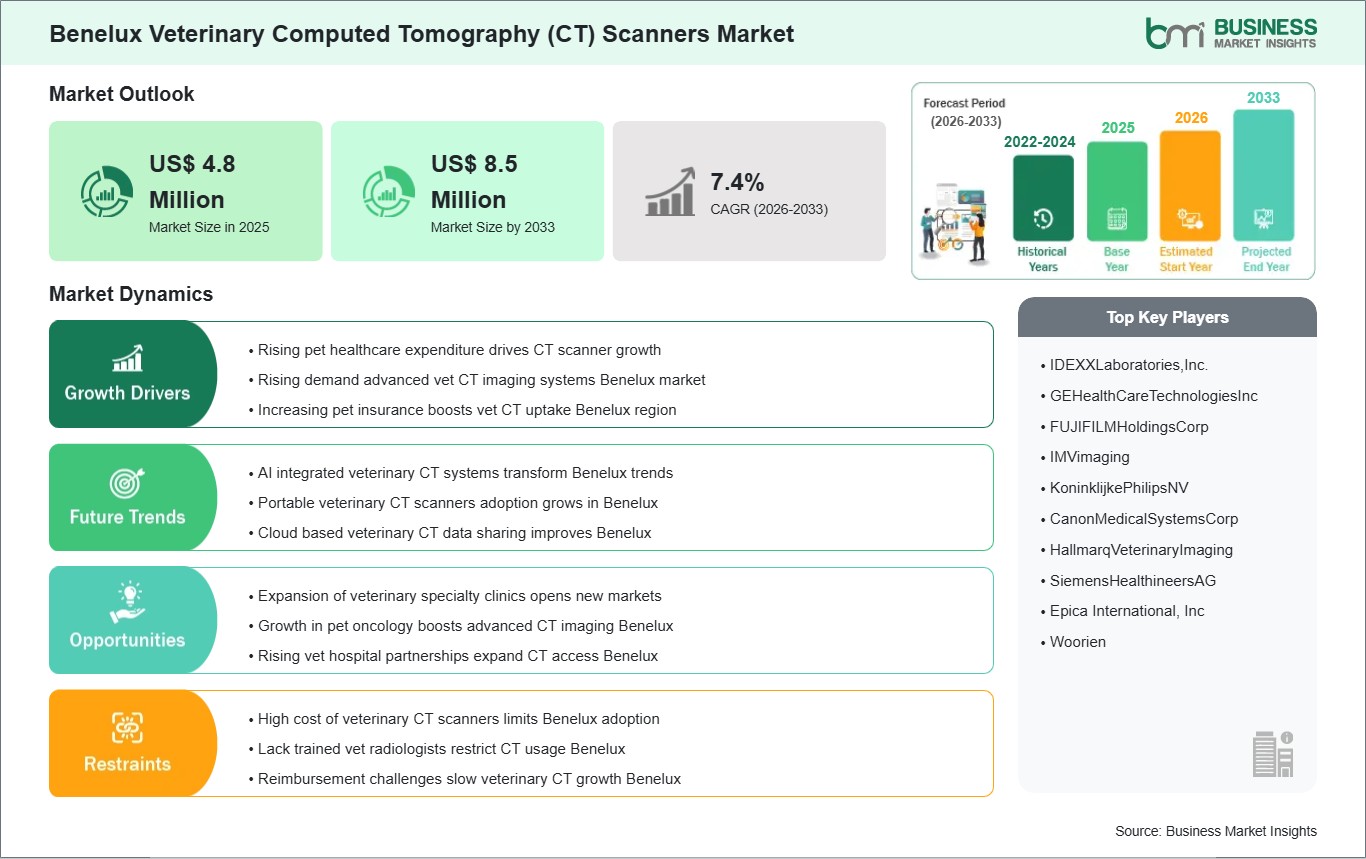
The Benelux Veterinary Computed Tomography (CT) Scanners Market represents a strategic and evolving segment within the broader veterinary imaging landscape in Belgium, the Netherlands, and Luxembourg. This region is distinguished by a mature veterinary healthcare infrastructure, high standards of animal welfare, and a progressive adoption of advanced diagnostic technologies. Veterinary CT scanners have increasingly become a critical tool for animal hospitals, specialty clinics, and referral centers throughout the Benelux, facilitating detailed cross‑sectional imaging that supports accurate diagnosis of complex musculoskeletal conditions, neurological disorders, oncological assessments, and pre‑surgical planning. A key driver in this regional market is the rising focus on precision veterinary care, supported by growing awareness among animal owners and equine/aerospace industries about the importance of advanced diagnostics for improved clinical outcomes. In parallel, the presence of well‑established academic and research institutions in this region fuels both clinical adoption and collaborative research in veterinary imaging, further reinforcing the demand for CT technology.
In the Benelux, the Netherlands often leads in adoption due to robust investments in veterinary research and a dense network of multi‑specialty practices catering to both companion animals and equine patients. Belgium contributes a strong demand trajectory driven by a consolidated group of referral centers that emphasize advanced orthopedic and neurological care. Luxembourg, while smaller in scale, shows growth tied to cross‑border collaborations with neighboring academic clinics and an increasing trend of specialized animal care facilities adopting high‑end imaging tools. Another significant driver is the regional impetus on preventive and early diagnostic practices, where CT systems play a pivotal role in detecting conditions that are otherwise challenging to visualize through conventional radiography or ultrasound.
Despite these positive forces, certain restraints temper accelerated market expansion. Budgetary constraints of smaller veterinary clinics can limit acquisition of high‑end CT systems, given the capital‑intensive nature of these technologies and the associated requirements for specialized training and maintenance. Additionally, the Benelux market grapples with nuanced regulatory landscapes surrounding ionizing radiation equipment and veterinary imaging protocols, which can influence the pace of installation and clinical integration. Nevertheless, ongoing efforts to streamline compliance and enhance veterinary practitioners’ proficiency continue to support the gradual yet steady incorporation of CT imaging within the veterinary care continuum across the Benelux region.
Segment Analysis
Benelux Veterinary Computed Tomography (CT) Scanners Market Segmentation
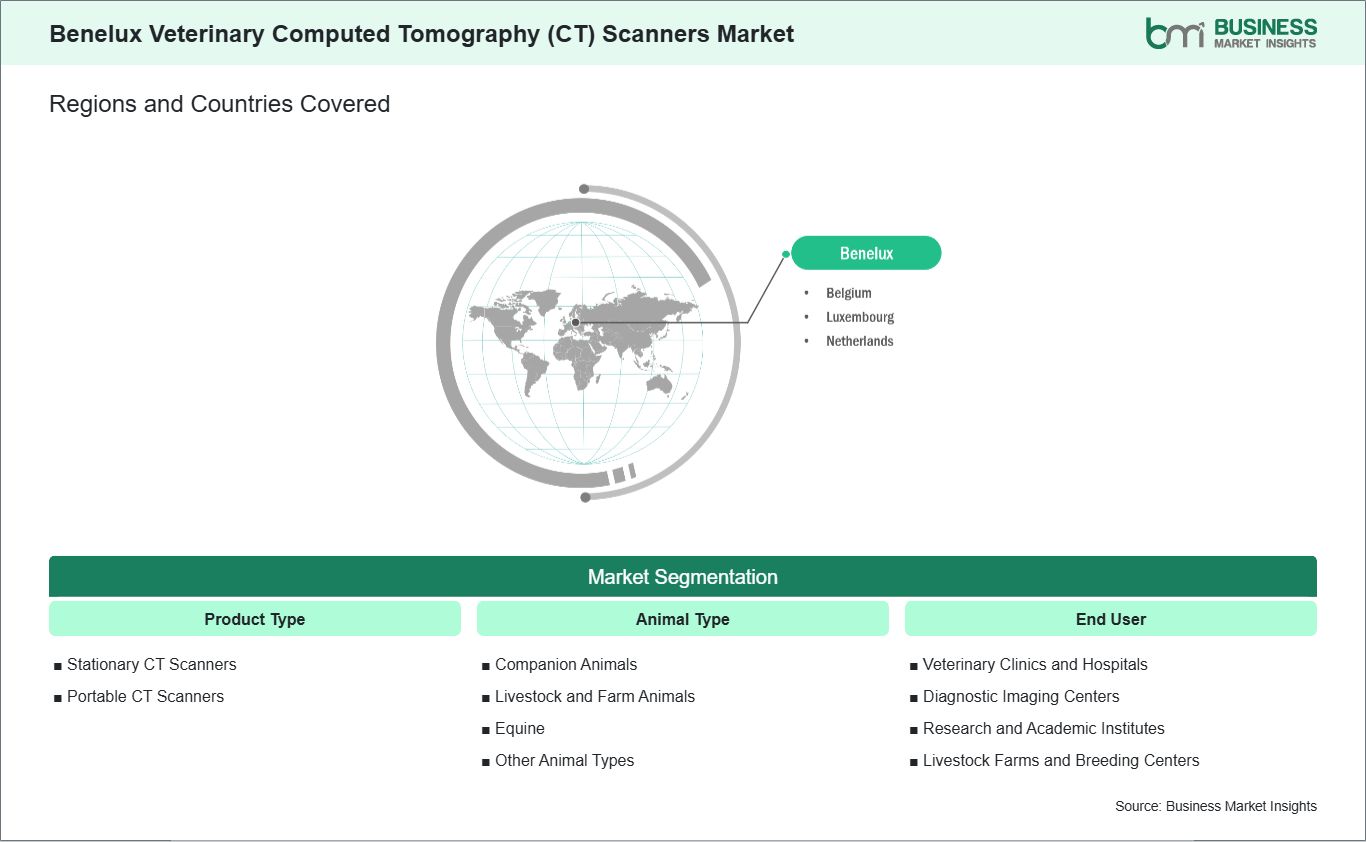
Key segments that contributed to the derivation of the Benelux veterinary computed tomography (CT) scanners market analysis are product type, animal type, and end user.
- By product type, the veterinary computed tomography (CT) scanners market is segmented into stationary CT scanners, portable CT scanners. The stationary CT scanners segment dominated the market in 2025.
- Based on animal type, the veterinary computed tomography (CT) scanners market is categorized into companion animals, livestock and farm animals, equine, other animal types. The companion animals segment dominated the market in 2025.
- In terms of end user, the veterinary computed tomography (CT) scanners market is categorized into veterinary clinics and hospitals, diagnostic imaging centers, research and academic institutes, livestock farms and breeding centers. The veterinary clinics and hospitals segment dominated the market in 2025.
Market Forces
Benelux Veterinary Computed Tomography (CT) Scanners Market Drivers and Opportunities
Rising pet healthcare expenditure drives CT scanner growth
A significant increase in pet care expenditures within Belgium, the Netherlands, and Luxembourg is propelling the growth of the Benelux veterinary computed tomography (CT) scanner market. Pet ownership is increasing and there is a growing awareness on the part of veterinary clinics concerning advanced diagnostic methods which is contributing to the increasing number of CT scanner purchases by veterinary clinics in order to determine the most accurate diagnosis for companion animals. The high amount of money currently spent on companion animals in large urban areas is also creating an increased demand for technologically sophisticated imaging equipment that allows for the early diagnosis of complex medical conditions such as neurological disorders and orthopedic injuries.
CTs are also being adopted by veterinary clinics in both Belgium and the Netherlands in order to enhance surgical planning and outcome. Through the use of a CT scanner, veterinarians are given the opportunity to view soft tissue structures and bone structures in a manner that will allow them to intervene more accurately. Even veterinary practices with minimal resources are beginning to recognize the benefits associated with implementing CT technology as owners of companion animals are seeking diagnostic technologies that are per the same standards as human diagnostic technology. This change represents a larger trend toward greater quality in veterinary medicine.
The ongoing improvements in CT scanner technology, including improved speed of scan times and decreased exposure to radiation, have increased the practicality of utilizing these devices as a standard of care in veterinary medicine. The combination of increased expenses on pet health care, growing clinical standards, and broader access to technology continues to drive the growth of veterinary computed tomography scanners within the Benelux region.
Expansion of veterinary specialty clinics opens new markets
Veterinary specialty clinics are greatly expanding throughout the Benelux region and present an excellent opportunity for the CT scanner industry. For instance, cities like Amsterdam, Brussels, and Luxembourg City are experiencing an influx of multi-service veterinary hospitals, which need advanced imaging technologies for their large number of complex cases. The same type of use for CT scanners will help provide comprehensive diagnostic expertise to pet owners who need to make accurate decisions regarding their pet's health. CT scanners will also be used for making decisions regarding tumors, trauma and surgery as they will serve as a reference tool for both small and larger animals.
In addition to the urban areas mentioned above, there is also a trend occurring in the suburbs as well with the growth of specialty veterinary offices. These types of practices will also create referral opportunities for general practice veterinarians; thus increasing the number of opportunities for CT scanners. Veterinarians will also use these specialty practices to differentiate their practice by providing timely and accurate diagnosis and will support the demand for high-quality imaging systems needed to support advanced veterinary care.
As the trend of pet insurance increases amongst the Benelux nations; this will allow clinics more financial flexibility to invest in advanced diagnostic imaging systems. Pet owners are more inclined to seek out a complete diagnostic evaluation when they have pet insurance and therefore pay only a small portion of the cost of the procedure after the fact. With the confluence of the specialty clinic market development, the pet insurance adoption increase and the increase in the expectation for high-level veterinary care, the CT scanner market will be changing rapidly.
Size and Share Analysis
Benelux Veterinary Computed Tomography (CT) Scanners Market Size and Share Analysis
The Benelux veterinary computed tomography (CT) scanners market demonstrates steady growth, with size and share analysis highlighting evolving trends and competitive dynamics among key players. The report examines subsegments categorized within product type, animal type, and end user, offering insights into their contribution to overall market performance.
By product type, the stationary CT scanners subsegment dominated the market in 2025, driven by thier higher imaging performance and greater suitability for routine clinical diagnostics in established veterinary facilities.
Based on animal type, the companion animals subsegment dominated the market in 2025, driven by the increasing demand for advanced diagnostic imaging to support preventive care and complex treatments for pets.
In terms of end user, the veterinary clinics and hospitals subsegment dominated the market in 2025, driven by their extensive adoption of CT technology to meet growing clinical caseloads and offer specialized diagnostic services.
Report Coverage
Benelux Veterinary Computed Tomography (CT) Scanners Market Report Coverage and Deliverables
The "Benelux Veterinary Computed Tomography (CT) Scanners Market Size and Forecast (2022–2033)" report provides a detailed analysis of the market covering below areas:
- Benelux Veterinary Computed Tomography (CT) Scanners Market size and forecast at regional, and country levels for all the key market segments covered under the scope
- Benelux Veterinary Computed Tomography (CT) Scanners Market trends, as well as drivers, restraints, and opportunities
- Benelux Veterinary Computed Tomography (CT) Scanners Market analysis covering key trends, regional framework, major players, regulations, and recent developments
- Industry landscape and competition analysis covering market concentration, heat map analysis, prominent players, and recent developments for the Benelux Veterinary Computed Tomography (CT) Scanners Market
- Detailed company profiles, including SWOT analysis
Geographic Insights
Benelux Veterinary Computed Tomography (CT) Scanners Market Geographic Insights
The geographical scope of the Benelux Veterinary Computed Tomography (CT) Scanners Market report is divided into Belgium, the Netherlands, and Luxembourg. Netherlands held the largest share in 2025.
In comparison to the veterinary CT scanner market, each country in Benelux has different dynamics; however, adoption levels and potential are greatest in the Netherlands. This is largely due to a well-developed veterinary healthcare infrastructure, high per capita pet ownership levels, strong culture around preventive/specialized animal care, and access to advanced electronics which creates a strong demand for advanced imaging technology like CT scanners in the Netherlands. Furthermore, there is growing investment from veterinary hospitals and specialty clinics for new multi-slice/high resolution CT systems that will be used for high-quality diagnostics in more complicated cases of small and large animals, demonstrating that the Netherlands is leading the way in integrating advanced technology into routine veterinary practice. Belgium has been steadily growing, but it has a less consolidated market than the Netherlands.
CT imaging adoption rates in Belgium are moderate, generally occurring in university hospitals and referral clinics; however, the majority of clinics that operate at large volumes handling exotic and companion animal patients requiring detailed diagnostics tend have the majority of their demand for CT imaging. The level of investment in Belgium is determined by the clinical need and cost-effectiveness of the CT scanner investments, therefore there are selective, but strategically placed, deployments of CT scanners in Belgium. Luxembourg is more of a niche market for CT scanners due to its small size and a relatively low number of veterinarians or veterinary facilities with a CT scanner.
Industry Activity
Recent Developments
The Benelux Veterinary Computed Tomography (CT) Scanners Market is evaluated by gathering qualitative and quantitative data post primary and secondary research, which includes important corporate publications, association data, and databases. A few of the key developments in the Benelux veterinary computed tomography (CT) scanners market are:
- In September 2024, IMV Technologies Group announced that it acquired UD‑Vet B.V., a leading provider of veterinary practice equipment and imaging modalities based in Utrecht (Netherlands) and Brussels (Belgium), strengthening its offering and distribution reach throughout the Benelux region.
- In January 2024, the Faculty of Veterinary Medicine at Utrecht University (Netherlands) reported that an advanced SPECT‑CT scanner (a combined imaging modality involving CT technology) was installed and commissioned at its Department of Diagnostic Imaging, enhancing diagnostic capabilities for veterinary patients at the university’s animal hospital.
Trust & Transparency
Research Methodology
The market analysis combines proprietary research with secondary data from government agencies, company disclosures, regulatory filings, industry databases and expert interviews. Market estimates are validated through data triangulation, cross-market benchmarking and analyst
review.
View Full Research Methodology
Key Sources Referred:
American College of Veterinary Radiology (ACVR) World Small Animal Veterinary Association (WSAVA) British Veterinary Association (BVA) International Veterinary Radiology Association (IVRA) American Veterinary Medical Association (AVMA) European College of Veterinary Diagnostic Imaging (ECVDI) World Organisation for Animal Health (WOAH / OIE) Veterinary Imaging & Radiation Oncology Society (VIROS)