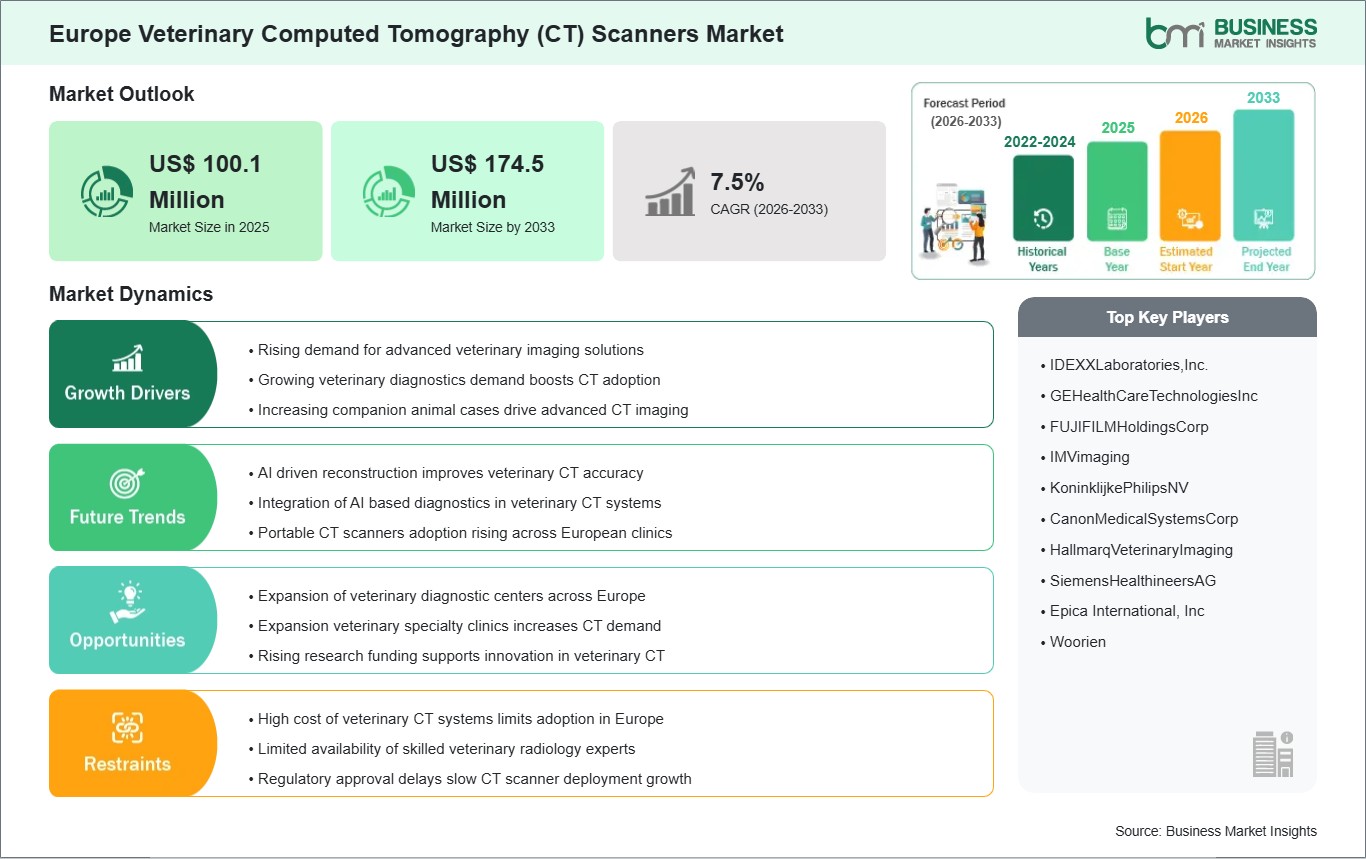
The Europe veterinary computed tomography (CT) scanners market size is expected to reach US$ 174.5 million by 2033 from US$ 100.1 million in 2025. The market is estimated to record a CAGR of 7.5% from 2026 to 2033.
The veterinary computed tomography (CT) scanner market in Europe operates as a mature market, which undergoes continuous development because veterinary healthcare facilities exist throughout the region, and they maintain high clinical standards, and people seek better diagnostic services. The veterinary profession throughout the region uses CT imaging to provide both standard and advanced medical treatment across various healthcare facilities, which include referral hospitals, university clinics and high-end private practices. The medical field uses this method to obtain precise diagnoses through non-invasive methods, which leads to better medical choices and treatment results for both companion animals and equine patients. The market experiences its main growth driver through Western Europe, which sees an ongoing transition towards premium veterinary services. Pet owners now demand diagnostic procedures, which match human medical care, leading to higher usage of CT scanners for severe medical conditions that include neurological diseases, traumatic injuries and cancer evaluations. The veterinary field requires advanced imaging technologies because of its need for specialists who work in orthopedics and cardiology and internal medicine. Countries with strong veterinary systems experience greater cooperation between private veterinary practices and research institutions, which helps to drive both technological progress and clinical advancements.
The market is being transformed through the advancement of technological innovations. Veterinary facilities now have access to CT technology because compact and user-friendly systems for CT scanning have been developed. The combination of advanced imaging software, rapid scanning capabilities and enhanced safety measures enables organizations to handle their operations better while improving their treatment of patients. The demand for combining imaging technologies with digital systems is increasing because this approach improves data sharing, teleconsultation and regional diagnostic accuracy. Positive trends exist, yet the system faces various challenges. The high initial investment and ongoing operational costs associated with CT scanners remain a key barrier, particularly for smaller clinics in Southern and Eastern Europe. The different rates at which European countries develop their economies and spend on veterinary services create discrepancies in how various regions adopt new technologies. The essential nature of regulatory requirements and compliance standards for safety and quality assurance creates market entry and expansion challenges for equipment providers. The European market exhibits both strong clinical demand and structural difficulties, which will lead to future growth through innovative solutions and specialized services and changing expectations in animal healthcare.

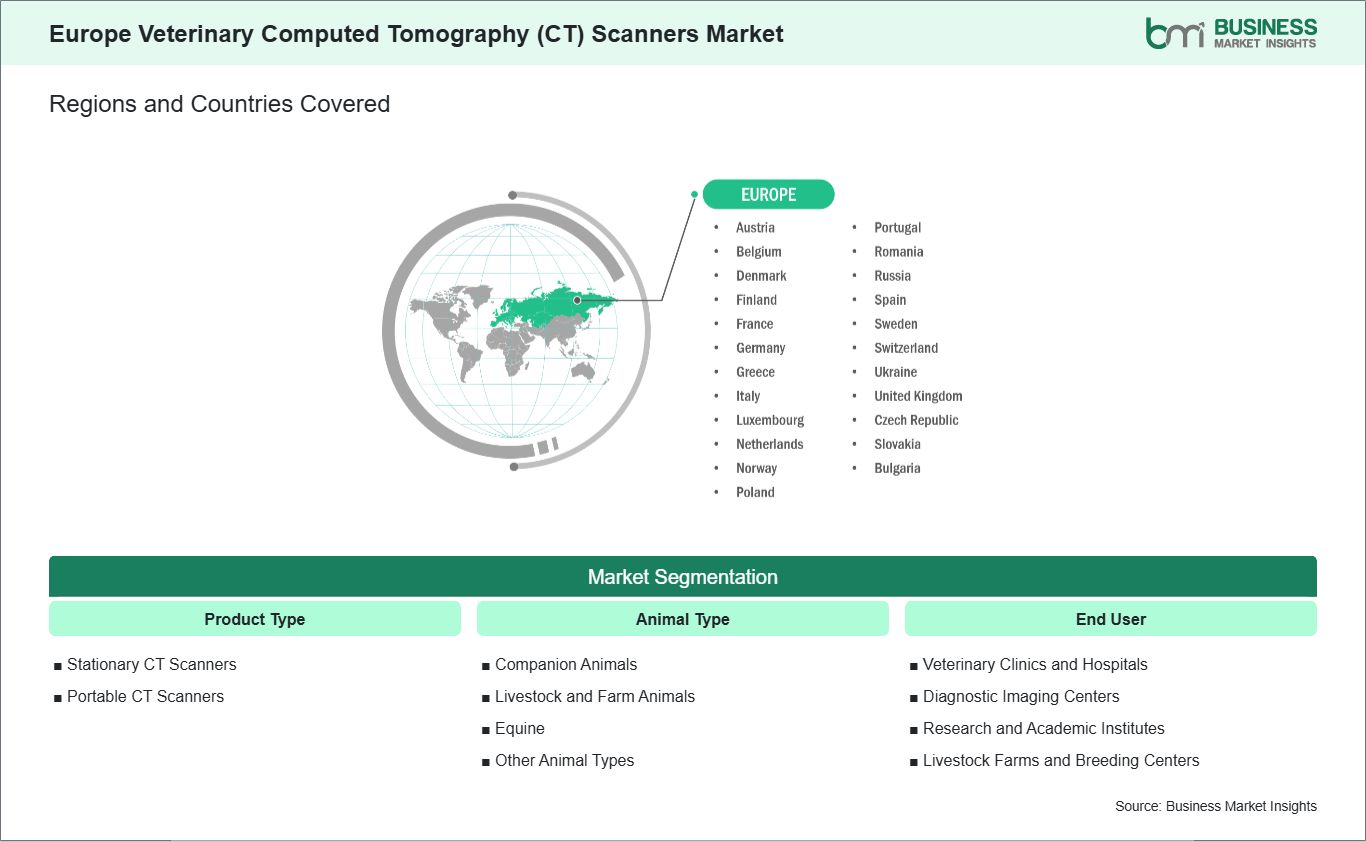
Key segments that contributed to the derivation of the Europe veterinary computed tomography (CT) scanners market analysis are product type, animal type, and end user.
The veterinary CT scanner market in Europe shows rapid expansion because people now understand animal health better, and veterinary diagnostic tools need precise solutions. The growing pet population in Germany, the United Kingdom and France has made people require specialized veterinary services that use CT imaging to identify complex medical conditions that include neurological disorders, orthopedic injuries and internal organ abnormalities. The trend shows strong evidence in urban areas where advanced veterinary hospitals operate.
The demand exists because people increasingly care about animal welfare and because regulations encourage better diagnostic methods. Veterinary clinics are investing in modern imaging systems to enhance their service offerings and meet the expectations of pet owners seeking timely and accurate diagnoses. The adoption of CT technology in large animal practices enables veterinarians to treat livestock and equine patients more effectively through advanced treatment methods and disease monitoring capabilities.
The development of CT scanners has resulted in compact and user-friendly devices that produce high-resolution images while using lower radiation levels. The system enables both small and large veterinary practices to adopt the technology at reduced costs. Veterinary schools and research institutions now use CT technology for both educational purposes and clinical studies, which helps more people understand the equipment and its use in routine veterinary procedures.
The expansion of veterinary diagnostic centers across Europe is creating substantial opportunities for CT scanner deployment. New specialty clinics and referral hospitals are being established in response to rising demand for high-quality animal healthcare services. Countries such as the United Kingdom, France, and the Netherlands are leading this expansion, with urban areas seeing the highest concentration of advanced diagnostic facilities. This growth is driven by increasing pet ownership and a greater willingness among owners to invest in advanced healthcare solutions for their animals.
Rural and semi-urban areas are also beginning to benefit from this trend, as veterinary networks expand and smaller clinics partner with larger centers to offer advanced imaging services through shared facilities or mobile CT units. This expansion improves access to sophisticated diagnostics for a wider population of animals, reducing the need for long-distance travel and improving overall healthcare outcomes.
Moreover, the integration of digital imaging and cloud-based platforms within these centers is facilitating collaboration between specialists and enhancing efficiency in clinical decision-making. Veterinary diagnostic centers are increasingly investing in CT technology not only for patient care but also for training purposes, enabling young veterinarians to gain expertise in modern imaging techniques. This strategic expansion of diagnostic infrastructure is positioning Europe as a leading region for advanced veterinary imaging, providing long-term growth opportunities for equipment manufacturers and service providers.
The Europe veterinary computed tomography (CT) scanners market demonstrates steady growth, with size and share analysis highlighting evolving trends and competitive dynamics among key players. The report examines subsegments categorized within product type, animal type, and end user, offering insights into their contribution to overall market performance.
By product type, the stationary CT scanners subsegment dominated the market in 2025, driven by their superior image quality, higher throughput and advanced diagnostic capabilities preferred in large veterinary facilities.
Based on animal type, the companion animals subsegment dominated the market in 2025, driven by the rising pet ownership and increased demand for advanced diagnostic imaging in dogs and cats.
In terms of end user, the veterinary clinics and hospitals subsegment dominated the market in 2025, driven by the growing adoption of CT technology for comprehensive diagnostic services in clinical and hospital settings.
| Report Attribute | Details |
|---|---|
| Market size in 2025 | US$ 100.1 Million |
| Market Size by 2033 | US$ 174.5 Million |
| CAGR (2026 - 2033) | 7.5% |
| Historical Data | 2022-2024 |
| Forecast period | 2026-2033 |
| Segments Covered | By Product Type
|
|
Regions and Countries Covered
| |
| Europe | Belgium, Austria, Finland, Denmark, Greece, Poland, Romania, Russia, Ukraine, Czech Republic, Slovakia, Bulgaria, Italy, Luxembourg, Germany, Switzerland, France, Netherlands, Norway, Portugal, Spain, Sweden, United Kingdom |
| Market leaders and key company profiles |
|
The "Europe Veterinary Computed Tomography (CT) Scanners Market Size and Forecast (2022–2033)" report provides a detailed analysis of the market covering below areas:
The geographical scope of the Europe Veterinary Computed Tomography (CT) Scanners Market report is divided into Belgium, Austria, Finland, Denmark, Greece, Poland, Romania, Russia, Ukraine, the Czech Republic, Slovakia, Bulgaria, Italy, Luxembourg, Germany, Switzerland, France, the Netherlands, Norway, Portugal, Spain, Sweden, and the UK. Germany held the largest share in 2025.
The European veterinary computed tomography (CT) scanners market shows different patterns across its various regions because of diverse veterinary infrastructure capacities, different economic development stages, and the extent to which countries use modern diagnostic equipment. Germany serves as the leading market because of its advanced veterinary medical facilities, extensive medical device production and its widespread adoption of sophisticated imaging systems for treating both household pets and farm animals.
The Western European markets, which include France, the United Kingdom, Italy, Spain and the Netherlands, show developed market status, which combines high animal health knowledge with extensive pet insurance market reach and their developed specialty veterinary clinics that now use CT imaging for their diagnostic and treatment procedures.
The Nordic countries, which include Sweden, Denmark, Finland and Norway, together with Switzerland, Austria, Belgium and Luxembourg, show high usage of electronic toys because their people have high disposable income, their medical system operates at advanced levels, and their veterinary schools and diagnostic centers keep getting funding. The Southern European markets in Portugal and Greece display moderately advancing demand, which has emerged from two factors: increasing urban pet ownership and better veterinary services. However, their market expansion faces obstacles from two factors: people who watch their expenses and their restricted access to premium imaging technologies.
The veterinary sector in Central European countries, including Poland, the Czech Republic, and Slovakia, experiences continuous advancement through two main factors, which include the growth of private veterinary clinics and the public awareness of advanced diagnostic methods. Romania and Bulgaria function as emerging markets within Eastern Europe, which currently display low adoption rates but will see growth when veterinary standards improve and clinical investments increase. The veterinary market in Russia and Ukraine shows complex patterns because existing demand potential faces multiple challenges, which include economic instability, infrastructural deficiencies and specific locations that lack access to modern veterinary equipment.
The region experiences essential growth factors through two trends which involve people owning more pets and their demand for superior veterinary services and the veterinary industry focusing on accurate early disease detection, while the need for substantial financial backing, combined with regional development disparities, determines how various regions will implement solutions that sustain Germany's position as Europe's main center for veterinary CT scanner research and development.

The Europe Veterinary Computed Tomography (CT) Scanners Market is evaluated by gathering qualitative and quantitative data post primary and secondary research, which includes important corporate publications, association data, and databases. A few of the key developments in the Europe veterinary computed tomography (CT) scanners market are:
The Europe Veterinary Computed Tomography (CT) Scanners Market is valued at US$ 100.1 Million in 2025, it is projected to reach US$ 174.5 Million by 2033.
As per our report Europe Veterinary Computed Tomography (CT) Scanners Market, the market size is valued at US$ 100.1 Million in 2025, projecting it to reach US$ 174.5 Million by 2033. This translates to a CAGR of approximately 7.5% during the forecast period.
The Europe Veterinary Computed Tomography (CT) Scanners Market report typically cover these key segments-
The historic period, base year, and forecast period can vary slightly depending on the specific market research report. However, for the Europe Veterinary Computed Tomography (CT) Scanners Market report:
The Europe Veterinary Computed Tomography (CT) Scanners Market is populated by several key players, each contributing to its growth and innovation. Some of the major players include:
The Europe Veterinary Computed Tomography (CT) Scanners Market report is valuable for diverse stakeholders, including:
Essentially, anyone involved in or considering involvement in the Europe Veterinary Computed Tomography (CT) Scanners Market value chain can benefit from the information contained in a comprehensive market report.
Please tell us your area of interest
(Market Segments/ Regions and Countries/ Companies)