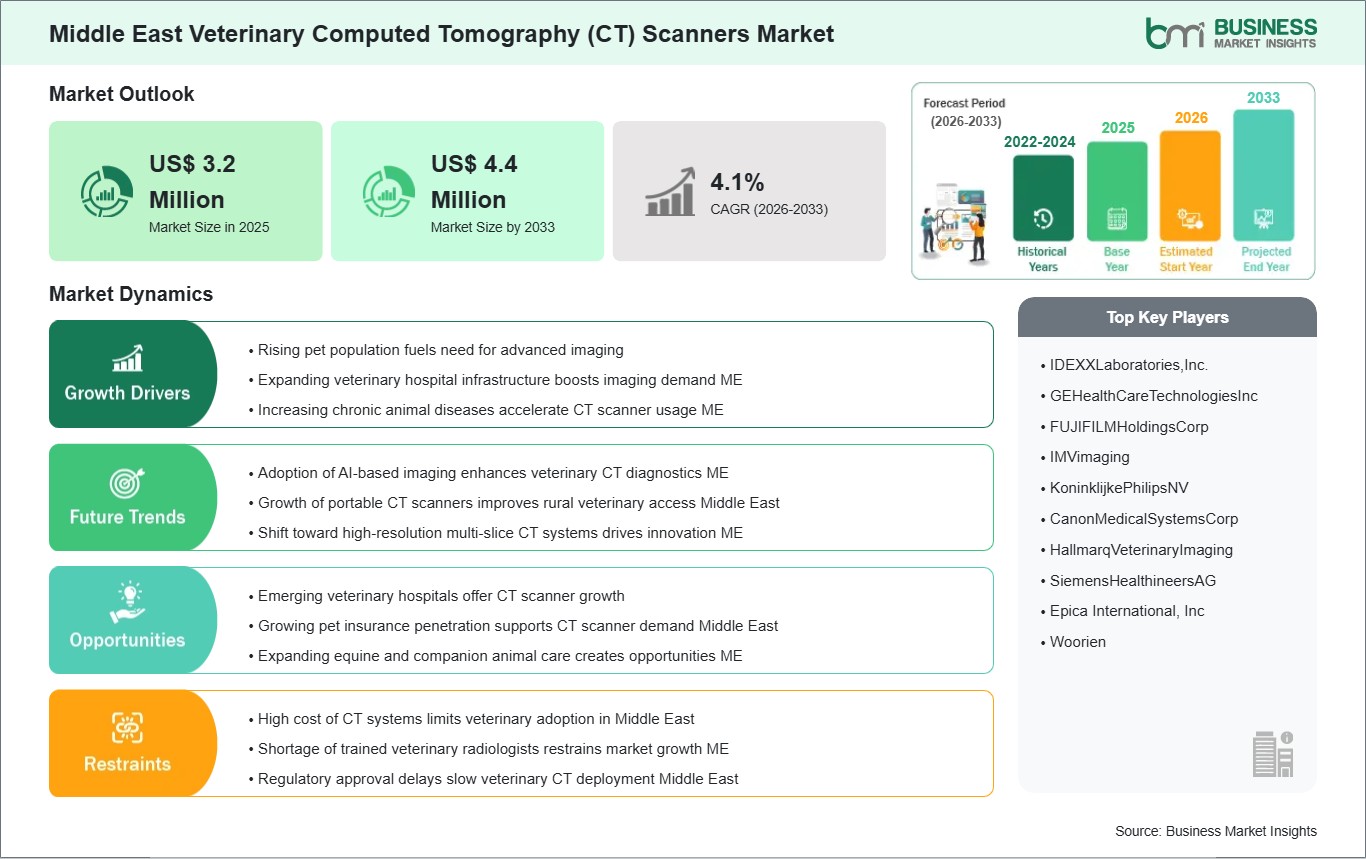
The Middle East veterinary computed tomography (CT) scanners market size is expected to reach US$ 4.4 million by 2033 from US$ 3.2 million in 2025. The market is estimated to record a CAGR of 4.1% from 2026 to 2033.
The Middle East veterinary computed tomography (CT) scanners market is experiencing steady growth because veterinary healthcare facilities are being modernized, and medical facilities need better diagnostic tools. The region's veterinary practices have used X-ray and ultrasound imaging systems as their main diagnostic tools. However, the growing need for precise, non-invasive imaging to diagnose complex conditions in both companion and farm animals has led to increased interest in CT technology. The market shows three specific cultural elements, together with economic elements and technological elements that define the regional market.
The increasing demand for veterinary services to treat companion animals in urban areas with rising pet ownership is one of the main factors that drives market expansion. Advanced imaging technologies, such as CT scanners, enable veterinarians to perform detailed examinations, support complex surgical planning, and improve treatment outcomes. Leading veterinary hospitals, together with specialty clinics in major Middle Eastern cities, use this trend to obtain CT equipment, which helps them create unique services through advanced technology. The market operates under 2 main factors, which include livestock health and agricultural animal health and their respective importance.
The missions of advanced diagnostic tools now help countries that have major livestock operations to enhance animal welfare and achieve early disease detection and increased productivity rates. Veterinary CT scanners serve as essential equipment that scientists use to perform complete anatomical studies that support their research activities and disease control efforts, and their development of procedures that safeguard both economic assets and public health safety. The market encounters multiple obstacles that will restrict its potential to expand. The expensive CT systems require specialized personnel who must handle both operation and scan interpretation tasks, which results in reduced adoption rates among small clinics and rural veterinary clinics.
The entire Middle East market shows uneven distribution because people in metropolitan areas understand the advantages of CT technology, while rural areas maintain limited knowledge about it. The Middle East veterinary CT scanners market will experience slow growth because pet healthcare needs, livestock health requirements and technological progress in veterinary services are increasing. The present situation requires providers and policymakers to develop solutions that will address both high operational expenses and their existing skill deficiencies.

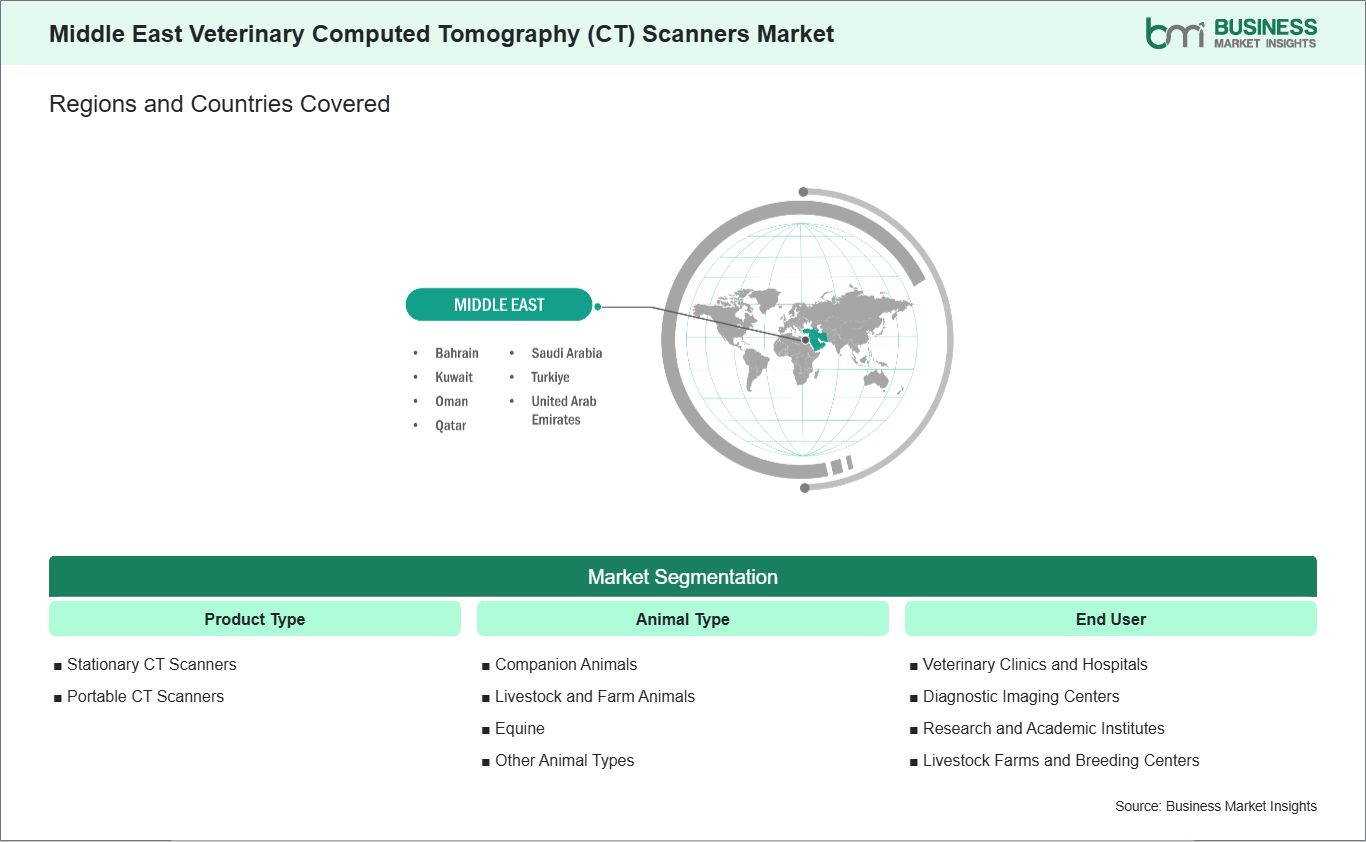
Key segments that contributed to the derivation of the Middle East veterinary computed tomography (CT) scanners market analysis are product type, animal type, and end user.
The Middle East veterinary CT scanners market is growing because pet ownership in the region is increasing at a fast rate. The United Arab Emirates, Saudi Arabia and Qatar have experienced continuous growth in cat, dog and exotic pet ownership among their urban populations. Pet owners are now demanding advanced diagnostic equipment that delivers detailed imaging results and helps identify diseases at their beginning stages, especially for long-lasting illnesses and complicated surgical procedures. Veterinary clinics have started to purchase computed tomography systems because pet owners expect them to provide top-quality medical services for their pets.
The development of companion animal services in urban areas has established fresh income streams for veterinary hospitals. Pet owners are more willing to pay for high-quality diagnostic procedures, including CT scans, to ensure accurate treatment planning. Veterinary facilities have started to enhance their technology by acquiring multi-slice CT scanners, which provide detailed imaging to improve their capability of diagnosing neurological, orthopedic and soft tissue issues in pets. Wealthier Gulf Cooperation Council countries show strong support for this particular trend.
CT scanners are now used in livestock and equine care facilities to improve veterinary treatment for large animals beyond their use for companion animals. Veterinarians use advanced imaging to detect injuries or diseases in horses and camels, which are essential for their roles in both sports and agricultural work. The combination of increased pet ownership, higher investment in animal healthcare plus the expansion of large-animal diagnostic services leads to CT scanners becoming essential instruments for veterinary practitioners throughout the Middle East.
The Middle East is witnessing a rapid expansion of veterinary hospitals and specialty clinics, creating a strong demand for computed tomography scanners. Urbanization, rising income levels, and increasing awareness of animal health are driving investments in modern veterinary infrastructure. Facilities in countries such as the UAE, Saudi Arabia, and Kuwait are not only expanding their capacity but also upgrading their equipment to meet international standards. This trend ensures that veterinarians can provide advanced diagnostic services, which is essential for the growing pet population and specialized care requirements.
The growth of veterinary hospitals is complemented by the diversification of clinical services. Beyond companion animals, these facilities are offering care for equine, livestock, and exotic animals. CT scanners are becoming integral for diagnosing complex conditions, monitoring treatment progress, and planning surgical interventions. Clinics equipped with advanced imaging tools can attract a broader client base, including owners of high-value animals, which further drives the adoption of CT technology.
Furthermore, the introduction of mobile and portable CT scanners is enabling diagnostic services in less accessible areas. Veterinary hospitals are leveraging these solutions to reach rural regions and large animal farms where fixed imaging units are not feasible. This mobility increases market penetration and ensures that CT technology is accessible across the Middle East. Collectively, the expansion of veterinary hospitals, service diversification, and adoption of portable imaging solutions are creating a favorable environment for CT scanner growth in the region.

The Middle East veterinary computed tomography (CT) scanners market demonstrates steady growth, with size and share analysis highlighting evolving trends and competitive dynamics among key players. The report examines subsegments categorized within product type, animal type, and end user, offering insights into their contribution to overall market performance.
By product type, the stationary CT scanners subsegment dominated the market in 2025, driven by their superior image quality, higher throughput and advanced diagnostic capabilities preferred in large veterinary facilities.
Based on animal type, the companion animals subsegment dominated the market in 2025, driven by the rising pet ownership and increased demand for advanced diagnostic imaging in dogs and cats.
In terms of end user, the veterinary clinics and hospitals subsegment dominated the market in 2025, driven by the growing adoption of CT technology for comprehensive diagnostic services in clinical and hospital settings.
| Report Attribute | Details |
|---|---|
| Market size in 2025 | US$ 3.2 Million |
| Market Size by 2033 | US$ 4.4 Million |
| CAGR (2026 - 2033) | 4.1% |
| Historical Data | 2022-2024 |
| Forecast period | 2026-2033 |
| Segments Covered | By Product Type
|
|
Regions and Countries Covered
| |
| Middle East | UAE, Saudi Arabia, Bahrain, Oman, Kuwait, Qatar, and Turkiye |
| Market leaders and key company profiles |
|
The "Middle East Veterinary Computed Tomography (CT) Scanners Market Size and Forecast (2022–2033)" report provides a detailed analysis of the market covering below areas:
The geographical scope of the Middle East Veterinary Computed Tomography (CT) Scanners Market report is divided into UAE, Saudi Arabia, Bahrain, Oman, Kuwait, Qatar, and Turkiye. Turkiye held the largest share in 2025.
The Middle East Veterinary Computed Tomography (CT) scanners market displays multiple commercial territories, which establish Turkiye as the leading market because of its established veterinary medical system, its larger population of companion and farm animals and its increased number of specialized veterinary hospitals and diagnostic facilities. The healthcare system in Turkiye has developed advanced imaging technologies because of increased public understanding about animal health and growing investments in veterinary medical equipment and the rising need for exact diagnostic tests in orthopedics, neurology and oncology.
The Gulf Cooperation Council (GCC) countries, which include the UAE, Saudi Arabia, Bahrain, Oman, Kuwait and Qatar, experience gradual market expansion in their veterinary CT industry. The UAE demonstrates unique characteristics within the GCC because its fast urban development, growing pet ownership and development of modern veterinary hospitals have created a greater need for high-definition medical testing equipment. The market in Saudi Arabia will expand because government programs aim to enhance veterinary medical practices and create specialized veterinary hospitals for pet and livestock treatment, although most of the market presence exists in urban areas.
The CT technology market in Bahrain, Oman, Kuwait and Qatar develops at a slow pace because it mostly spreads through urban areas and special medical centers. Market expansion throughout the region proceeds because people now understand animal welfare, while veterinary practices adopt advanced diagnostic methods, and they need to deliver correct medical treatment to animals without delay. The development of CT scanner technology through its creation of portable and multi-slice systems has improved user access to veterinary equipment, which enables doctors to perform better clinical evaluations through more precise testing methods. The growing number of pet animals, together with changing economic conditions drive private companies to invest in building veterinary medical facilities across Turkiye, which acts as a regional standard for using modern veterinary imaging technology.
The GCC countries display potential market development, but Turkiye leads as the top market in the Middle East for veterinary CT scanners because of its strong veterinary infrastructure, large animal population and adoption of modern diagnostic technologies.

The Middle East Veterinary Computed Tomography (CT) Scanners Market is evaluated by gathering qualitative and quantitative data post primary and secondary research, which includes important corporate publications, association data, and databases. A few of the key developments in the Middle East veterinary computed tomography (CT) scanners market are:
The Middle East Veterinary Computed Tomography (CT) Scanners Market is valued at US$ 3.2 Million in 2025, it is projected to reach US$ 4.4 Million by 2033.
As per our report Middle East Veterinary Computed Tomography (CT) Scanners Market, the market size is valued at US$ 3.2 Million in 2025, projecting it to reach US$ 4.4 Million by 2033. This translates to a CAGR of approximately 4.1% during the forecast period.
The Middle East Veterinary Computed Tomography (CT) Scanners Market report typically cover these key segments-
The historic period, base year, and forecast period can vary slightly depending on the specific market research report. However, for the Middle East Veterinary Computed Tomography (CT) Scanners Market report:
The Middle East Veterinary Computed Tomography (CT) Scanners Market is populated by several key players, each contributing to its growth and innovation. Some of the major players include:
The Middle East Veterinary Computed Tomography (CT) Scanners Market report is valuable for diverse stakeholders, including:
Essentially, anyone involved in or considering involvement in the Middle East Veterinary Computed Tomography (CT) Scanners Market value chain can benefit from the information contained in a comprehensive market report.
Please tell us your area of interest
(Market Segments/ Regions and Countries/ Companies)