Market Summary
Executive Summary and Market Analysis
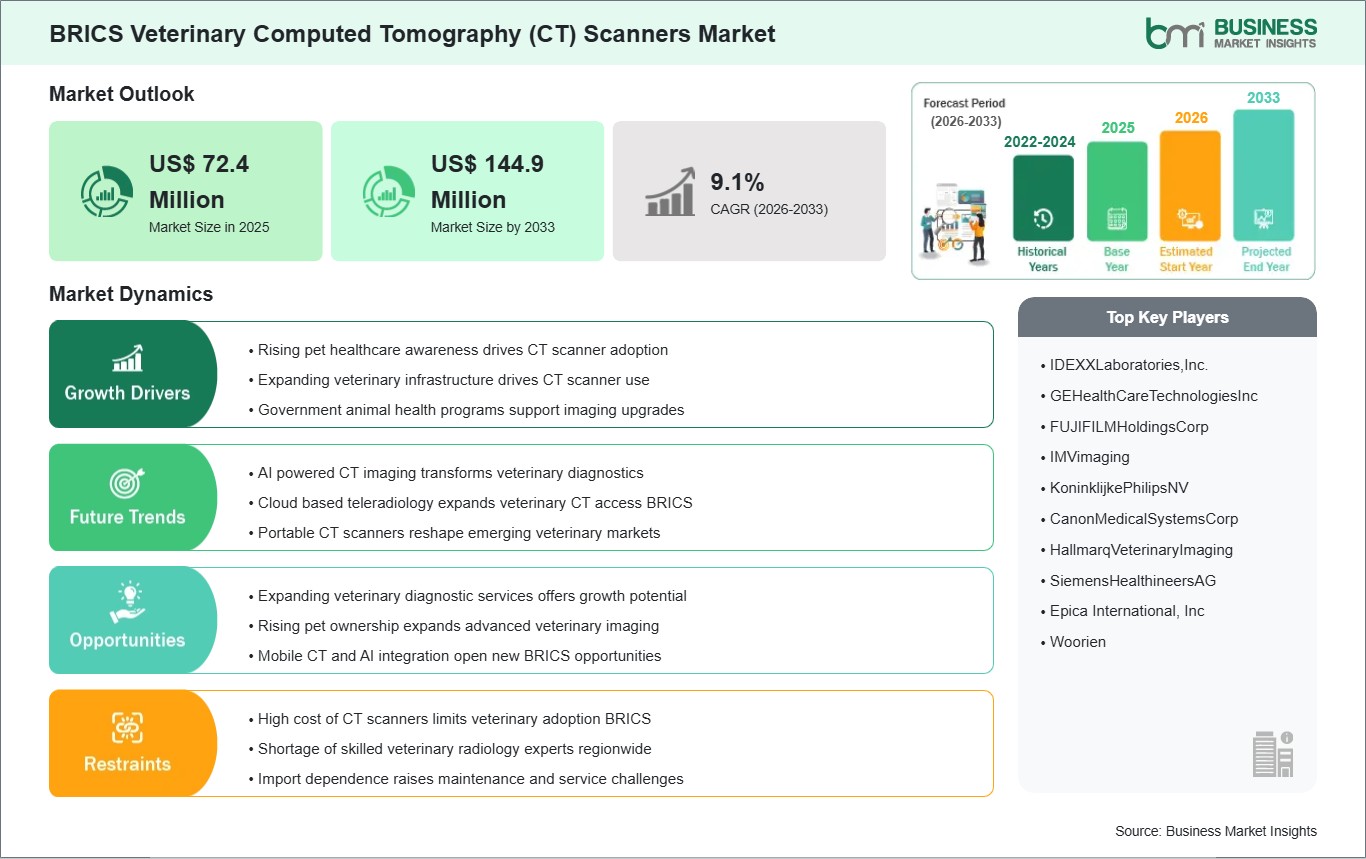
The BRICS Veterinary Computed Tomography (CT) Scanners Market is witnessing steadily growing recognition as a key diagnostic imaging segment across emerging economies, driven by expanding livestock industries, rising companion animal healthcare spend, and an increased emphasis on advanced veterinary diagnostics. In Brazil, the maturation of the livestock export sector and heightened concerns around animal health surveillance have propelled demand for high‑resolution imaging systems. Veterinary practitioners in Brazil increasingly adopt CT scanners to support complex diagnostics in both livestock and companion animals, particularly for orthopedic and neurological conditions where traditional imaging falls short. However, installation and operational costs remain a cautious factor for smaller clinics. Across Russia, veterinary CT adoption is influenced by growing investment in animal care infrastructure and veterinary specialist training. As pet ownership increases in urban centers and awareness of advanced diagnostic tools rises, more veterinary facilities are integrating CT technology to improve diagnostic accuracy.
Nonetheless, uneven distribution of advanced imaging facilities between metropolitan and rural areas restrains broader access. In the Indian context, the market’s expansion is underpinned by a sizable animal population, government initiatives to boost animal healthcare standards, and increased veterinarian training in diagnostic imaging. Indian veterinary hospitals and diagnostic centers are progressively incorporating CT scanners to manage complex cases in equines, bovines, and pets. The cost sensitivity of the market and limited availability of trained radiologic technicians continue to challenge rapid adoption.
China’s veterinary CT sector benefits from robust investment in animal health infrastructure, a thriving companion animal market, and strong government focus on livestock disease prevention and food safety. Regional veterinary centers, particularly in economically advanced provinces, are equipping themselves with state‑of‑the‑art CT scanners to cater to both clinical and research needs. However, technology gaps between urban and less developed areas persist. In South Africa, the growing companion animal care segment and the development of specialized veterinary facilities are supporting gradual uptake of CT scanning. Veterinary universities and referral centers are key early adopters, although broader market penetration is moderated by cost barriers and limited local manufacturing support.
Overall, the BRICS region reflects a landscape where veterinary CT scanners are increasingly acknowledged as essential diagnostic tools, with growth driven by evolving animal healthcare standards, rising demand for precision diagnostics, and expanding investment in veterinary infrastructure, tempered by cost and access challenges across varying regional healthcare environments.
Segment Analysis
BRICS Veterinary Computed Tomography (CT) Scanners Market Segmentation
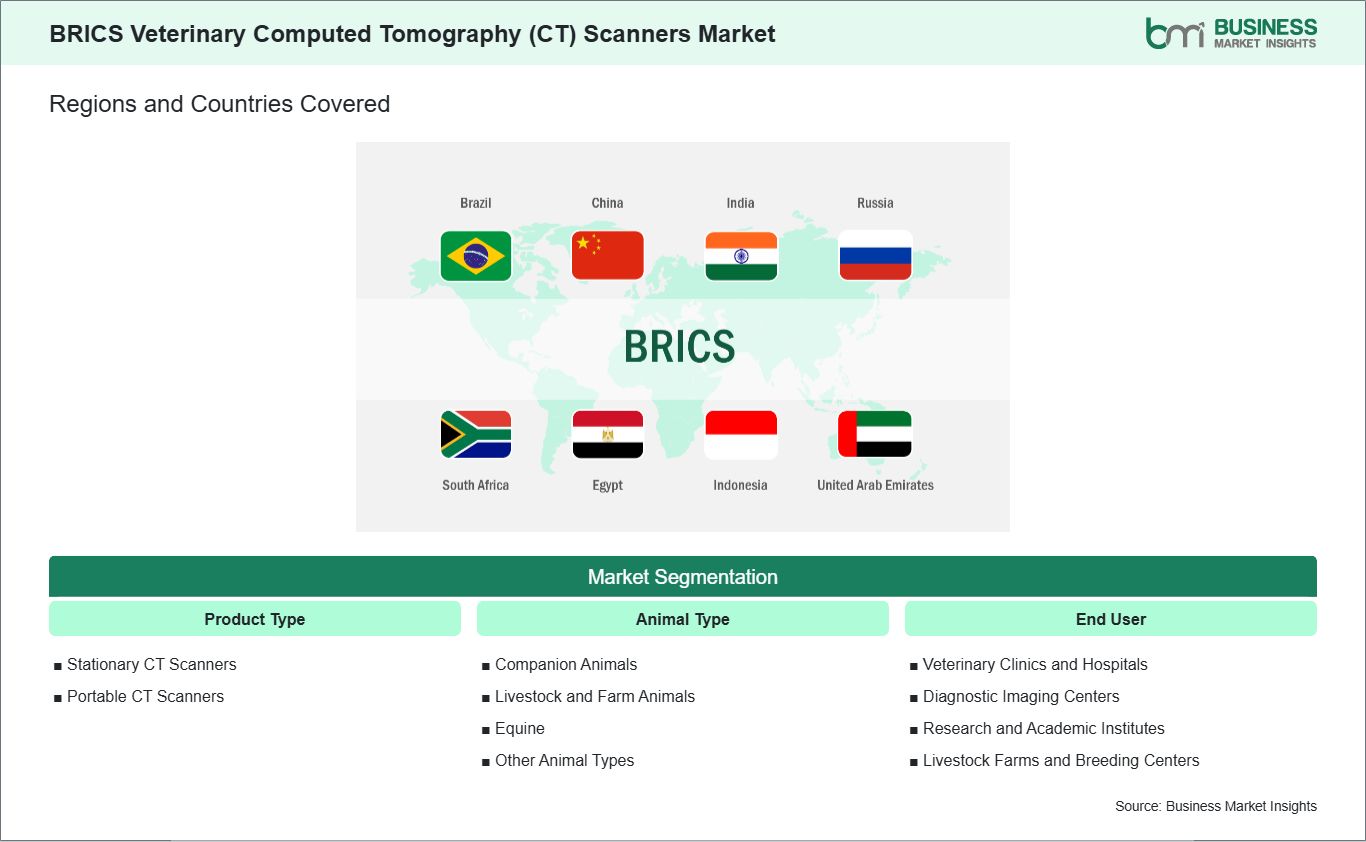
Key segments that contributed to the derivation of the BRICS veterinary computed tomography (CT) scanners market analysis are product type, animal type, and end user.
- By product type, the veterinary computed tomography (CT) scanners market is segmented into stationary CT scanners, portable CT scanners. The stationary CT scanners segment dominated the market in 2025.
- Based on animal type, the veterinary computed tomography (CT) scanners market is categorized into companion animals, livestock and farm animals, equine, other animal types. The companion animals segment dominated the market in 2025.
- In terms of end user, the veterinary computed tomography (CT) scanners market is categorized into veterinary clinics and hospitals, diagnostic imaging centers, research and academic institutes, livestock farms and breeding centers. The veterinary clinics and hospitals segment dominated the market in 2025.
Market Forces
BRICS Veterinary Computed Tomography (CT) Scanners Market Drivers and Opportunities
Rising pet healthcare awareness drives CT scanner adoption
Due to the growing awareness of pet health care, veterinary CT scanners are increasingly being adopted in BRICS countries. As more people own pets in Brazil’s urban centers, the number of routine imaging procedures has risen; therefore, veterinary clinics in Sao Paulo and Rio de Janeiro have started using CT technology. In Russia, the welfare of animals has improved and the amount of money being spent on companion animal health is increasing. Veterinary facilities in Moscow have begun to include CT scanning as an everyday part of their practices.
In India, there are numerous early disease detection campaigns conducted by veterinary colleges and non-governmental organisations (NGOs) that have resulted in more veterinarians using high resolution CT imaging. Hospitals and teaching facilities in Delhi and Bengaluru have seen huge increases in CT referrals for complex cases of musculoskeletal injuries for both companion animals and valuable livestock. Similarly, the growing middle class in China is investing a lot of money into premium quality pet care, which has caused top veterinary hospitals in Shanghai to use multi-slice CT scanners in order to remain competitive.
In South Africa, the heightened awareness regarding wildlife trauma and zoo animal care has also played a role in the increase in the use of veterinary CT scanners. Overall, the increase in the awareness of the importance of animal health as well as the need to care for them will ultimately lead to the growth of the veterinary CT scanner market within BRICS countries.
Expanding veterinary diagnostic services offers growth potential
There are tremendous growth potential opportunities in the Veterinary CT scanner industry due to expanding diagnostics across BRICS countries. In China, government programs aim to modernize rural veterinarians and as a result, many provincial veterinary hospitals/clínicas have been modernized with newer equipment and now tie into the CT Scanner being performed as part of routine procedures within the context of providing complete diagnostic services on complex fractures and internal diseases. Also, there are several private imaging centers being established in China (specifically in the Beijing and Guangzhou areas) to become imaging centers providing a full range of diagnostic imaging tools required to provide diagnostic services to all veterinary clinics in these two cities. The establishment of these imaging centers will create new revenue streams for veterinarians and improve the standard of care for animal patients in these cities.
In India, specialty diagnostic imaging centers are being developed in several cities in India including Pune and Hyderabad that will provide expanded access to CT imaging services beyond just the metropolitan areas and/or large university hospitals. Additionally, as demand for detail-oriented diagnostic imaging increases from the equine and livestock industries in India, suppliers of diagnostic imaging products will create CT Scanner products that are more economical for veterinarians and therefore, more suitable for the full range of veterinary clinical settings. Brazil is also seeing a dramatic increase in demand for CT Imaging from both veterinary clinician associations and from individual veterinary practices, and these groups have begun to partner with international imaging manufacturers to help localize service and maintenance support for their CT scanners throughout the state of Rio Grande do Sul and the state of Minas Gerais.
Finally, both South Africa and Russia have seen increases in the number of veterinary practices providing imaging services for small animal practices and for large animal practices alike with the expansion of the use of veterinary CT scanners to provide these much-needed services demonstrates the considerable growth opportunity for CT Scanners in veterinary diagnostic imaging globally and specifically within the BRICs market.
Size and Share Analysis
BRICS Veterinary Computed Tomography (CT) Scanners Market Size and Share Analysis
The BRICS veterinary computed tomography (CT) scanners market demonstrates steady growth, with size and share analysis highlighting evolving trends and competitive dynamics among key players. The report examines subsegments categorized within product type, animal type, and end user, offering insights into their contribution to overall market performance.
By product type, the stationary CT scanners subsegment dominated the market in 2025, driven by higher imaging precision, greater scanning capacity, and broader clinical application in veterinary diagnostics.
Based on animal type, the companion animals subsegment dominated the market in 2025, driven by rising pet ownership, increased spending on advanced diagnostics, and strong demand for precise imaging in small animal care.
In terms of end user, the veterinary clinics and hospitals subsegment dominated the market in 2025, driven by the growing adoption of advanced diagnostic equipment, expanding veterinary service infrastructure, and preference for in‑house imaging capabilities.
Report Coverage
BRICS Veterinary Computed Tomography (CT) Scanners Market Report Coverage and Deliverables
The "BRICS Veterinary Computed Tomography (CT) Scanners Market Size and Forecast (2022–2033)" report provides a detailed analysis of the market covering below areas:
- BRICS Veterinary Computed Tomography (CT) Scanners Market size and forecast at regional, and country levels for all the key market segments covered under the scope
- BRICS Veterinary Computed Tomography (CT) Scanners Market trends, as well as drivers, restraints, and opportunities
- BRICS Veterinary Computed Tomography (CT) Scanners Market analysis covering key trends, regional framework, major players, regulations, and recent developments
- Industry landscape and competition analysis covering market concentration, heat map analysis, prominent players, and recent developments for the BRICS Veterinary Computed Tomography (CT) Scanners Market
- Detailed company profiles, including SWOT analysis
Geographic Insights
BRICS Veterinary Computed Tomography (CT) Scanners Market Geographic Insights
The geographical scope of the BRICS Veterinary Computed Tomography (CT) Scanners Market report is divided into Russia, Brazil, South Africa, India, the UAE, and China. China held the largest share in 2025.
The BRICS region's veterinary computed tomography (CT) scanner market is influenced by different geographical regions' economic condition, capital development, veterinary infrastructure as well as the adoption of sophisticated diagnostic technology. China is leading the BRICS region's veterinary CT scanner market, with increased investment in veterinary health, urban pet ownership, and generalized livestock management system modernization. Large veterinary hospitals, private clinics, and veterinary research facilities are increasingly utilizing CT imaging systems to obtain greater diagnostic accuracy in diagnosing both companion and production animals; therefore, China is currently projected to be the primary growth driver of the overall BRICS veterinary CT scanner market. In Russia, the veterinary CT scanner market is showing a continuing trend in growth mainly as a result of the development of urban veterinary clinics and specialized veterinary imaging diagnostics facilities; however, growth is currently being impacted by slower expansions of rural veterinary diagnostic centers and the continuing reliance on advanced veterinary imaging systems being imported.
The veterinary CT scanner market in Brazil has had increased growth over the last several years due to the increasing amount of pet ownership in metropolitan areas as well as significantly more dollars spent on veterinary services; however, there are still considerable regional variances and many smaller veterinary clinics will not have the capability to purchase these CT scanners because of the higher initial cost of purchasing and maintaining these systems. The veterinary CT scanner market in South Africa is centered around large cities and university-affiliated veterinary hospitals, with most of the current veterinary CT scanner use being focused on research-based projects and livestock imaging projects.
Therefore, the adoption of CT scanners in South Africa is substantially lower than it is in China due to a lack of veterinary infrastructure such as adequate veterinary diagnostic imaging equipment. In India, the veterinary CT scanner market represents an immature but rapidly expanding veterinary diagnostic imaging market, with a majority of veterinary clinics in urban areas already utilizing CT scanning technology.
Industry Activity
Recent Developments
The BRICS Veterinary Computed Tomography (CT) Scanners Market is evaluated by gathering qualitative and quantitative data post primary and secondary research, which includes important corporate publications, association data, and databases. A few of the key developments in the BRICS veterinary computed tomography (CT) scanners market are:
- In January 2025, Siemens Healthineers announced at the Asian Oceanian Congress of Radiology (AOCR) 2025 that it showcased and introduced its advanced Dual Source CT scanner (SOMATOM Pro.Pulse) and broader imaging portfolio in Chennai, India. The announcement highlighted Siemens Healthineers’ commitment to advancing diagnostic imaging by presenting the SOMATOM Pro.Pulse CT along with other solutions, reinforcing the company’s innovation focus in medical imaging.
- In March 2026, GE HealthCare, announced that its Photonova Spectra photon‑counting CT system received 510(k) clearance from the U.S. Food and Drug Administration (FDA). This clearance represents a significant regulatory milestone for GE HealthCare’s advanced CT imaging technology, a platform designed to deliver enhanced spectral and spatial imaging performance and enable more precise diagnostic insights.
Trust & Transparency
Research Methodology
The market analysis combines proprietary research with secondary data from government agencies, company disclosures, regulatory filings, industry databases and expert interviews. Market estimates are validated through data triangulation, cross-market benchmarking and analyst
review.
View Full Research Methodology
Key Sources Referred:
American College of Veterinary Radiology (ACVR) World Small Animal Veterinary Association (WSAVA) British Veterinary Association (BVA) International Veterinary Radiology Association (IVRA) American Veterinary Medical Association (AVMA) European College of Veterinary Diagnostic Imaging (ECVDI) World Organisation for Animal Health (WOAH / OIE) Veterinary Imaging & Radiation Oncology Society (VIROS)