Market Summary
Executive Summary and Market Analysis
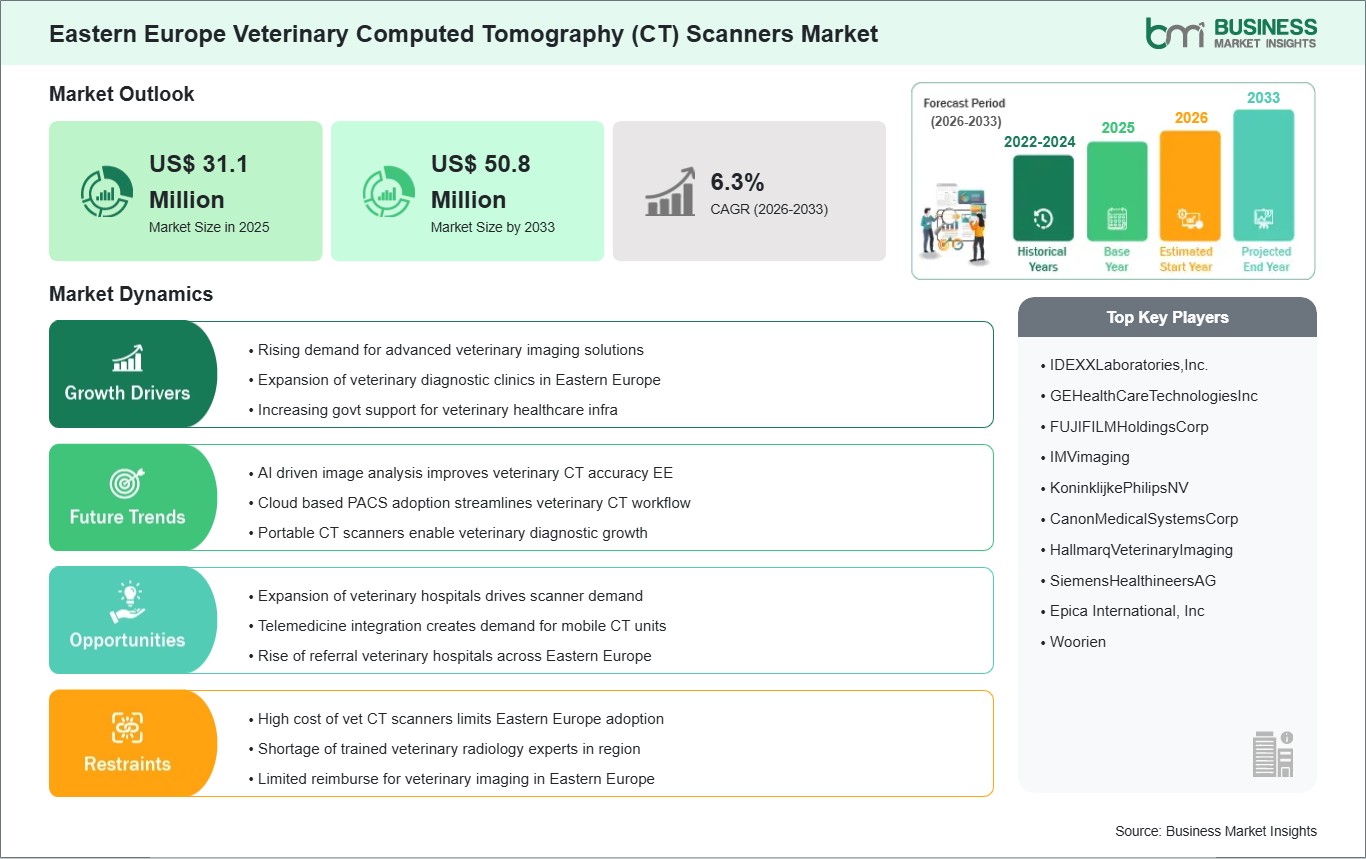
The Eastern Europe veterinary computed tomography (CT) scanners market is emerging as a key segment within the region’s veterinary healthcare landscape. Increasing awareness of advanced diagnostic technologies among veterinary professionals, combined with rising demand for high-quality animal care, is driving the adoption of CT scanners in both companion animal and livestock care. Countries such as Poland, Hungary, the Czech Republic, Romania, and Russia are witnessing gradual growth in specialized veterinary clinics and teaching hospitals, which serve as primary adopters of these advanced imaging solutions.
The shift from traditional radiography and ultrasound toward CT technology reflects a broader trend in the region toward precision diagnostics and evidence-based treatment planning. Several factors are fueling market growth. Rising pet ownership, particularly among urban populations, is contributing to increased expenditure on healthcare services, including advanced diagnostic imaging. Veterinary professionals are increasingly recognizing the value of CT scanners in detecting complex conditions such as neurological disorders, orthopedic injuries, and tumors, which are often challenging to diagnose with conventional imaging. Additionally, technological advancements, including more compact scanner designs, faster image processing, and user-friendly interfaces, have improved the accessibility of CT systems for smaller practices. The expansion of veterinary education and specialized training programs is also creating a workforce capable of operating these systems and interpreting advanced imaging results, further supporting market growth.
Despite these positive trends, the market faces certain constraints. High capital investment required for CT scanners remains a significant barrier for small and mid-sized veterinary clinics, limiting widespread adoption. Furthermore, the shortage of skilled radiology professionals in some countries poses operational challenges, as accurate imaging and interpretation require trained expertise. Limited infrastructure in rural areas also restricts access to advanced diagnostic services for both companion animals and livestock. The Eastern Europe veterinary CT scanners market presents steady growth potential driven by technological advancement, increasing veterinary service demand, and rising clinical awareness. While adoption remains concentrated in urban and specialized centers, ongoing improvements in accessibility and professional training are expected to gradually expand market reach across the region.
Segment Analysis
Eastern Europe Veterinary Computed Tomography (CT) Scanners Market Segmentation
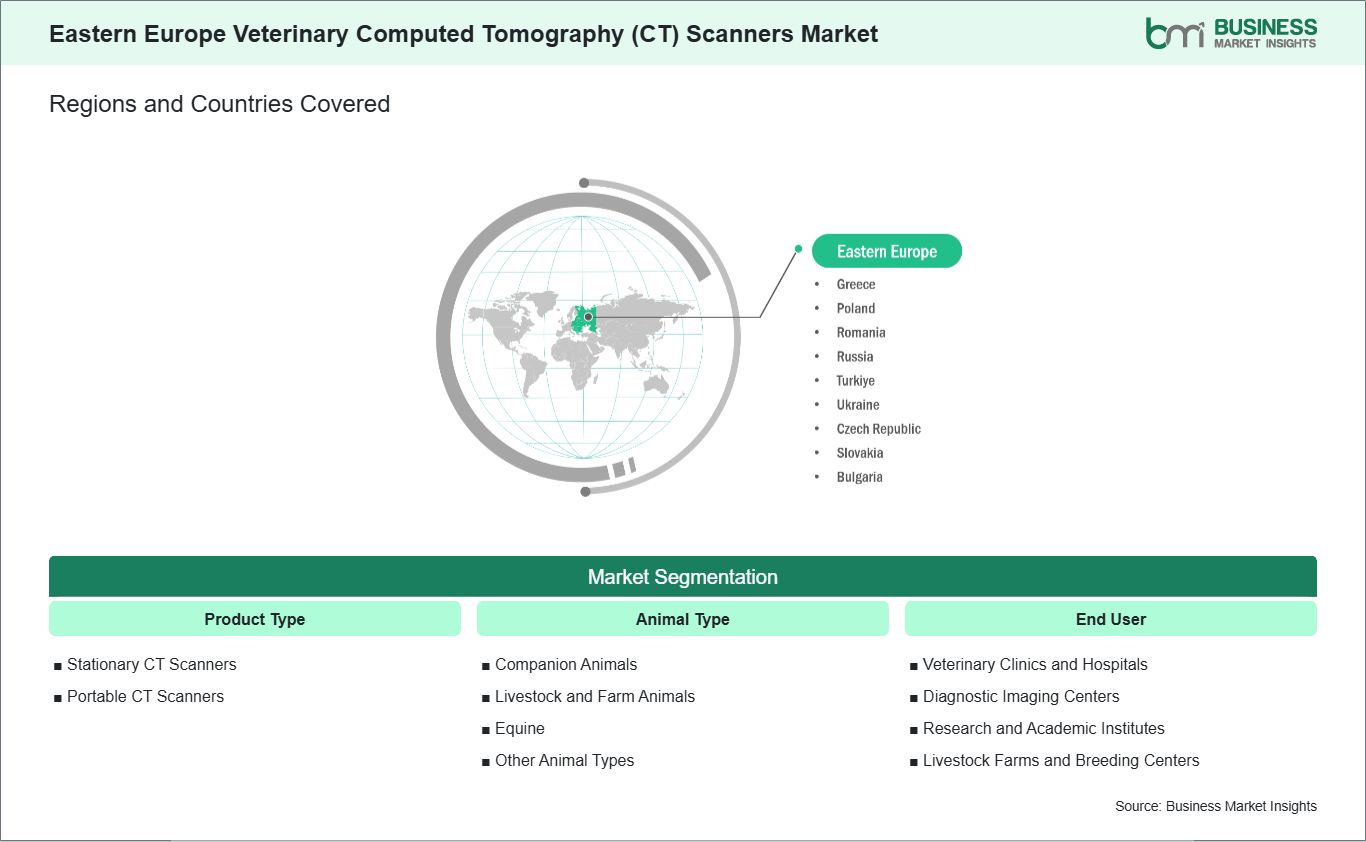
Key segments that contributed to the derivation of the Eastern Europe veterinary computed tomography (CT) scanners market analysis are product type, animal type, and end user.
- By product type, the veterinary computed tomography (CT) scanners market is segmented into stationary CT scanners, portable CT scanners. The stationary CT scanners segment dominated the market in 2025.
- Based on animal type, the veterinary computed tomography (CT) scanners market is categorized into companion animals, livestock and farm animals, equine, other animal types. The companion animals segment dominated the market in 2025.
- In terms of end user, the veterinary computed tomography (CT) scanners market is categorized into veterinary clinics and hospitals, diagnostic imaging centers, research and academic institutes, livestock farms and breeding centers. The veterinary clinics and hospitals segment dominated the market in 2025.
Market Forces
Eastern Europe Veterinary Computed Tomography (CT) Scanners Market Drivers and Opportunities
Rising demand for advanced veterinary imaging solutions
The growing need for diagnostic imaging is driving the demand for a plethora of new technologies in the Eastern European veterinary CT scanner market. Veterinary clinics and veterinary hospitals throughout Eastern Europe, particularly those in Poland, Romania, and Russia, are upgrading their diagnostic equipment to implement advanced imaging solutions providing rapid and accurate diagnoses of progressively complex animal disease processes. The demand for high-resolution CT scanners can be attributed to the surge in the urban pet population and the increasing standard of animal care compared to Western Europe. Veterinarians can detect and diagnose diseases such as neurological disorders, tumors, and internal injuries with far greater accuracy when utilizing high-resolution CT imaging. Therefore, the overall treatment outcome for animals examined by veterinarians utilizing CT imaging technology will also improve. The increasing numbers of investments being made in specialized veterinary care, particularly, equine and exotic animal medicine, is another reason for driving the demand for CT scanners in the Eastern European veterinary CT scanner market. Referral hospitals and veterinary schools throughout Eastern Europe have adopted multi-slice CT technology to perform complex advanced imaging procedures, including reconstructive 3D imaging to assist with pre-operative surgical planning. The increased usage of veterinary medical CT imaging technology in clinics also reflects the increasing expectations of pet owners regarding the quality of care they provide for their animals, which will result in the increased demand for advanced diagnostic imaging technology. Additionally, as veterinary clinics in Eastern Europe continue to change how veterinarians practice veterinary medicine by focusing on preventive care and early identification of diseases, the use of CT imaging will become an integral element of the overall diagnostic protocol and will provide veterinary clinics with timely and accurate results compared to traditional radiography.
Expansion of veterinary hospitals drives scanner demand
With the increase of veterinary clinics across Eastern Europe, there is also increasing demand for CT scanners. In the Czech Republic, Slovakia, and Hungary, there is an increase in the number of private veterinary centers that are able to provide a variety of services with advanced diagnostic imaging. As the number of these facilities increases, so will the demand for high-quality equipment to remain competitive with the current level of patient expectations regarding the quality of diagnostics provided. CT scanners are now considered to be essential for the diagnosis of trauma, cancer, and complex internal conditions, and therefore are viewed as a necessary investment for hospitals expanding their capabilities. Urbanization and increased disposable incomes are driving the growth of pet ownership, particularly in large cities. In addition, with the trend towards the use of quality veterinary services, more veterinary hospitals are looking to invest in CT technologies to improve their diagnostic capabilities. Hospitals that previously relied on only X-ray or ultrasound technology are now utilizing CT imaging to obtain more accurate and timely diagnostic information, resulting in improved patient care and customer experience. Finally, another trend that is driving the growth of the CT market is the growing desire for accessibility. Many smaller veterinary hospitals and regional veterinary centers are now looking at portable or compact CT scanners that can be used in restrictive spaces. These scalable solutions provide more clinics with advanced imaging capabilities and improve regional access to advanced imaging services.
Size and Share Analysis
Eastern Europe Veterinary Computed Tomography (CT) Scanners Market Size and Share Analysis
The Eastern Europe veterinary computed tomography (CT) scanners market demonstrates steady growth, with size and share analysis highlighting evolving trends and competitive dynamics among key players. The report examines subsegments categorized within product type, animal type, and end user, offering insights into their contribution to overall market performance.
By product type, the stationary CT scanners subsegment dominated the market in 2025, driven by their superior imaging capabilities and widespread installation in advanced veterinary facilities.
Based on animal type, the companion animals subsegment dominated the market in 2025, driven by the increasing pet ownership and rising demand for advanced diagnostic imaging for pets.
In terms of end user, the veterinary clinics and hospitals subsegment dominated the market in 2025, driven by the high volume of animal diagnostics and availability of specialized veterinary imaging infrastructure.
Report Coverage
Eastern Europe Veterinary Computed Tomography (CT) Scanners Market Report Coverage and Deliverables
The "Eastern Europe Veterinary Computed Tomography (CT) Scanners Market Size and Forecast (2022–2033)" report provides a detailed analysis of the market covering below areas:
- Eastern Europe Veterinary Computed Tomography (CT) Scanners Market size and forecast at regional, and country levels for all the key market segments covered under the scope
- Eastern Europe Veterinary Computed Tomography (CT) Scanners Market trends, as well as drivers, restraints, and opportunities
- Eastern Europe Veterinary Computed Tomography (CT) Scanners Market analysis covering key trends, regional framework, major players, regulations, and recent developments
- Industry landscape and competition analysis covering market concentration, heat map analysis, prominent players, and recent developments for the Eastern Europe Veterinary Computed Tomography (CT) Scanners Market
- Detailed company profiles, including SWOT analysis
Geographic Insights
Eastern Europe Veterinary Computed Tomography (CT) Scanners Market Geographic Insights
The geographical scope of the Eastern Europe Veterinary Computed Tomography (CT) Scanners Market report is divided into Russia, Poland, Ukraine, Romania, the Czech Republic, Slovakia, Bulgaria, and Greece. Russia held the largest share in 2025.
Russia has the largest veterinary Computed Tomography (CT) market in all of Eastern Europe; this is due to the fact that Russia has an extremely well-developed veterinary infrastructure, therefore, a very large population both for companion animals and livestock. It is also growing due to the increased investment in new and innovative diagnostic technologies. The medical and diagnostic facilities that provide services to the veterinary community in Russia are now utilizing CT imaging more frequently to support both their complex diagnosis, the surgical planning and research, thereby contributing to a much larger market for CT imaging when compared to the other Eastern European countries. Of the moderately developed countries in Eastern Europe, Poland and the Czech Republic are on the cutting edge of urban companion animal veterinary practice and are purchasing and using CT scanners for companion animal treatment based on, among other things, an increase in pet ownership and the increasing awareness of the benefits of new and innovative diagnostic technologies. Romania, Slovakia, and Bulgaria are all emerging countries in the use of veterinary CT and do so more slowly due primarily to their stricter budgetary constraints, as well as the fact they have smaller veterinary facilities, and also depend on using either shared or centralized diagnostic services. Ukraine has a large veterinary sector.
However, due to the economic and infrastructure challenges that it faces, it is adopting high technology imaging equipment at a slower rate compared to other countries. There are several urban veterinary hospitals in the major cities, as well as a number of the universities that have veterinary medicine programs, which are incorporating CT technology, however, it is still being done at a cautiously. While Greece continues to show growth in the use of veterinary CT, it is slower than other countries in the region because the majority of the veterinary practices using CT are in the metropolitan areas. Compared to other countries, Greece has a much smaller market for veterinary CT.
Industry Activity
Recent Developments
The Eastern Europe Veterinary Computed Tomography (CT) Scanners Market is evaluated by gathering qualitative and quantitative data post primary and secondary research, which includes important corporate publications, association data, and databases. A few of the key developments in the Eastern Europe veterinary computed tomography (CT) scanners market are:
- In February 2025, Royal Philips announced that its Radiology Operations Command Center Console received certification under the European Union Medical Device Regulation (MDR) enabling remote CT scanning capabilities across Europe. This development is positioned to improve diagnostic efficiency for CT imaging workflows in European healthcare settings, which indirectly supports broader CT scanner adoption — including in veterinary imaging facilities in the region.
- In November 2025, GE HealthCare announced the launch of its Photonova™ Spectra CT system with Deep Silicon detector technology — a next‑generation photon‑counting CT platform designed to enhance spectral and spatial imaging resolution. While this press release was broadly global and not yet CE marked at the time, it represents a major new CT scanner innovation from a leading imaging company that will influence European CT offerings once regulatory approvals are secured.
Trust & Transparency
Research Methodology
The market analysis combines proprietary research with secondary data from government agencies, company disclosures, regulatory filings, industry databases and expert interviews. Market estimates are validated through data triangulation, cross-market benchmarking and analyst
review.
View Full Research Methodology
Key Sources Referred:
American College of Veterinary Radiology (ACVR) World Small Animal Veterinary Association (WSAVA) British Veterinary Association (BVA) International Veterinary Radiology Association (IVRA) American Veterinary Medical Association (AVMA) European College of Veterinary Diagnostic Imaging (ECVDI) World Organisation for Animal Health (WOAH / OIE) Veterinary Imaging & Radiation Oncology Society (VIROS)