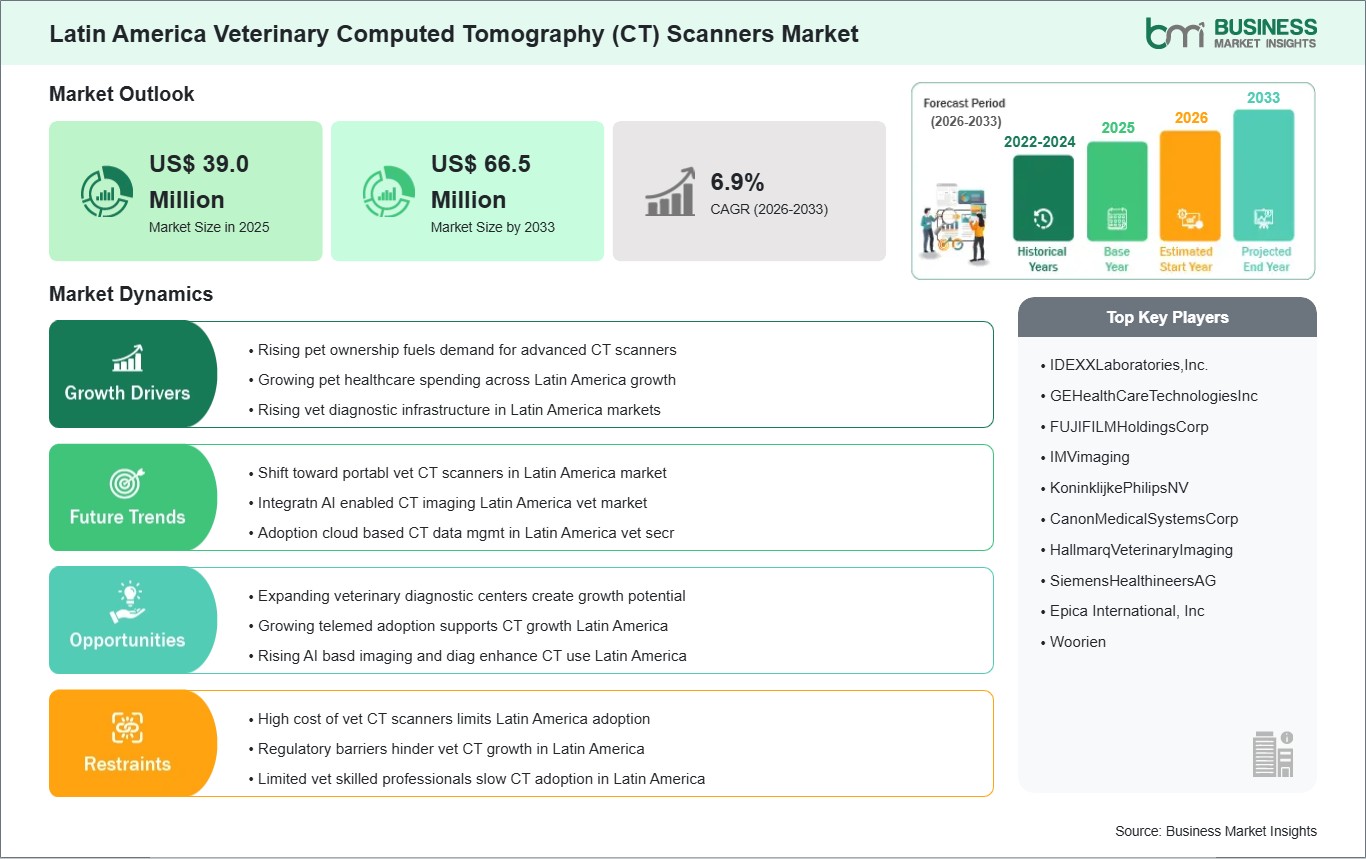
The Latin America veterinary computed tomography (CT) scanners market size is expected to reach US$ 66.5 million by 2033 from US$ 39.0 million in 2025. The market is estimated to record a CAGR of 6.9% from 2026 to 2033.
The market for veterinary CT scanners in Latin America is undergoing a slow transformation, which proceeds through two factors. The first factor is rising animal healthcare knowledge among the general public, while the second factor consists of developing veterinary medical facilities. The urban population across Brazil, Mexico and Argentina exhibits increasing pet ownership, which creates demand for advanced diagnostic technologies. Veterinary practitioners currently prefer CT scanners because they deliver rapid and precise imaging capacity, which supports their work with both small and large animal medical procedures. The expansion of veterinary clinics and service facilities constitutes the primary factor that drives market development in this area. Pet owners in urban areas now prefer to spend money on specialized medical treatment, which has led clinics to adopt advanced imaging technologies that help them stay competitive while meeting the needs of their patients. The livestock and agricultural sectors now utilize precision veterinary technologies as an approach to enhance their herd health and operational efficiency.
The industries find CT scanners appealing because these devices enable early disease detection, accurate diagnostic results and detailed assessment of both musculoskeletal and internal organ health conditions. Veterinary teaching hospitals and academic institutions are transforming market trends through their initial adoption of CT technology. The institutions offer training programs and research opportunities while serving as demonstration sites to promote clinical adoption. The availability of international equipment suppliers who establish local service centers enables secondary cities to gain access to CT scanners, which allows smaller veterinary clinics to acquire advanced imaging technology through flexible procurement options.
Market growth faces multiple obstacles despite existing positive market trends. The high costs of initial investment and ongoing maintenance expenses prevent smaller veterinary practices and rural clinics from adopting new technologies. The veterinary sector faces a shortage of trained radiology specialists, which prevents effective implementation of CT systems. The infrastructure challenges that develop areas face include unreliable electricity systems and inadequate technical assistance, which create obstacles to market expansion.
The Latin America veterinary CT scanners market will experience continuous growth because of increasing demand for advanced diagnostic methods, new veterinary facilities and collaborations between clinical and academic institutions. The region will reach its complete economic potential when organizations address cost challenges and build up their workforce.

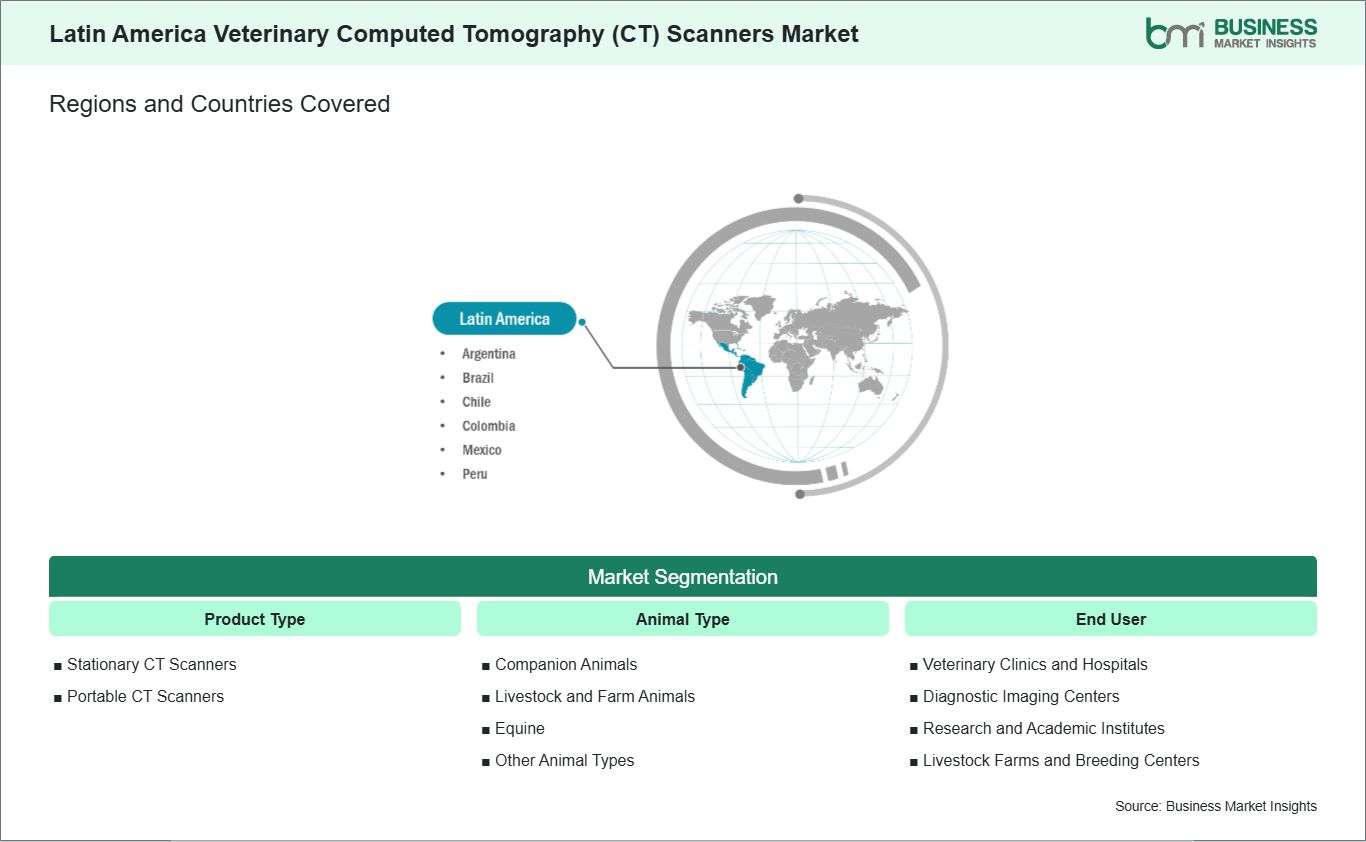
Key segments that contributed to the derivation of the Latin America veterinary computed tomography (CT) scanners market analysis are product type, animal type, and end user.
Pet ownership is increasing in Latin America because urban Brazilian, Mexican and Argentinean neighborhoods are seeing more residents acquire dogs and cats. The pet ownership trend drives pet owners to require advanced veterinary services, which include computed tomography scanners, for their need to obtain early, accurate health assessments of complex medical issues. Urban veterinary clinics are now investing in high-resolution imaging equipment to provide faster, more accurate assessments for tumors, orthopedic injuries, and internal organ evaluations.
Veterinary practices have increased their diagnostic capacity through companion animal growth, which now includes CT scanning as part of their standard preventive assessments. Pet owners in metropolitan regions are willing to pay for high-quality diagnostics, which leads clinics to implement contemporary imaging systems that were previously available only to extensive medical facilities and specialized medical centers.
Pet owners are becoming more aware of pet wellness, which results in them visiting veterinarians more often, creating a continuous demand for advanced CT scanner technology. This particular growth process shows strong growth in areas where veterinary systems develop quickly, and modern clinics establish themselves as top providers of premium animal healthcare.
The expansion of veterinary diagnostic centers in Latin America presents a significant growth opportunity for CT scanner adoption. Cities such as São Paulo, Mexico City, and Buenos Aires are seeing a rise in multi-specialty veterinary hospitals and imaging facilities, which are integrating advanced CT systems to enhance their service offerings. These centers cater to both companion animals and larger livestock, providing comprehensive diagnostic solutions in a single location.
Investment in new diagnostic facilities is supported by the increasing demand for precision medicine in veterinary care. Clinics are upgrading traditional X-ray imaging with CT technology to improve diagnostic accuracy and efficiency, allowing veterinarians to detect conditions that were previously challenging to identify. Portable and compact CT units are also gaining popularity, providing flexibility for clinics handling multiple species and large animals.
Furthermore, the growing emphasis on preventive healthcare and early disease detection is encouraging private clinics and veterinary chains to expand their imaging capabilities. This creates a favorable environment for CT scanner manufacturers and service providers to introduce tailored solutions for Latin America’s diverse veterinary market, promoting long-term adoption and regional market growth.

The Latin America veterinary computed tomography (CT) scanners market demonstrates steady growth, with size and share analysis highlighting evolving trends and competitive dynamics among key players. The report examines subsegments categorized within product type, animal type, and end user, offering insights into their contribution to overall market performance.
By product type, the stationary CT scanners subsegment dominated the market in 2025, driven by their superior image quality, higher throughput and advanced diagnostic capabilities preferred in large veterinary facilities.
Based on animal type, the companion animals subsegment dominated the market in 2025, driven by the rising pet ownership and increased demand for advanced diagnostic imaging in dogs and cats.
In terms of end user, the veterinary clinics and hospitals subsegment dominated the market in 2025, driven by the growing adoption of CT technology for comprehensive diagnostic services in clinical and hospital settings.
| Report Attribute | Details |
|---|---|
| Market size in 2025 | US$ 39.0 Million |
| Market Size by 2033 | US$ 66.5 Million |
| CAGR (2026 - 2033) | 6.9% |
| Historical Data | 2022-2024 |
| Forecast period | 2026-2033 |
| Segments Covered | By Product Type
|
|
Regions and Countries Covered
| |
| Latin America | Mexico, Brazil, Argentina, Peru, Chile, Colombia |
| Market leaders and key company profiles |
|
The "Latin America Veterinary Computed Tomography (CT) Scanners Market Size and Forecast (2022–2033)" report provides a detailed analysis of the market covering below areas:
The geographical scope of the Latin America Veterinary Computed Tomography (CT) Scanners Market report is divided into Mexico, Brazil, Argentina, Peru, Chile, and Colombia. Brazil held the largest share in 2025.
The Latin American Veterinary Computed Tomography (CT) Scanners market shows different adoption levels across its main countries. Brazil leads the market because it has developed veterinary facilities, a large pet population and capacity to spend on advanced diagnostic tools. Brazil's two main cities, São Paulo and Rio de Janeiro, show high demand for advanced CT scanners, which veterinarians need to treat both companion animals and large animals.
Mexico serves as the next major market because people are becoming more aware of animal health testing, and private veterinary clinics are expanding their services according to the needs of the rising middle-class population, who want pet healthcare services. The adoption rate in Argentina shows gradual improvement across its metropolitan areas, which include Buenos Aires and Córdoba; private diagnostic centers and referral hospitals throughout these areas have started using CT imaging to diagnose complicated cases. Colombia exists as a new market that shows moderate growth because its main cities possess more advanced veterinary services, but its rural regions struggle with high costs and poor infrastructure.
The growth of Chilean markets stems from people who care about companion animals and their need to diagnose diseases at an early stage, but the market size still remains smaller than the Brazilian market. The Peruvian market has just started to develop because demand exists only in Lima, and modern veterinary facilities are found in other urban areas, while adoption remains limited because of insufficient veterinary resources and low spending in the field. The rising pet ownership, together with better awareness about advanced veterinary diagnostics and private veterinary networks, helps drive growth across these nations.
The market has different stages of development because Brazil stands out as the most advanced country through its extensive investment and widespread technology use, which positions it as the main center for veterinary CT imaging equipment, while other nations advance their systems according to their financial resources and city-based veterinary development.

The Latin America Veterinary Computed Tomography (CT) Scanners Market is evaluated by gathering qualitative and quantitative data post primary and secondary research, which includes important corporate publications, association data, and databases. A few of the key developments in the Latin America veterinary computed tomography (CT) scanners market are:
The Latin America Veterinary Computed Tomography (CT) Scanners Market is valued at US$ 39.0 Million in 2025, it is projected to reach US$ 66.5 Million by 2033.
As per our report Latin America Veterinary Computed Tomography (CT) Scanners Market, the market size is valued at US$ 39.0 Million in 2025, projecting it to reach US$ 66.5 Million by 2033. This translates to a CAGR of approximately 6.9% during the forecast period.
The Latin America Veterinary Computed Tomography (CT) Scanners Market report typically cover these key segments-
The historic period, base year, and forecast period can vary slightly depending on the specific market research report. However, for the Latin America Veterinary Computed Tomography (CT) Scanners Market report:
The Latin America Veterinary Computed Tomography (CT) Scanners Market is populated by several key players, each contributing to its growth and innovation. Some of the major players include:
The Latin America Veterinary Computed Tomography (CT) Scanners Market report is valuable for diverse stakeholders, including:
Essentially, anyone involved in or considering involvement in the Latin America Veterinary Computed Tomography (CT) Scanners Market value chain can benefit from the information contained in a comprehensive market report.
Please tell us your area of interest
(Market Segments/ Regions and Countries/ Companies)