Market Summary
Executive Summary and Market Analysis
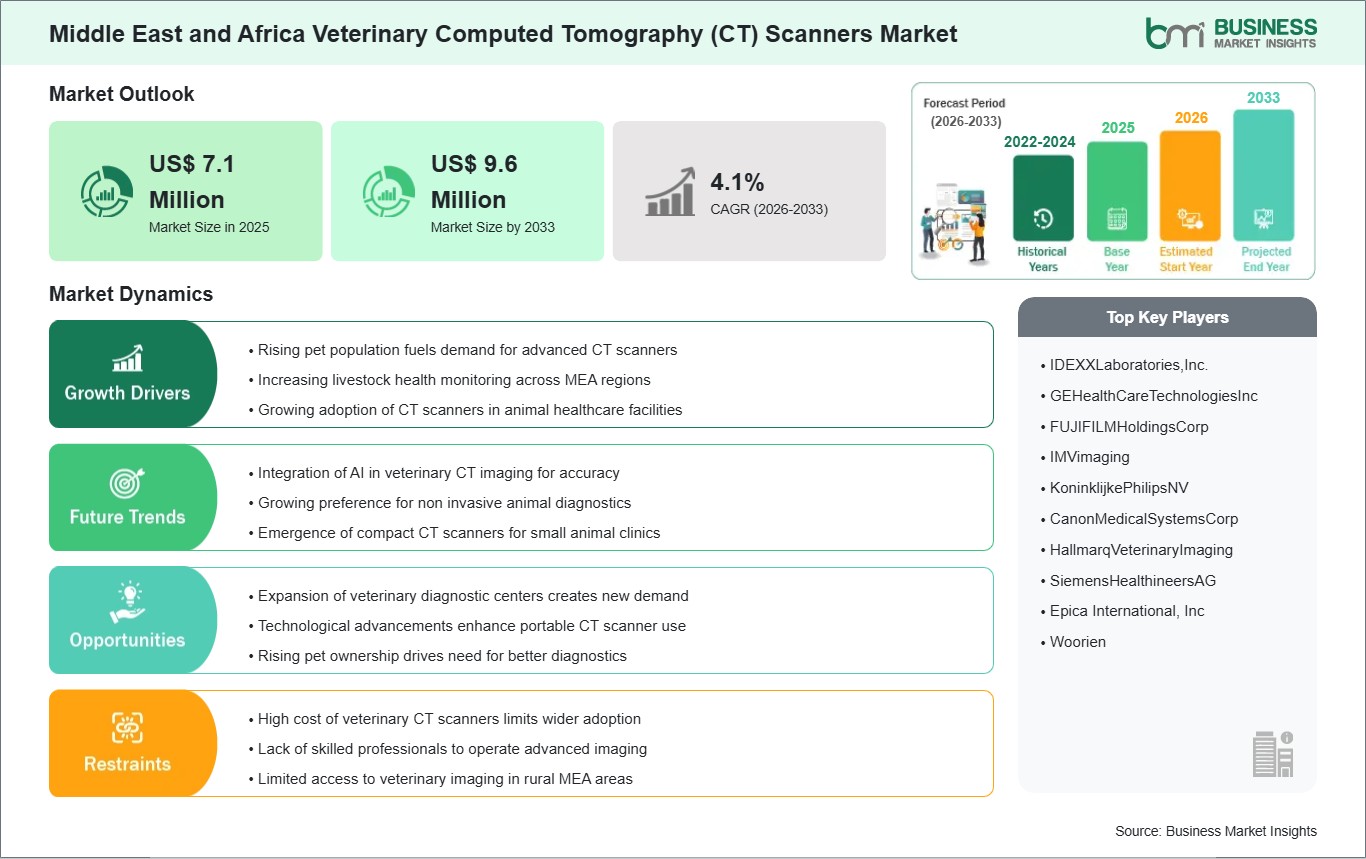
The Middle East and Africa (MEA) Veterinary Computed Tomography (CT) Scanners Market is witnessing gradual development as the region increasingly recognizes the importance of advanced diagnostic imaging in veterinary care. Veterinary CT scanners enable high-resolution cross-sectional imaging, which veterinarians use to diagnose complex medical conditions that affect companion animals, livestock and wildlife. In the MEA region, rising awareness of animal health and welfare, together with better veterinary services in urban and semi-urban areas, drives demand for such technologies. Countries in the Gulf and Southern Africa that have developed veterinary practices are now spending money on advanced imaging equipment to boost their diagnostic accuracy and treatment success rates. The market experiences growth because pet owners now treat their animals as family members. Pet ownership is increasing in urban centers of the Middle East, and owners now prefer advanced diagnostic tests to support their needs for preventive care, surgical planning and complex disease management. African agricultural health programs with CT technology enable livestock owners to monitor herd health and detect diseases while boosting production.
The demand from companion animals, together with livestock needs, creates multiple market options for veterinary CT systems throughout the region. The market expansion process encounters obstacles. CT scanners need substantial capital investment because their costs include both the scanner equipment and the necessary shielding, maintenance and specialized software, which creates financial difficulties for smaller veterinary clinics and new veterinary practices in developing countries. The shortage of trained personnel who can operate and interpret CT scans hinders adoption in areas where veterinary education and technical training still need to be developed. The process of importing and installing advanced imaging equipment requires regulatory compliance, which results in market delays and extra expenses for some regions.
The MEA Veterinary CT Scanners Market will experience continuous expansion despite facing various obstacles. The region will achieve permanent CT technology adoption through current veterinary infrastructure developments, enhanced professional skills and growing understanding of advanced imaging benefits in clinical and agricultural fields.
Segment Analysis
Middle East and Africa Veterinary Computed Tomography (CT) Scanners Market Segmentation
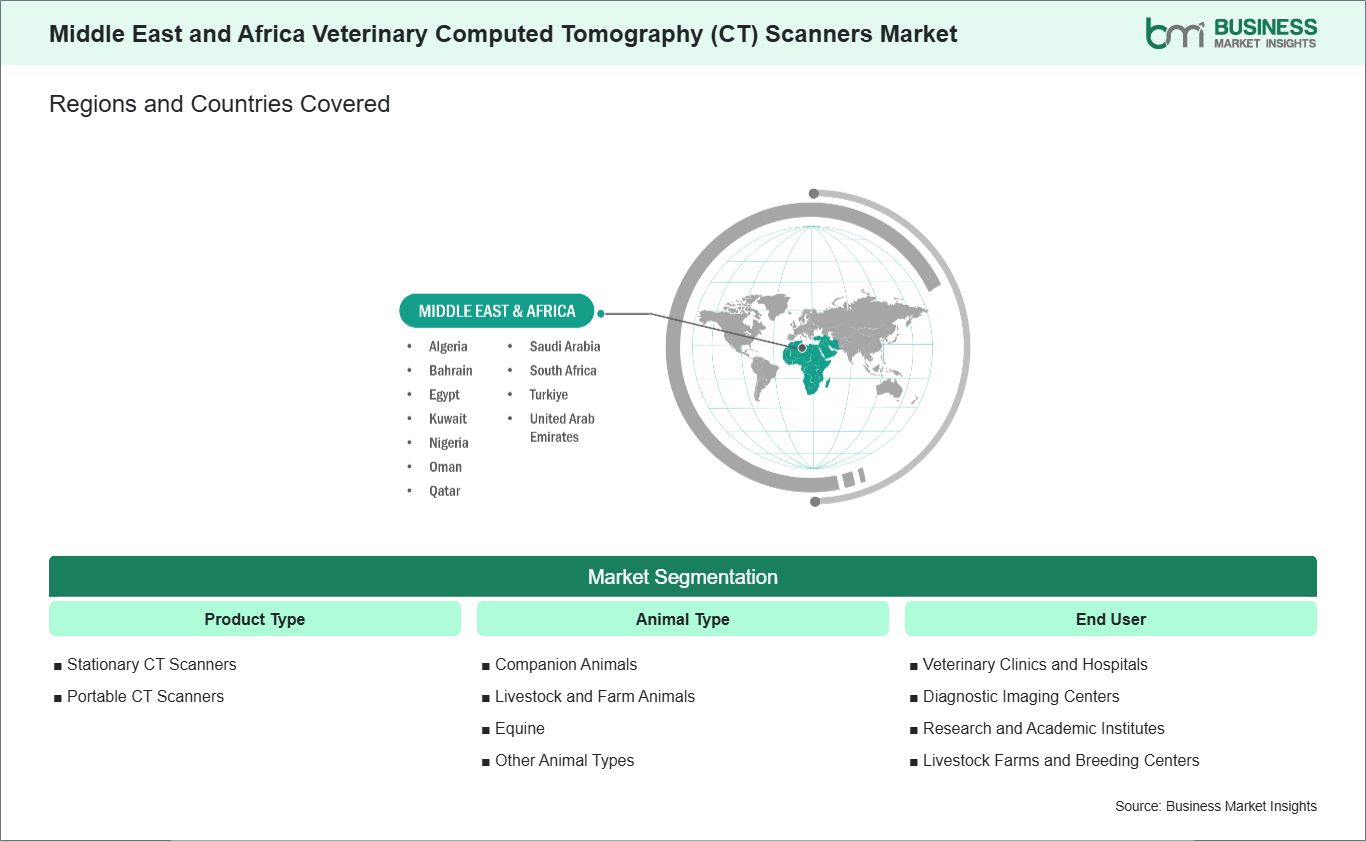
Key segments that contributed to the derivation of the Middle East and Africa veterinary computed tomography (CT) scanners market analysis are product type, animal type, and end user.
- By product type, the veterinary computed tomography (CT) scanners market is segmented into stationary CT scanners, portable CT scanners. The stationary CT scanners segment dominated the market in 2025.
- Based on animal type, the veterinary computed tomography (CT) scanners market is categorized into companion animals, livestock and farm animals, equine, other animal types. The companion animals segment dominated the market in 2025.
- In terms of end user, the veterinary computed tomography (CT) scanners market is categorized into veterinary clinics and hospitals, diagnostic imaging centers, research and academic institutes, livestock farms and breeding centers. The veterinary clinics and hospitals segment dominated the market in 2025.
Market Forces
Middle East and Africa Veterinary Computed Tomography (CT) Scanners Market Drivers and Opportunities
Rising pet population fuels demand for advanced CT scanners
The market for veterinary CT scanners in the Middle East and Africa shows continuous expansion because urban areas and suburban communities experience a significant increase in pet ownership. The demand for advanced diagnostic tools has arisen because pet owners now understand through their animal health knowledge and preventive care practices. Pet owners in the UAE, Saudi Arabia and South Africa now search for precise and early diagnosis of common medical conditions, which drives veterinary clinics to purchase computed tomography systems.
Veterinary practices improve their imaging systems because urbanization and higher disposable incomes create more demand for their services. Veterinary clinics need advanced CT technology to achieve better clinical results because their high-value pets, which include show dogs and cats, create this requirement. The adoption of advanced diagnostic equipment in veterinary service providers shows strong growth because metropolitan areas have multiple competing providers in their market.
Veterinary hospitals that treat both companion and livestock animals now use CT scanners to enhance their disease detection capabilities and treatment planning processes. The market across the region experiences growth because pet populations increase, while owner expectations rise, and veterinary services expand their reach.
Expansion of veterinary diagnostic centers creates new demand
The growth of veterinary diagnostic centers across the Middle East and Africa is a major driver for the CT scanner market. New specialty hospitals and multi-service clinics are being established in major cities, enabling comprehensive diagnostic services for pets and livestock. The expansion of such centers allows veterinary practices to offer high-quality imaging solutions, including CT scans for neurological, orthopedic, and soft tissue assessments, which were previously limited to a few advanced facilities.
In addition to private hospitals, government-supported animal health programs in the region are encouraging investment in diagnostic infrastructure. This trend is particularly visible in metropolitan hubs, where access to advanced imaging enhances the efficiency and accuracy of veterinary care. Smaller clinics also benefit from referral networks, allowing them to utilize CT services without direct investment in costly equipment.
The proliferation of diagnostic centers, coupled with rising awareness among pet owners and livestock managers, is creating substantial new demand for CT scanners. As these centers expand in number and capability, the market for veterinary CT technology in the Middle East and Africa is expected to grow steadily over the coming years.
Size and Share Analysis
Middle East and Africa Veterinary Computed Tomography (CT) Scanners Market Size and Share Analysis
The Middle East and Africa veterinary computed tomography (CT) scanners market demonstrates steady growth, with size and share analysis highlighting evolving trends and competitive dynamics among key players. The report examines subsegments categorized within product type, animal type, and end user, offering insights into their contribution to overall market performance.
By product type, the stationary CT scanners subsegment dominated the market in 2025, driven by their ability to provide high-precision imaging for complex cases and handle high patient volumes efficiently in veterinary facilities.
Based on animal type, the companion animals subsegment dominated the market in 2025, driven by the growing pet ownership culture and increasing demand for advanced diagnostic care for cats and dogs.
In terms of end user, the veterinary clinics and hospitals subsegment dominated the market in 2025, driven by their higher capacity and preference for investing in cutting-edge imaging equipment to support diverse animal healthcare needs.
Report Coverage
Middle East and Africa Veterinary Computed Tomography (CT) Scanners Market Report Coverage and Deliverables
The "Middle East and Africa Veterinary Computed Tomography (CT) Scanners Market Size and Forecast (2022–2033)" report provides a detailed analysis of the market covering below areas:
- Middle East and Africa Veterinary Computed Tomography (CT) Scanners Market size and forecast at regional, and country levels for all the key market segments covered under the scope
- Middle East and Africa Veterinary Computed Tomography (CT) Scanners Market trends, as well as drivers, restraints, and opportunities
- Middle East and Africa Veterinary Computed Tomography (CT) Scanners Market analysis covering key trends, regional framework, major players, regulations, and recent developments
- Industry landscape and competition analysis covering market concentration, heat map analysis, prominent players, and recent developments for the Middle East and Africa Veterinary Computed Tomography (CT) Scanners Market
- Detailed company profiles, including SWOT analysis
Geographic Insights
Middle East and Africa Veterinary Computed Tomography (CT) Scanners Market Geographic Insights
The geographical scope of the Middle East and Africa Veterinary Computed Tomography (CT) Scanners Market report is divided into Turkiye, the UAE, Saudi Arabia, Bahrain, Oman, Egypt, South Africa and Africa, Algeria, Nigeria, Kuwait, and Qatar. Turkiye held the largest share in 2025.
The veterinary computed tomography (CT) scanners market throughout the Middle East and Africa region operates under Turkish control because the country functions as a major regional center that delivers advanced veterinary services through its existing veterinary facilities and an increasing number of specialized veterinary clinics, which use modern imaging equipment for all types of animals. The country benefits from a combination of rising pet ownership, a robust livestock sector, and a healthcare ecosystem that supports investment in high-end diagnostic equipment, which positions it as the primary growth driver for the regional market. The market in the United Arab Emirates experiences continuous growth because of urban pet ownership trends, which combine with high-income demographic groups and the expansion of private veterinary clinics that provide advanced diagnostic services. The Saudi Arabian market shows moderate growth potential because government programs aim to improve veterinary services and increase animal healthcare services, which mostly operate in major cities. The smaller Gulf nations of Bahrain, Oman, Kuwait, and Qatar currently experience initial demand for veterinary CT scanners, which continues to grow because people now understand the benefits of advanced diagnostic technology while they own more expensive pets, but the market remains small because of limited population numbers and few available veterinary clinics.
North Africa sees Egypt as a developing growth corridor that handles livestock health monitoring requirements through its new network of private veterinary facilities that use modern imaging equipment. The development of private veterinary services and livestock management in Algeria and Nigeria has created new demand, yet infrastructural challenges and expensive equipment requirements continue to slow their implementation process. The veterinary market in South Africa represents its most developed stage because the country has established veterinary educational hospitals and research centers, and numerous private medical facilities that utilize advanced diagnostic equipment such as CT scanners. The region experiences growth through three main factors, which include rising pet ownership, improved livestock health management practices, and growing adoption of preventive veterinary services, although technical limitations and expensive equipment acquisition continue to hinder progress in underdeveloped areas. Equipment manufacturers need to establish training facilities and maintenance centers while forming partnerships with veterinary schools to create solutions that will reduce existing regional disparities and support business growth in underserved regions.
Industry Activity
Recent Developments
The Middle East and Africa Veterinary Computed Tomography (CT) Scanners Market is evaluated by gathering qualitative and quantitative data post primary and secondary research, which includes important corporate publications, association data, and databases. A few of the key developments in the Middle East and Africa veterinary computed tomography (CT) scanners market are:
- In September 2025, Zahrawi Group and GE HealthCare announced a strategic partnership in Qatar to enhance diagnostic imaging solutions across the region. This collaboration between GE HealthCare Middle East, Turkey & Africa and Zahrawi Group was launched to expand and enhance access to diagnostic imaging technologies, including CT systems across Qatar and surrounding markets, laying groundwork for expanded availability of advanced imaging devices important to veterinary diagnostics as well as human healthcare.
- In March 2026, Canon Inc. announced that its Aquilion Rise CT scanner won the iF Design Award 2026 (Gold), a recognition tied to the design and innovation of its CT systems. While this is a global product award, Aquilion CT systems are part of Canon’s CT technology portfolio potentially used in diverse imaging markets (human and veterinary) worldwide, including the Middle East and Africa.
Trust & Transparency
Research Methodology
The market analysis combines proprietary research with secondary data from government agencies, company disclosures, regulatory filings, industry databases and expert interviews. Market estimates are validated through data triangulation, cross-market benchmarking and analyst
review.
View Full Research Methodology
Key Sources Referred:
American College of Veterinary Radiology (ACVR) World Small Animal Veterinary Association (WSAVA) British Veterinary Association (BVA) International Veterinary Radiology Association (IVRA) American Veterinary Medical Association (AVMA) European College of Veterinary Diagnostic Imaging (ECVDI) World Organisation for Animal Health (WOAH / OIE) Veterinary Imaging & Radiation Oncology Society (VIROS)