Market Summary
Executive Summary and Market Analysis
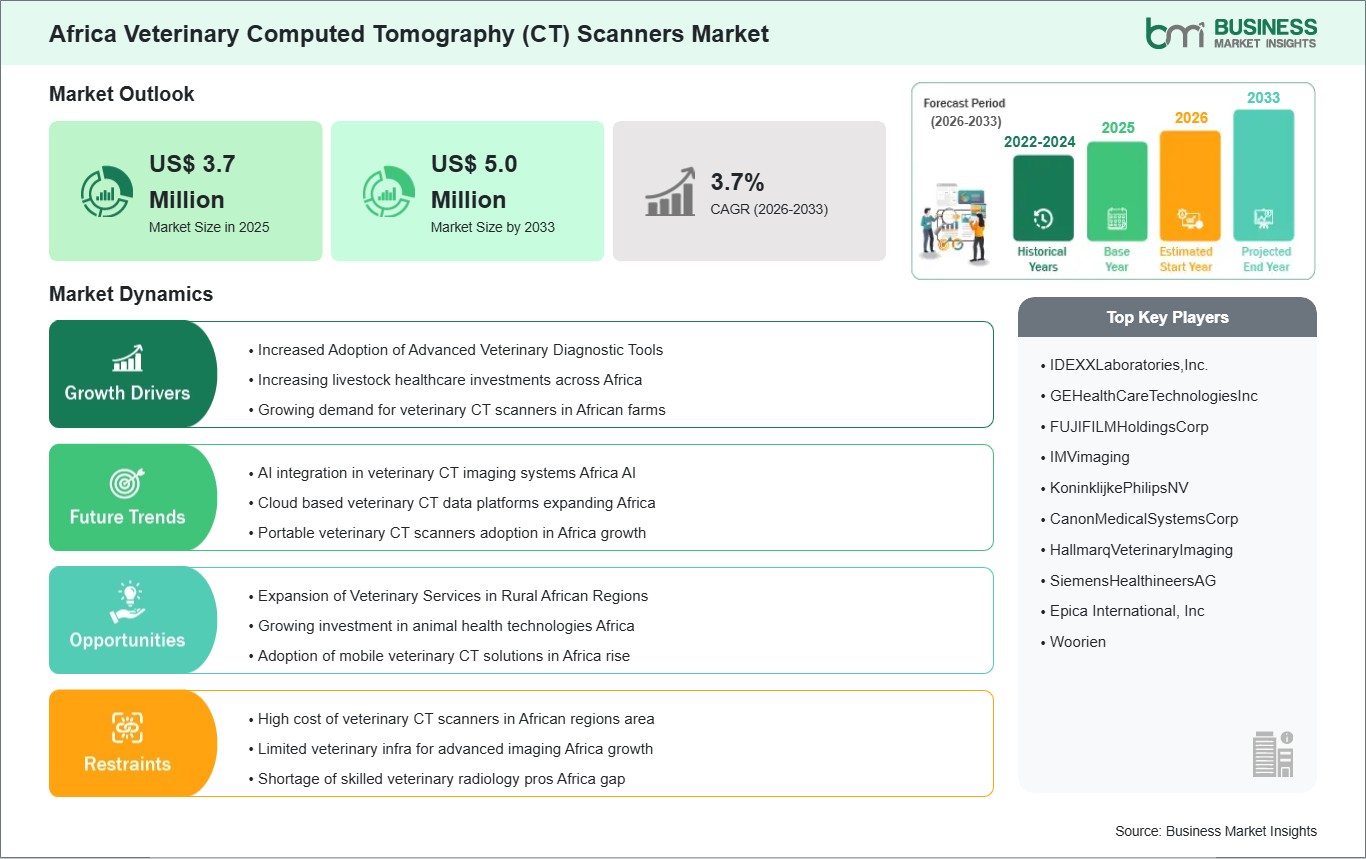
In Africa, growth in the veterinary CT scanner market is driven by rising awareness of pet healthcare and increasing livestock and pet ownership. Additionally, there has been an increase in the adoption of new technologies to assist in diagnosing animals. Veterinary schools and private practices across the continent in countries such as South Africa, Kenya, and Egypt see CT imaging as a major tool in accurately diagnosing, prepping for, or assisting with surgical procedures, and managing complicated illnesses or health conditions. Since CT technology can create detailed cross-sectional views of internal organs, it becomes an important part of the practice of veterinary medicine with respect to diagnosing neurology, orthopedics, oncology, and cardiology cases.
The expansion of veterinary infrastructure in developing regions such as Africa, including the integration of CT scanners in veterinary colleges, research centers, and specialty hospitals, is expected to be a key driver of market growth. The increasing occurrences of using and operating CT scanners at these facilities will improve the amount and level of diagnostic evaluation performed and will also improve the level of advanced diagnostic services provided in countries on the African continent. Growing professionalism in the veterinary industry and an increasing interest in pet ownership are expected to contribute to the increasing demand for advanced imaging technologies in Africa. Furthermore, the increasing number of training programs to produce new radiologists and veterinary technicians will further assist hospitals and veterinary practices in adopting CT scanners.
Segment Analysis
Africa Veterinary Computed Tomography (CT) Scanners Market Segmentation
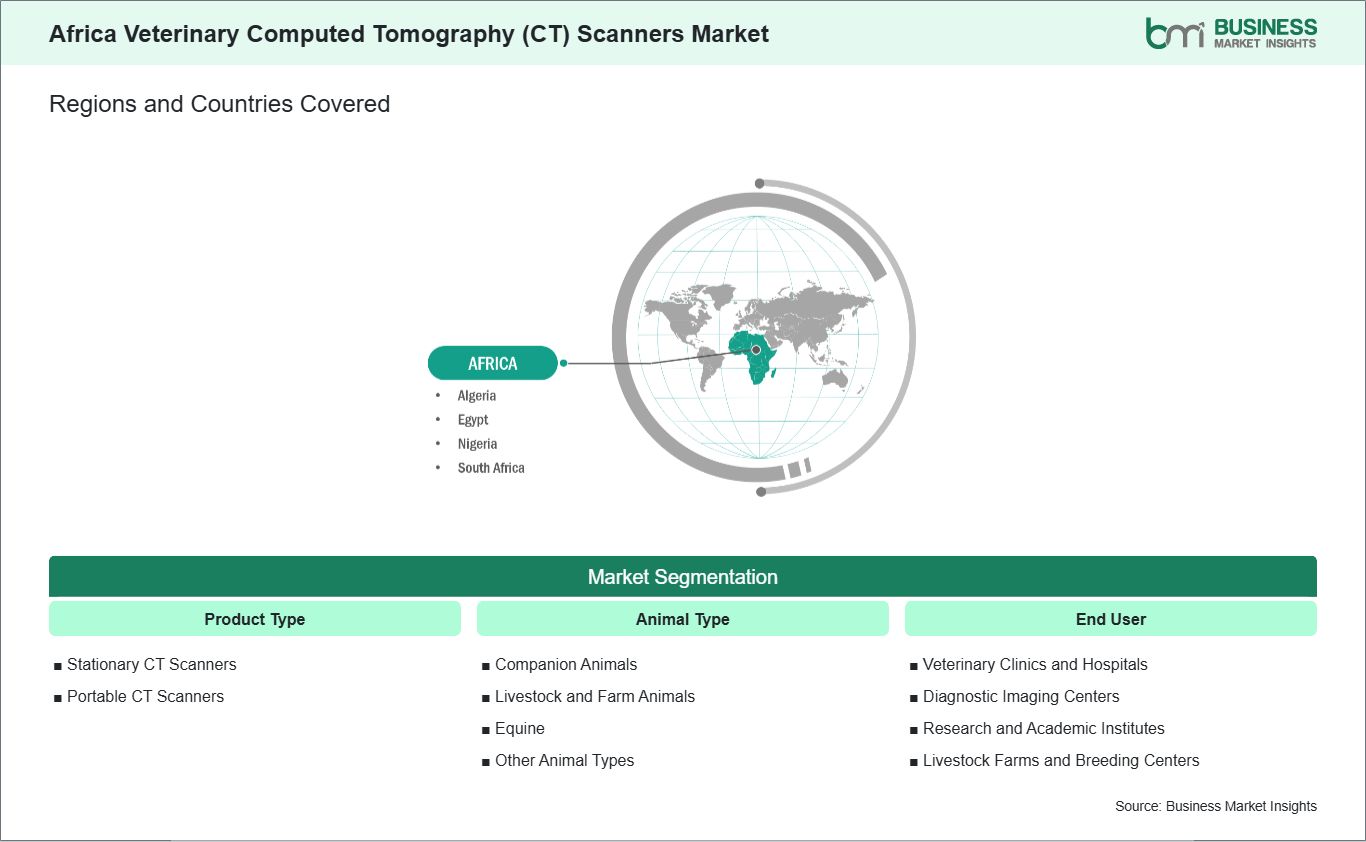
Key segments that contributed to the derivation of the Africa veterinary computed tomography (CT) scanners market analysis are product type, animal type, and end user.
- By product type, the veterinary computed tomography (CT) scanners market is bifurcated into stationary CT scanners and portable CT scanners. The stationary CT scanners segment dominated the market in 2025.
- Based on animal type, the veterinary computed tomography (CT) scanners market is categorized into companion animals, livestock and farm animals, equine, and other animal types. The companion animals segment dominated the market in 2025.
- In terms of end user, the veterinary computed tomography (CT) scanners market is segmented into veterinary clinics and hospitals, diagnostic imaging centers, research and academic institutes, livestock farms, and breeding centers. The veterinary clinics and hospitals segment dominated the market in 2025.
Market Forces
Africa Veterinary Computed Tomography (CT) Scanners Market Drivers and Opportunities
Increased Adoption of Advanced Veterinary Diagnostic Tools
Due to a rising demand for accurate diagnostics, there has been an increase in veterinary diagnostics using CT scanners across Africa. Several veterinary hospitals are investing in CT scanners to diagnose complex cases accurately, including musculoskeletal injuries, tumors, and neurological disorders in both companion and livestock animals.
Urban veterinarians are expanding their service offerings to meet the increasing demand for quality diagnostic services. In urban areas—such as Johannesburg and Cairo—many veterinary clinics have begun using CT imaging as a part of their routine examinations of animals so that they can provide their clients with rapid and reliable results.
Additionally, veterinary equipment manufacturers have begun to provide custom-built CT systems that can be used in smaller veterinary clinics and mobile veterinarian units. These innovations are vital to veterinary clinics in non-metropolitan areas because they enable these clinics to access high-quality veterinary diagnostic technologies.
Expansion of Veterinary Services in Rural African Regions
The expansion of veterinary services in rural African areas is creating significant opportunities for CT scanner adoption. Livestock farming is a primary source of income for many rural communities in East, West, and Southern Africa. Access to advanced diagnostic equipment allows veterinarians to detect diseases early, prevent outbreaks, and improve overall herd health. Mobile clinics and regional veterinary outreach programs are increasingly incorporating imaging technologies, enabling farmers to benefit from advanced diagnostics without having to travel to urban centers.
Government initiatives and local veterinary associations are also supporting the establishment of clinical facilities in rural areas. By providing training, equipment, and logistical support, these programs ensure that advanced veterinary care reaches underserved communities. In addition to livestock health, the introduction of CT scanners into rural clinics increases the quality of care for companion animals, reflecting a broader trend of improving animal welfare across Africa.
Educational institutions and veterinary colleges are partnering with rural veterinary centers to provide practical training in CT imaging. These collaborations help build local expertise, ensuring that advanced diagnostic tools are used effectively. By increasing access to CT scanners and fostering skilled personnel, rural areas in Africa represent a market opportunity for veterinary imaging technologies.
Size and Share Analysis
Africa Veterinary Computed Tomography (CT) Scanners Market Size and Share Analysis
The Africa veterinary computed tomography (CT) scanners market demonstrates steady growth, with size and share analysis highlighting evolving trends and competitive dynamics among key players. The report examines subsegments categorized within product type, animal type, and end user, offering insights into their contribution to overall market performance.
By product type, the stationary CT scanners subsegment dominated the market in 2025, driven by their higher imaging accuracy, greater capacity for continuous use, and preference in well-equipped veterinary facilities for advanced diagnostics.
Based on animal type, the companion animals subsegment dominated the market in 2025, driven by the increasing pet adoption and higher willingness of owners to spend on advanced diagnostic imaging for improved animal health.
In terms of end user, the veterinary clinics and hospitals subsegment dominated the market in 2025, driven by their access to better infrastructure, skilled professionals, and higher patient inflow requiring routine and specialized CT imaging services.
Report Coverage
Africa Veterinary Computed Tomography (CT) Scanners Market Report Coverage and Deliverables
The "Africa Veterinary Computed Tomography (CT) Scanners Market Size and Forecast (2022–2033)" report provides a detailed analysis of the market covering below areas:
- Africa Veterinary Computed Tomography (CT) Scanners Market size and forecast at regional and country levels for all the key market segments covered under the scope
- Africa Veterinary Computed Tomography (CT) Scanners Market trends, as well as drivers, restraints, and opportunities
- Africa Veterinary Computed Tomography (CT) Scanners Market analysis covering key trends, regional framework, major players, regulations, and recent developments
- Industry landscape and competition analysis covering market concentration, heat map analysis, prominent players, and recent developments for the Africa Veterinary Computed Tomography (CT) Scanners Market
- Detailed company profiles, including SWOT analysis
Geographic Insights
Africa Veterinary Computed Tomography (CT) Scanners Market Geographic Insights
The geographical scope of the Africa Veterinary Computed Tomography (CT) Scanners Market report is divided into Egypt, South Africa, Nigeria, and Algeria. Nigeria held the largest share in 2025.
The Africa Veterinary Computed Tomography (CT) Scanners Market demonstrates a diverse regional landscape. Nigeria has an expanding veterinary healthcare sector, and there is an increasing demand for advanced diagnostic tools. Market growth in Nigeria is largely driven by rising livestock production, a growing population of companion animals, and an increasing focus on preventive and specialized veterinary care. In addition, the gradual development of urban veterinary infrastructure and private clinics equipped with modern imaging facilities further strengthens Nigeria's leading market position. In Egypt, the veterinary CT market is experiencing moderate growth, supported by the presence of urban veterinary hospitals and clinics that are increasingly adopting advanced imaging for companion and farm animals. Investment in training and infrastructure, along with rising awareness of animal health and diagnostics, is slowly enhancing the adoption of CT scanners despite challenges such as high acquisition costs and limited access in rural areas.
South Africa presents a relatively mature veterinary imaging landscape, with established referral hospitals and academic institutions utilizing CT technology for complex diagnostics and research purposes. The market growth is reinforced by a combination of private investment and public veterinary initiatives. However, expansion is still constrained by high equipment costs and a shortage of specialized veterinary radiologists. In Algeria, the adoption of CT technology remains limited primarily to major urban centers. While awareness of advanced diagnostic techniques is increasing, the country faces infrastructural limitations and budgetary constraints that hinder widespread implementation. Across all four countries, common trends include a gradual shift toward preventive and high-precision veterinary care, an increasing role of private veterinary service providers, and the need for skilled personnel to operate complex imaging equipment.
Industry Activity
Recent Developments
The Africa Veterinary Computed Tomography (CT) Scanners Market is evaluated by gathering qualitative and quantitative data post primary and secondary research, which includes important corporate publications, association data, and databases. A few of the key developments in the Africa veterinary computed tomography (CT) scanners market are:
- In February 2024, the University of Pretoria's Onderstepoort Veterinary Academic Hospital installed the Siemens Somatom Confidence 64 Slice CT scanner—the largest CT scanner ever used in veterinary practice in South Africa—with a sliding gantry, funded through a US$ 700,000 million donation to enhance clinical diagnostics and research capability for both small and large animals.
- In March 2026, GE HealthCare announced that its Photonova Spectra photon‑counting CT received clearance from the US Food and Drug Administration (FDA), enabling deployment of next‑generation spectral photon‑counting CT technology that offers higher resolution imaging and improved tissue characterization across a wide range of clinical applications.
Trust & Transparency
Research Methodology
The market analysis combines proprietary research with secondary data from government agencies, company disclosures, regulatory filings, industry databases and expert interviews. Market estimates are validated through data triangulation, cross-market benchmarking and analyst
review.
View Full Research Methodology
Key Sources Referred:
American College of Veterinary Radiology (ACVR) World Small Animal Veterinary Association (WSAVA) British Veterinary Association (BVA) International Veterinary Radiology Association (IVRA) American Veterinary Medical Association (AVMA) European College of Veterinary Diagnostic Imaging (ECVDI) World Organisation for Animal Health (WOAH / OIE) Veterinary Imaging & Radiation Oncology Society (VIROS)