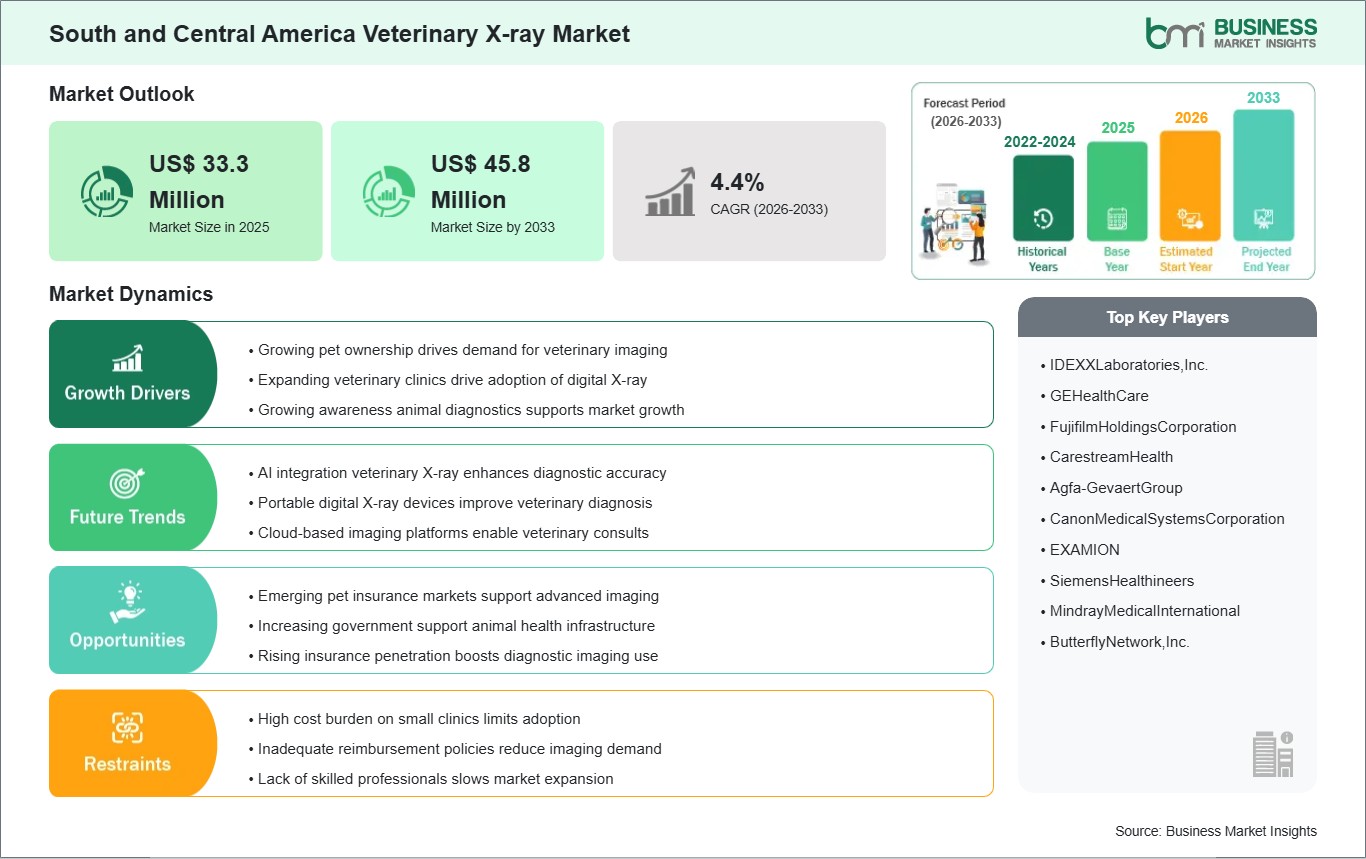
The South and Central America veterinary x-ray market size is expected to reach US$ 45.8 million by 2033 from US$ 33.3 million in 2025. The market is estimated to record a CAGR of 4.4% from 2026 to 2033.
The South and Central America veterinary X‑ray market is evolving against a backdrop of expanding veterinary healthcare services, increasing awareness of animal welfare, and gradual modernization of diagnostic infrastructure. In this region, veterinary practices range from small animal clinics in urban centers to mixed animal and livestock facilities in rural areas, each with distinct diagnostic requirements. While the adoption of advanced imaging technologies has historically lagged behind more mature regions, the landscape is gradually transforming as clinics recognize the clinical and economic value of veterinary X‑ray systems.
A primary driver of the market is the growing emphasis on improved animal health outcomes, particularly for companion animals. Pet ownership is on the rise in major urban centers throughout South and Central America, prompting a shift toward more comprehensive healthcare services that include diagnostic imaging as a cornerstone of practice. Veterinary X‑ray systems are increasingly viewed as essential tools for accurate diagnosis of fractures, dental conditions, respiratory issues, and internal abnormalities. This trend is supported by a broader cultural shift that prioritizes preventive care and early intervention, mirroring patterns seen in more developed markets. Another significant factor shaping the market is the rising investment in veterinary education and professional training within the region. Veterinary professionals are gaining greater exposure to modern imaging techniques through continuing education programs and partnerships with international veterinary organizations.
As clinical expertise grows, so does the demand for reliable diagnostic tools that can elevate the standard of care. In addition, animal agricultural sectors in countries such as Brazil and Argentina are driving demand for imaging solutions in livestock and equine practice, where skeletal and soft tissue assessment can directly impact animal productivity and operational efficiency. Despite these positive trends, several restraints influence the pace of market development. Cost sensitivity among veterinary practices, particularly smaller clinics and those serving rural communities, remains a key barrier to the acquisition of digital or advanced X‑ray systems. Many practices continue to rely on older analog equipment due to budget limitations, delaying the transition to more efficient and higher‑resolution digital alternatives. Infrastructure challenges, including inconsistent access to reliable power and technical support services in remote areas, further complicate adoption efforts.
Additionally, the presence of alternative imaging modalities, such as ultrasound, which may be perceived as more versatile or cost‑effective for certain applications, can divert investment away from dedicated X‑ray systems. Limited availability of service and maintenance networks for sophisticated imaging equipment is another concern that can deter potential buyers from investing in new technology. The South and Central America veterinary X‑ray market is characterized by a gradual shift toward modernization, driven by rising animal care standards, professional capacity building, and expanding demand across companion and livestock segments. Yet cost barriers, infrastructure limitations, and competitive imaging alternatives continue to influence adoption patterns and market growth dynamics.

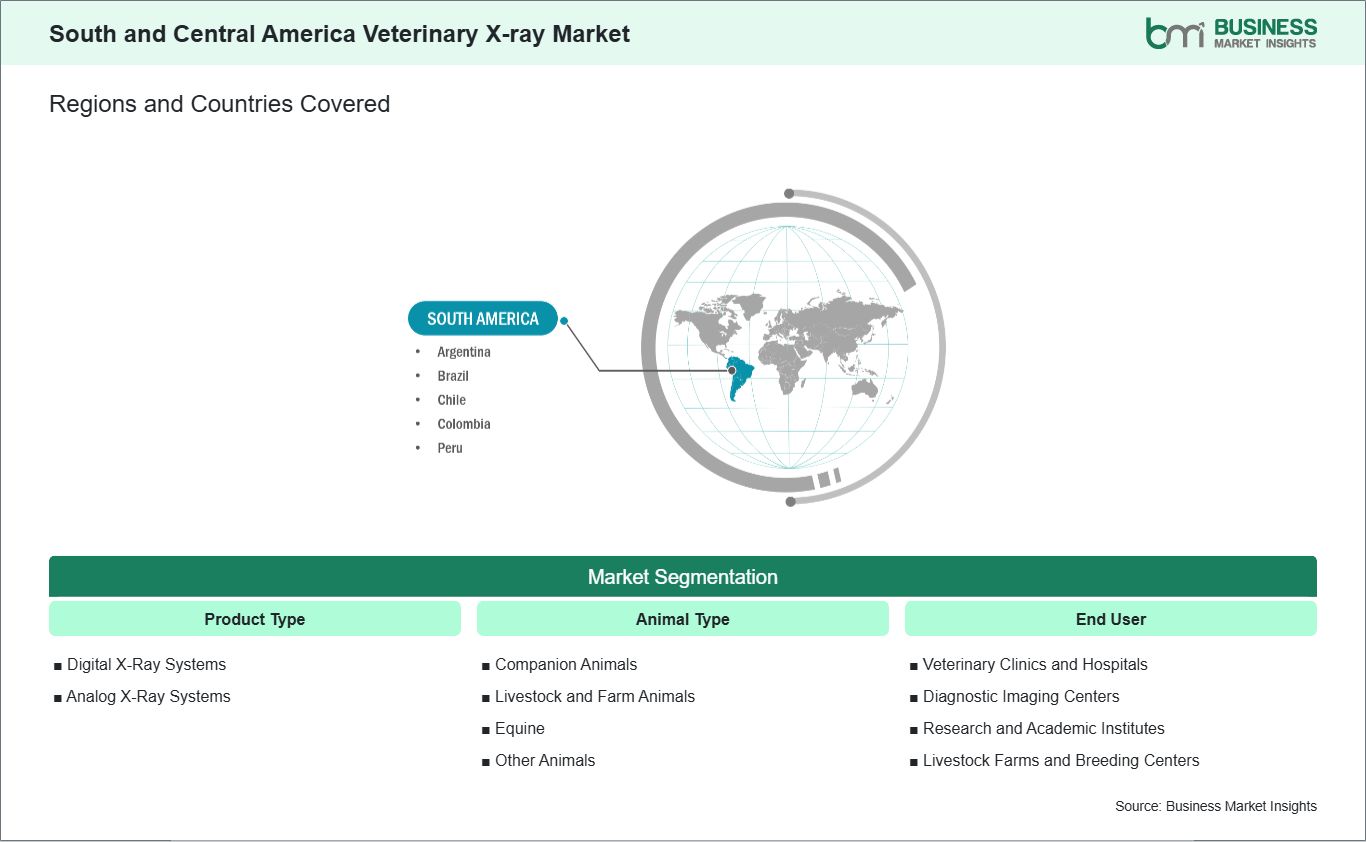
Key segments that contributed to the derivation of the South and Central America veterinary x-ray market analysis are product type, animal type, and end user.
The increase in ownership of pets in South America and Central America serves as a key factor contributing to the growth of the veterinary X-ray market. Urban sections of countries such as Brazil, Argentina, and Chile have begun viewing their pets as family and are willing to make additional investments in their pets' health. This change has led to greater use of veterinary clinics and more emphasis on diagnostic services, including the use of X-ray imaging as part of routine and disease detection processes. To meet the expectations of pet owners, veterinarians are seeking to adopt trusted imaging systems.
As advancements in diagnostic technology and X-ray imaging occur in larger metropolitan areas, there will be many opportunities for veterinarians to provide advanced diagnostic services to their clients. For example, clinics in São Paulo and Buenos Aires provide specialty imaging services including orthopedic and dental imaging, which are heavily dependent on the use of X-ray technology. While these advancements are being made in larger cities, rural areas will continue to receive digital imaging systems as demand increases.
Moreover, the increased emphasis placed on preventative care for pets translates directly into increased investment into diagnostic tools for use by veterinarians. Digital imaging using X-ray technology provides veterinarians with resources to assist in the early detection of ailments and provide customised treatment of dogs or cats based on the pet's needs.
Across the Caribbean, veterinary x-ray markets have begun evolving gradually. Significantly, this creates opportunities for the veterinary X‑ray sector throughout South and Central America, where the pet insurance marketplace is still developing compared to North America and Europe. For example, in Brazil and Mexico, more insurers have launched comprehensive pet insurance plans that include coverage for diagnostics. Improved access to quality imaging services will help to eliminate financial barriers associated with using x-ray technology in routine veterinary practice by providing more pet owners with the financial means to have their pets diagnosed and treated with x-ray technology.
As more insurance products are introduced into the marketplace, veterinarians can now recommend diagnostics without imposing a financial burden on their clients. This new trend has motivated many clinics to implement new generation X-ray systems, such as digital radiography, which provide significantly better image quality and faster turnaround times compared to traditional x-ray systems. Increased clarity and resolution of images produced by advanced imaging systems will significantly improve diagnostic accuracy for many clinical conditions, including fractures and respiratory distress, thereby improving the quality of veterinary care delivered to the animal patients.
Furthermore, as insurance becomes more common and accepted in South and Central America, it will influence the investment decisions of smaller veterinary clinics when purchasing x-ray equipment and capital items. In particular, knowing that some reimbursement will be available from insurance will make providers more inclined to invest in portable and state-of-the-art x-ray equipment. This trend is especially pronounced in urban and suburban settings.

The South and Central America veterinary x-ray market demonstrates steady growth, with size and share analysis highlighting evolving trends and competitive dynamics among key players. The report examines subsegments categorized within product type, animal type, and end user, offering insights into their contribution to overall market performance.
By product type, the digital x-ray systems subsegment dominated the market in 2025, driven by its enhanced image quality, faster processing time, and growing adoption in modern veterinary practices.
Based on animal type, the companion animals subsegment dominated the market in 2025, driven by increasing pet ownership and rising demand for advanced diagnostic imaging in routine veterinary care.
In terms of end user, the veterinary clinics and hospitals subsegment dominated the market in 2025, driven by the widespread adoption of x-ray systems for comprehensive diagnostic and treatment services.
| Report Attribute | Details |
|---|---|
| Market size in 2025 | US$ 33.3 Million |
| Market Size by 2033 | US$ 45.8 Million |
| CAGR (2026 - 2033) | 4.4% |
| Historical Data | 2022-2024 |
| Forecast period | 2026-2033 |
| Segments Covered | By Product Type
|
|
Regions and Countries Covered
| |
| South and Central America | Brazil, Argentina, Peru, Chile, Colombia |
| Market leaders and key company profiles |
|
The "South and Central America Veterinary X-ray Market Size and Forecast (2022–2033)" report provides a detailed analysis of the market covering below areas:
The geographical scope of the South and Central America Veterinary X-ray Market report is divided into Brazil, Argentina, Peru, Chile, and Colombia. The Brazil held the largest share in 2025.
The veterinary X-ray market in South and Central America features a diverse regional profile; however, Brazil has clearly established itself as the market leader due to its significantly sized and varied animal population, well-educated veterinary professionals, and thus significantly higher investments in advanced diagnostic technologies (compared to other South American countries). Brazil's position as a market leader is supported by many factors, including the significant size of its companion animal base, its strong livestock industries, and an increasing number of private and corporate veterinary clinics moving towards digital radiography and portable X-ray systems to improve diagnostic accuracy and workflow efficiency. The majority of the population of Brazil is concentrated in major urban areas, which creates better access to financing for the purchase of veterinary equipment, and therefore creates more opportunity for both small animal and large animal clinics to adopt modern imaging solutions.
While Argentina’s veterinary X-ray market is considerably smaller than Brazil’s, the country’s veterinary industry continues to expand as a result of increasing pet ownership, greater awareness of the need for preventive care for animals, and gradually upgrading clinical infrastructures. In Argentina, economic volatility can be a factor affecting investment cycles for veterinary practices; however, an increasing number of veterinarians are incorporating X-ray systems into routine practice, primarily to meet the growing demand from their clients for complete diagnostic services, particularly in metropolitan areas. Peru is a developing market segment in the region, with increasing demand for veterinary X-ray technology emerging alongside a larger veterinary X-ray market that has been established in other areas of South America.

The South and Central America Veterinary X-ray Market is evaluated by gathering qualitative and quantitative data post primary and secondary research, which includes important corporate publications, association data, and databases. A few of the key developments in the South and Central America veterinary x-ray market are:
The South and Central America Veterinary X-ray Market is valued at US$ 33.3 Million in 2025, it is projected to reach US$ 45.8 Million by 2033.
As per our report South and Central America Veterinary X-ray Market, the market size is valued at US$ 33.3 Million in 2025, projecting it to reach US$ 45.8 Million by 2033. This translates to a CAGR of approximately 4.4% during the forecast period.
The South and Central America Veterinary X-ray Market report typically cover these key segments-
The historic period, base year, and forecast period can vary slightly depending on the specific market research report. However, for the South and Central America Veterinary X-ray Market report:
The South and Central America Veterinary X-ray Market is populated by several key players, each contributing to its growth and innovation. Some of the major players include:
The South and Central America Veterinary X-ray Market report is valuable for diverse stakeholders, including:
Essentially, anyone involved in or considering involvement in the South and Central America Veterinary X-ray Market value chain can benefit from the information contained in a comprehensive market report.
Please tell us your area of interest
(Market Segments/ Regions and Countries/ Companies)