Market Summary
Executive Summary and Market Analysis
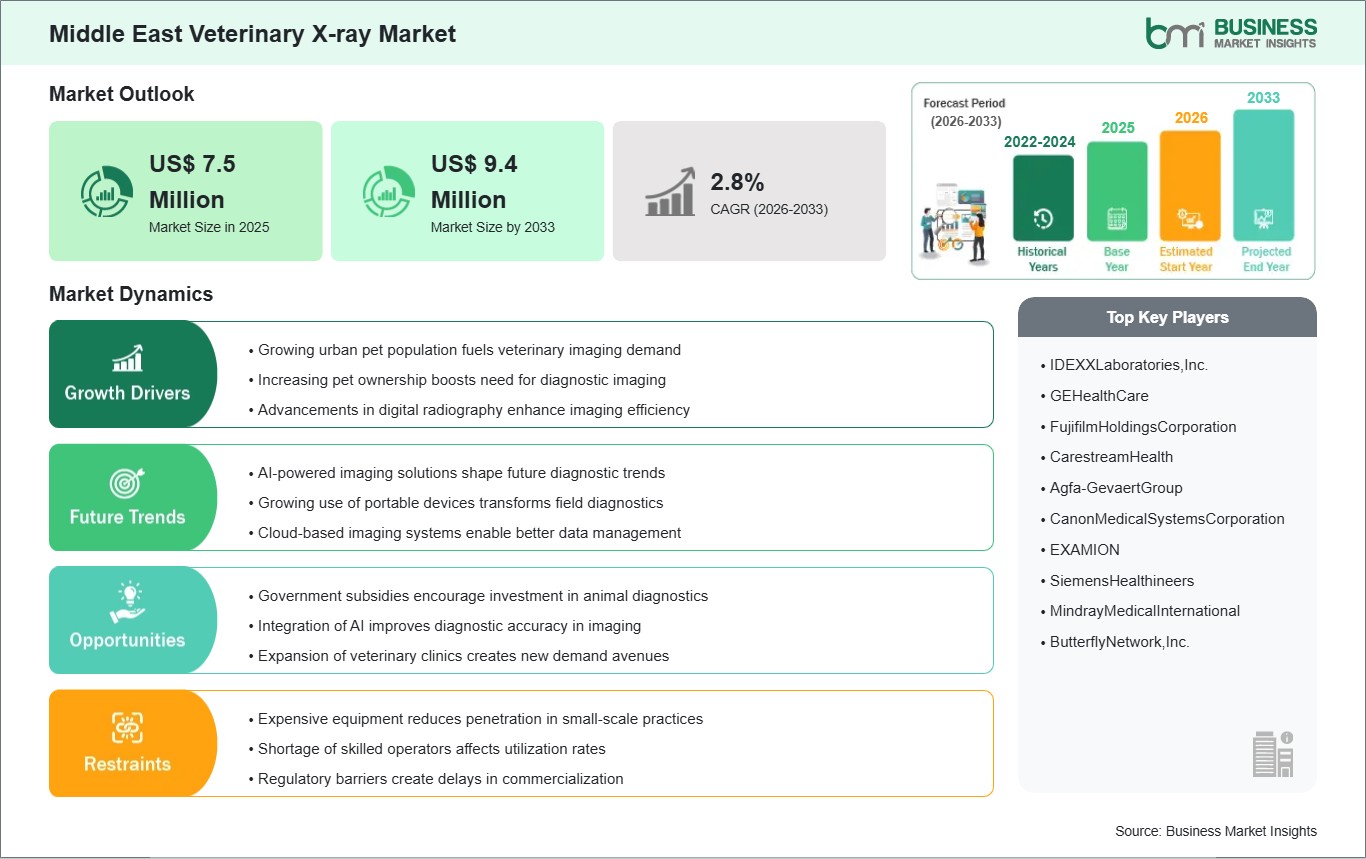
The Middle East veterinary X‑ray market is in a phase of strategic development, shaped by a rising focus on animal health, increasing disposable income, and the expansion of veterinary healthcare infrastructure across major countries in the region. Traditionally, veterinary services in the Middle East were concentrated on basic care for livestock and working animals. However, a noticeable shift toward companion animal care and advanced clinical practices has fostered a growing interest in diagnostic imaging technologies, including X‑ray systems. This trend is supported by a cultural evolution in pet ownership, particularly in urban and affluent populations, where pets are increasingly viewed as family members rather than utility animals.
One of the primary drivers of this market is the expanding awareness of the importance of early and accurate diagnosis for both companion and performance animals. Veterinarians in metropolitan areas are emphasizing the role of X‑ray imaging in addressing a wide range of clinical concerns such as orthopedic injuries, dental pathologies, respiratory conditions, and soft tissue abnormalities. The preference for non‑invasive diagnostics that provide rapid clinical insights has elevated the status of X‑ray as a core component of standard veterinary care.
Moreover, specialized animal hospitals and referral centers in countries like the United Arab Emirates, Saudi Arabia, and Kuwait are increasingly investing in digital radiography solutions to enhance diagnostic capabilities and support complex treatments. Another influential factor is the ongoing enhancement of veterinary education and professional training within the region. Veterinary practitioners are gaining exposure to advanced imaging techniques through collaborations with international institutions, conferences, and continuing education programs. As local expertise in diagnostic imaging strengthens, so does the confidence of clinics to adopt and integrate X‑ray systems into their practices. Additionally, the growth of equine sports, show animals, and performance breeding in parts of the Middle East creates demand for high‑precision diagnostics, where X‑ray imaging plays a central role in assessing musculoskeletal health and preventive care.
Despite these positive dynamics, the Middle East veterinary X‑ray market faces certain restraints. The high cost associated with acquiring advanced X‑ray equipment can be a barrier for smaller clinics and practices that must balance investment in imaging technology with other operational needs. While digital systems offer significant advantages in image quality and workflow efficiency, their upfront investment and ongoing maintenance expenses may limit adoption, especially in markets where veterinary services are still emerging. Infrastructure and support services also present challenges in some parts of the region. Reliable servicing, availability of spare parts, and access to trained technical personnel are important factors influencing purchasing decisions. Clinics in less centralized areas may experience delays in equipment installation and support, which can impede smooth integration of diagnostic systems.
Furthermore, alternative modalities such as portable ultrasound—perceived as more affordable or multifunctional—may compete with X‑ray for budget allocation in certain clinical settings. The Middle East veterinary X‑ray market reflects a blend of opportunity and constraint. Growing clinical sophistication, rising demand for advanced diagnostic care, and expanding veterinary professional capacity are propelling the region forward. At the same time, cost considerations and logistical limitations continue to influence the pace and breadth of market penetration.
Segment Analysis
Middle East Veterinary X-ray Market Segmentation
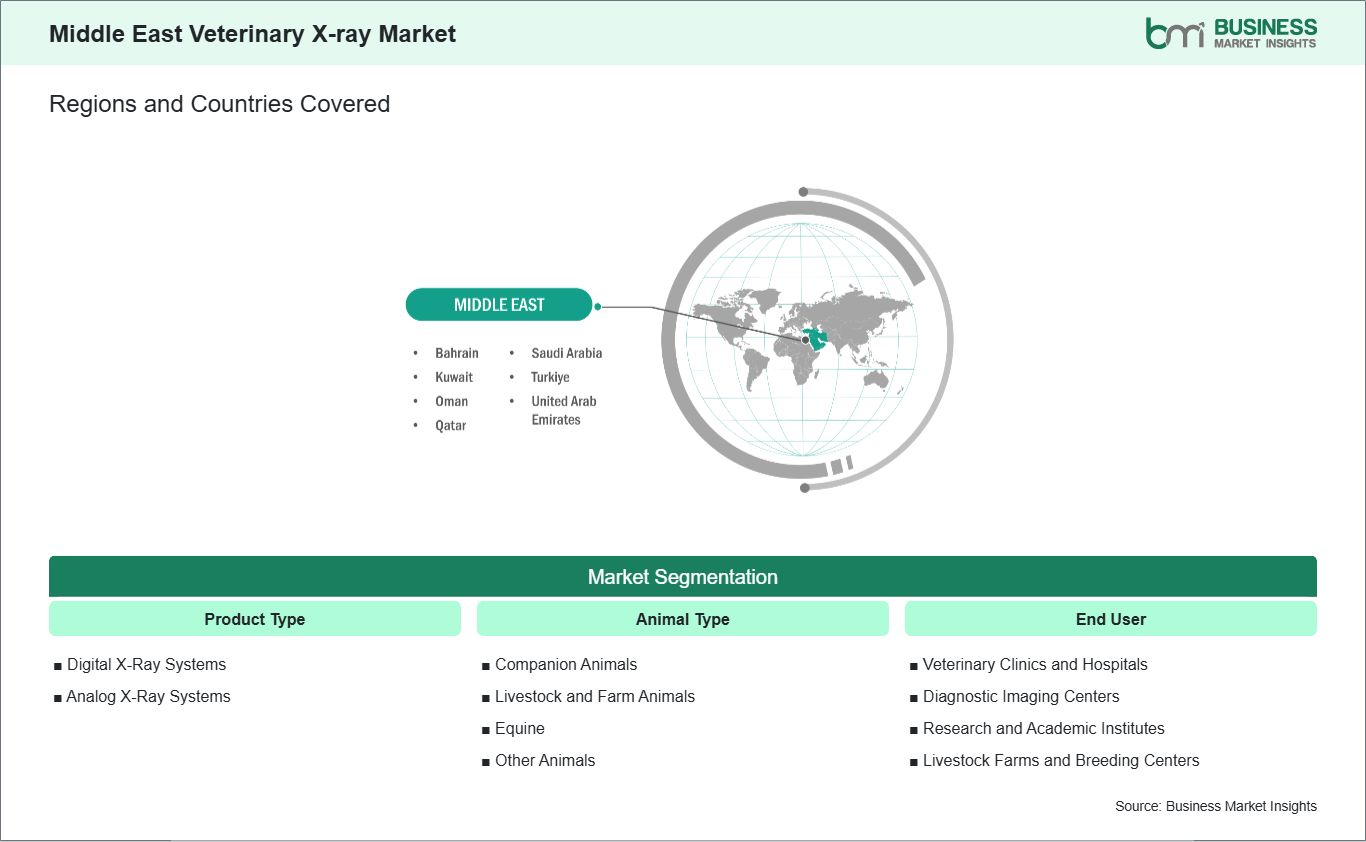
Key segments that contributed to the derivation of the Middle East veterinary x-ray market analysis are product type, animal type, and end user.
- By product type, the veterinary x-ray market is segmented into digital x-ray systems, analog x-ray systems. The digital x-ray systems segment dominated the market in 2025.
- Based on animal type, the veterinary x-ray market is categorized into companion animals, livestock and farm animals, equine, other animal types. The companion animals segment dominated the market in 2025.
- In terms of end user, the veterinary x-ray market is categorized into veterinary clinics and hospitals, diagnostic imaging centers, research and academic institutes, livestock farms and breeding centers. The veterinary clinics and hospitals segment dominated the market in 2025.
Market Forces
Middle East Veterinary X-ray Market Drivers and Opportunities
Growing urban pet population fuels veterinary imaging demand
As the Middle Eastern X-ray market for veterinary use continues to expand, the amount of pets owned in urban centers is also increasing. The countries within the Gulf Cooperation Council (GCC) region (UAE, Saudi Arabia, and Kuwait) are seeing an explosion of young, affluent professionals and families living in large urban areas and treating their pets as an integral part of their household and spending more money on routine and preventive care, diagnostics of many pet illnesses or injuries. This new pet owner mentality is also being interpreted by veterinary practices in urban centers as more and more requests for imaging modalities (particularly musculoskeletal and respiratory assessment) are received by veterinary practices. Consequently, it has been determined that any veterinary practice in today's environment must have a minimum of one X-ray imaging system in order to remain successful.
The continuing expansion of the veterinary clinic network within urban areas has also improved access to diagnostic services and increased demand for comprehensive specialized care as new specialty veterinary clinics are being opened in areas such as Dubai and Riyadh that offer digital X-ray systems as an essential piece of equipment. One of the reasons the new specialty clinics are being established is the ability to deliver fast, accurate diagnostic services that are comparable to human healthcare service levels, which tend to be driving demand from clients.
Moreover, expanding rates of companion animal adoption have increased demand for training programs and veterinary technology. There is more emphasis on imaging/digital imaging in the veterinarians' training, and an increased number of veterinary practices are upgrading their traditional X-ray imaging to digital imaging platforms in order to optimize workflow and image clarity. The combination of these trends is being supported by a sustained growth in demand for advanced small animal diagnostic imaging equipment.
Government subsidies encourage investment in animal diagnostics
Size and Share Analysis
Middle East Veterinary X-ray Market Size and Share Analysis
The Middle East veterinary x-ray market demonstrates steady growth, with size and share analysis highlighting evolving trends and competitive dynamics among key players. The report examines subsegments categorized within product type, animal type, and end user, offering insights into their contribution to overall market performance.
By product type, the digital x-ray systems subsegment dominated the market in 2025, driven by its enhanced image quality, faster processing time, and growing adoption in modern veterinary practices.
Based on animal type, the companion animals subsegment dominated the market in 2025, driven by increasing pet ownership and rising demand for advanced diagnostic imaging in routine veterinary care.
In terms of end user, the veterinary clinics and hospitals subsegment dominated the market in 2025, driven by the widespread adoption of x-ray systems for comprehensive diagnostic and treatment services.
Report Coverage
Middle East Veterinary X-ray Market Report Coverage and Deliverables
The "Middle East Veterinary X-ray Market Size and Forecast (2022–2033)" report provides a detailed analysis of the market covering below areas:
- Middle East Veterinary X-ray Market size and forecast at global, regional, and country levels for all the key market segments covered under the scope
- Middle East Veterinary X-ray Market trends, as well as drivers, restraints, and opportunities
- Middle East Veterinary X-ray Market analysis covering key trends, global and regional framework, major players, regulations, and recent developments
- Industry landscape and competition analysis covering market concentration, heat map analysis, prominent players, and recent developments for the Middle East Veterinary X-ray Market
- Detailed company profiles, including SWOT analysis
Geographic Insights
Middle East Veterinary X-ray Market Geographic Insights
The geographical scope of the Middle East Veterinary X-ray Market report is divided into UAE, Saudi Arabia, Bahrain, Oman, Kuwait, Qatar, and Turkiye. The Turkiye held the largest share in 2025.
The veterinary X‑ray market in the Middle East has different regional dynamics, and Turkiye stands out. It has the largest and most diverse veterinary service markets, with a huge amount of diagnostic technology being used, as well as a significant number of companion and food-producing animals. The veterinary ecosystem in Turkiye has many veterinary clinics and hospitals, where there is a greater emphasis on diagnostic imaging for animal care than elsewhere in the region. Additionally, there are a number of programs in place throughout the country that train veterinarians to use diagnostic imaging. Also, there are many financing options available for purchasing diagnostic imaging equipment.
As a result, many veterinary clinics in urban and peri-urban locations continue to buy a combination of fixed and portable digital X‑ray machines for their practices, which makes Turkiye the leading country in veterinary imaging in the Middle East. The UAE veterinary X‑ray market is characterized by a high level of care for pets, as well as a high level of investment in veterinary services, especially in the urban areas of Dubai and Abu Dhabi. The high level of disposable income in the UAE, along with a strong regulatory framework, encourages veterinary clinics to invest in modern digital X‑ray systems to meet their clients' expectations for high-quality diagnostic imaging. In Saudi Arabia, there is also increasing demand for veterinary diagnostics, with the market expanding, due to increased investment in animal health infrastructure, the increasing number of pet owners and the strategic development of the agricultural sector.
Industry Activity
Recent Developments
The Middle East Veterinary X-ray Market is evaluated by gathering qualitative and quantitative data post primary and secondary research, which includes important corporate publications, association data, and databases. A few of the key developments in the Middle East veterinary x-ray market are:
- In October 2025, Siemens Healthineers AG showcased its full diagnostic imaging portfolio at the Global Health Exhibition 2025 in Riyadh, Saudi Arabia, where it presented an expanded range of imaging solutions — including systems for radiography, cancer imaging and laboratory diagnostics — reinforcing its regional engagement and presence in the Middle East healthcare ecosystem.
- In December 2024, Zoetis, a leading animal health company, announced the global launch of the Vetscan OptiCell™ point‑of‑care hematology analyzer — an advanced diagnostic tool combining viscoelastic focusing and AI to deliver complete blood count analysis quickly at the point of care. Sources indicate availability will roll out into additional key markets in 2025–2026, which would include regions beyond the U.S.
Trust & Transparency
Research Methodology
The market analysis combines proprietary research with secondary data from government agencies, company disclosures, regulatory filings, industry databases and expert interviews. Market estimates are validated through data triangulation, cross-market benchmarking and analyst
review.
View Full Research Methodology
Key Sources Referred:
American College of Veterinary Radiology (ACVR) World Small Animal Veterinary Association (WSAVA) British Veterinary Association (BVA) International Veterinary Radiology Association (IVRA) American Veterinary Medical Association (AVMA) European College of Veterinary Diagnostic Imaging (ECVDI) World Organisation for Animal Health (WOAH / OIE) Veterinary Imaging & Radiation Oncology Society (VIROS)