Market Summary
Executive Summary and Market Analysis
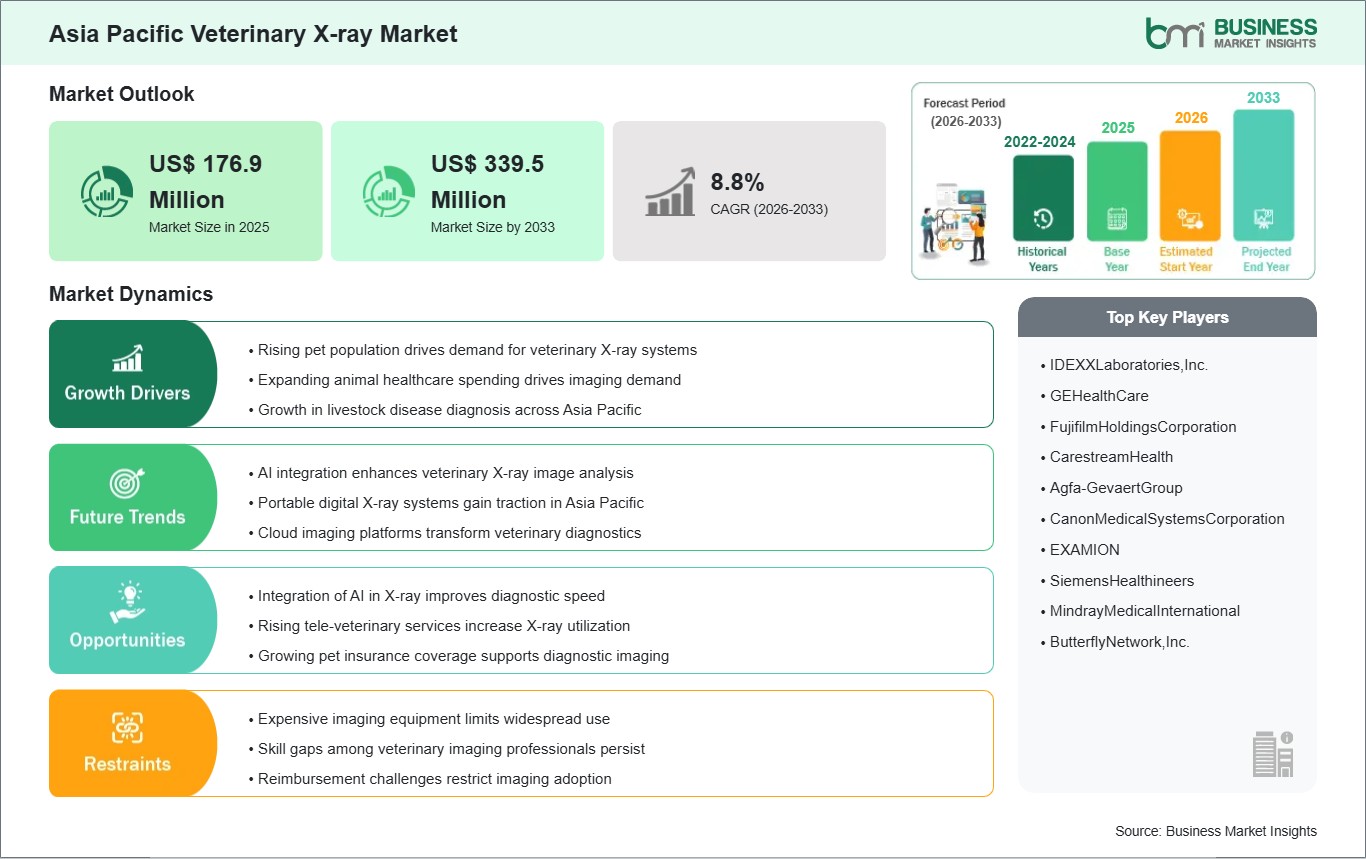
The Asia Pacific veterinary X‑ray market has emerged as a strategically important segment within the broader animal healthcare spectrum, reflecting a growing emphasis on diagnostic imaging for companion animals, livestock, and equine care. Across the region, there is a discernible shift in veterinary practice from traditional clinical assessments toward technology‑enabled diagnostics, driven by heightened awareness of animal welfare, the expansion of veterinary infrastructure, and the adoption of advanced imaging solutions. Veterinary X‑ray systems, ranging from portable analog units to digital radiography platforms, are increasingly valued by practitioners for their ability to deliver detailed anatomical insights essential for accurate diagnosis, treatment planning, and surgical evaluation.
One of the core drivers of market momentum in the Asia Pacific region is the rapid expansion of the companion animal segment. Pet ownership is experiencing cultural and socioeconomic transformation in countries such as Japan, South Korea, China, and Australia, where small animal clinics are becoming more numerous and technologically equipped. These clinics are prioritizing diagnostic technologies that can enhance care quality, improve patient outcomes, and build client trust. In parallel, government and private investment in livestock health management has reinforced the role of imaging diagnostics in disease surveillance and animal productivity enhancement. This trend is particularly notable in nations with large agrarian sectors, where veterinary diagnostic services are integral to maintaining herd health and minimizing disease outbreaks. Regional healthcare policies that support technology adoption in animal health, coupled with initiatives from veterinary associations advocating for standardized clinical practices, have further elevated the acceptance of X‑ray imaging solutions.
Furthermore, key stakeholders in the veterinary ecosystem - including distributors, OEMs, and veterinary educational institutions - are collaborating to expand training on imaging technologies, which in turn is fostering greater confidence among practitioners in leveraging X‑ray systems within clinical workflows. However, despite positive momentum, the Asia Pacific veterinary X‑ray market faces certain restraints. In emerging markets across Southeast Asia and South Asia, limited access to capital and a shortage of trained imaging specialists can slow technology diffusion. Additionally, cost sensitivities among small‑scale veterinary practices may constrain investments in advanced digital systems, maintaining a reliance on older analog solutions. Nonetheless, the overarching trajectory remains progressive as the region continues to prioritize diagnostic excellence in animal healthcare.
Segment Analysis
Asia Pacific Veterinary X-ray Market Segmentation
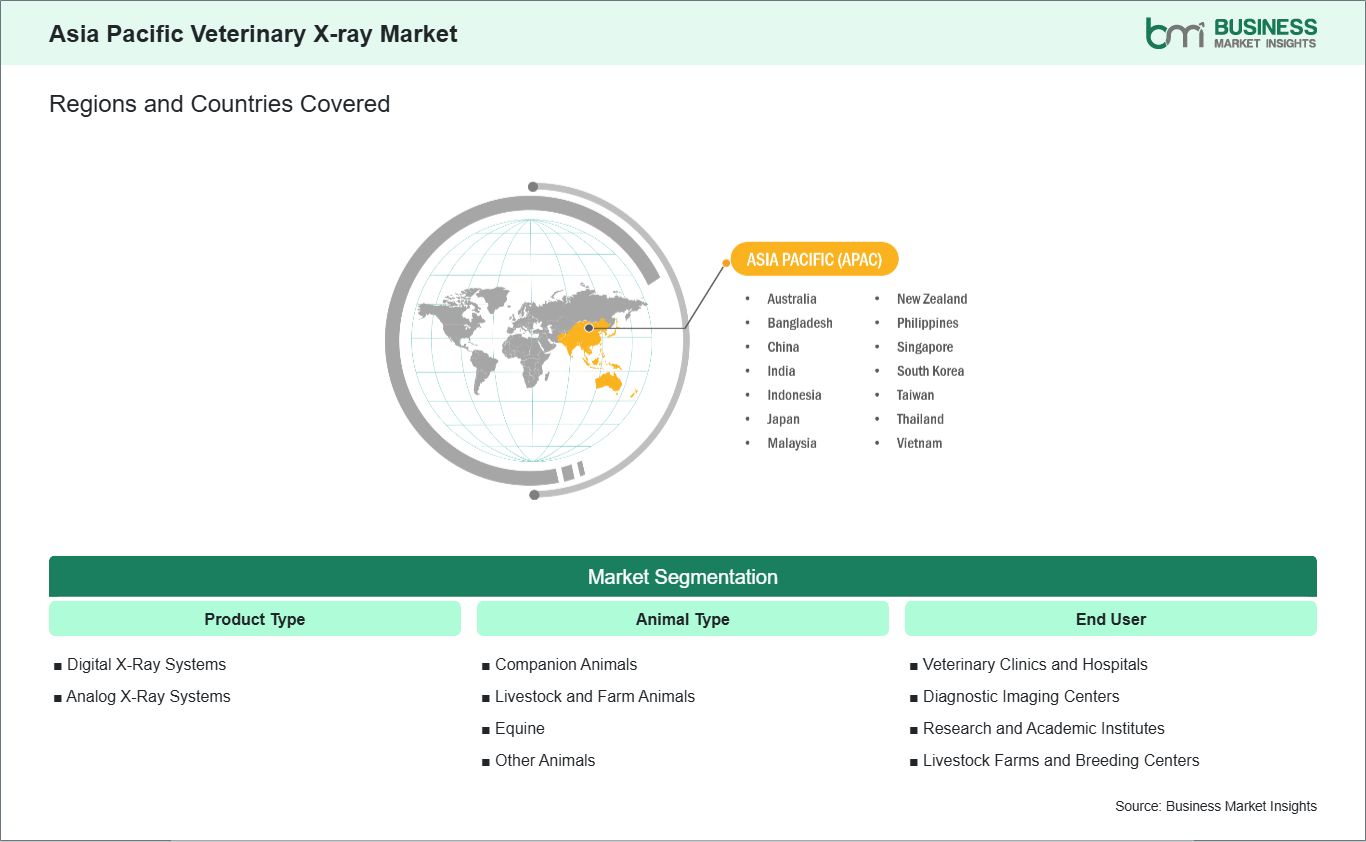
Key segments that contributed to the derivation of the Asia Pacific veterinary x-ray market analysis are product type, animal type, and end user.
- By product type, the veterinary x-ray market is segmented into digital x-ray systems, analog x-ray systems. The digital x-ray systems segment dominated the market in 2025.
- Based on animal type, the veterinary x-ray market is categorized into companion animals, livestock and farm animals, equine, other animal types. The companion animals segment dominated the market in 2025.
- In terms of end user, the veterinary x-ray market is categorized into veterinary clinics and hospitals, diagnostic imaging centers, research and academic institutes, livestock farms and breeding centers. The veterinary clinics and hospitals segment dominated the market in 2025.
Market Forces
Asia Pacific Veterinary X-ray Market Drivers and Opportunities
Rising pet population drives demand for veterinary X‑ray systems
The growth of the Asia Pacific veterinary X-ray market has been accelerated by the growing pet population across the region. There has been a rising pet population in countries such as China, India, Japan, and Australia, especially in urban areas where there are higher disposable incomes, so veterinary clinics are investing more in diagnostic imaging systems to provide complete care for companion animals, and also the demand for routine diagnostic procedures (e.g., skeletal, dental, thoracic) has increased due to the growing pet population, which is further driving the adoption of advanced X-ray technologies. The management of the health of livestock and farm animals is another reason for the increased growth rate of the Asia Pacific veterinary X-ray market. In countries such as India, Vietnam, and Thailand, the agricultural industry uses imaging solutions to ensure herd health, to detect skeletal injuries, and to prevent diseases before they occur. As veterinary practitioners have increasingly recognized the importance of preventive care to animal health and its impact on long-term treatment costs, they have accelerated their purchases of X-ray systems in rural and urban veterinary clinics, thereby increasing the demand for timely diagnostics for animal health. In addition to the demand created by the growing use of veterinary imaging equipment, the emergence of specialized veterinary services has also created a need for X-ray systems in veterinary clinics.
Integration of AI in X‑ray improves diagnostic speed
Artificial intelligence (AI) integration into veterinary X-ray systems is generating growth opportunities for the Asia-Pacific market. By enhancing the speed, accuracy, and automation of radiograph review, AI-enabled imaging technologies enable veterinarians to access diagnostic information to better inform their decisions while minimizing the potential for human error. The use of AI-enabled X-ray systems is most prevalent in technologically advanced economies like Japan, South Korea, and Australia, where clinics are looking to improve workflow efficiency and patient care.
AI integration also supports the expansion of telemedicine for veterinary services, which helps improve access to veterinary services in remote and rural areas. Portable X-ray equipment is enabling rapid image transmission from farmer's fields to specialists for quick assessments in large agricultural and dispersed population countries such as India and Indonesia; early identification of fractures, tumors, and other medical conditions supports improved patient outcomes and reduces strain on veterinary infrastructure.
Size and Share Analysis
Asia Pacific Veterinary X-ray Market Size and Share Analysis
The Asia Pacific veterinary x-ray market demonstrates steady growth, with size and share analysis highlighting evolving trends and competitive dynamics among key players. The report examines subsegments categorized within product type, animal type, and end user, offering insights into their contribution to overall market performance.
By product type, the digital x-ray systems subsegment dominated the market in 2025, driven by its enhanced image quality, faster processing time, and growing adoption in modern veterinary practices.
Based on animal type, the companion animals subsegment dominated the market in 2025, driven by increasing pet ownership and rising demand for advanced diagnostic imaging in routine veterinary care.
In terms of end user, the veterinary clinics and hospitals subsegment dominated the market in 2025, driven by the widespread adoption of x-ray systems for comprehensive diagnostic and treatment services.
Report Coverage
Asia Pacific Veterinary X-ray Market Report Coverage and Deliverables
The "Asia Pacific Veterinary X-ray Market Size and Forecast (2022–2033)" report provides a detailed analysis of the market covering below areas:
- Asia Pacific Veterinary X-ray Market size and forecast at global, regional, and country levels for all the key market segments covered under the scope
- Asia Pacific Veterinary X-ray Market trends, as well as drivers, restraints, and opportunities
- Asia Pacific Veterinary X-ray Market analysis covering key trends, global and regional framework, major players, regulations, and recent developments
- Industry landscape and competition analysis covering market concentration, heat map analysis, prominent players, and recent developments for the Asia Pacific Veterinary X-ray Market
- Detailed company profiles, including SWOT analysis
Geographic Insights
Asia Pacific Veterinary X-ray Market Geographic Insights
The geographical scope of the Asia Pacific Veterinary X-ray Market report is divided into China, India, Japan, Australia, Bangladesh, Indonesia, Malaysia, New Zealand, Philippines, Singapore, South Korea, Taiwan, Thailand, and Vietnam. China held the largest share in 2025.
The X-ray market for veterinary use in the Asia Pacific region is very heterogeneous across the major geographic regions within it; China is expected to dominate due to its large livestock population as well as rapidly urbanizing populations and their supporting veterinary infrastructure. There is an increased awareness of the importance of animal health and increasing numbers of pet owners in urban populations, both of which will drive the demand for advanced diagnostic imaging technologies including portable X-ray systems and fixed X-ray systems.
India has an enormous potential for growth within this veterinary X-ray market due to the increase in the size of the dairy and poultry sectors, increased government and private investment in veterinary care services as well as increasing adoption of digital radiography both in urban veterinary hospitals and in rural areas served by veterinary centers.
Japan is a mature market for veterinary X-rays with substantial usage of advanced imaging systems in veterinary offices that treat companion animals; Japan is characterized by high standards of veterinary diagnostic care and a focus on precision diagnosis. Australia and South Korea have both experienced slow and steady growth within their respective veterinary X-ray markets as a result of advanced veterinary medicine practices, increasing use of integrated digital X-ray systems, and a focus on preventive medicine and specialized care.
Industry Activity
Recent Developments
The Asia Pacific Veterinary X-ray Market is evaluated by gathering qualitative and quantitative data post primary and secondary research, which includes important corporate publications, association data, and databases. A few of the key developments in the Asia Pacific veterinary x-ray market are:
- In July 2025, Carestream Health announced that it secured a distribution partnership with Vietnam South East Asia Joint Stock Company (VISTACOM) to distribute its advanced imaging solutions (including X‑ray systems such as the Horizon X‑ray System and Focus/Focus HD detectors) across Vietnam, enhancing market access for diagnostic imaging in the Asia Pacific region.
- In May 2024, SK Telecom announced that it officially launched its AI‑powered veterinary X‑ray image diagnosis assistance service “X Caliber” in Australia, delivering AI‑assisted analysis of X‑ray images for dogs and cats, and marking an expansion of its veterinary diagnostic technology into the Asia Pacific veterinary market (including collaboration contracts in Asia).
Trust & Transparency
Research Methodology
The market analysis combines proprietary research with secondary data from government agencies, company disclosures, regulatory filings, industry databases and expert interviews. Market estimates are validated through data triangulation, cross-market benchmarking and analyst
review.
View Full Research Methodology
Key Sources Referred:
American College of Veterinary Radiology (ACVR) World Small Animal Veterinary Association (WSAVA) British Veterinary Association (BVA) International Veterinary Radiology Association (IVRA) American Veterinary Medical Association (AVMA) European College of Veterinary Diagnostic Imaging (ECVDI) World Organisation for Animal Health (WOAH / OIE) Veterinary Imaging & Radiation Oncology Society (VIROS)