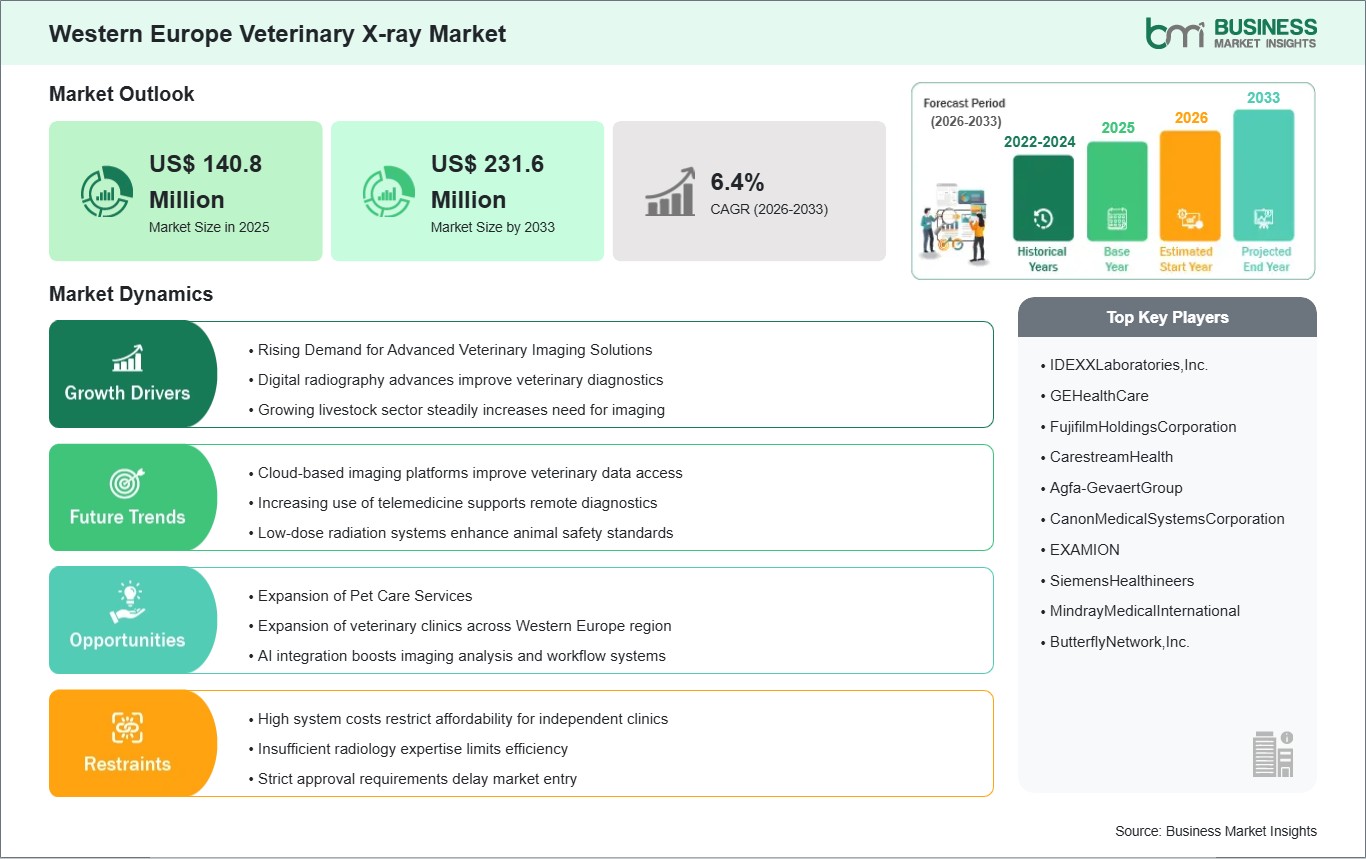
The Western Europe veterinary x-ray market size is expected to reach US$ 231.6 million by 2033 from US$ 140.8 million in 2025. The market is estimated to record a CAGR of 6.4% from 2026 to 2033.
With advanced diagnostic imaging solutions available to veterinarians and other animal health care professionals in Western Europe (such as companion animal clinics and specialty veterinary hospitals), the veterinary x-ray market has become a critical segment within the larger animal health care industry in Western Europe. There is a growing focus on early disease detection, improved treatment outcomes, and better animal welfare. As a result, veterinary professionals are upgrading their imaging technologies (film-based) to digital X-ray systems for their patients. The trend toward owning pets (particularly within large urban centers and high-income populations) continues to grow in Germany, the UK, France, and the Benelux countries. Thus, there is an increasing need for reliable, consistent diagnostic imaging infrastructure among veterinarians.
The trend toward preventive care by veterinary professionals is increasing the number of imaging studies performed-similar to trends seen in human health care-especially related to orthopedics, dentistry, and internal medicine. Advances in digital image acquisition and processing, lower-dose X-ray techniques, and the ability to integrate imaging systems with electronic medical record (EMR) systems are significant drivers for the market. The continued growth of small animal veterinary practices is encouraging veterinarians to use solutions that provide rapid image acquisition times, high-resolution images of small animal anatomy, and ease of use in busy clinical practices. There is increased interest in using portable and/or wireless X-ray devices in ambulatory veterinarian practices.

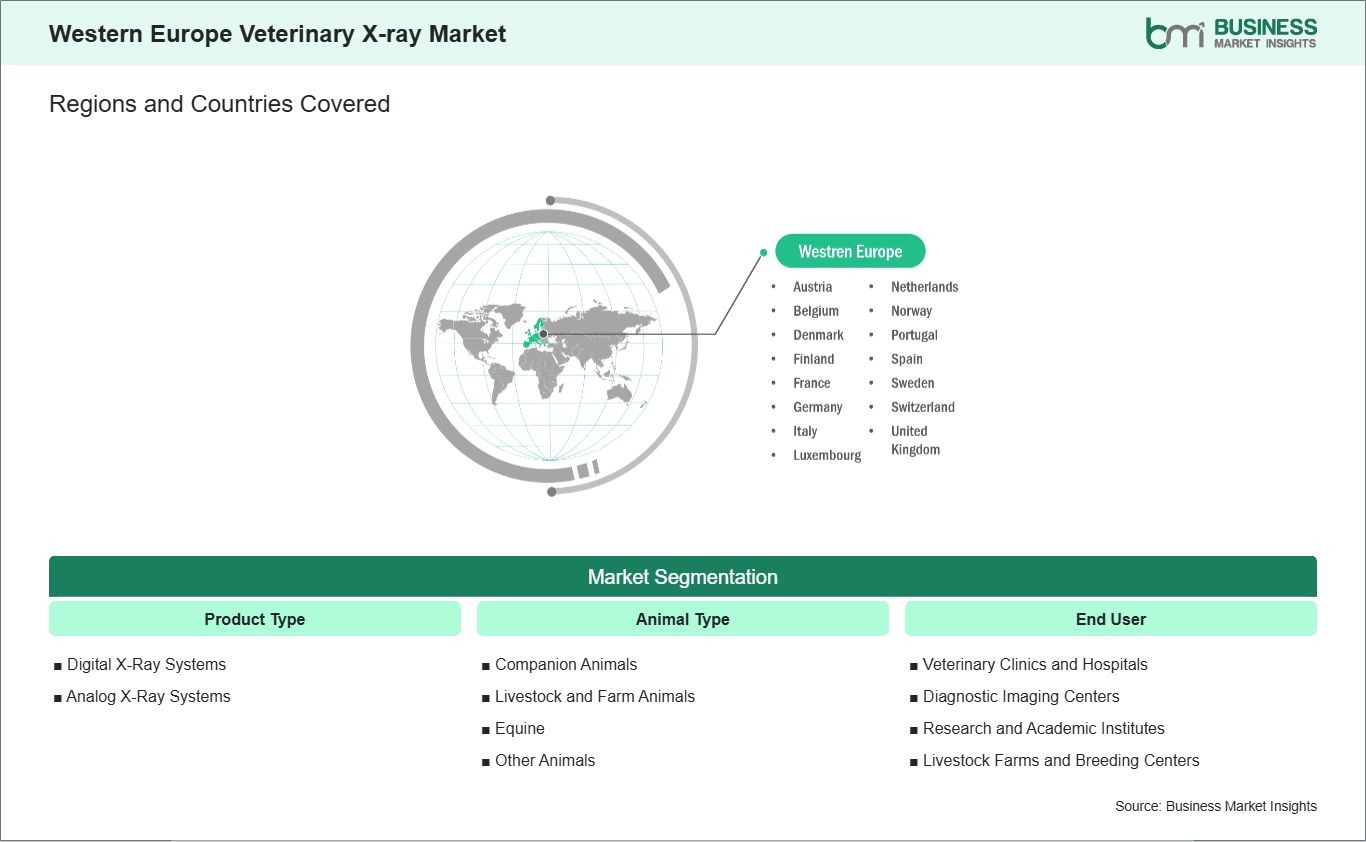
Key segments that contributed to the derivation of the Western Europe veterinary x-ray market analysis are product type, animal type, and end user.
Pet ownership continues to trend upwards in countries such as Germany, France, and the UK, which has led veterinary clinics to begin investing in new radiographic equipment to achieve improved accuracy in diagnosing. Small-animal practices have placed a major focus on using high-resolution digital X‑ray systems to identify orthopedic and dental problems. Clinics providing imaging services for horses and livestock are utilizing portable X‑ray units for in-the-field imaging.
Rapid advancements in technology drive the demand for new radiographic systems. Digital radiography, wireless detectors, and software-based image-enhancement technologies allow veterinarians to provide quicker, more accurate diagnoses. As a result, treatment outcomes are better, and there is greater client satisfaction. These innovations reduce the amount of radiation that is delivered to staff and patients, as well as comply with strict animal welfare regulations found throughout Western Europe.
Specialized veterinary radiology training programs in the Netherlands and Switzerland are adding to the demand for new veterinary imaging technologies. Clinics are pursuing individuals with the requisite expertise to fully utilize the capabilities of new imaging technologies, which will result in accurate diagnoses and support the growth of the veterinary X‑ray market in Western Europe.
Increasing urbanization and disposable income levels have resulted in increased levels of pet ownership and demand for comprehensive veterinary care. Clinics are expanding their service offerings to include routine imaging as part of the process of early diagnosis of disease, preventive health checks, and special diagnostics, making the introduction of veterinary X-ray systems important in the modern veterinary healthcare environment.
Specialty and referral centers in Italy, Germany, and France need advanced imaging solutions to deal with complex cases such as those associated with orthopedic surgeries and for cancer detection. The development of portable X-ray systems is becoming popular, allowing veterinarians to provide their services on-site for large animals and address logistical issues faced when transporting large animals to the veterinary facility.
The increasing level of awareness among pet owners about preventative and diagnostic care has created opportunities for clinics to invest in the latest high-performance X-ray technologies. This trend will lead to an increased level of investment in high-tech equipment to continue supporting the expansion of services and facilitating the modernization of the veterinary care infrastructure across Western Europe.
The Western Europe veterinary X-ray market demonstrates steady growth, with size and share analysis highlighting evolving trends and competitive dynamics among key players. The report examines subsegments categorized within product type, animal type, and end user, offering insights into their contribution to overall market performance.
By product type, the digital X-ray systems subsegment dominated the market in 2025, driven by its enhanced image quality, faster processing time, and growing adoption in modern veterinary practices.
Based on animal type, the companion animals subsegment dominated the market in 2025, driven by increasing pet ownership and rising demand for advanced diagnostic imaging in routine veterinary care.
In terms of end user, the veterinary clinics and hospitals subsegment dominated the market in 2025, driven by the widespread adoption of X-ray systems for comprehensive diagnostic and treatment services.
| Report Attribute | Details |
|---|---|
| Market size in 2025 | US$ 140.8 Million |
| Market Size by 2033 | US$ 231.6 Million |
| CAGR (2026 - 2033) | 6.4% |
| Historical Data | 2022-2024 |
| Forecast period | 2026-2033 |
| Segments Covered | By Product Type
|
|
Regions and Countries Covered
| |
| Western Europe | Belgium, the Netherlands, Luxembourg, Germany, France, Italy, Spain, Switzerland, Sweden, Austria, the United Kingdom, Denmark, Portugal, Norway, Finland |
| Market leaders and key company profiles |
|
The "Western Europe Veterinary X-ray Market Size and Forecast (2022–2033)" report provides a detailed analysis of the market covering below areas:
The geographical scope of the Western Europe Veterinary X-ray Market report is divided into Belgium, the Netherlands, Luxembourg, Germany, France, Italy, Spain, Switzerland, Sweden, Austria, the UK, Denmark, Portugal, Norway, and Finland. Germany held the largest share in 2025.
Germany emerges as the dominant market due to its well-established veterinary infrastructure, high concentration of specialized animal hospitals, and progressive adoption of digital and portable X‑ray systems. Veterinary clinics are investing in high-resolution imaging equipment to enhance diagnostic accuracy and improve workflow efficiency, supported by stringent regulatory standards that emphasize patient safety and image quality. In France, market expansion is steady, fueled by the modernization of veterinary facilities and a gradual transition from analog to digital radiography, particularly in urban centers. The UK exhibits robust demand for advanced imaging solutions in companion and equine practices, with private veterinary networks driving the need for mobile and stationary X‑ray units. Italy and Spain show moderate growth, influenced by rising investments in veterinary clinics and the expansion of mobile radiography services in rural areas.
The Benelux region, encompassing Belgium, the Netherlands, and Luxembourg, demonstrates early adoption of integrated digital solutions and portable X‑ray devices, supported by well-funded veterinary practices. However, its market size is comparatively smaller. Switzerland and Austria are characterized by high standards of animal welfare and sophisticated imaging usage, ensuring consistent demand for digital radiography across small- and large-animal care. In the Nordic countries - Sweden, Denmark, Norway, and Finland - advanced technology adoption, strong rural veterinary networks, and an emphasis on equine and agricultural animal diagnostics contribute to steady growth. Western Europe's veterinary X‑ray market is marked by technological advancement, increased operational efficiency, and diversified demand across companion, large-animal, and specialty veterinary services, with Germany maintaining a clear leadership position due to its scale, infrastructure, and adoption of cutting-edge imaging technologies.

The Western Europe Veterinary X-ray Market is evaluated by gathering qualitative and quantitative data post primary and secondary research, which includes important corporate publications, association data, and databases. A few of the key developments in the Western Europe veterinary X-ray market are:
The Western Europe Veterinary X-ray Market is valued at US$ 140.8 Million in 2025, it is projected to reach US$ 231.6 Million by 2033.
As per our report Western Europe Veterinary X-ray Market, the market size is valued at US$ 140.8 Million in 2025, projecting it to reach US$ 231.6 Million by 2033. This translates to a CAGR of approximately 6.4% during the forecast period.
The Western Europe Veterinary X-ray Market report typically cover these key segments-
The historic period, base year, and forecast period can vary slightly depending on the specific market research report. However, for the Western Europe Veterinary X-ray Market report:
The Western Europe Veterinary X-ray Market is populated by several key players, each contributing to its growth and innovation. Some of the major players include:
The Western Europe Veterinary X-ray Market report is valuable for diverse stakeholders, including:
Essentially, anyone involved in or considering involvement in the Western Europe Veterinary X-ray Market value chain can benefit from the information contained in a comprehensive market report.
Please tell us your area of interest
(Market Segments/ Regions and Countries/ Companies)