Market Summary
Executive Summary and Market Analysis
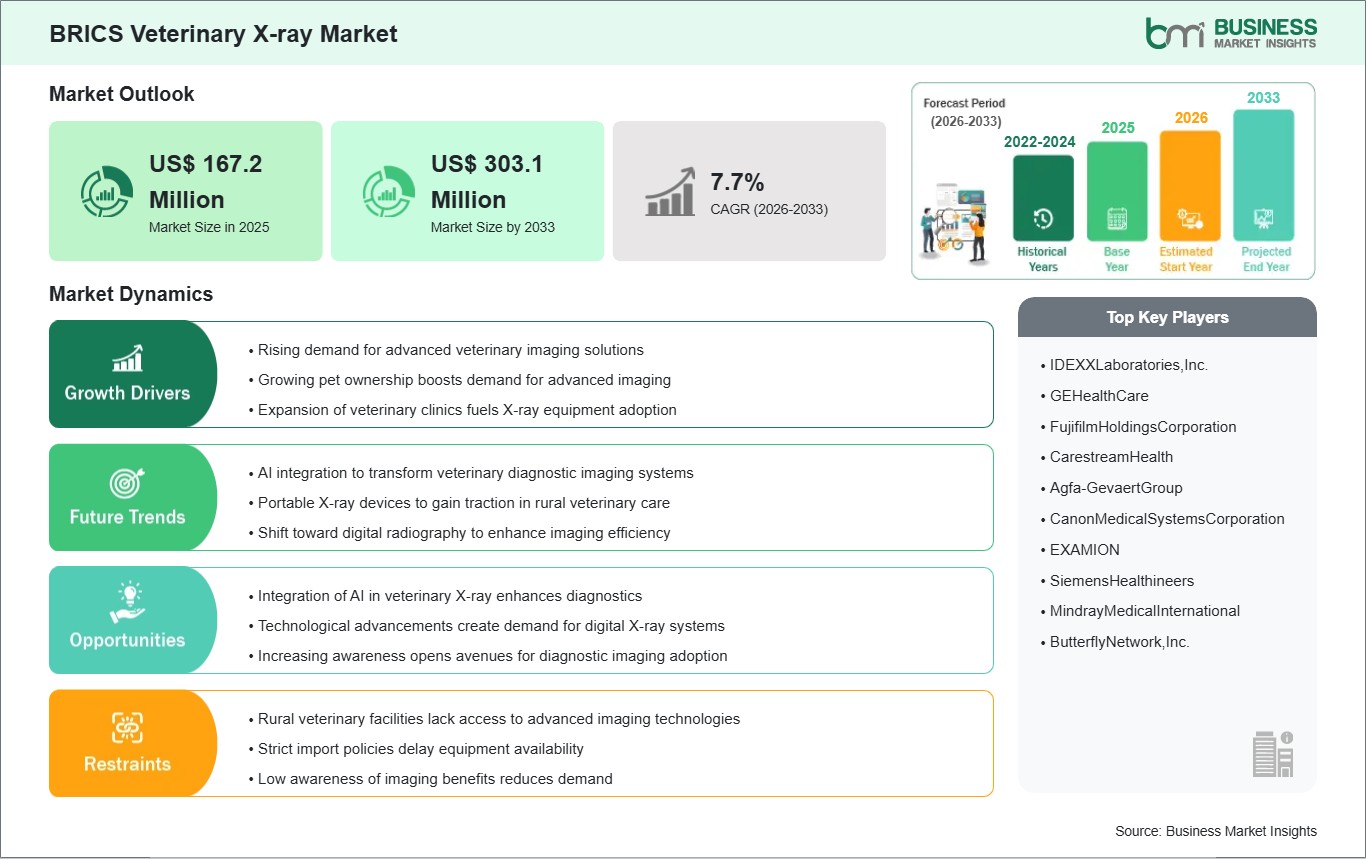
The BRICS Veterinary X‑ray Market has emerged as a strategically significant segment within the global animal healthcare ecosystem, driven by the collective growth in livestock populations, expansion of companion animal ownership, and rising awareness around animal welfare across Brazil, Russia, India, China, and South Africa. In this diverse regional landscape, each market exhibits distinct characteristics yet shares common themes of modernization in veterinary diagnostics and increased investment in animal health infrastructure.
Across the BRICS bloc, the shift from traditional, symptom‑based veterinary care toward technology‑enabled diagnostic practices has amplified the relevance of X‑ray imaging equipment as a foundational tool for accurate disease detection, orthopedic assessments, and preventive healthcare in both livestock and companion animals. In Brazil, agricultural intensification and the country's role as a major meat exporter have prompted heightened demand for reliable veterinary imaging to ensure herd health and biosecurity standards. The expansion of private veterinary clinics and mobile diagnostic services in rural states has further created accessible avenues for X‑ray usage beyond urban veterinary hospitals. Russia’s veterinary imaging landscape is influenced by its vast geographical expanse and dispersed animal populations, fostering demand for portable and rugged X‑ray systems capable of withstanding challenging conditions; however, uneven distribution of advanced imaging services remains a regional constraint. In India, the exponential rise in pet ownership coupled with evolving pet care expectations has accelerated adoption of diagnostic imaging in urban and semi‑urban markets, even as limited awareness in rural regions and budget constraints among small animal practices temper growth potential.
China’s veterinary sector reflects robust modernization, with large corporate hospital chains integrating high‑end X‑ray technologies and a strong trend toward early disease screening in valuable livestock assets; yet, regulatory hurdles and varied proficiency levels among practitioners present adoption challenges. South Africa sees a balanced market with both livestock and companion animal segments contributing to veterinary imaging needs, underpinned by improved professional training and cross‑border collaborations, even though economic disparities influence technology penetration.
Segment Analysis
BRICS Veterinary X-ray Market Segmentation
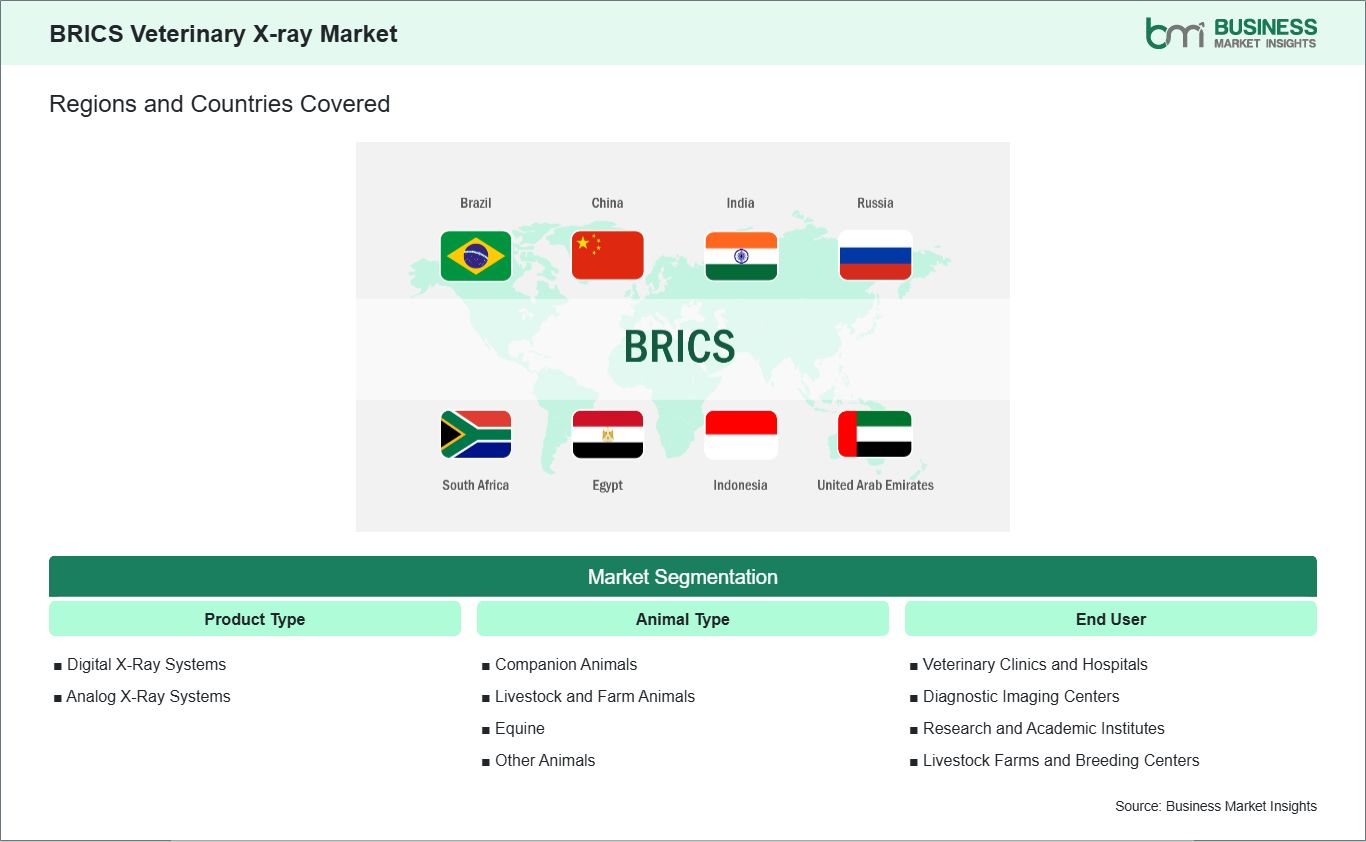
Key segments that contributed to the derivation of the BRICS veterinary x-ray market analysis are product type, animal type, and end user.
- By product type, the veterinary x-ray market is segmented into digital x-ray systems, analog x-ray systems. The digital x-ray systems segment dominated the market in 2025.
- Based on animal type, the veterinary x-ray market is categorized into companion animals, livestock and farm animals, equine, other animal types. The companion animals segment dominated the market in 2025.
- In terms of end user, the veterinary x-ray market is categorized into veterinary clinics and hospitals, diagnostic imaging centers, research and academic institutes, livestock farms and breeding centers. The veterinary clinics and hospitals segment dominated the market in 2025.
Market Forces
BRICS Veterinary X-ray Market Drivers and Opportunities
Rising demand for advanced veterinary imaging solutions
Rapidly rising demand for sophisticated imaging solutions continues to be one of the major drivers behind growth in the BRICS veterinary X-ray market. In India, an increase in awareness by farmers and owners of livestock regarding early detection of disease has resulted in the increased use of veterinary radiography, particularly in states such as Maharashtra and Karnataka. Similarly, funding for digital X-ray equipment by large dairy farms in China has caused that country to increase monitoring of bovine skeletal health, decrease time spent treating injured animals, and improve overall herd productivity. Brazil also has many high-resolution imaging systems within the equine sports industry, facilitating appropriate diagnosis and treatment of tendon and bone injuries. All regional regulatory agencies have aided this rising demand through the use of expedited processes for evaluating equipment and the approval of their use in veterinary clinics to assist clinics in transitioning from using analog X-ray devices to using digital X-ray devices. Many of the rural provinces in South Africa, such as KwaZulu-Natal, do not have stationary diagnostic centres. Consequently, mobile X-ray devices are becoming commonplace in these areas. In Russia, robust animal husbandry has resulted in increased budget allocations for veterinary diagnostic tools. The overall trends throughout the BRICS countries show that sophisticated imaging technology is a necessity as opposed to a luxury and will therefore help to fuel growth of the veterinary X-ray market within the BRICS.
Integration of AI in veterinary X‑ray enhances diagnostics
AI has begun to play a significant role in the transformation of veterinary diagnostic imaging across the BRICS countries. The integration of AI technologies into veterinary x-ray imaging systems offers a great deal of opportunity for companies conducting this type of business. For example, China's advanced technology in veterinary medicine is starting to use AI algorithms in the identification of slight fractures or lesions through computerized analysis of veterinary x-rays. As a result, there is a faster process for generating x-ray reports, as well as increased accuracy due to the number of interpretations conducted by a single person being reduced to one. India's emerging technology companies are starting to develop machine learning software applications specifically designed to interpret bovine and canine radiographs. These applications will assist veterinarians in making quick diagnostic decisions in high-traffic veterinary clinics such as those located in Delhi and Bangalore. In addition, Brazil's universities are partnering with software developers to further refine AI-based models that distinguish between normal anatomical variations and pathological diagnoses using AI-based medical imaging. In addition to the major metropolitan areas of the BRICS countries, AI-based applications for veterinary diagnostic imaging are being utilized in rural areas of South Africa through telemedicine programs that allow rural clinics to send their x-ray images to cloud platforms for pre-interpretation by AI programs prior to consulting with a veterinarian. Russia's federal veterinary services are currently experimenting with the use of AI-assisted imaging as a means of improving disease surveillance in livestock herds, particularly in the case of livestock suffering from respiratory diseases.
The above examples highlight how the integration of AI will not only increase veterinarians' confidence in their ability to make accurate diagnoses, but also address the shortage of veterinarians in the workforce and provide for greater workflow efficiencies; therefore, AI is an avenue from which to achieve growth within the BRICS countries' veterinary x-ray markets.
Size and Share Analysis
BRICS Veterinary X-ray Market Size and Share Analysis
The BRICS veterinary x-ray market demonstrates steady growth, with size and share analysis highlighting evolving trends and competitive dynamics among key players. The report examines subsegments categorized within product type, animal type, and end user, offering insights into their contribution to overall market performance.
By product type, the digital x-ray systems subsegment dominated the market in 2025, driven by its enhanced image quality, faster processing time, and growing adoption in modern veterinary practices.
Based on animal type, the companion animals subsegment dominated the market in 2025, driven by increasing pet ownership and rising demand for advanced diagnostic imaging in routine veterinary care.
In terms of end user, the veterinary clinics and hospitals subsegment dominated the market in 2025, driven by the widespread adoption of x-ray systems for comprehensive diagnostic and treatment services.
Report Coverage
BRICS Veterinary X-ray Market Report Coverage and Deliverables
The "BRICS Veterinary X-ray Market Size and Forecast (2022–2033)" report provides a detailed analysis of the market covering below areas:
- BRICS Veterinary X-ray Market size and forecast at global, regional, and country levels for all the key market segments covered under the scope
- BRICS Veterinary X-ray Market trends, as well as drivers, restraints, and opportunities
- BRICS Veterinary X-ray Market analysis covering key trends, global and regional framework, major players, regulations, and recent developments
- Industry landscape and competition analysis covering market concentration, heat map analysis, prominent players, and recent developments for the BRICS Veterinary X-ray Market
- Detailed company profiles, including SWOT analysis
Geographic Insights
BRICS Veterinary X-ray Market Geographic Insights
The geographical scope of the BRICS Veterinary X-ray Market report is divided into Russia, Brazil, South Africa, India, the UAE, and China. China held the largest share in 2025.
In the BRICS veterinary X‑ray market, China clearly emerges as the dominant region due to its expansive animal healthcare infrastructure, rapid adoption of digital radiography, and strong domestic manufacturing capabilities for imaging equipment. The country’s growing focus on modernizing veterinary services, both for livestock and companion animals, has driven demand for advanced X‑ray solutions, including portable and high-resolution digital systems. India represents a fast-growing segment, fueled by rising pet ownership, increasing awareness of animal health, and expanding private veterinary clinics. Despite budget constraints and uneven access in rural areas, India is seeing steady adoption of digital and mobile X‑ray devices, especially in urban centers and specialized practices. Brazil demonstrates consistent growth driven by large-scale livestock industries and an increasing number of urban veterinary clinics that are integrating digital imaging solutions to enhance diagnostic efficiency.
Russia’s market is shaped by government initiatives to modernize veterinary facilities, with a focus on both large-scale agricultural operations and companion animal care, although economic fluctuations and reliance on imported technology can impact the pace of adoption. South Africa’s veterinary X‑ray market benefits from strong livestock and equine industries, which drive demand for reliable diagnostic tools, while private veterinary practices in urban centers increasingly invest in digital and portable X‑ray systems. Infrastructure gaps and regulatory complexities in rural regions moderate overall growth.
The UAE, though smaller in market size compared to BRICS countries, exhibits rapid technological adoption in veterinary radiography, driven by high-income pet owners, modern veterinary clinics, and a preference for advanced imaging technologies. Across these regions, the market trends reveal a combination of livestock health priorities, companion animal care, and technological modernization, with China leading both in scale and in innovation readiness, setting a benchmark for other BRICS nations seeking to expand their veterinary imaging capabilities.
Industry Activity
Recent Developments
The BRICS Veterinary X-ray Market is evaluated by gathering qualitative and quantitative data post primary and secondary research, which includes important corporate publications, association data, and databases. A few of the key developments in the BRICS veterinary x-ray market are:
- In August 2023, Fujifilm announced that it expanded into veterinary healthcare with a comprehensive lineup of veterinary medical solutions, including digital X‑ray systems such as its high‑performance X‑ray solution “FDR Smart X” designed to support precise animal diagnostics. This initiative reflects Fujifilm’s expansion of its diagnostic imaging technology into the veterinary segment globally, enhancing X‑ray capabilities across veterinary clinical settings.
- In January 2026, IDEXX Laboratories announced that it had launched the ImageVue™ DR50 Plus Digital Imaging System, an advanced veterinary radiography solution that provides next‑level imaging with significantly reduced radiation dose (up to ~25–60% lower) and integrated AI‑enhanced workflows to help veterinarians make faster and more confident diagnoses. This system enhances digital X‑ray imaging and integrates with IDEXX imaging software for centralized access, viewing, and workflow efficiency.
Trust & Transparency
Research Methodology
The market analysis combines proprietary research with secondary data from government agencies, company disclosures, regulatory filings, industry databases and expert interviews. Market estimates are validated through data triangulation, cross-market benchmarking and analyst
review.
View Full Research Methodology
Key Sources Referred:
American College of Veterinary Radiology (ACVR) World Small Animal Veterinary Association (WSAVA) British Veterinary Association (BVA) International Veterinary Radiology Association (IVRA) American Veterinary Medical Association (AVMA) European College of Veterinary Diagnostic Imaging (ECVDI) World Organisation for Animal Health (WOAH / OIE) Veterinary Imaging & Radiation Oncology Society (VIROS)