Market Summary
Executive Summary and Market Analysis
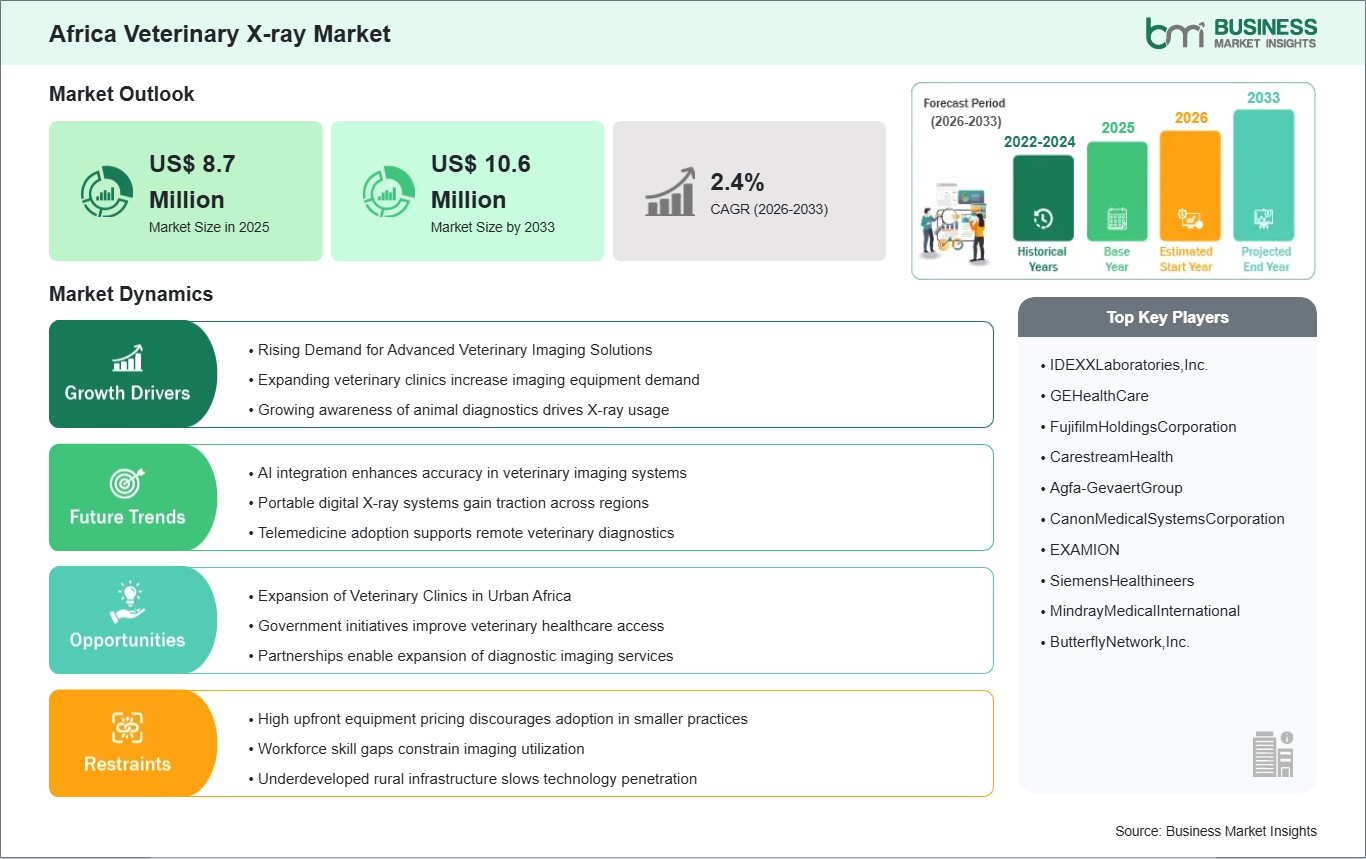
Unlike in Western parts of the world, veterinary imaging technology was underdeveloped in Africa. Nonetheless, the sector is shifting from basic clinical examination to the advanced practice of animal healthcare by incorporating X-ray machines in veterinary health facilities. With countries that have high levels of cattle, poultry, and small ruminants focusing on proper diagnosis and disease control to ensure low morbidity and mortality of animals, it has become imperative to use X-ray equipment to help veterinarians make immediate diagnoses of animal diseases, including fractures, lung infections, gastrointestinal complications, and foreign objects. East and West African countries, which have integrated pastoralism and animal husbandry practices into their social and economic fabric, are developing a strong interest in veterinary X-ray technology. South Africa, with its relatively mature veterinary services ecosystem, serves as a focal point for higher‑end X‑ray adoption, including digital solutions. Neighboring countries look toward refurbished or cost‑effective analog units to balance budgetary constraints with diagnostic needs. Limited financial resources within rural veterinary practices, logistics challenges in distributing and servicing imaging equipment across vast geographies, and a shortage of trained veterinary radiology professionals hinder market penetration. In Africa, where animal health services remain primarily reactive rather than preventive, the need for advanced imaging equipment is building among small‑scale practitioners. As digital transformation continues and the value of early disease detection becomes recognized, the veterinary X‑ray segment in Africa is poised for progressive development, underpinning efforts to strengthen animal health systems across the region.
Segment Analysis
Africa Veterinary X-ray Market Segmentation
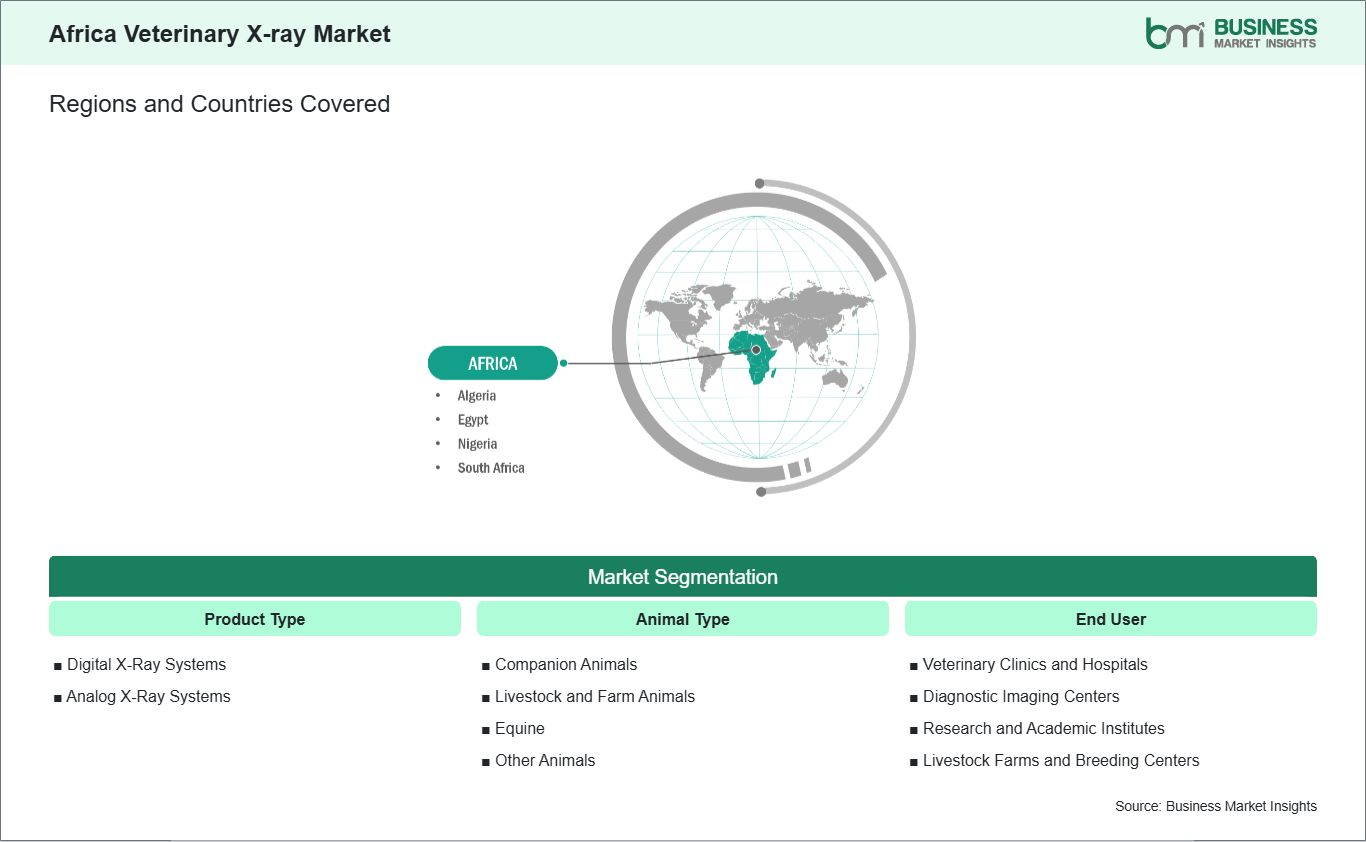
Key segments that contributed to the derivation of the Africa veterinary X-ray market analysis are product type, animal type, and end user.
- By product type, the veterinary x-ray market is segmented into digital x-ray systems and analog x-ray systems. The digital X-ray systems segment dominated the market in 2025.
- Based on animal type, the veterinary x-ray market is categorized into companion animals, livestock and farm animals, equine, and other animals. The companion animals segment dominated the market in 2025.
- In terms of end user, the veterinary x-ray market is categorized into veterinary clinics and hospitals, diagnostic imaging centers, research and academic institutes, livestock farms, and breeding centers. The veterinary clinics and hospitals segment dominated the market in 2025.
Market Forces
Africa Veterinary X-ray Market Drivers and Opportunities
Rising Demand for Advanced Veterinary Imaging Solutions
Advanced imaging technology is demanded by urban centers such as Johannesburg, Nairobi, and Lagos due to the growing population of pets and the demand for high-quality veterinary services. Contemporary clinics are purchasing state-of-the-art imaging equipment that will allow them to carry out quick and accurate diagnoses, which is essential for surgery, fractures, and disease detection. Demand is expected from livestock sectors in Kenya and South Africa. The use of X-ray technology by veterinarians will enable them to evaluate the health status of herds, diagnose internal injuries, and offer reproductive and orthopedic services to large animals. X-ray units are helpful when used in rural settings, where vets can carry out imaging at the place where the animals are found, avoiding moving the animals from their original locations to diagnostic facilities. Pet owners and livestock farmers have become increasingly aware of preventative medicine. Veterinary practices employing advanced imaging techniques have a chance to offer better services, boosting their business growth in Africa.
Expansion of Veterinary Clinics in Urban Africa
There is a significant increase in modern animal diagnostic and medical clinics in urban areas such as Lagos, Cairo, and Cape Town, as the need for sophisticated diagnostics is continuously growing. The incorporation of X-ray machines in these facilities offers complete animal medical care that includes assessing internal injuries and illnesses as well as treating dental problems in pets. Diagnostic centers targeting farm animals have begun to emerge in the areas where farming activity is quite intensive. They rely on portable and digital X-ray technology to provide healthcare services ranging from herd health monitoring, reproduction examination, to orthopedics of large farm animals. Increased urban veterinary clinic infrastructure results in the adoption of new diagnostic techniques. With the development of urban animal healthcare, the demand for efficient X-ray technology will grow, providing more opportunities for this segment. The increasing availability of veterinary services in cities fuels the growth of the market in Africa.
Size and Share Analysis
Africa Veterinary X-ray Market Size and Share Analysis
The Africa veterinary X-ray market demonstrates steady growth, with size and share analysis highlighting evolving trends and competitive dynamics among key players. The report examines subsegments categorized within product type, animal type, and end user, offering insights into their contribution to overall market performance.
By product type, the digital X-ray systems subsegment dominated the market in 2025, driven by its enhanced image quality, faster processing time, and growing adoption in modern veterinary practices.
Based on animal type, the companion animals subsegment dominated the market in 2025, driven by increasing pet ownership and rising demand for advanced diagnostic imaging in routine veterinary care.
In terms of end user, the veterinary clinics and hospitals subsegment dominated the market in 2025, driven by the widespread adoption of X-ray systems for comprehensive diagnostic and treatment services.
Report Coverage
Africa Veterinary X-ray Market Report Coverage and Deliverables
The "Africa Veterinary X-ray Market Size and Forecast (2022–2033)" report provides a detailed analysis of the market covering below areas:
- Africa Veterinary X-ray Market size and forecast at global, regional, and country levels for all the key market segments covered under the scope
- Africa Veterinary X-ray Market trends, as well as drivers, restraints, and opportunities
- Africa Veterinary X-ray Market analysis covering key trends, global and regional framework, major players, regulations, and recent developments
- Industry landscape and competition analysis covering market concentration, heat map analysis, prominent players, and recent developments for the Africa Veterinary X-ray Market
- Detailed company profiles, including SWOT analysis
Geographic Insights
Africa Veterinary X-ray Market Geographic Insights
The geographical scope of the Africa Veterinary X-ray Market report is divided into Egypt, South Africa, Nigeria, and Algeria. Nigeria held the largest share in 2025.
Nigeria's market growth is fueled by increasing livestock populations, heightened awareness of animal health, and the rising number of veterinary clinics and diagnostic centers in urban and peri-urban areas. The country's large agricultural economy, coupled with government initiatives aimed at improving animal health and disease management, has created a demand for veterinary imaging solutions, particularly X‑ray systems for livestock and companion animals. South Africa represents a more mature segment with advanced veterinary services and higher adoption of modern digital and portable X‑ray technologies. Structured veterinary hospitals, specialized diagnostic centers, and a growing trend toward preventive care sustain steady demand for sophisticated imaging equipment. In Egypt, urban veterinary clinics and increased pet ownership drive moderate adoption of traditional and digital radiography systems. The market is benefiting from rising awareness of diagnostic accuracy and efficiency, though rural areas still face limited access to advanced imaging. Algeria's veterinary X‑ray sector is supported by its livestock industry and emerging veterinary facilities. Adoption of digital X‑ray technologies is slower compared to Nigeria and South Africa due to infrastructure and investment constraints. Yet, there is potential for growth as awareness of diagnostic importance rises.
Across these nations, the common drivers shaping the veterinary X‑ray market include the shift from analog to digital imaging, increased use of portable X‑ray units for field diagnostics, and a broader emphasis on early disease detection and preventive care for both livestock and companion animals. Nigeria's scale and demand intensity position it as the dominant regional hub, while South Africa leads in technology sophistication, Egypt and Algeria offer incremental opportunities, forming a diverse and evolving landscape for veterinary radiography across Africa.
Industry Activity
Recent Developments
The Africa Veterinary X-ray Market is evaluated by gathering qualitative and quantitative data post primary and secondary research, which includes important corporate publications, association data, and databases. A few of the key developments in the Africa veterinary X-ray market are:
- In January 2026, IDEXX Laboratories announced that it had launched the ImageVue DR50 Plus Digital Imaging System, its veterinary digital radiography solution with lower radiation dose and enhanced diagnostic imaging performance. The new ImageVue DR50 Plus system combines high‑definition imaging with reduced radiation exposure and integrated clinical workflows to accelerate diagnosis in veterinary practices.
- In November 2025, Canon Medical Systems Corporation started global sales of the Mobirex i9 / Smart Edition mobile X‑ray system, a high‑end X‑ray unit with enhanced radiography support functions. This broad product portfolio expansion benefits the veterinary and medical imaging markets.
Trust & Transparency
Research Methodology
The market analysis combines proprietary research with secondary data from government agencies, company disclosures, regulatory filings, industry databases and expert interviews. Market estimates are validated through data triangulation, cross-market benchmarking and analyst
review.
View Full Research Methodology
Key Sources Referred:
American College of Veterinary Radiology (ACVR) World Small Animal Veterinary Association (WSAVA) British Veterinary Association (BVA) International Veterinary Radiology Association (IVRA) American Veterinary Medical Association (AVMA) European College of Veterinary Diagnostic Imaging (ECVDI) World Organisation for Animal Health (WOAH / OIE) Veterinary Imaging & Radiation Oncology Society (VIROS)