Market Summary
Executive Summary and Global Market Analysis
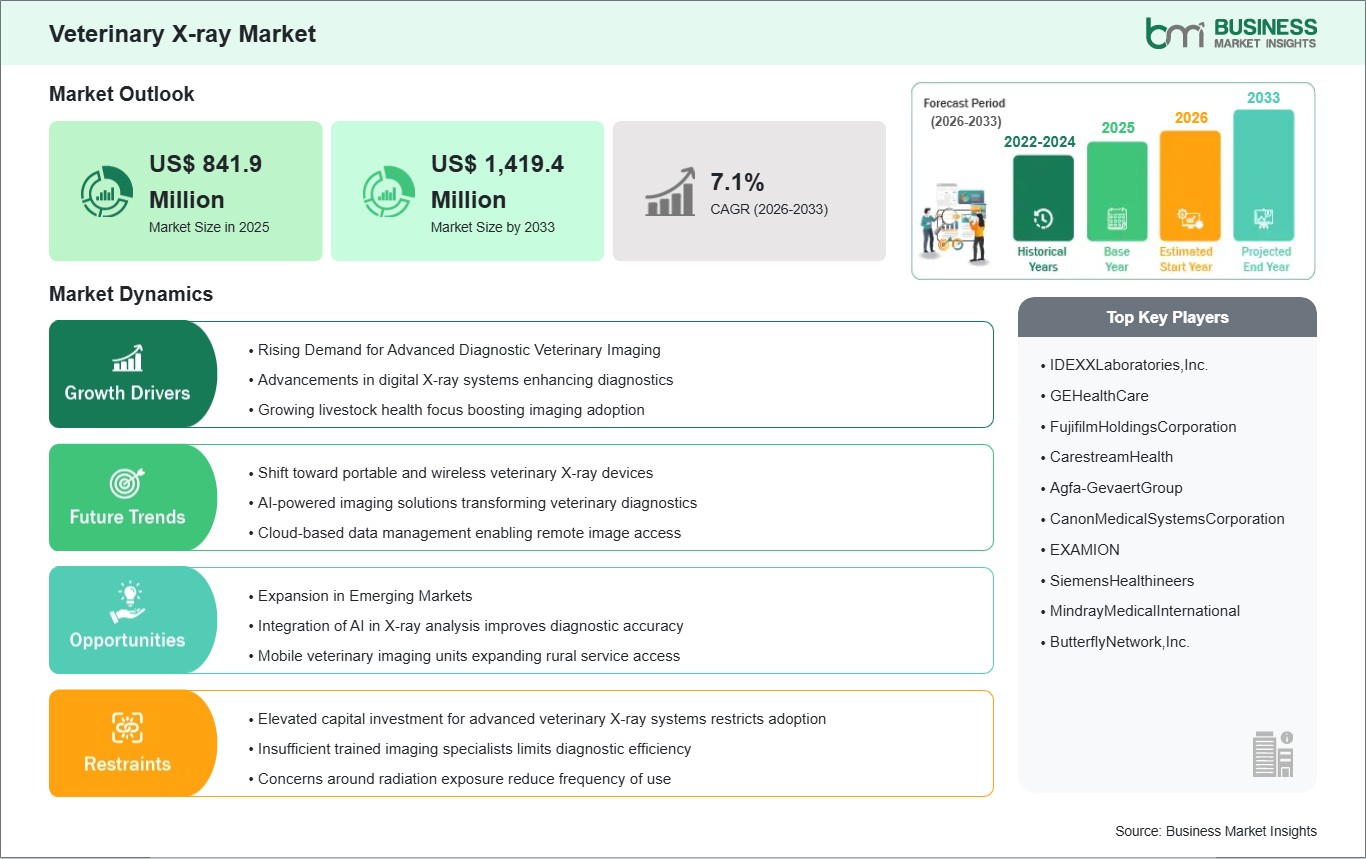
As pet ownership continues to rise worldwide and livestock management becomes sophisticated, the demand for advanced diagnostic tools such as X‑ray systems has grown commensurately. Veterinary X‑ray solutions enable practitioners to visualize musculoskeletal structures, detect fractures, assess organ integrity, and support preventative health care, making them indispensable in small animal clinics and large animal practices. With companion animals viewed as family members, there is a shift toward preventive and therapeutic care that mirrors human healthcare expectations. Pet owners are seeking higher standards of imaging accuracy, quick diagnosis, and minimally invasive procedures, all of which enhance the adoption of sophisticated X‑ray equipment. Improvements in digital radiography, including portability and image processing, have expanded accessibility in field environments, ambulatory clinics, and rural veterinary practices. Advancements in technology enhance image quality, workflow efficiency, and integration with digital record systems. Veterinary professionals are leveraging innovations such as wireless detectors, intuitive software, and cloud‑based storage to improve diagnostic confidence and clinical decision‑making. This technological sophistication supports educational institutions and research facilities, which rely on high‑performance imaging for training and scientific inquiry. The high initial investment cost of advanced X‑ray systems can be a barrier, especially for smaller clinics or in regions with limited veterinary infrastructure. The requirement for specialized training to operate complex imaging technologies may slow adoption among practitioners who lack access to technical support or education. Market growth is shaped by ongoing innovation, shifting perceptions of veterinary care, and the universal need for effective diagnostic solutions that support animal welfare and clinical excellence.
Segment Analysis
Veterinary X-ray Market Segmentation
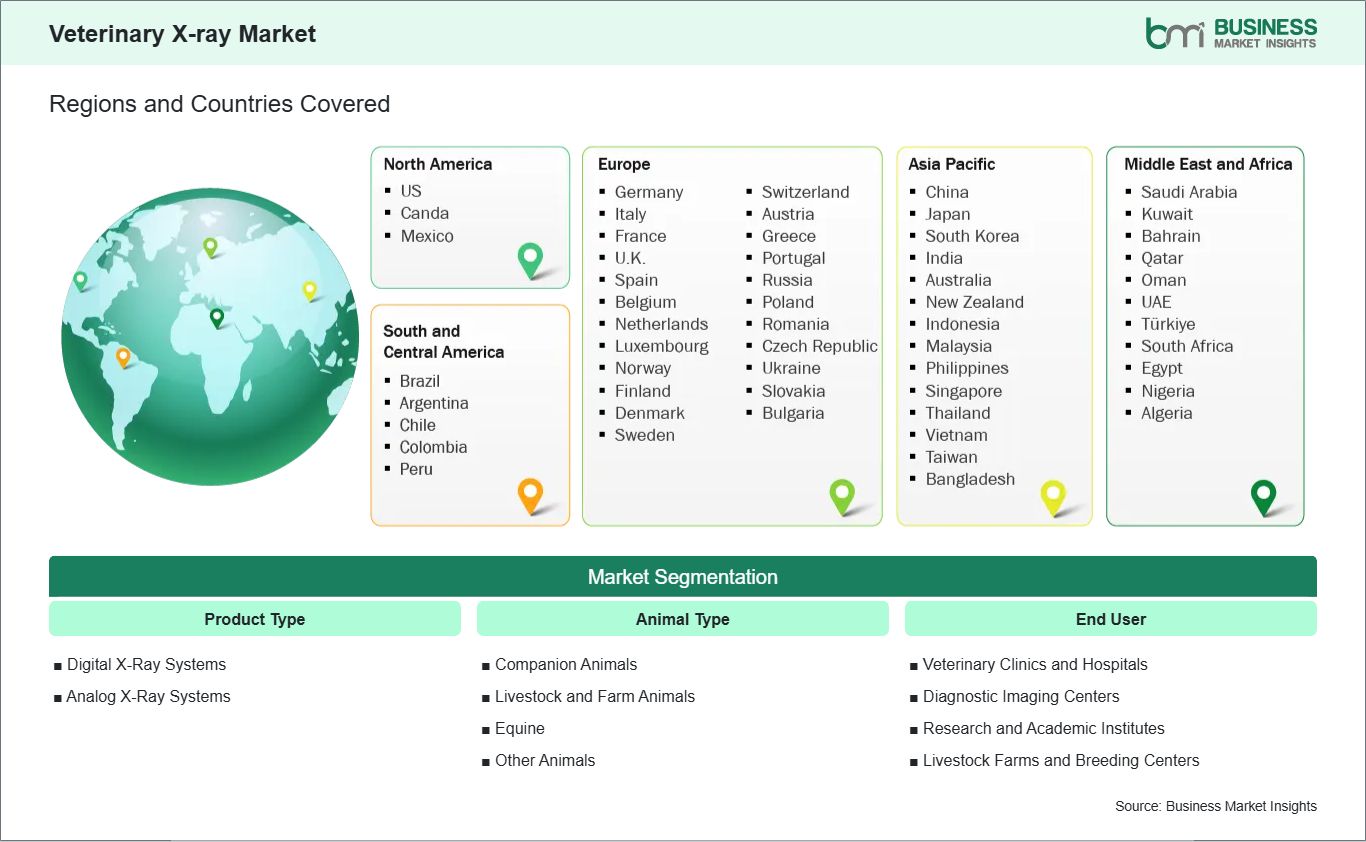
Key segments that contributed to the derivation of the veterinary X-ray market analysis are product type, animal type, and end user.
- By product type, the veterinary x-ray market is segmented into digital x-ray systems and analog x-ray systems. The digital X-ray systems segment dominated the market in 2025.
- Based on animal type, the veterinary x-ray market is categorized into companion animals, livestock and farm animals, equine, and other animals. The companion animals segment dominated the market in 2025.
- In terms of end user, the veterinary x-ray market is categorized into veterinary clinics and hospitals, diagnostic imaging centers, research and academic institutes, livestock farms, and breeding centers. The veterinary clinics and hospitals segment dominated the market in 2025.
Market Forces
Veterinary X-ray Market Drivers and Opportunities
Rising Demand for Advanced Diagnostic Veterinary Imaging
Veterinary practitioners are utilizing X-ray equipment to diagnose fractures, identify internal abnormalities, and monitor chronic diseases in a variety of animal species. This trend indicates a trend toward accurate, timely diagnosis in a more efficient way throughout the healthcare indusstry, allowing veterinarians to provide treatment more rapidly with an appropriate resolution. Imaging solutions have become an integral part of veterinary practice within regions with established veterinary infrastructure (e.g., North America and Europe), whether it be for routine wellness examinations or emergency care.
The continued increase in ownership of companion animals continues to support the need for high-quality imaging capabilities. Pet owners are better educated and expect high levels of care, encouraging clinics to implement upgraded X-ray systems that provide better quality images with shorter processing times. In markets that focus on livestock, increased quality of imaging provides improved herd health status and productiveness through earlier diagnosis of musculoskeletal problems being critical for the health of an animal's herd population. Animal research laboratories and educational institutions are adding more advanced forms of radiologic technology to their applied studies to integrate this technology into their institutions and thus their communities. Manufacturers are providing a wide variety of radiographic equipment appropriate for differing practice types, from portable units for use by field veterinarians to fixed units suitable for use by both equine and companion animal practices. However, the most remarkable trend in radiographic technology is the continued evolution of digital (X-ray) imaging.
Expansion in Emerging Markets
Veterinary practices, especially those that traditionally operated on a referral basis, are developing in-house X-ray capabilities, improving client turnaround time and patient satisfaction, as well as meeting the diagnostic needs of the large and growing companion animal population. Investments in imaging technology have been linked to higher disposable income levels, greater access to veterinary education, and a more sensitive approach to issues related to animal welfare. Investing in portable, affordable X-ray solutions allows veterinarians to provide diagnostic services beyond the traditional confines of their clinic. Portable X-ray solutions for large-scale commercial livestock operations are giving producers a new means of increasing herd health management and reducing economic impact associated with undiagnosed or untreated injuries. Government programs that support animal health, disease surveillance, and food safety propel the adoption of veterinary diagnostic imaging. Global manufacturers develop and deliver products that meet the unique requirements of developing markets, which focus on aspects of durability, usability, and service networks to ensure long-term support performance for their customers. As practices in developing economies become more advanced and technologically sophisticated, the distinction between developed and developing markets will diminish.
Size and Share Analysis
Veterinary X-ray Market Size and Share Analysis
The veterinary x-ray market demonstrates steady growth, with size and share analysis highlighting evolving trends and competitive dynamics among key players. The report examines subsegments categorized within product type, animal type, and end user, offering insights into their contribution to overall market performance.
By product type, the digital x-ray systems subsegment dominated the market in 2025, driven by its enhanced image quality, faster processing time, and growing adoption in modern veterinary practices.
Based on animal type, the companion animals subsegment dominated the market in 2025, driven by increasing pet ownership and rising demand for advanced diagnostic imaging in routine veterinary care.
In terms of end user, the veterinary clinics and hospitals subsegment dominated the market in 2025, driven by the widespread adoption of x-ray systems for comprehensive diagnostic and treatment services.
Report Coverage
Veterinary X-ray Market Report Coverage and Deliverables
The "Veterinary X-ray Market Size and Forecast (2022–2033)" report provides a detailed analysis of the market covering below areas:
- Veterinary X-ray Market size and forecast at global, regional, and country levels for all the key market segments covered under the scope
- Veterinary X-ray Market trends, as well as drivers, restraints, and opportunities
- Veterinary X-ray Market analysis covering key trends, global and regional framework, major players, regulations, and recent developments
- Industry landscape and competition analysis covering market concentration, heat map analysis, prominent players, and recent developments for the Veterinary X-ray Market
- Detailed company profiles, including SWOT analysis
Geographic Insights
Veterinary X-ray Market Geographic Insights
The geographical scope of the Veterinary X-ray Market report is divided into North America, Asia Pacific, Europe, Middle East & Africa, and South & Central America. North America held the largest share in 2025.
North America is the most developed region for veterinary X-ray due to its existing veterinary ecosystem, investment in advanced diagnostic imaging technology, and emphasis on preventative and specialty care for animals. The sophistication of imaging solutions, widespread pet ownership, advanced training for veterinarians, and the well-established regulatory framework which promotes the adoption of technology into veterinary practice has made North America a competitive region with veterinary service providers continuing to develop new ways of meeting clinician and client expectations through innovation. Europe demonstrates significant levels of adoption due to increased awareness of animal welfare and the implementation of more comprehensive animal health policies. There is a well-developed network of veterinary hospitals that are dedicated to sourcing diagnostic precision through their utilization of advanced diagnostic imaging solutions such as digital radiography and portable imaging devices. The regulatory harmonization initiative across western and northern Europe will enhance the cross-border diffusion of veterinary diagnostic imaging technology. Asia Pacific has emerged as a rapidly evolving market for veterinary services. The increasing availability of veterinary services, rising disposable incomes, increasing urbanization and growing investment in pet health are key factors driving demand for veterinary imaging products.
Industry Activity
Recent Developments
The Veterinary X-ray Market is evaluated by gathering qualitative and quantitative data post primary and secondary research, which includes important corporate publications, association data, and databases. A few of the key developments in the veterinary x-ray market are:
- In January 2026, IDEXX Laboratories announced the launch of the ImageVue DR50 Plus, introducing an enhanced digital radiography system designed to deliver lower‑dose radiography with improved imaging performance for veterinary clinics worldwide, advancing diagnostic capabilities for small animal practices.
- In June 2024, Adaptix Ltd announced a distribution partnership with Televere Systems, LLC under which Televere was appointed as the official US distributor for Adaptix's advanced 3D Small Animal Imaging System, enhancing access to its innovative imaging products for veterinary clinics in North America.
Trust & Transparency
Research Methodology
The market analysis combines proprietary research with secondary data from government agencies, company disclosures, regulatory filings, industry databases and expert interviews. Market estimates are validated through data triangulation, cross-market benchmarking and analyst
review.
View Full Research Methodology
Key Sources Referred:
American College of Veterinary Radiology (ACVR) World Small Animal Veterinary Association (WSAVA) British Veterinary Association (BVA) International Veterinary Radiology Association (IVRA) American Veterinary Medical Association (AVMA) European College of Veterinary Diagnostic Imaging (ECVDI) World Organisation for Animal Health (WOAH / OIE) Veterinary Imaging & Radiation Oncology Society (VIROS)