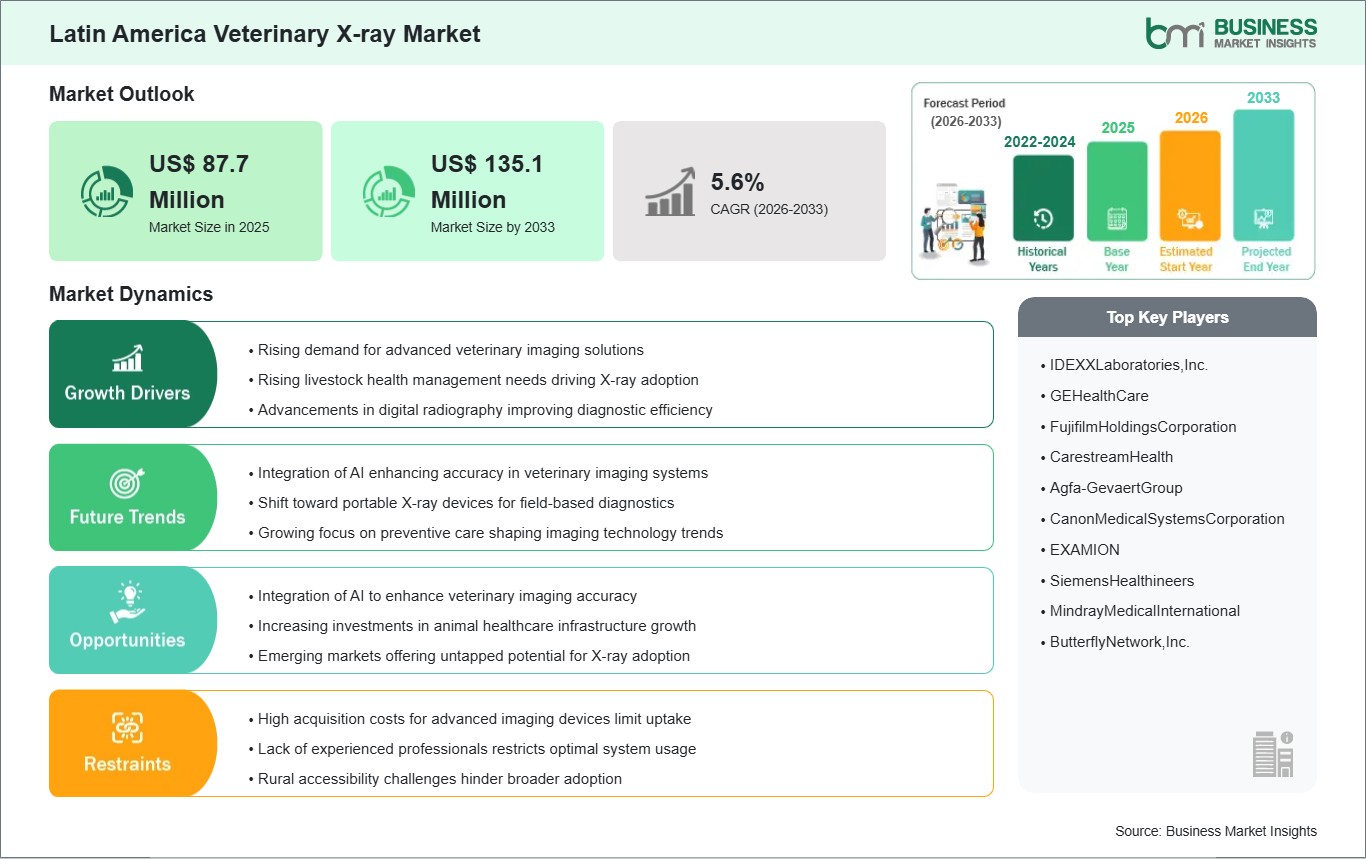
The Latin America veterinary x-ray market size is expected to reach US$ 135.1 million by 2033 from US$ 87.7 million in 2025. The market is estimated to record a CAGR of 5.6% from 2026 to 2033.
The Latin America Veterinary X‑ray market is characterized by a gradual but steady expansion driven by a growing emphasis on animal health and well‑being across both companion and livestock sectors. In recent years, awareness among pet owners and livestock farmers has shifted significantly toward preventive healthcare and early diagnosis, making diagnostic imaging a central consideration in veterinary practice. Veterinary X‑ray systems serve as a key diagnostic tool, enabling practitioners to effectively identify fractures, dental conditions, gastrointestinal issues, and other internal abnormalities in animals. The broadening scope of veterinary services, including specialized care and advanced diagnostic facilities, has reinforced the importance of X‑ray imaging as a baseline diagnostic capability for modern veterinary clinics and hospitals across the region.
A major driver of market momentum stems from increased investments in veterinary infrastructure, particularly in urban centers where private clinics and animal hospitals are expanding their capabilities. These investments are often triggered by pet owners’ rising propensity to seek advanced medical care and by livestock producers’ need for efficient disease management in commercial operations. Educational initiatives and training programs aimed at veterinarians have also heightened the uptake of digital X‑ray technologies, which offer improved image quality, faster processing, and enhanced record‑keeping compared to traditional radiography solutions.
This shift toward digital imaging aligns with global trends in veterinary diagnostics and reflects the growing competitiveness between clinics striving to offer cutting‑edge services. While positive, market growth faces some notable restraints. Cost considerations remain a key challenge, particularly for smaller clinics and rural practices that operate on tighter margins and may lack access to financing options or leasing models for high‑end equipment. Additionally, there is variability in regulatory frameworks and import policies across Latin American countries that can influence pricing, equipment availability, and service adoption rates. Skills gaps in certain areas and resistance to replacing legacy analog systems with digital alternatives further slow uniform market penetration.
Despite these restraints, the outlook for veterinary X‑ray adoption in Latin America remains optimistic. Continued emphasis on animal health, combined with ongoing modernization of veterinary facilities and rising discretionary spending on pets, positions the region as a significant growth landscape for diagnostic imaging solutions tailored to veterinary needs.

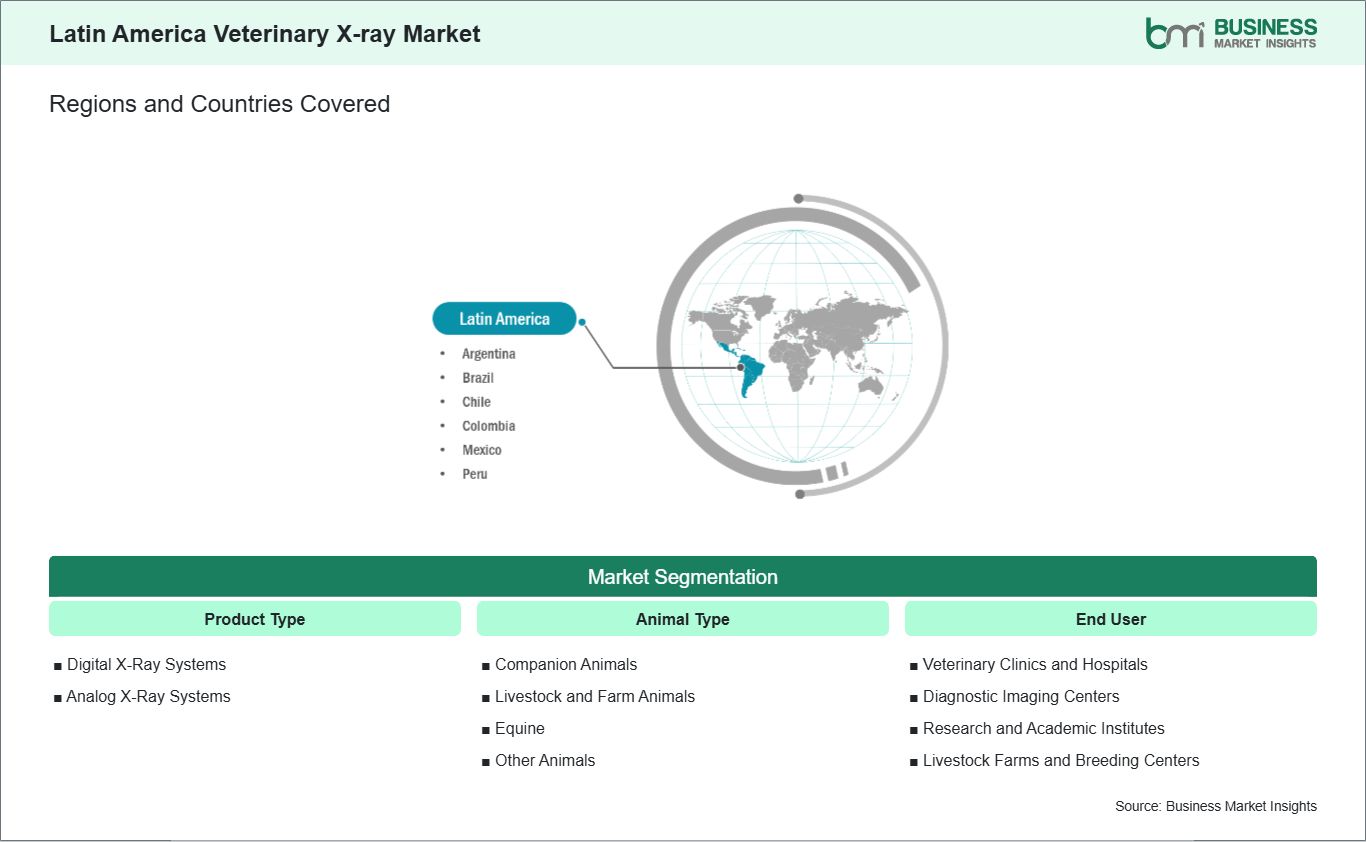
Key segments that contributed to the derivation of the Latin America veterinary x-ray market analysis are product type, animal type, and end user.
The veterinary x-ray market in Latin America has been growing substantially due to an increase in the demand for efficient and accurate diagnostic tools throughout the region; as a result of increasing urbanization, more people are purchasing dogs for companionship, which has also led to an increase in veterinary clinics upgrading their imaging technology. Additionally, with the increasing awareness of the benefits of preventative health care for all animals, both companion and production animals, veterinarians have been investing in more advanced x-ray systems that will allow them to detect conditions such as bone fractures, tumors, and internal anomalies earlier than before.
As economies grow and disposable incomes rise in countries such as Brazil and Chile, pet owners are looking for high-quality veterinary services and this includes modern diagnostic services; essentially clinics have begun placing greater emphasis on digital/portable x-ray systems that improve the accuracy of their imaging and increase the efficiency of their workflow. Smaller veterinary clinics have found compact portable x-ray systems to be especially attractive as they produce results faster and take up less space.
In addition to the use of technology, many manufacturers have supported the growth of this industry by providing user-friendly interfaces and integrated imaging software that is specifically designed for regional use. In addition to this, training programs developed in conjunction with veterinary associations will help ensure that the systems are properly used, develop trust in the use of veterinary x-ray diagnostics, and promote greater acceptance and use of these systems throughout Latin America.
The integration of AI into veterinary imaging in Latin America has the potential to grow tremendously. AI-enabled X-ray systems allow the veterinarian to analyze images in real-time, thus improving diagnostic accuracy of bone fractures, joint disorders, and soft tissue disorders. The reduction of human error and the acceleration of clinical decision-making through these systems enables clinics to provide faster and more reliable clinical care to a variety of both companion and farm animals.
AI-enabled mobile and portable X-ray systems are especially valuable in such places as rural Colombia, Peru, and Mexico where veterinary facilities are limited in equipment. Field practitioners can obtain high-quality diagnostic images and benefit from AI-assisted analysis in real-time which allows for better treatment planning for livestock and working animals via the delivery of care. Increased availability of veterinary services expands access to care for both types of animals and allows clinics that provide advanced diagnosis to differentiate themselves from competitors.
Additional benefits to this integration involve improvement of digital record keeping and image management so veterinarians can track the effectiveness of treatment and maintain thorough patient history files. As more veterinary practices convert to cloud-based and AI-supported solutions, the Latin American veterinary X-ray market is expected to continue to grow sustainably due to improved efficiency, enhanced clinical outcomes, and greater patient satisfaction.

The Latin America veterinary x-ray market demonstrates steady growth, with size and share analysis highlighting evolving trends and competitive dynamics among key players. The report examines subsegments categorized within product type, animal type, and end user, offering insights into their contribution to overall market performance.
By product type, the digital x-ray systems subsegment dominated the market in 2025, driven by its enhanced image quality, faster processing time, and growing adoption in modern veterinary practices.
Based on animal type, the companion animals subsegment dominated the market in 2025, driven by increasing pet ownership and rising demand for advanced diagnostic imaging in routine veterinary care.
In terms of end user, the veterinary clinics and hospitals subsegment dominated the market in 2025, driven by the widespread adoption of x-ray systems for comprehensive diagnostic and treatment services.
| Report Attribute | Details |
|---|---|
| Market size in 2025 | US$ 87.7 Million |
| Market Size by 2033 | US$ 135.1 Million |
| CAGR (2026 - 2033) | 5.6% |
| Historical Data | 2022-2024 |
| Forecast period | 2026-2033 |
| Segments Covered | By Product Type
|
|
Regions and Countries Covered
| |
| Latin America | Mexico, Brazil, Argentina, Peru, Chile, Colombia |
| Market leaders and key company profiles |
|
The "Latin America Veterinary X-ray Market Size and Forecast (2022–2033)" report provides a detailed analysis of the market covering below areas:
The geographical scope of the Latin America Veterinary X-ray Market report is divided into Mexico, Brazil, Argentina, Peru, Chile, and Colombia. The Brazil held the largest share in 2025.
Brazil is the leading player in the Latin American veterinary radiography market primarily due to a large and mature veterinary infrastructure, a significant number of companion animals, and a well-established livestock industry. The country shows significant levels of both digital and portable X-ray system adoption, which has been supported by substantial rural investment in animal health and advanced diagnostic technology. In addition, the fact that Brazil has one of the largest numbers of veterinary clinics, universities, and research centres in the region only helps enhance the demand within the market — making it the largest contributor of sales in the region. Mexico is next in line as a major developing market; recent history has shown substantial growth in the number of urban veterinary clinics and an increasing level of awareness amongst pet owners regarding the benefits of diagnostic imaging.
Although the primary demand for veterinary X-ray solutions remains concentrated in major cities, there is a gradual trend of increasing demand for these systems in many emerging regions due to their growing commitment to improving the health of companion animals. Argentina is also enjoying consistent growth due to a combination of increasing livestock management practices and a growing interest in preventive healthcare services for companion animals; however, the penetration of modern X-ray modalities remains relatively low in rural areas of Argentina. Peru is projected to provide moderate growth in terms of the expected demand for veterinary imaging, as this is largely spurred by urban pet owners and small producers of livestock.
However, insufficient budgetary means among veterinary clinics and inadequate access to advanced diagnostic technology has prevented widespread adoption of these systems. Overall, Chile provides moderate but continued growth potential in this market.

The Latin America Veterinary X-ray Market is evaluated by gathering qualitative and quantitative data post primary and secondary research, which includes important corporate publications, association data, and databases. A few of the key developments in the Latin America veterinary x-ray market are:
The Latin America Veterinary X-ray Market is valued at US$ 87.7 Million in 2025, it is projected to reach US$ 135.1 Million by 2033.
As per our report Latin America Veterinary X-ray Market, the market size is valued at US$ 87.7 Million in 2025, projecting it to reach US$ 135.1 Million by 2033. This translates to a CAGR of approximately 5.6% during the forecast period.
The Latin America Veterinary X-ray Market report typically cover these key segments-
The historic period, base year, and forecast period can vary slightly depending on the specific market research report. However, for the Latin America Veterinary X-ray Market report:
The Latin America Veterinary X-ray Market is populated by several key players, each contributing to its growth and innovation. Some of the major players include:
The Latin America Veterinary X-ray Market report is valuable for diverse stakeholders, including:
Essentially, anyone involved in or considering involvement in the Latin America Veterinary X-ray Market value chain can benefit from the information contained in a comprehensive market report.
Please tell us your area of interest
(Market Segments/ Regions and Countries/ Companies)