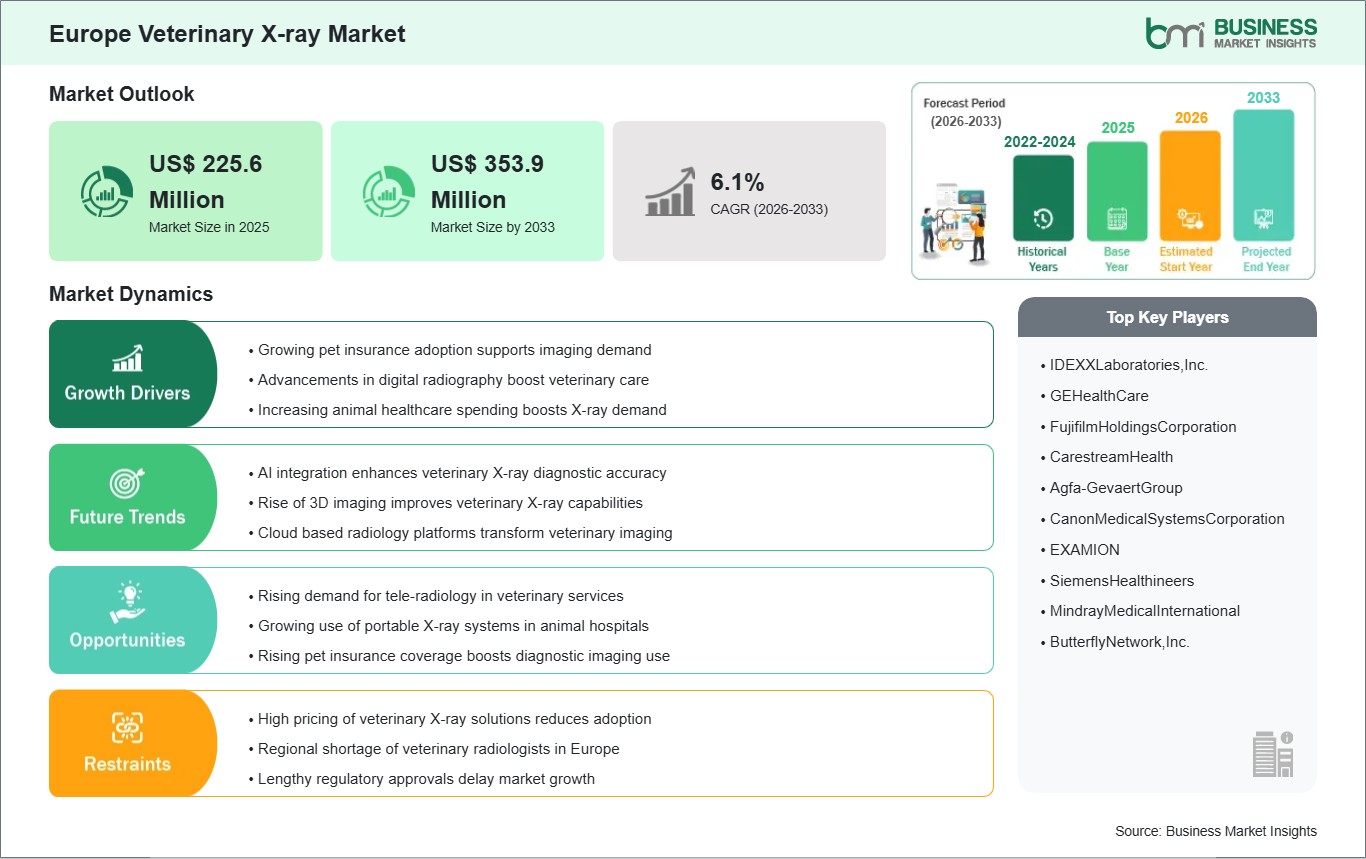
The Europe veterinary x-ray market size is expected to reach US$ 353.9 million by 2033 from US$ 225.6 million in 2025. The market is estimated to record a CAGR of 6.1% from 2026 to 2033.
The Europe veterinary X-ray market reflects a well-established and innovation-driven landscape, supported by advanced veterinary healthcare systems and a strong cultural emphasis on animal welfare. The region demonstrates widespread integration of diagnostic imaging within routine veterinary practice, with X-ray systems serving as a core diagnostic modality across companion animal clinics, equine facilities, and livestock healthcare settings. The presence of structured veterinary networks, referral centers, and academic institutions contributes to a high level of clinical sophistication, reinforcing consistent demand for both stationary and portable X-ray solutions. A primary driver of market growth in Europe is the increasing prioritization of preventive and precision-based veterinary care. Pet ownership trends across key countries such as Germany, the United Kingdom, and France have evolved toward greater emotional attachment and higher willingness to invest in advanced medical services. This shift has led to a greater reliance on diagnostic imaging for early disease detection and treatment planning. In parallel, the livestock sector—particularly in countries with strong agricultural output—utilizes X-ray imaging to support herd health management, biosecurity, and productivity optimization. These dual demand streams from companion and production animals collectively sustain market expansion. T
echnological advancement is another critical factor shaping the European market. Veterinary practices are progressively transitioning from analog systems to digital radiography, driven by the need for improved image clarity, faster processing times, and streamlined data management. Integration with practice management software and remote consultation capabilities further enhances clinical efficiency and supports collaborative diagnostics. Additionally, equipment manufacturers are focusing on ergonomic designs and mobile solutions, enabling veterinarians to deliver imaging services in diverse settings, including field environments and large animal facilities.
Despite these positive drivers, certain constraints continue to influence market dynamics. The high upfront investment required for advanced X-ray systems poses a challenge, particularly for small and independent clinics with limited capital resources. While financing and leasing options are available in some markets, access remains uneven across the region.
Furthermore, disparities in economic development and healthcare infrastructure between Western and Eastern Europe result in varying adoption rates, with some areas still reliant on legacy imaging systems. Another limiting factor is the need for specialized training to effectively operate and interpret advanced imaging technologies. In regions where access to continuous professional development is limited, this can slow the transition toward more sophisticated diagnostic practices. The Europe veterinary X-ray market is defined by technological maturity, strong clinical integration, and high standards of animal care, balanced by cost considerations and regional variability in infrastructure and expertise.

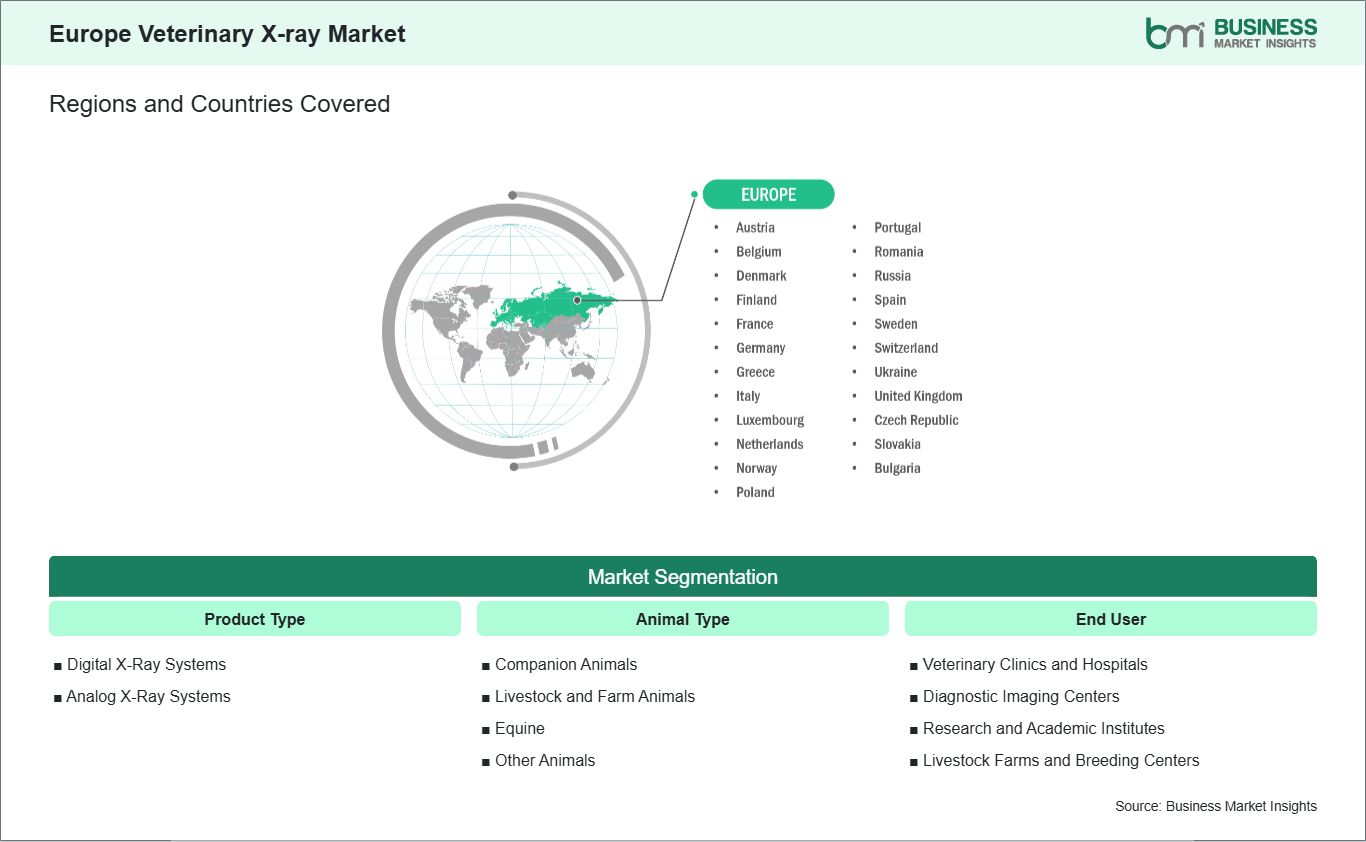
Key segments that contributed to the derivation of the Europe veterinary x-ray market analysis are product type, animal type, and end user.
Growth in the veterinary X-ray market across Europe is steady due to the ongoing rise in popularity of pet insurance in major European markets like the UK, Germany and Sweden, making it easier for pet owners to afford access to advanced diagnostic procedures (such as X-ray imaging) without the burden of high costs. This has encouraged more frequent veterinary visits and an increased acceptance of imaging being a standard part of providing both preventative care and diagnosis-related types of care. As a result, veterinary practices are expanding their imaging capabilities to meet the increased expectations of clients on the availability of high-quality medical care.
The humanisation of pets in Western Europe has also led to increased spending on animal health care by owners who want early diagnosis and comprehensive treatment options. The increase in humanisation has heightened demand for accurate imaging technology to help provide an accurate clinical diagnosis. To this end, veterinary practices are investing in fully digital radiography systems that have the capability to produce images in a less amount of time, and with greater quality when compared to traditional systems.
The established veterinary infrastructure will also help to ensure continued and consistent adoption of advanced diagnostic imaging technology. As pet insurance continues to proliferate in the market and more people become aware of the importance of preventative veterinary care, demand for veterinary X-ray systems is projected to remain strong across Europe.
With demand rising for tele-radiology more veterinary clinics are using remote imaging solutions for medical service expansion with remote veterinary radiologist services to use outside veterinary service providers by sending images from their clinics to radiologist for quick reporting, which improves patient outcomes by providing quicker diagnosis and decreasing time to treat decisions. Tele-radiology services will continue to be an important tool in the evolution of veterinary medicine and health care in all parts of Europe.
Additionally, the rapid transformation of digital technologies within the veterinary industry continues to facilitate the use of tele-radiology by providing web-based technology and comprehensive veterinary imaging software solutions that provide easy access to and shares images with other veterinary health care providers. These technologies allow general veterinary practitioners to work collaboratively with the various specialists helping to better manage the delivery of care and improve animal health. Additionally, advances in image processing capabilities and software will provide even more improved quality and usability features for x-ray images sent via tele-radiology.
The expansion of mobile veterinarians providing services in more rural and remote areas in Europe also impacts the growth of tele-radiology. Mobile veterinarians use portable x-ray machines along with tele-radiology systems allowing them to get timely diagnoses to animal patients in field settings. As technology improves and communication becomes easier, using tele-radiology will continue to play a vital role in improving access to advanced veterinary services.
The Europe veterinary x-ray market demonstrates steady growth, with size and share analysis highlighting evolving trends and competitive dynamics among key players. The report examines subsegments categorized within product type, animal type, and end user, offering insights into their contribution to overall market performance.
By product type, the digital x-ray systems subsegment dominated the market in 2025, driven by its enhanced image quality, faster processing time, and growing adoption in modern veterinary practices.
Based on animal type, the companion animals subsegment dominated the market in 2025, driven by increasing pet ownership and rising demand for advanced diagnostic imaging in routine veterinary care.
In terms of end user, the veterinary clinics and hospitals subsegment dominated the market in 2025, driven by the widespread adoption of x-ray systems for comprehensive diagnostic and treatment services.
| Report Attribute | Details |
|---|---|
| Market size in 2025 | US$ 225.6 Million |
| Market Size by 2033 | US$ 353.9 Million |
| CAGR (2026 - 2033) | 6.1% |
| Historical Data | 2022-2024 |
| Forecast period | 2026-2033 |
| Segments Covered | By Product Type
|
|
Regions and Countries Covered
| |
| Europe | Belgium, Austria, Finland, Denmark, Greece, Poland, Romania, Russia, Ukraine, Czech Republic, Slovakia, Bulgaria, Italy, Luxembourg, Germany, Switzerland, France, Netherlands, Norway, Portugal, Spain, Sweden, United Kingdom |
| Market leaders and key company profiles |
|
The "Europe Veterinary X-ray Market Size and Forecast (2022–2033)" report provides a detailed analysis of the market covering below areas:
The geographical scope of the Europe Veterinary X-ray Market report is divided into Belgium, Austria, Finland, Denmark, Greece, Poland, Romania, Russia, Ukraine, the Czech Republic, Slovakia, Bulgaria, Italy, Luxembourg, Germany, Switzerland, France, the Netherlands, Norway, Portugal, Spain, Sweden, and the UK. The Germany held the largest share in 2025.
Germany is the largest player in the European veterinary X-ray market, due largely to its advanced veterinary care system, strong clinical research base, and early implementation of more advanced images like digital and portable X-ray systems. The concentration of veterinary specialty hospitals, research universities and skilled veterinarians creates a situation where demand for diagnostic imaging products remains constant and Germany leads in innovation and revenue contribution from veterinary diagnostic imaging products.
Other major markets are France and the United Kingdom, where a large network of veterinarians, high number of pets, and a continuing need for accurate and timely diagnostic tools will contribute to growth in demand for diagnostic imaging products. The Netherlands, Switzerland, and Sweden have experienced an increasing number of advanced technology systems due to high levels of animal welfare and efforts to improve the efficiency of clinical work flows.
Countries in Southern Europe, including Spain, Italy, and Portugal, are seeing growth in their markets due in part to improving veterinary systems and a greater awareness of preventive care for animals; however, there are differences in market acceptance of diagnostic imaging products between urban and rural veterinarians. Belgium, Austria, and Denmark have a stable market in Northern and Western Europe and will continue to regularly integrate imaging technology into daily veterinary practice, while Finland and Norway demonstrate similar levels of integration.

The Europe Veterinary X-ray Market is evaluated by gathering qualitative and quantitative data post primary and secondary research, which includes important corporate publications, association data, and databases. A few of the key developments in the Europe veterinary x-ray market are:
The Europe Veterinary X-ray Market is valued at US$ 225.6 Million in 2025, it is projected to reach US$ 353.9 Million by 2033.
As per our report Europe Veterinary X-ray Market, the market size is valued at US$ 225.6 Million in 2025, projecting it to reach US$ 353.9 Million by 2033. This translates to a CAGR of approximately 6.1% during the forecast period.
The Europe Veterinary X-ray Market report typically cover these key segments-
The historic period, base year, and forecast period can vary slightly depending on the specific market research report. However, for the Europe Veterinary X-ray Market report:
The Europe Veterinary X-ray Market is populated by several key players, each contributing to its growth and innovation. Some of the major players include:
The Europe Veterinary X-ray Market report is valuable for diverse stakeholders, including:
Essentially, anyone involved in or considering involvement in the Europe Veterinary X-ray Market value chain can benefit from the information contained in a comprehensive market report.
Please tell us your area of interest
(Market Segments/ Regions and Countries/ Companies)