Market Summary
Executive Summary and Market Analysis
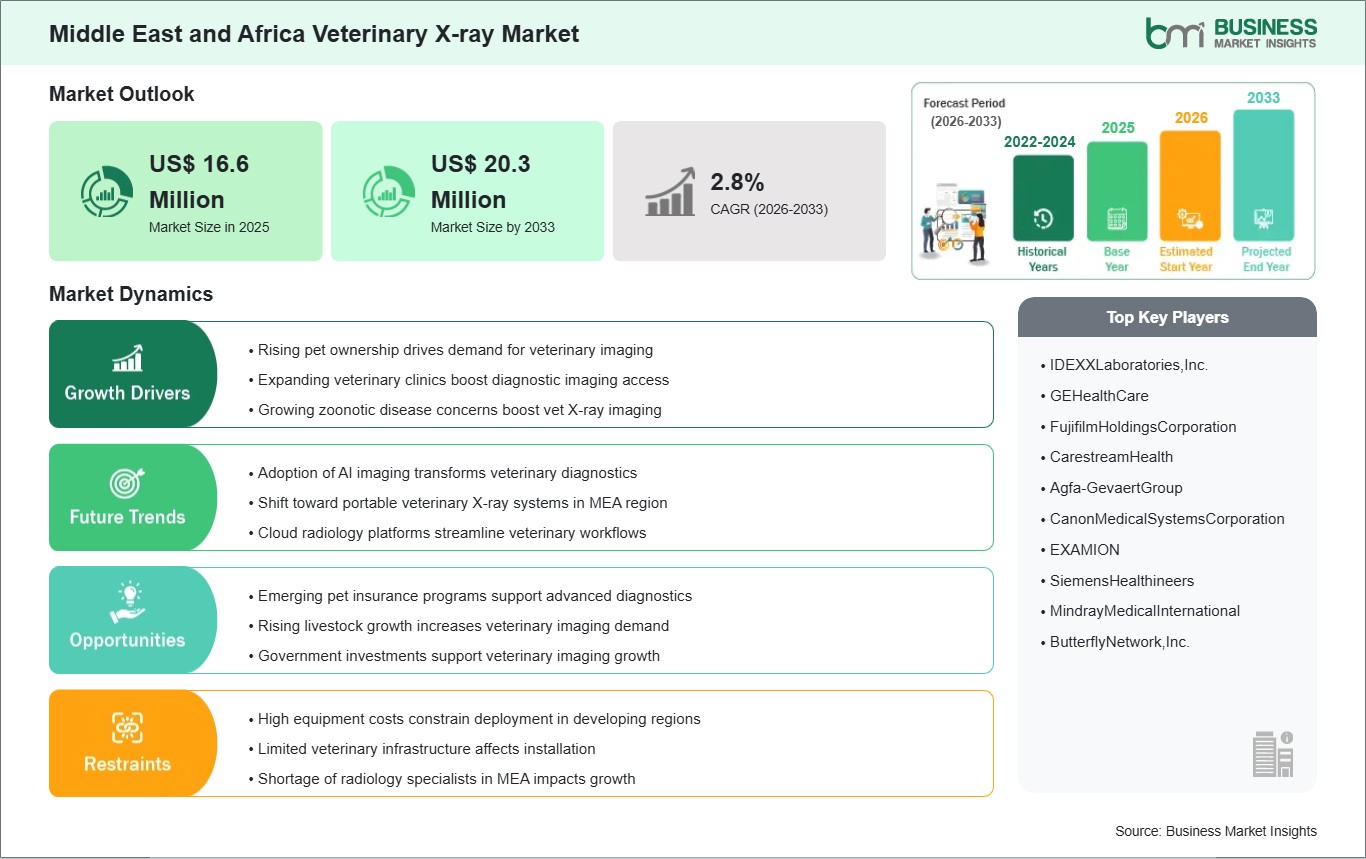
The Middle East and Africa veterinary X‑ray market is marked by a landscape of emerging opportunities and uneven development across countries, shaped by diverse economic profiles, animal health priorities, and healthcare infrastructure maturity. In many parts of the Middle East, rapid urbanization, rising standards of living, and growing awareness of companion animal healthcare are driving broader investment in veterinary services. In contrast, large portions of Africa are still in early stages of structured veterinary care adoption, with diagnostic imaging often concentrated in major metropolitan centers and specialized institutions. Despite this variability, there is a clear trend toward increased recognition of the value of diagnostic imaging, particularly X‑ray systems, in both companion and livestock animal care.
One of the primary factors driving this market is the expanding emphasis on improving clinical outcomes for pets and performance animals. In affluent markets such as the Gulf Cooperation Council (GCC) countries, pet owners are increasingly willing to seek advanced diagnostic care for conditions ranging from orthopedic injuries to complex internal health concerns. Veterinary practices in these markets are progressively upgrading their diagnostic capabilities, with X‑ray imaging serving as a critical tool for accurate assessment and treatment planning. Additionally, the growing equine and performance animal sectors in parts of the Middle East emphasize the need for reliable imaging technologies to support competitive and preventive health management.
Across Africa, the driving forces for market growth include rising livestock health initiatives and expanding veterinary educational programs. As governments and private sector stakeholders recognize the economic importance of healthy livestock populations, there is greater interest in adopting diagnostic solutions that can improve herd health management and mitigate disease impact. Veterinary X‑ray systems are increasingly valued in university clinics and larger diagnostic centers, where they enhance clinical teaching and support evidence‑based treatment. Professional training efforts, often supported by international partnerships, are also contributing to a gradual shift in clinical practice toward more comprehensive diagnostic approaches. Despite these growth dynamics, the market faces several notable restraints. Cost remains a significant barrier, particularly for small veterinary practices and rural facilities with limited financial resources. Advanced digital X‑ray systems represent a substantial investment, and many clinics must prioritize more immediate operational needs over diagnostic upgrades.
In addition, inconsistent access to reliable servicing, maintenance support, and technical expertise can deter the adoption of sophisticated imaging technologies, especially in remote or under‑resourced regions. Infrastructure challenges such as irregular power supply and limited distribution networks for medical equipment further complicate market penetration. Another restraint is the competitive presence of lower‑cost diagnostic alternatives, such as portable ultrasound units, which are often perceived as more versatile or accessible for basic clinical needs. In regions where veterinary healthcare resources are constrained, the preference for multifunctional equipment can limit the specific uptake of dedicated X‑ray systems.
Moreover, regulatory complexities and varying animal healthcare policies across countries in the Middle East and Africa present additional hurdles for consistent market growth. The Middle East and Africa veterinary X‑ray market is at an early but evolving stage, characterized by pockets of advanced demand, especially in affluent urban and performance animal segments, juxtaposed with gradual modernization in emerging and rural veterinary settings. While cost, infrastructure, and technical support constraints temper rapid expansion, ongoing awareness of diagnostic value and investment in veterinary capacity building are shaping a trajectory toward broader adoption of imaging technologies.
Segment Analysis
Middle East and Africa Veterinary X-ray Market Segmentation
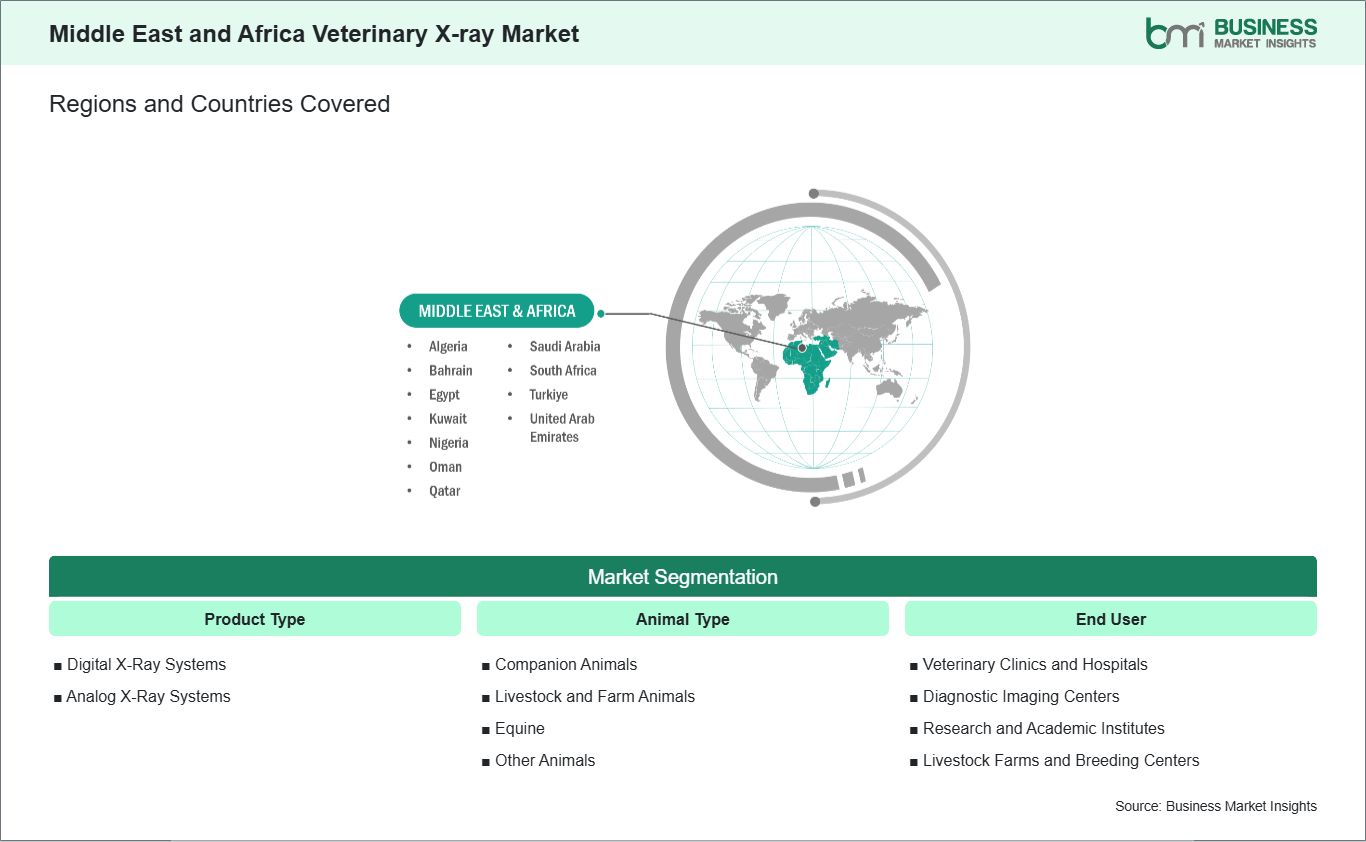
Key segments that contributed to the derivation of the Middle East and Africa veterinary x-ray market analysis are product type, animal type, and end user.
- By product type, the veterinary x-ray market is segmented into digital x-ray systems, analog x-ray systems. The digital x-ray systems segment dominated the market in 2025.
- Based on animal type, the veterinary x-ray market is categorized into companion animals, livestock and farm animals, equine, other animal types. The companion animals segment dominated the market in 2025.
- In terms of end user, the veterinary x-ray market is categorized into veterinary clinics and hospitals, diagnostic imaging centers, research and academic institutes, livestock farms and breeding centers. The veterinary clinics and hospitals segment dominated the market in 2025.
Market Forces
Middle East and Africa Veterinary X-ray Market Drivers and Opportunities
Rising pet ownership drives demand for veterinary imaging
The veterinary X-ray market in the Middle East and Africa is driven by an increase in pet ownership as family members in both emerging cities and established urban centers. Parents in the United Arab Emirates, Saudi Arabia and South Africa are willing to spend more on their pets’ health as they care about their well-being, so they will visit veterinarians more often. As a result, there has been a dramatic increase in the demand for diagnostic imaging services, with an emphasis on X-ray systems. To take advantage of this trend, veterinary practices are investing in more advanced imaging systems in order to meet the growing number of requests from clients.
The demand for diagnostic imaging in the Middle East and Africa region is also being driven by the number of livestock in the region. Therefore, many governments and private farms are developing better animal health care protocols to reduce the number of disease outbreaks across Egypt, Kenya and Morocco. Animal health is now critical to both food security and productivity of agriculture; thus, veterinary clinics are using diagnostic imaging as a key component of their operations.
Many urban veterinary clinics are incorporating X-ray technology into their routine protocols for all areas of animal care, but especially for evaluating orthopaedic and respiratory issues. The price of portable digital X-ray products is now falling fast, and therefore, small veterinary clinics are upgrading from analogue to digital methods of imaging. This shift helps the entire industry improve its veterinary practices through the use of better diagnostic imaging tools.
Emerging pet insurance programs support advanced diagnostics
In the Middle East and Africa, new pet insurance options are providing the veterinary X-ray industry with the means to overcome cost barriers to the use of advanced diagnostic methods. Though pet insurance is still at an early stage in these regions when compared to established markets, some countries (e.g., the UAE and South Africa) are beginning to introduce plans that include diagnostic procedures covered under the new pet insurance plans. Increased access to X-ray imaging for pet owners will lead to more frequent usage of X-ray imaging as part of preventive care and treatment planning.
The continued increase in insurance coverage will also allow veterinary clinics to recommend comprehensive diagnostic evaluation without putting an unreasonable amount of financial burden on their clients. This is particularly important in urban markets where pet owners are expecting more from their pets’ healthcare. Clinics in both Dubai and Johannesburg have been steadily implementing digital X-ray technologies to provide accurate diagnostics to the increasing number of pet owners seeking high-quality services covered by pet insurance.
In addition, the existence of insurance products that include diagnostic coverage is driving the development of modern imaging infrastructure. Smaller veterinary practices in developing regions are considering investing in portable X-ray systems that are cost-effective and flexible. As the availability of pet insurance expands, the demand for modern diagnostic imaging equipment is expected to grow, which will allow for the increased adoption of X-ray imaging throughout the veterinary community.
Size and Share Analysis
Middle East and Africa Veterinary X-ray Market Size and Share Analysis
The Middle East and Africa veterinary x-ray market demonstrates steady growth, with size and share analysis highlighting evolving trends and competitive dynamics among key players. The report examines subsegments categorized within product type, animal type, and end user, offering insights into their contribution to overall market performance.
By product type, the digital x-ray systems subsegment dominated the market in 2025, driven by its enhanced image quality, faster processing time, and growing adoption in modern veterinary practices.
Based on animal type, the companion animals subsegment dominated the market in 2025, driven by increasing pet ownership and rising demand for advanced diagnostic imaging in routine veterinary care.
In terms of end user, the veterinary clinics and hospitals subsegment dominated the market in 2025, driven by the widespread adoption of x-ray systems for comprehensive diagnostic and treatment services.
Report Coverage
Middle East and Africa Veterinary X-ray Market Report Coverage and Deliverables
The "Middle East and Africa Veterinary X-ray Market Size and Forecast (2022–2033)" report provides a detailed analysis of the market covering below areas:
- Middle East and Africa Veterinary X-ray Market size and forecast at global, regional, and country levels for all the key market segments covered under the scope
- Middle East and Africa Veterinary X-ray Market trends, as well as drivers, restraints, and opportunities
- Middle East and Africa Veterinary X-ray Market analysis covering key trends, global and regional framework, major players, regulations, and recent developments
- Industry landscape and competition analysis covering market concentration, heat map analysis, prominent players, and recent developments for the Middle East and Africa Veterinary X-ray Market
- Detailed company profiles, including SWOT analysis
Geographic Insights
Middle East and Africa Veterinary X-ray Market Geographic Insights
The geographical scope of the Middle East and Africa Veterinary X-ray Market report is divided into Turkiye, the UAE, Saudi Arabia, Bahrain, Oman, Egypt, South Africa and Africa, Algeria, Nigeria, Kuwait, and Qatar. The Turkiye held the largest share in 2025.
There is a divergence of the veterinary X-ray market in Middle Eastand Africa, and Turkiye is the leader in the region due to its combination of high levels of demand for advanced diagnostic services; the sheer number and diversity of animals in the country; the well-developed infrastructure supporting veterinary clinics and animal hospitals; and a well-developed referral system. High levels of investment in the veterinary infrastructure support the increased use of digital and portable X-ray machines for routine diagnostics, orthopedic evaluations, and preventative health programs for both companion animals and livestock; the positioning of Turkiye as a hub of Europe and the Middle East further strengthens its position as an exporter to technology and service providers.
The veterinary X-ray market will have similar dynamics in the United Arab Emirates (UAE) and Saudi Arabia since these countries are experiencing greater demand for high-quality animal healthcare and increasing focus on pet wellness. Increasing disposable income and the presence of the multinational veterinary groups will expedite the adoption of digital radiography in these countries. Even though the markets are smaller than Turkiye, they also have high disposable income; therefore, the difference in population and clinic density is the primary factor accounting for the considerable difference in market size. Bahrain, Oman, and Qatar are other smaller but growing markets for the veterinary x-ray market; investment in animal health is incrementally increasing.
Industry Activity
Recent Developments
The Middle East and Africa Veterinary X-ray Market is evaluated by gathering qualitative and quantitative data post primary and secondary research, which includes important corporate publications, association data, and databases. A few of the key developments in the Middle East and Africa veterinary x-ray market are:
- In September 2025, FUJIFILM Corporation, announced that it will open its first “NURA” health screening center in Cape Town, South Africa, and also establish a center in Dubai, UAE, expanding health screening services across the Middle East and Africa region, using advanced diagnostic devices.
- In February 2026, OR Technology and Hallmarq Veterinary Imaging, announced that they joined forces to build a global multimodality imaging group, combining their veterinary imaging portfolios (including digital X‑ray systems) with broader imaging technologies. This newly formed group expands its market access and capabilities across Europe, Middle East & Africa (MEA), and North America, strengthening technology and distribution reach across those regions.
Trust & Transparency
Research Methodology
The market analysis combines proprietary research with secondary data from government agencies, company disclosures, regulatory filings, industry databases and expert interviews. Market estimates are validated through data triangulation, cross-market benchmarking and analyst
review.
View Full Research Methodology
Key Sources Referred:
American College of Veterinary Radiology (ACVR) World Small Animal Veterinary Association (WSAVA) British Veterinary Association (BVA) International Veterinary Radiology Association (IVRA) American Veterinary Medical Association (AVMA) European College of Veterinary Diagnostic Imaging (ECVDI) World Organisation for Animal Health (WOAH / OIE) Veterinary Imaging & Radiation Oncology Society (VIROS)