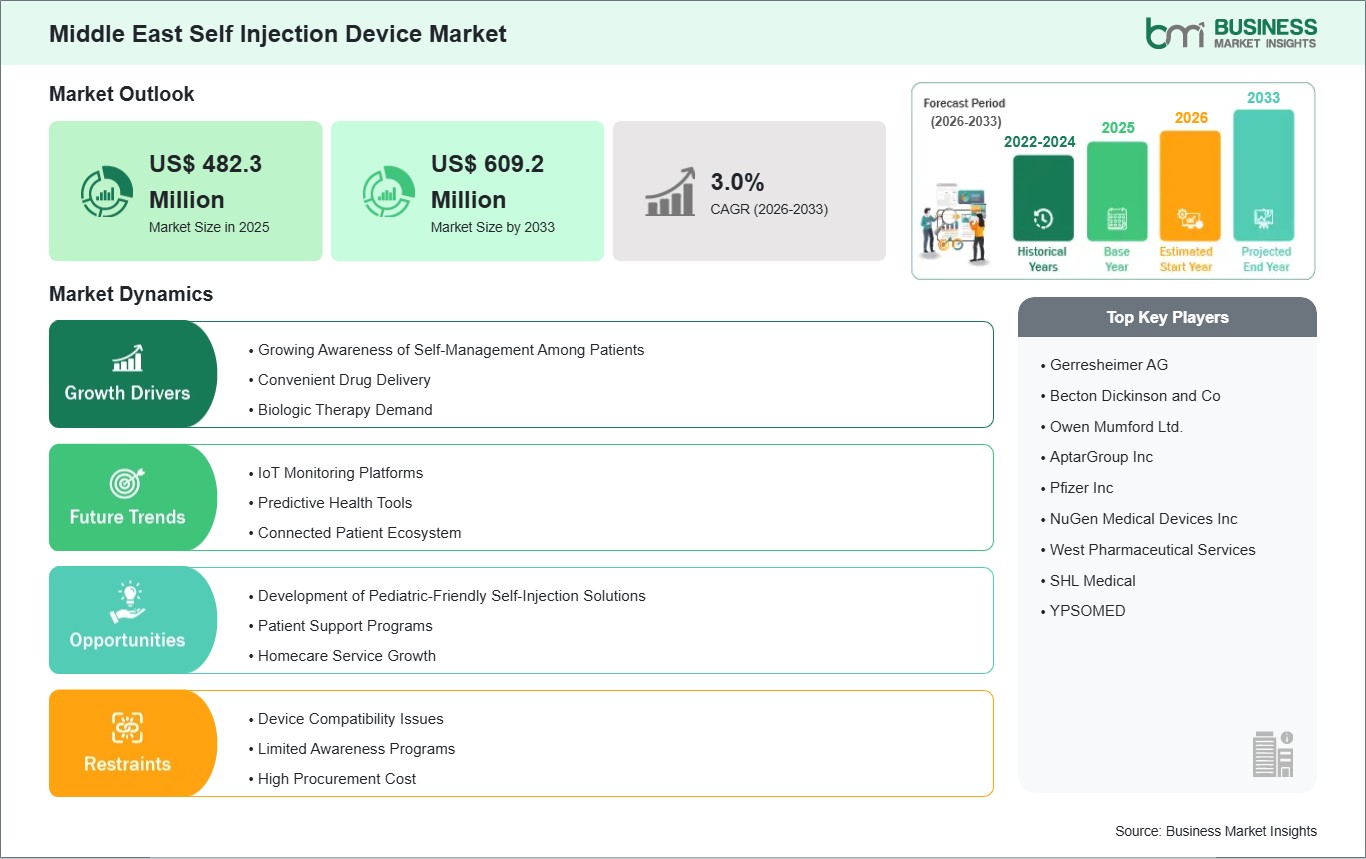
The Middle East Self Injection Device Market size is expected to reach US$ 609.2 million by 2033 from US$ 482.3 million in 2025. The market is estimated to record a CAGR of 3.0 % from 2026 to 2033.
The Middle East self-injection device market is evolving rapidly as regional healthcare systems prioritize decentralized care, chronic disease management, and patient autonomy. Persistently high prevalence rates of diabetes, autoimmune conditions, and growth in specialty biologic therapies have compelled healthcare providers, payers, and policymakers to integrate self-administration devices such as autoinjectors, prefilled pens, and wearable delivery systems into treatment paradigms. Governments in the Gulf Cooperation Council (GCC), notably Saudi Arabia and the UAE, are scaling investments in chronic care infrastructure and implementing regulatory reforms that streamline approval pathways for combination drug-device products, reflecting broader commitments to enhancing patient outcomes and easing clinical burdens.
Multichannel distribution frameworks are emerging, as traditional hospital tenders, retail pharmacy networks, and digital pharmacy platforms expand reach, while telemedicine platforms support remote patient education and post-prescription care. Competitive dynamics involve multinational manufacturers, regional distributors, and strategic alliances that emphasize supply continuity, clinician engagement programs, and localized training resources to build confidence in self-injection adoption. Operational challenges persist; regional heterogeneity in reimbursement frameworks means price sensitivity can impede device uptake in non-GCC and lower-coverage markets.
Countries where insurance penetration remains limited face slower adoption curves, requiring manufacturers to deploy tiered pricing strategies or co-development partnerships with public health systems. Physician and patient education efforts are increasingly regarded as key differentiators, with successful market entrants investing in technique training, adherence programs, and digital support tools to reduce administration errors and improve long-term outcomes. Market analysis indicates that sustainable adoption will depend on aligning device portfolios with regional healthcare priorities, including enhanced digital support, regulatory compliance, and value-based care outcomes.

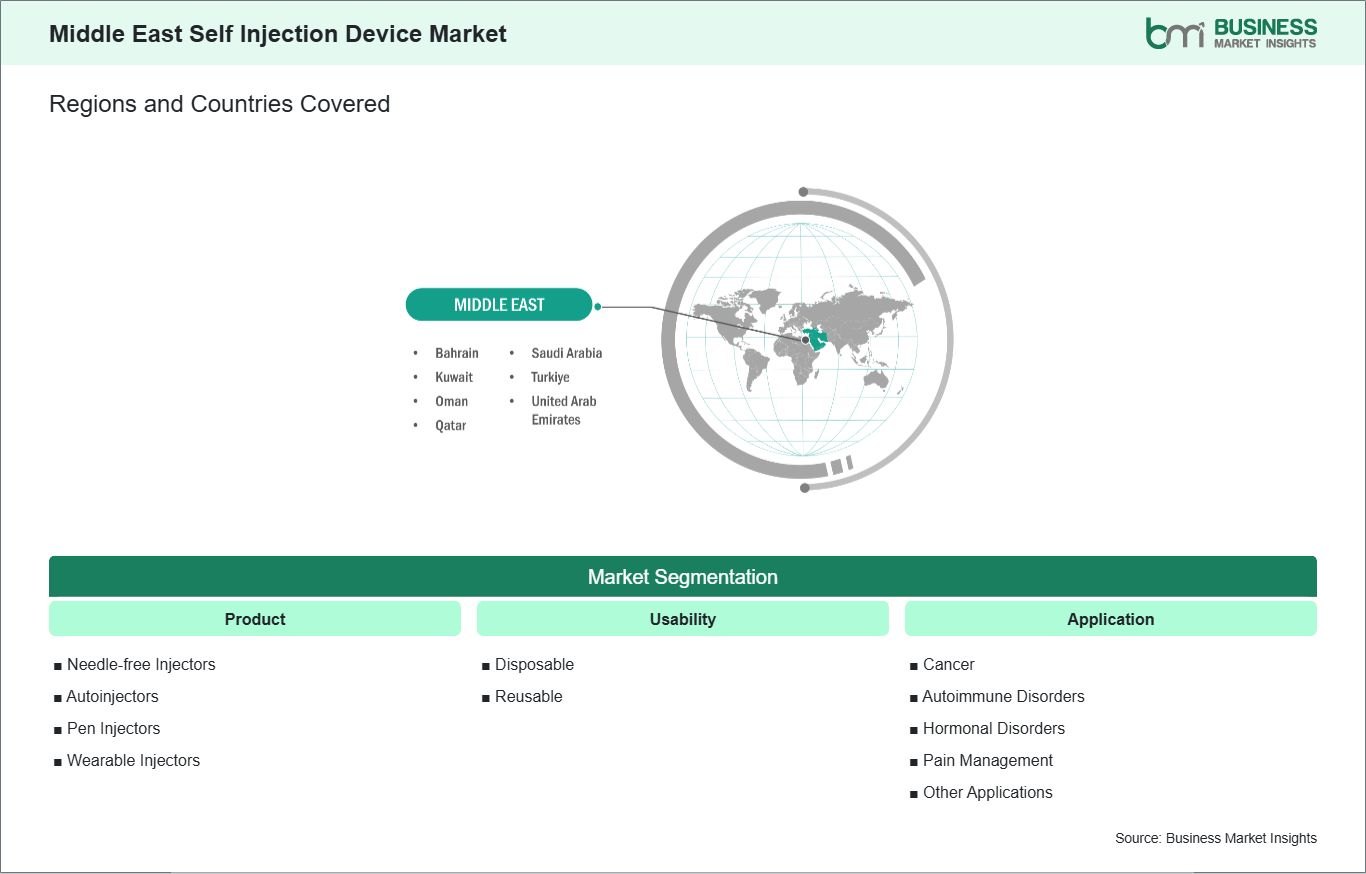
Key segments that contributed to the derivation of the Middle East self injection device market analysis are product, usability, and application.
Across the Middle East, patient awareness of self-management is increasing as healthcare systems place greater emphasis on chronic disease control and preventive care. The rising prevalence of diabetes, autoimmune disorders, and hormonal conditions has encouraged patients to take a more active role in managing long-term therapies. Educational campaigns led by hospitals, pharmacies, and digital health platforms are improving patient understanding of self-injection techniques, safety, and adherence. As a result, self-injection devices are increasingly viewed as empowering tools. Urbanization and high smartphone penetration in the Middle East have also played a major role in shaping patient behavior.
Patients now have greater access to online educational resources, instructional videos, and virtual consultations that reinforce correct self-injection practices. This digital exposure has reduced fear associated with injectable therapies and increased confidence in home administration. In parallel, pharmacies and outpatient clinics frequently offer structured onboarding sessions for patients initiating injectable treatments, supporting sustained adherence and correct device usage. Cultural shifts are further reinforcing self-management trends. Busy lifestyles, frequent travel, and work commitments make repeated clinic visits inconvenient for many patients. Self-injection devices enable flexible treatment schedules while maintaining clinical effectiveness.
For elderly patients and those with mobility limitations, self-administration also reduces dependence on caregivers and healthcare facilities. Overall, growing awareness of self-management in the Middle East is accelerating the adoption of self-injection devices and reshaping chronic disease care toward a more patient-centered model.
Pediatric care is emerging as an important focus area in the Middle East self-injection device market, driven by rising diagnosis rates of pediatric diabetes, growth hormone deficiencies, and autoimmune conditions. Children requiring long-term injectable therapy present unique challenges, including fear of needles, anxiety, and reliance on caregivers. To address this challenge, manufacturers are developing pediatric-friendly self-injection solutions designed to reduce pain perception and simplify administration. Devices with hidden needles, shorter injection times, and quieter mechanisms are gaining attention among pediatric specialists.
Healthcare providers in the Middle East increasingly recognize the importance of early treatment adherence in pediatric populations. Pediatric-friendly devices often feature colorful designs, smaller form factors, and intuitive operation to make injections less intimidating. These features help reduce treatment resistance and improve long-term outcomes. Training programs aimed at parents and caregivers emphasize proper technique, storage, and emotional reassurance, ensuring that home administration is both safe and stress-free. Hospitals and specialty clinics are playing a key role in introducing these devices during early treatment stages.
The development of pediatric self-injection solutions also aligns with broader healthcare goals in the Middle East, including improved quality of life and reduced hospital dependency. Devices that allow children to receive therapy at home minimize school disruptions and reduce the emotional burden of frequent clinic visits. As awareness grows among caregivers and healthcare professionals, demand for child-specific injection solutions is expected to increase

The Middle East Self Injection Device Market demonstrates steady growth, with size and share analysis highlighting evolving trends and competitive dynamics among key players. The report examines subsegments categorized within product, usability, and application, offering insights into their contribution to overall market performance.
By product, the needle-free Injectors subsegment dominated the market in 2025, driven by increasing adoption of advanced injection technologies that improve patient comfort and adherence.
Based on usability, the disposable subsegment dominated the market in 2025, driven by healthcare systems' emphasis on infection control and reduced device handling.
In terms of application, the autoimmune disorders subsegment dominated the market in 2025, driven by expanding use of biologic therapies that require long-term, at-home administration.
| Report Attribute | Details |
|---|---|
| Market size in 2025 | US$ 482.3 Million |
| Market Size by 2033 | US$ 609.2 Million |
| CAGR (2026 - 2033) | 3.0% |
| Historical Data | 2022-2024 |
| Forecast period | 2026-2033 |
| Segments Covered | By Product
|
|
Regions and Countries Covered
| |
| Middle East | UAE, Saudi Arabia, Bahrain, Oman, Kuwait, Qatar, Turkiye |
| Market leaders and key company profiles |
|
The "Middle East Self Injection Device Market Size and Forecast (2026–2033)" report provides a detailed analysis of the market covering below areas:
The geographical scope of the Middle East Self Injection Device Market report is divided into the UAE, Saudi Arabia, Bahrain, Oman, Kuwait, Qatar, and Turkiye. Turkiye held the largest share in 2025.
Country-specific dynamics within the Middle East self-injection device market reveal distinct healthcare system structures, regulatory environments, and adoption patterns that shape competitive strategies. Turkey stands at the forefront, combining a sophisticated healthcare infrastructure, progressive regulatory framework, and strong domestic manufacturing capabilities. The Turkish Medicines and Medical Devices Agency (TİTCK) has adopted streamlined device approval pathways that align with European standards, enabling faster commercialization of autoinjectors, prefilled pens, and connected delivery systems. Turkey's robust public and private insurance landscape further supports uptake, particularly for chronic disease therapies where self-injection devices reduce reliance on clinical administration.
In addition, Turkey's growing medtech manufacturing base positions it as both an adopter and exporter of advanced delivery formats within the wider Middle East. Saudi Arabia follows closely, where the SFDA has accelerated approvals for a range of self-injection platforms, particularly in diabetes and autoimmune therapy segments, supported by strong public health investments and clinician engagement initiatives that emphasize patient education. The UAE demonstrates high adoption of digital-enabled self-injection technologies, with health authorities in Dubai and Abu Dhabi actively promoting telehealth strategies that integrate device data for improved continuity of care.
Other GCC countries, including Qatar, Kuwait, and Bahrain, benefit from comprehensive public funding schemes and clinician outreach programs that increase access to advanced delivery systems. However, uptake is often most pronounced in urban centers. Egypt represents a growing market in North Africa, with expanding private healthcare services and increasing availability of ergonomic injectors in metropolitan pharmacies, though rural access and reimbursement limitations temper adoption rates. Across the region, physician advocacy, localized educational initiatives, and alignment with national chronic disease strategies remain critical to driving sustained device adoption, highlighting the need for tailored market approaches based on country-specific healthcare dynamics.

The Middle East Self Injection Device Market is evaluated by gathering qualitative and quantitative data post primary and secondary research, which includes important corporate publications, association data, and databases. A few of the key developments in the Middle East self injection device market are:
The Middle East Self Injection Device Market is valued at US$ 482.3 Million in 2025, it is projected to reach US$ 609.2 Million by 2033.
As per our report Middle East Self Injection Device Market, the market size is valued at US$ 482.3 Million in 2025, projecting it to reach US$ 609.2 Million by 2033. This translates to a CAGR of approximately 3.0% during the forecast period.
The Middle East Self Injection Device Market report typically cover these key segments-
The historic period, base year, and forecast period can vary slightly depending on the specific market research report. However, for the Middle East Self Injection Device Market report:
The Middle East Self Injection Device Market is populated by several key players, each contributing to its growth and innovation. Some of the major players include:
The Middle East Self Injection Device Market report is valuable for diverse stakeholders, including:
Essentially, anyone involved in or considering involvement in the Middle East Self Injection Device Market value chain can benefit from the information contained in a comprehensive market report.
Please tell us your area of interest
(Market Segments/ Regions and Countries/ Companies)