The Middle East and Africa Self Injection Device Market size is expected to reach US$ 1,240.9 million by 2033 from US$ 997.6 million in 2025. The market is estimated to record a CAGR of 3.0 % from 2026 to 2033.
The Middle East and Africa (MEA) self injection device market is undergoing a strategic transformation as healthcare infrastructures evolve and chronic disease burdens increase. Governments across the region, particularly in the Gulf Cooperation Council (GCC) countries and North Africa, are intensifying investments in non-communicable disease management, necessitating delivery solutions that reduce clinical dependency and enhance patient autonomy. Self-injection devices—including autoinjectors, prefilled pens, wearable injectors, and syringe systems—are being adopted to support decentralized care models in diabetes, autoimmune disorders, and hormone therapies. The competitive landscape integrates multinational medical device leaders with growing regional players that tailor products for local clinical practices and affordability considerations.
Urban hubs benefit from well-established hospital procurement and retail pharmacy channels, whereas rural and peri-urban areas depend on emerging e-commerce and telemedicine platforms to bridge access gaps. Regulatory environments differ markedly across the MEA, with GCC nations rapidly aligning device approval processes with international standards. In contrast, parts of sub-Saharan Africa are still developing robust regulatory frameworks, creating complexity for manufacturers seeking pan-regional market access. Medical providers in urban centers emphasize ease of use and advanced safety features, while those in lower-resource settings often prioritize cost-effectiveness and basic usability.
Reimbursement policies are equally heterogeneous, with Gulf countries and South Africa demonstrating stronger payer support, while several East and West African markets rely heavily on out-of-pocket expenditures. Patient advocacy groups and professional associations are actively involved in shaping awareness campaigns, where improper technique has historically impacted adherence. Market analysis also indicates that local partnerships, strategic alliances with healthcare providers, and investments in post-market support ecosystems confer competitive advantage. Overall, the market reflects a diverse, rapidly evolving healthcare environment where innovation must be balanced with access, education, and localized deployment strategies.

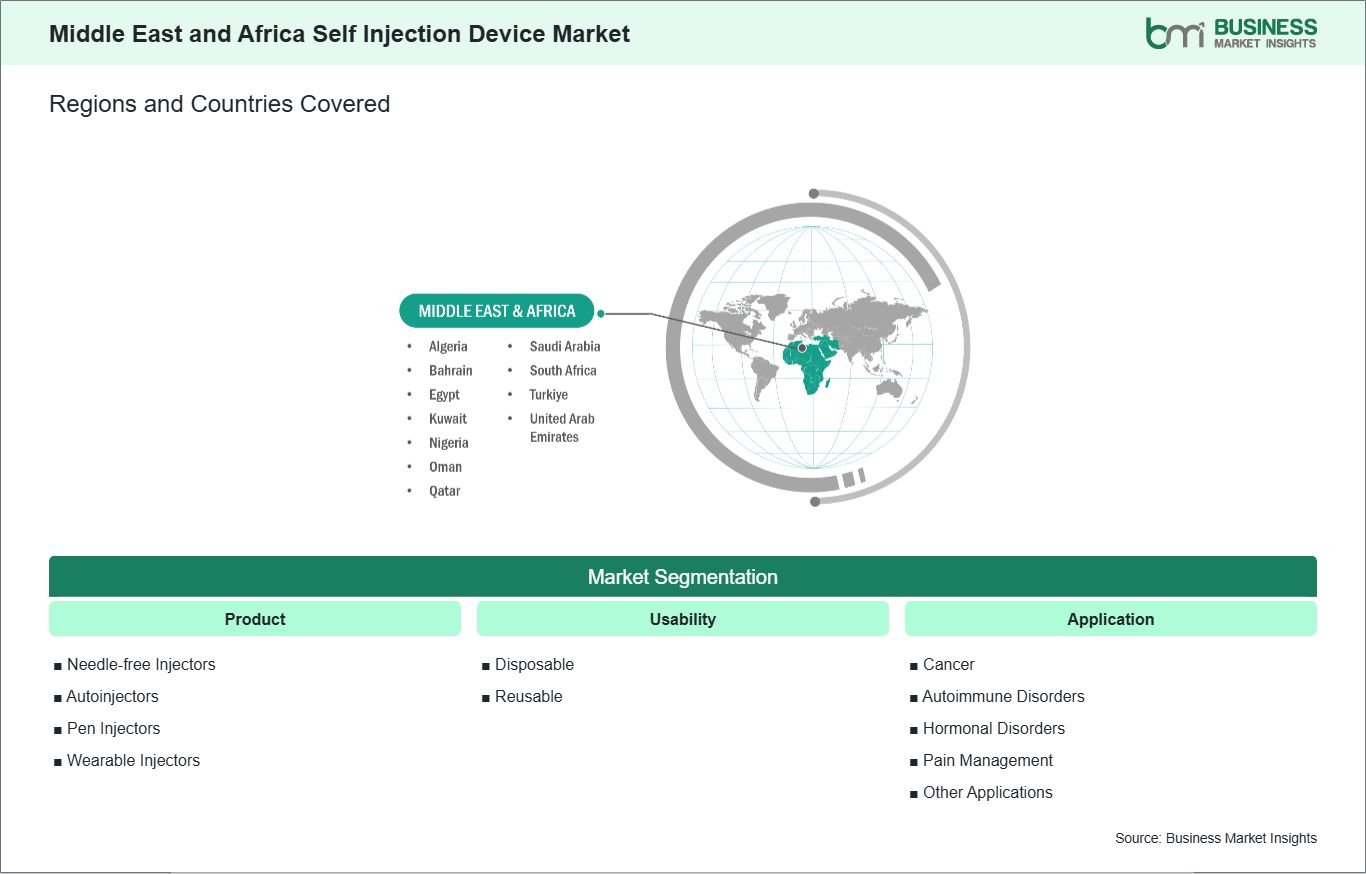
Key segments that contributed to the derivation of the Middle East and Africa self injection device market analysis are product, usability, and application.
Middle East and Africa is witnessing steady growth in specialty drugs, particularly biologics and advanced therapies used to treat autoimmune diseases, diabetes, oncology-related conditions, and rare disorders. These therapies often require regular injectable administration over long periods, making self-injection devices an increasingly practical solution. In wealthier Middle Eastern healthcare systems, specialty drugs are being incorporated into outpatient and home-care treatment pathways, accelerating demand for autoinjectors and prefilled pens that support safe and accurate self-administration. This shift reduces reliance on hospital-based infusion centers and improves patient convenience.
In many parts of Africa, access to specialty drugs is expanding gradually through international health programs, private healthcare investment, and improved pharmaceutical distribution networks. As injectable specialty therapies become more available, self-injection devices help overcome infrastructure constraints such as limited clinic capacity and long travel distances. Patients receiving long-term therapies benefit from devices that simplify administration and reduce the need for frequent in-person visits. This is particularly beneficial for chronic inflammatory and metabolic conditions, where consistent dosing is critical to disease control.
Across the MEA, specialty drugs are also driving demand for devices with enhanced safety and usability features. Because many therapies involve potent biologics, healthcare providers prioritize devices that minimize dosing errors and support patient confidence. Training programs linked to specialty drug prescriptions increasingly include instruction on self-injection device use. As specialty drug pipelines continue to expand across the region, self-injection devices are becoming a core component of treatment delivery.
Telehealth adoption is accelerating across the Middle East and Africa, driven by investments in digital infrastructure, mobile connectivity, and the need to improve healthcare access in underserved areas. This expansion is creating strong alignment with self-injection devices, which allow clinicians to remotely oversee patient therapy without requiring frequent in-clinic visits. In the Middle East, teleconsultations are increasingly used for chronic disease follow-up, enabling physicians to review patient-reported injection data and adjust treatment plans remotely. In Africa, telehealth plays a critical role in bridging geographic gaps between patients and healthcare professionals. Self-injection devices supported by remote check-ins allow patients to maintain therapy adherence even in regions with limited specialist availability. Community healthcare workers often assist patients during initial training, after which telehealth platforms are used for follow-up guidance. This model supports continuity of care while reducing travel costs and time burdens for patients managing long-term injectable therapies.
The integration of telehealth with self-injection is also encouraging the adoption of connected and semi-connected devices. Patients can report injection timing, side effects, and adherence patterns through mobile platforms, giving clinicians greater visibility into treatment progress. This remote oversight improves early intervention when adherence declines or complications arise. As telehealth ecosystems mature, self-injection devices are increasingly viewed not as standalone tools, but as part of a connected care model that improves outcomes, expands access, and supports sustainable healthcare delivery across the region.
The Middle East and Africa Self Injection Device Market demonstrates steady growth, with size and share analysis highlighting evolving trends and competitive dynamics among key players. The report examines subsegments categorized within product, usability, and application, offering insights into their contribution to overall market performance.
By product, the needle-free Injectors subsegment dominated the market in 2025, driven by rising demand for less painful and more patient-friendly drug delivery options.
Based on usability, the disposable subsegment dominated the market in 2025, driven by a strong preference for easy-to-use, single-use devices that enhance hygiene and minimize infection risk.
In terms of application, the autoimmune disorders subsegment dominated the market in 2025, driven by the increasing prevalence of chronic autoimmune conditions requiring frequent self-administered injectable treatments.
| Report Attribute | Details |
|---|---|
| Market size in 2025 | US$ 997.6 Million |
| Market Size by 2033 | US$ 1,240.9 Million |
| CAGR (2026 - 2033) | 3.0% |
| Historical Data | 2022-2024 |
| Forecast period | 2026-2033 |
| Segments Covered | By Product
|
|
Regions and Countries Covered
| |
| Middle East and Africa | Turkiye, the UAE, Saudi Arabia, Bahrain, Oman, Egypt, South Africa, Algeria, Nigeria, Kuwait, Qatar |
| Market leaders and key company profiles |
|
The "Middle East and Africa Self Injection Device Market Size and Forecast (2022–2033)" report provides a detailed analysis of the market covering below areas:
The geographical scope of the Middle East and Africa Self Injection Device Market report is divided into Turkiye, the UAE, Saudi Arabia, Bahrain, Oman, Egypt, South Africa and Africa, Algeria, Nigeria, Kuwait, and Qatar. Turkiye held the largest share in 2025.
Country-level dynamics within the MEA self injection device market reveal distinct adoption patterns, regulatory frameworks, and healthcare priorities that shape competitive positioning and growth strategies. Turkey stands at the forefront of the regional market, supported by a sophisticated healthcare system, a progressive regulatory environment, and a strong manufacturing base. The Turkish Medicines and Medical Devices Agency (TİTCK) has adopted streamlined pathways for approval of self-injection devices and combination drug-device products, enabling rapid market entry for autoinjectors and smart pens across chronic disease segments such as diabetes, autoimmune disorders, and hormone therapies. Robust public and private insurance coverage further facilitates uptake, while digital health initiatives promote remote monitoring and adherence tracking.
In the Gulf Cooperation Council (GCC) states—including Saudi Arabia, the UAE, Qatar, Kuwait, Bahrain, and Oman—self-injection device adoption is driven by high prevalence of chronic conditions, significant government investment in healthcare infrastructure, and payer support mechanisms that include device reimbursement for indicated therapies. Saudi Arabia demonstrates strong institutional procurement practices and clinician endorsement, while the UAE emphasizes digital connectivity and telehealth-linked device ecosystems. Qatar, Kuwait, and Bahrain benefit from comprehensive public funding schemes that support access to advanced delivery systems, particularly for biologic therapies.
Egypt is emerging as a growth market in North Africa, with expanding private sector services and increasing availability of ergonomic, easy-to-use injectors in urban pharmacies. However, device access in rural areas remains variable. Clinician engagement, localized patient education, and alignment with national disease management strategies are critical to adoption. Manufacturers that tailor device features, support services, and regulatory strategies to country-specific realities will achieve more sustainable penetration and competitive differentiation in the market.

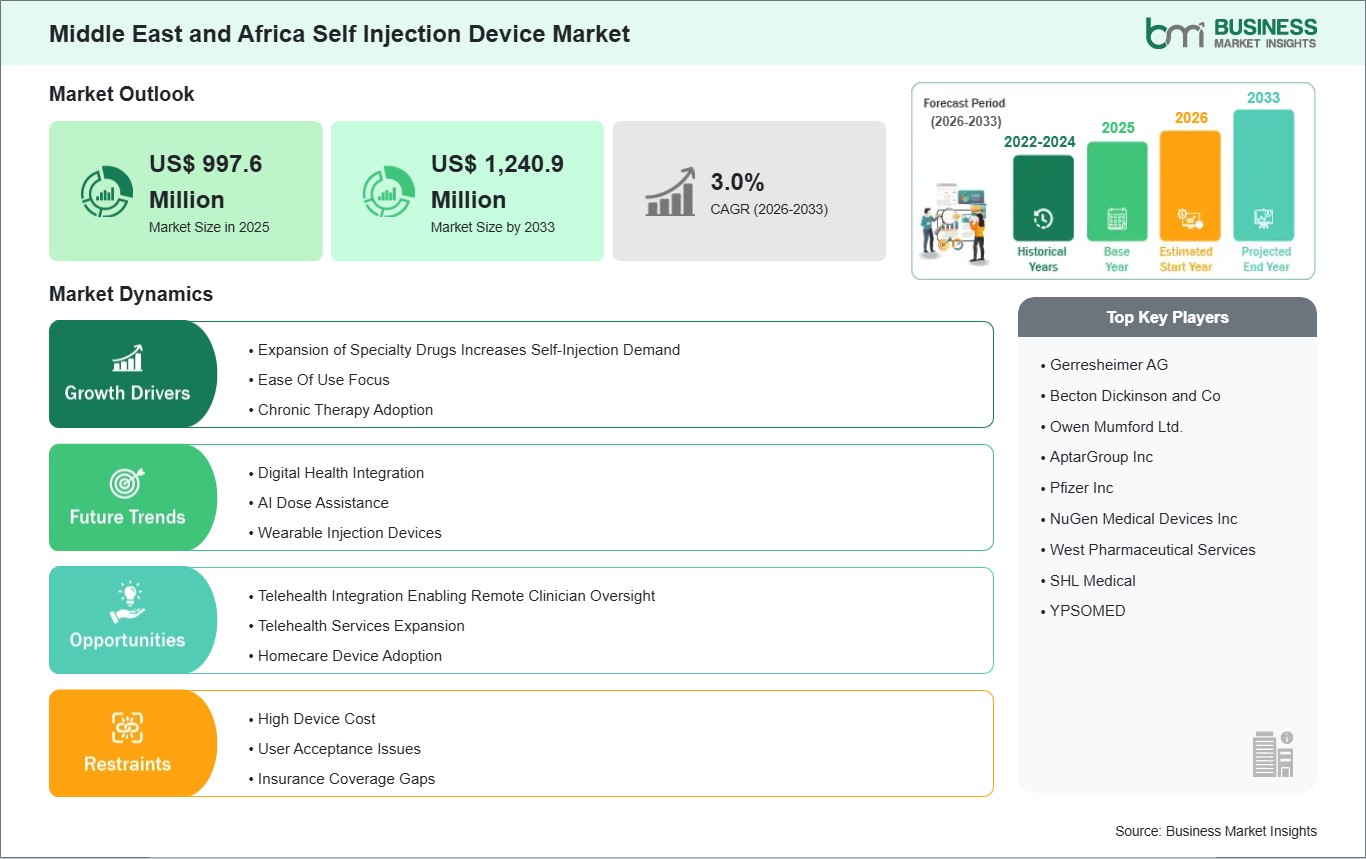
The Middle East and Africa Self Injection Device Market is evaluated by gathering qualitative and quantitative data post primary and secondary research, which includes important corporate publications, association data, and databases. A few of the key developments in the Middle East and Africa self injection device market are:
The Middle East and Africa Self Injection Device Market is valued at US$ 997.6 Million in 2025, it is projected to reach US$ 1,240.9 Million by 2033.
As per our report Middle East and Africa Self Injection Device Market, the market size is valued at US$ 997.6 Million in 2025, projecting it to reach US$ 1,240.9 Million by 2033. This translates to a CAGR of approximately 3.0% during the forecast period.
The Middle East and Africa Self Injection Device Market report typically cover these key segments-
The historic period, base year, and forecast period can vary slightly depending on the specific market research report. However, for the Middle East and Africa Self Injection Device Market report:
The Middle East and Africa Self Injection Device Market is populated by several key players, each contributing to its growth and innovation. Some of the major players include:
The Middle East and Africa Self Injection Device Market report is valuable for diverse stakeholders, including:
Essentially, anyone involved in or considering involvement in the Middle East and Africa Self Injection Device Market value chain can benefit from the information contained in a comprehensive market report.
Please tell us your area of interest
(Market Segments/ Regions and Countries/ Companies)