Market Summary
Executive Summary and Market Analysis
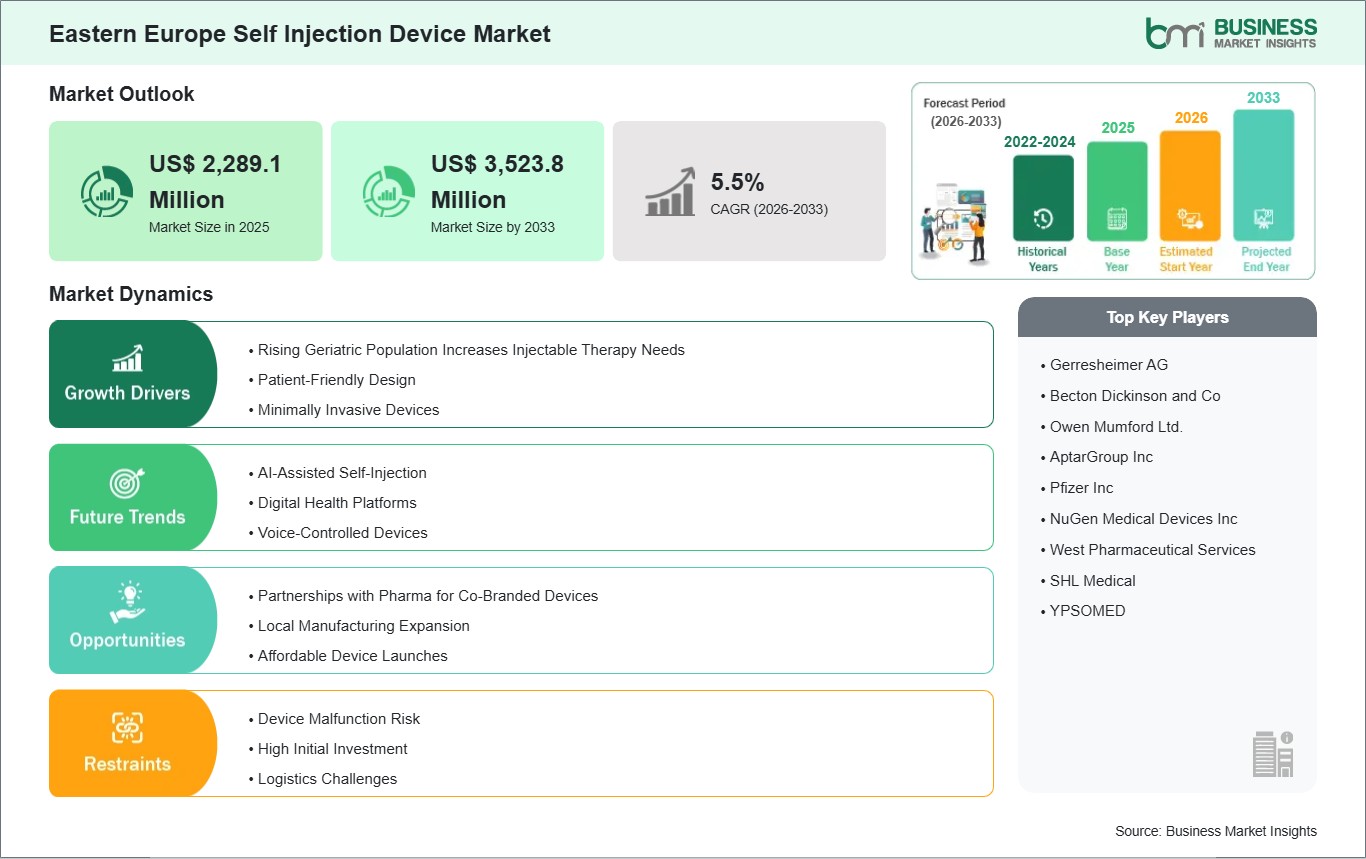
The Eastern Europe self-injection device market is evolving rapidly as healthcare priorities shift toward decentralized care delivery and patient empowerment. Aging populations and rising prevalence of chronic conditions such as diabetes, rheumatoid arthritis, and multiple sclerosis are key drivers pushing demand for at-home drug administration platforms. Governments and payers across countries such as Poland, Hungary, Czech Republic, Romania, and Bulgaria are increasingly emphasizing cost-efficiency in long-term disease management, prompting providers to integrate self-injection devices into care pathways that reduce hospital visits and inpatient costs. The market actively encompasses a range of delivery formats—autoinjectors, reusable pens, prefilled syringes, and emerging wearable injectors—tailored to diverse therapeutic categories. Autoinjector usage is particularly high for biologics and high-viscosity formulations.
Global medical device manufacturers are collaborating with regional distributors, and there is a growing interest from local engineering firms developing ergonomic and cost-competitive designs. Distribution modalities are diversifying; traditional hospital procurement remains important, but vertical integration with community pharmacies and digital pharmacies is reshaping how devices reach patients. Regulatory frameworks in Eastern Europe largely align with European Union Medical Device Regulation (MDR) standards, ensuring safety and quality alongside significant compliance investments from smaller entrants. Reimbursement remains uneven by country and indication, influencing physician prescribing behaviors and patient uptake.
Companies that invest in comprehensive training programmes, injection technique support, and post-sales service are better positioned to foster adherence and brand loyalty. Operationally, stakeholders are also navigating supply chain complexities and fluctuating reimbursement policies shaped by macroeconomic pressures. Overall, the Eastern Europe self-injection device market reflects a transitional healthcare landscape shaped by clinical needs, cost control, and patient-centric innovation.
Segment Analysis
Eastern Europe Self Injection Device Market Segmentation
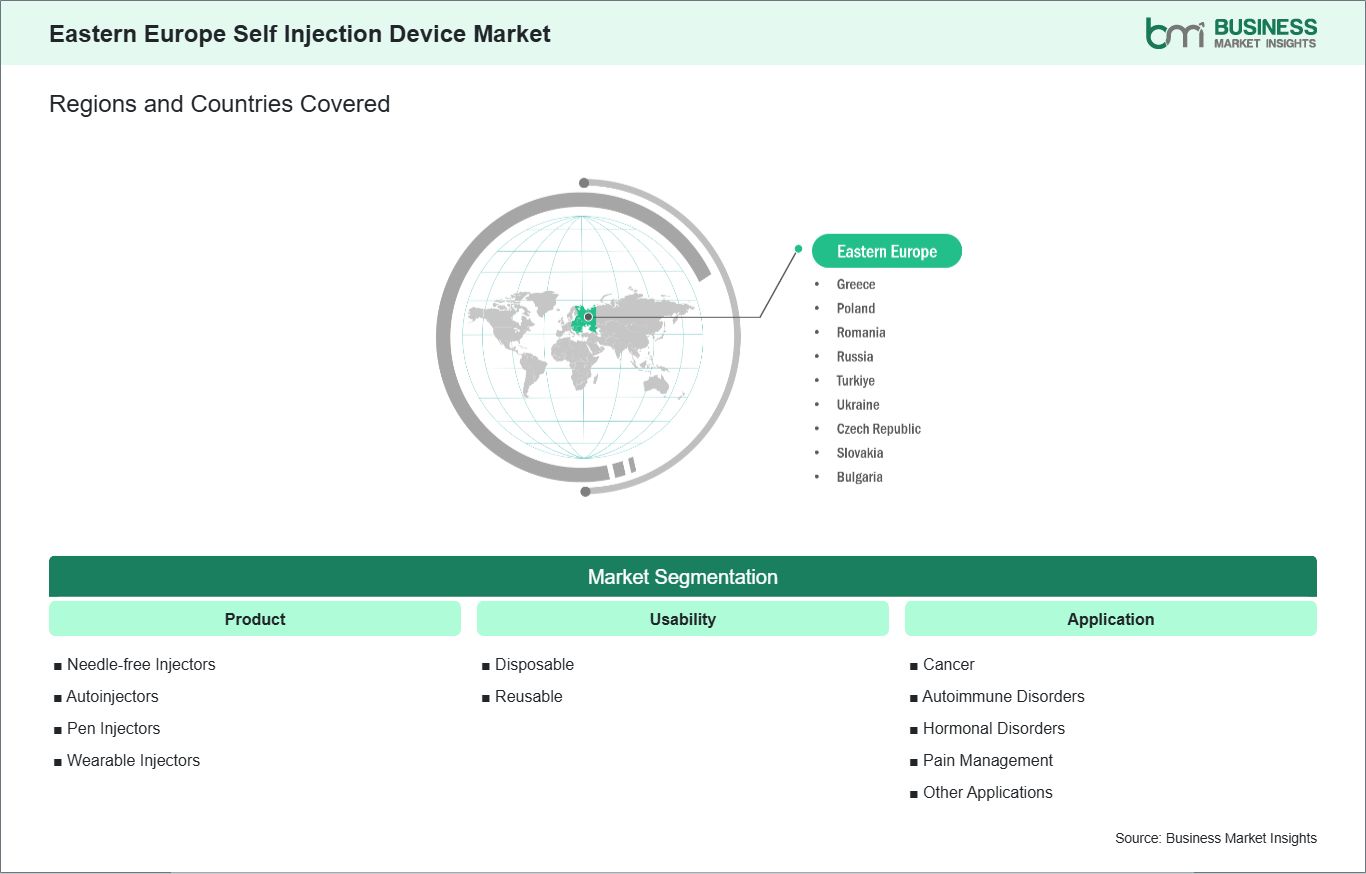
Key segments that contributed to the derivation of the Eastern Europe self injection device market analysis are product, usability, and application.
- By product, the self injection device market is segmented into needle-free Injectors, autoinjectors, pen Injectors, and wearable Injectors. The needle-free Injectors segment dominated the market in 2025.
- Based on usability, the self injection device market is categorized into disposable and reusable. The disposable segment dominated the market in 2025.
- In terms of application, the market is classified into cancer, autoimmune disorders, hormonal disorders, pain management and other applications. The autoimmune disorders segment dominated the market in 2025.
Market Forces
Eastern Europe Self Injection Device Market Drivers and Opportunities
Rising Geriatric Population Increases Injectable Therapy Needs
Eastern Europe is experiencing a significant demographic shift toward an aging population, which is driving higher demand for injectable therapies. As the proportion of elderly citizens increases, chronic conditions such as diabetes, cardiovascular diseases, rheumatoid arthritis, and chronic respiratory disorders become more prevalent. These conditions often require long-term injectable medications or biologic therapies. Many elderly patients face mobility and transport challenges, especially in regions where access to specialized clinics is limited.
Self-injection devices help reduce dependence on hospital visits and make long-term treatment more feasible for older patients living in smaller towns or rural areas. The aging demographic is also increasing demand for devices designed with senior-friendly features. Several elderly patients have reduced manual dexterity, impaired vision, or tremors, which makes traditional syringes difficult to handle. As a result, devices with larger dose windows, ergonomic grips, low injection force, and automatic needle protection are becoming more widely adopted. Healthcare providers and pharmacies in the region increasingly offer training sessions focused on elderly users, teaching them correct injection techniques and safe disposal practices. This is particularly important because incorrect dosing or poor technique can lead to serious complications.
Eastern Europe also has a growing number of elderly patients requiring biologic therapies for autoimmune diseases and cancer supportive care. These treatments are increasingly being administered outside hospitals, in outpatient settings, or at home. Demand for insulin pens is increasing as diabetes prevalence grows. Thus, the growing geriatric population in Eastern Europe is a major driver of demand for self-injection devices, pushing manufacturers to develop solutions that support long-term adherence and ease of use.
Partnerships with Pharma for Co-Branded Devices
Co-branded devices are becoming a key market strategy in Eastern Europe as pharmaceutical companies seek to enhance patient adherence and streamline treatment delivery. In the region, a large number of patients depend on government-funded healthcare systems where medication supply is standardized, but device availability can be inconsistent. By partnering with device manufacturers, pharma companies can provide integrated therapy packages that include both the drug and a compatible self-injection device. This reduces the need for patients to source devices separately and improves overall treatment continuity. In Eastern Europe, these partnerships often focus on biologic therapies and insulin, where accurate dosing and patient comfort are crucial.
Co-branded devices may offer custom dosing options, easy-to-read dose displays, and safety features such as needle retraction. They are also frequently accompanied by patient support programs, including training videos, nurse-led workshops, and multilingual instructions. Such programs are particularly valuable in Eastern Europe where health literacy varies and some patient groups may require additional guidance to properly self-administer injections. Co-branded devices thus help build patient trust and reduce the risk of non-adherence due to fear or confusion. Another major benefit of pharma-device partnerships is the improved supply chain and distribution reach. Pharmaceutical companies often have extensive networks across urban and rural regions, which can be leveraged to distribute co-branded devices along with medication. This is especially important in areas where pharmacies may not stock specialized injection devices. Co-branding also strengthens brand loyalty, as patients associate the therapy with a complete, reliable solution. Thus, co-branded self-injection devices are becoming standard in Eastern Europe, improving adherence and outcomes.
Size and Share Analysis
Eastern Europe Self Injection Device Market Size and Share Analysis
The Eastern Europe Self Injection Device Market demonstrates steady growth, with size and share analysis highlighting evolving trends and competitive dynamics among key players. The report examines subsegments categorized within product, usability, and application, offering insights into their contribution to overall market performance.
By product, the needle-free Injectors subsegment dominated the market in 2025, driven by growing demand for less painful and more user-friendly drug delivery solutions among patients.
Based on usability, the disposable subsegment dominated the market in 2025, driven by widespread preference for convenient, single-use devices that enhance hygiene and reduce contamination risks.
In terms of application, the autoimmune disorders subsegment dominated the market in 2025, driven by increasing prevalence of chronic autoimmune conditions requiring frequent self-administered injectable therapies.
Report Coverage
Eastern Europe Self Injection Device Market Report Coverage and Deliverables
The "Eastern Europe Self Injection Device Market Size and Forecast (2022–2033)" report provides a detailed analysis of the market covering below areas:
- Eastern Europe Self Injection Device Market size and forecast at regional and country levels for all market segments covered under the scope
- Eastern Europe Self Injection Device Market trends, as well as drivers, restraints, and opportunities
- Eastern Europe Self Injection Device Market analysis covering key trends, regional framework, major players, regulations, and recent developments
- Industry landscape and competition analysis covering market concentration, heat map analysis, prominent players, and recent developments for the Eastern Europe Self Injection Device Market
- Detailed company profiles, including SWOT analysis
Geographic Insights
Eastern Europe Self Injection Device Market Geographic Insights
The geographical scope of the Eastern Europe Self Injection Device Market report is divided into Russia, Poland, Ukraine, Romania, the Czech Republic, Slovakia, Bulgaria, and Greece. Russia held the largest share in 2025.
Country-level analysis of the Eastern Europe self-injection device market highlights nuanced dynamics shaped by national healthcare systems, regulatory environments, and patient expectations. Poland stands out with a mature procurement ecosystem in public and private sectors, where self-injection devices for diabetes and rheumatologic indications are widely prescribed, supported by structured training initiatives and integrated pharmacy networks. In Czech Republic, high physician engagement and robust insurance coverage facilitate quicker adoption of advanced autoinjectors and prefilled pens, with ongoing pilot programmes exploring smart device integration in outpatient care.
In Romania, rising prevalence of chronic conditions and expanding private insurance penetration are prompting increased demand, but fragmented distribution channels and regional disparities require targeted outreach and education to ensure equitable access. Bulgaria shows growing interest in needle-free and wearable injection options, particularly in urban centres where patient demand for convenience and minimal clinic dependency is rising. Across these countries, regulatory alignment with EU standards mandates consistent quality and safety. However, local reimbursement policies and tender processes differ markedly, influencing pricing strategies and market entry decisions.
Country stakeholders increasingly emphasize patient education infrastructure, with national diabetes associations, rheumatology societies, and pharmacy coalitions partnering with device manufacturers to enhance injection technique proficiency and adherence support. Cultural perceptions of home-based care and clinician-patient trust also vary, guiding tailored communication strategies in physician detailing and consumer awareness campaigns.
Industry Activity
Recent Developments
The Eastern Europe Self Injection Device Market is evaluated by gathering qualitative and quantitative data post primary and secondary research, which includes important corporate publications, association data, and databases. A few of the key developments in the Eastern Europe self injection device market are:
- In May 2025, Sandoz launched the PYZCHIVA ustekinumab autoinjector, the first biosimilar in autoinjector format commercially available in Europe as part of its chronic inflammatory disease portfolio. Initially rolled out in multiple Western European markets, the product’s ongoing European expansion plan includes availability phases covering Eastern European countries such as Poland and Czech Republic, broadening therapeutic delivery options for psoriasis, arthritis, and Crohn’s patients. This launch signifies a key milestone for self-injection formats in Europe’s biologics segment, responding to rising demand for comfortable, home-based administration. The device’s ergonomic design and automatic dosing support improved adherence and patient independence in routine care.
- In June 2025, SHL Medical’s Molly modular platform autoinjector technology supported the commercial introduction of Pyzchiva in Europe, strengthening regional access to advanced self-injection solutions. While the rollout continues across broader Europe, Eastern European healthcare systems are expected to benefit from improved device manufacturing scalability and distribution networks that shorten time-to-clinic access. The strategic collaboration between SHL Medical, Sandoz, and Samsung Bioepis underscores a trend toward modular device platforms that can accommodate a variety of biologic therapies. Adoption of these modular platforms enables device manufacturers and pharmaceutical sponsors to more efficiently meet diverse dosing and patient-centric needs in Central and Eastern European markets.
Trust & Transparency
Research Methodology
The market analysis combines proprietary research with secondary data from government agencies, company disclosures, regulatory filings, industry databases and expert interviews. Market estimates are validated through data triangulation, cross-market benchmarking and analyst
review.
View Full Research Methodology
Key Sources Referred:
World Health Organization (WHO) Organisation for Economic Cooperation and Development (OECD) The World Bank Group Worldometer The Lancet International Bar Association International Trade Administration