The self-injection device market consists of medical devices that allow patients to give themselves medications without having a nurse or a doctor present. The devices concerned with this market include auto-injectors, pen injectors, needle-free systems, and wearable injectors which are quite different but all functionally similar and are widely used for chronic diseases such as diabetes, autoimmune diseases, cancer therapies, and hormonal diseases. The rising number of chronic diseases and the older population have created a demand for such drug delivery systems which are convenient, safe, and easy to use. These systems are the ones that do not require the patients to go to the hospital, hence they lower healthcare costs while making treatment adherence and quality of life better. The trend is given additional impetus by the biologics and biosimilars market & the latter having many products developed for subcutaneous administration & prompting pharmaceutical companies to associate new medicines with sophisticated injection technologies which ensure precision and user-friendliness. Today technologies that come with ergonomic design, built-in safety features, and dose tracking as well as digital connectivity have become standard in the industry and they also contribute to the realization of better patient outcomes and engagement. The market also receives a boost from the growing trend of patients wanting to take charge of their long-term therapy, together with the adoption of telehealth. The main obstacles in this market are the long and complicated regulations and the high cost of devices.
Furthermore, advancements in self-injection technologies are driving market growth. Self-injection technologies are a relatively quicker mode of drug delivery and thus allow better reproducibility when compared to invasive drug delivery methods. Additionally, these devices reduce the amount of medication required, making it easier for older patients to adhere to their medication regimen. Among non-invasive methods, needle-free injectors, such as jet injectors, stand out as effective and convenient, leading to fewer hospitalizations, lower overall healthcare costs, improved patient adherence, and ease of use in home care scenarios. Hence, the increasing benefits associated with self-injection devices are likely to bolster market growth.
In terms of geography, developed regions with strong healthcare infrastructure are the leaders in adoption, while the emerging markets are getting to be more and more significant since healthcare access and awareness are increasing. To sum up, self-injection devices are becoming even more important in the treatment of modern diseases because they are not only facilitating the power of patients but also maximizing the management of chronic diseases aligning with major healthcare trends.

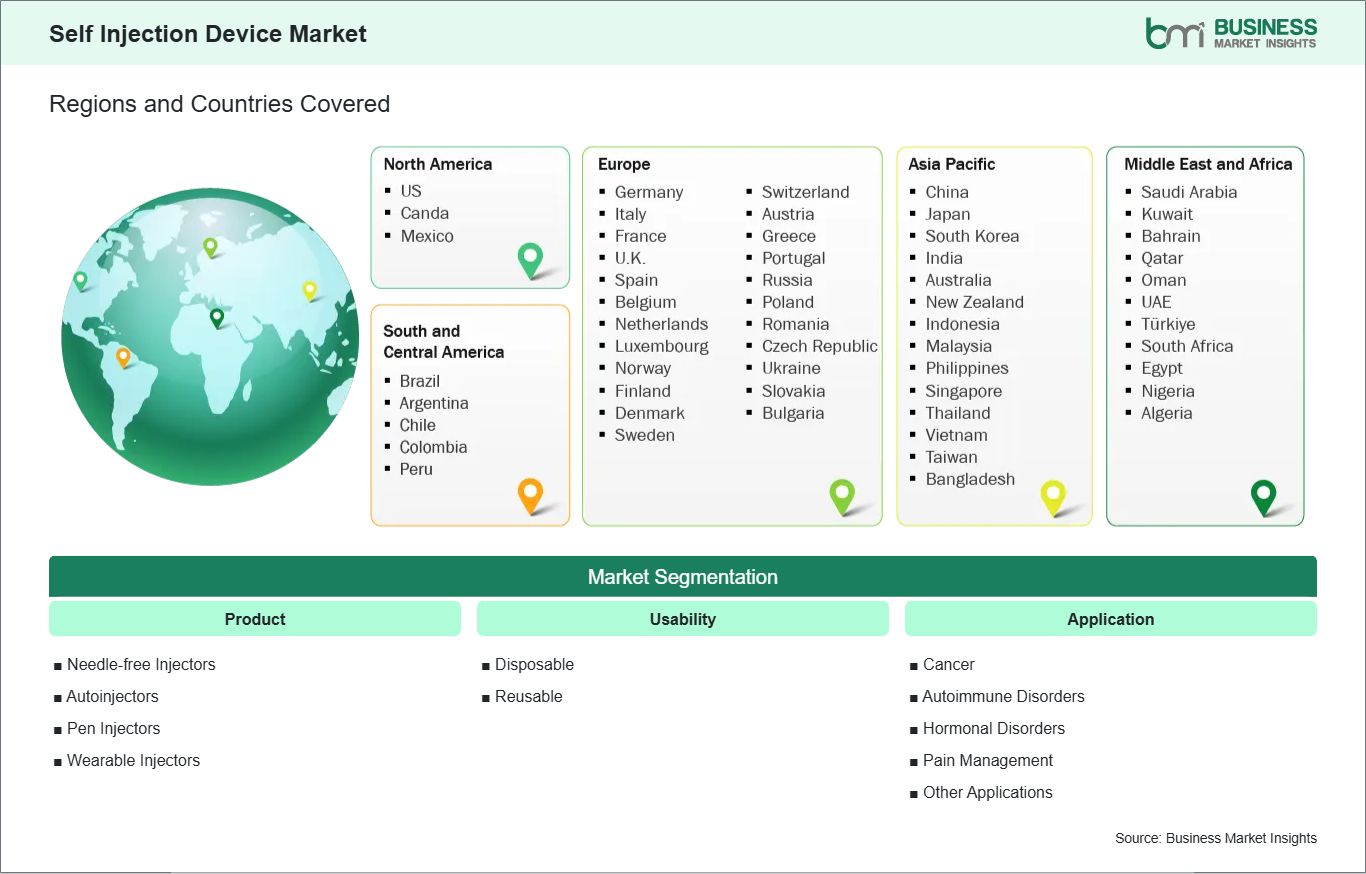
Key segments that contributed to the derivation of the self injection device market analysis are product, usability, and application.
The needlestick injuries from contaminated needles have increasingly been a major factor in the self-injection device market since they point out very high safety risks and at the same time increase the demand for devices that can help with this kind of exposure both professionally and accidentally. Injuries from needlestick occur when a used needle mistakenly punctures the skin and can, consequently, expose the healthcare worker or patient to bloodborne viruses like hepatitis B, hepatitis C, and HIV, thus highlighting not only health but psychological risks as well that are associated with traditional injection methods. According to reports, every year millions of healthcare professionals worldwide are subjected to needlestick incidents, however, it is also stated by various studies that a significant portion of them — including nurses, phlebotomists and other clinicians — have at least one such event reported over time and a notable percentage is related to the handling or disposal of sharp instruments.
The matter of contaminated needles leading to percutaneous exposure events that are either unreported or underreported has made it so that most facilities and regulatory bodies have started to put safety-engineered injection devices on top of their list of priorities and are looking for the safest devices to use that will reduce these risks. Among these devices are self-injection systems with safety mechanisms, retractable needles, and needle-free technologies that keep users away from accidental sticks, especially in chronic disease management where patients administer medications at home. As the knowledge of occupational health hazards becomes more common among both medical professionals and patients, and as the setting of strict safety standards in the workplace leads to the demand for safer alternatives, the need to minimize the occurrence and repercussions of contaminated needlestick injuries is still liberating the use of high-tech self-injection devices.
To sum up, the great number of cases of needlestick injuries and the health, emotional, and economic burdens that come with them are encouraging both healthcare providers and patients to choose self-injection technologies that focus on safety, thus speeding up the innovation and market demand for safer delivery solutions.
The option of patient preference for self-administration in the self-injection device market is becoming a major factor, supported by the general trend of moving towards more autonomy, convenience, and comfort when managing chronic diseases at home. Patients undergoing long-term treatments like diabetes, rheumatoid arthritis, and other autoimmune diseases are increasingly choosing to use devices that enable them to give themselves their medications rather than depend on painful and inconvenient frequent clinic visits showed through a major root change of the patient-centric and home treatment. There is a patient survey and report which states that when given user-friendly and least painful devices, quite a number of people would definitely opt for self-injection, many of them are particularly drawn to device design features like the hidden needles, auto-injection, and feedback which indicate safety and also reduce anxiety and thus, increase confidence in self-administration.
Furthermore, some research studies have indicated that patients are prepared to pay a little bit more for features that make self-injection easier and less painful, thus highlighting that preference is not just about the necessity but also the quality of the experience. As the self-injection technology is advancing, including the development of smart auto-injectors, connected applications for monitoring doses, and easy-to-use wearable injectors, more and more patients are opting for self-administration for the sake of controlling their treatment schedules, improving compliance, and avoiding the hassle of regular visits to the healthcare facility. The trend towards self-injection getting more acceptance along with the supportive health policies and increased comfort with remote health solutions creates a great opportunity for manufacturers not only to come up with new devices but also to produce the ones which are user-friendly, patient-centered and meet the changing treatment preferences.
By product, the self injection device market is bifurcated into needle-free injectors, autoinjectors, pen injectors, wearable injectors. The needle-free injectors segment dominated the market in 2025. Needle-free injectors made up the largest market share because they are highly effective and widely adopted. These devices are a new step forward in medication delivery, removing the need for needles and offering a safe way for people to give themselves medicine.
By usability, the market is bifurcated into disposable, reusable. The disposable segment held the largest share of the market in 2025. Growing concerns about needle stick injuries and greater awareness of the benefits of drug delivery devices have led to fast growth in the disposable self-injection device market. These devices are simple to use for frequent, low-volume injections or changing doses. Companies such as BD, Gerresheimer AG, and Ypsomed AG are introducing new disposable self-injection devices to strengthen their market positions.
By application, the market is segmented into cancer, autoimmune disorders, hormonal disorders, pain management, other applications. The cancer segment held the largest share of the market in 2025. As cancer becomes more common, demand for self-injection devices is expected to rise. In 2022, there were nearly 20 million new cancer cases and 9.7 million cancer deaths, as per the International Agency for Research on Cancer (IARC). More cancer patients are choosing to self-administer medication, which should help this market segment grow.
| Report Attribute | Details |
|---|---|
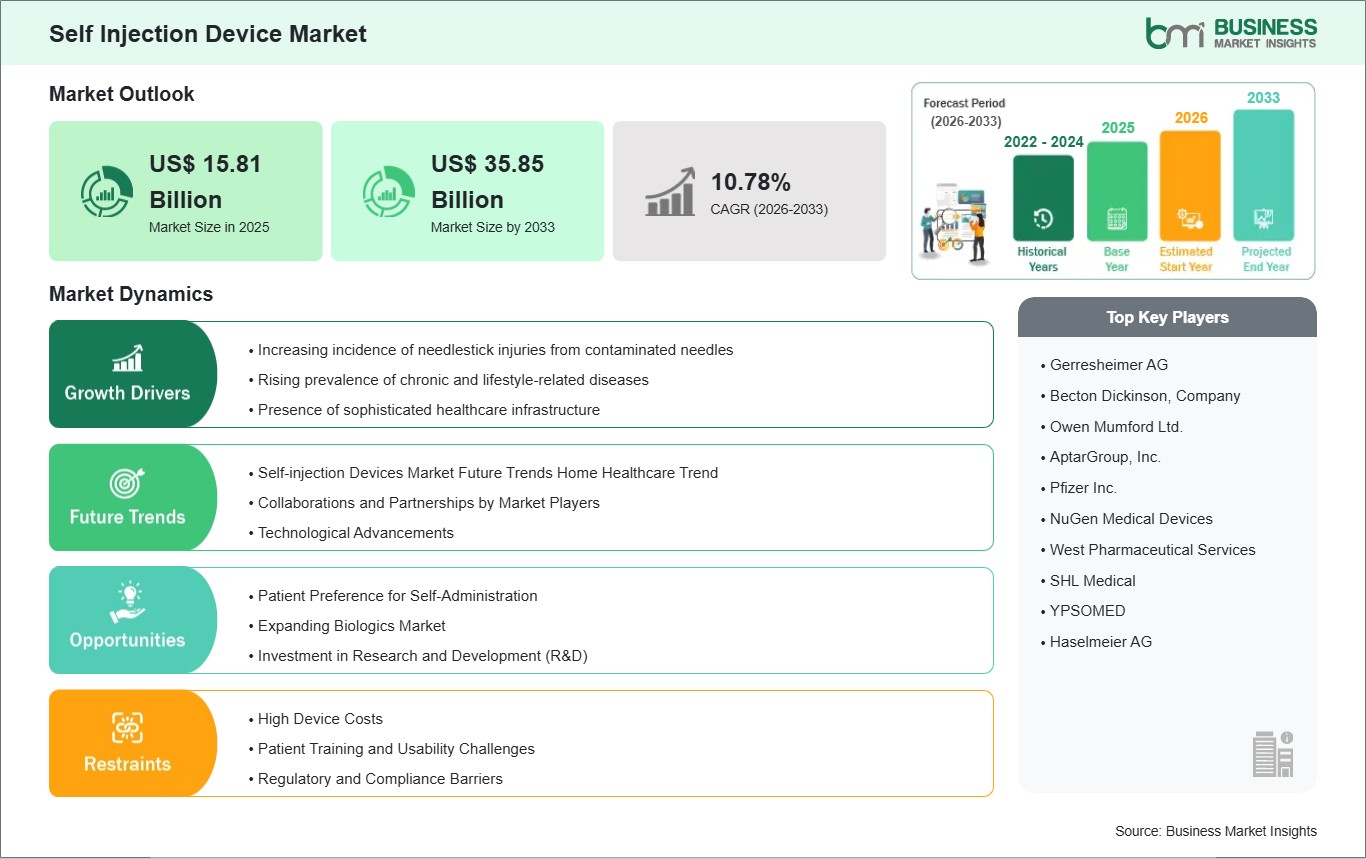
| Market size in 2025 | US$ 15.81 Billion |
| Market Size by 2033 | US$ 35.85 Billion |
| Global CAGR (2026 - 2033) | 10.78% |
| Historical Data | 2022 - 2024 |
| Forecast period | 2026-2033 |
| Segments Covered | By Product
|
| Regions and Countries Covered | North America
|
| Market leaders and key company profiles |
|
The geographical scope of the self injection device market report is divided into five regions: North America, Asia Pacific, Europe, Middle East & Africa, and South & Central America. The self injection device market in Asia Pacific is expected to grow significantly during the forecast period.
The Asia-Pacific self injection device market is segmented into China, Japan, South Korea, India, Australia, and the rest of Asia. The self-injection devices market in the Asia Pacific is rapidly expanding. This acceleration is driven by the improved healthcare infrastructure in India, China, and Japan, as well as increased investment in chronic disease management. These countries are enhancing access to healthcare, elevating workforce training, and deploying advanced medical technologies. Consequently, more patients adopt self-injection therapies for diabetes and rheumatoid arthritis. Rising healthcare expenditures further indicate a stronger focus on chronic disease management, fueling demand for self-injection devices.
India’s self-injection devices market is intensely competitive, partly because of the broad availability of affordable options. Local companies are introducing new products, accelerating market growth. For instance, in May 2022, Medmix Drug Delivery unveiled a new autoinjector at the Pharmapack event to optimize drug delivery. This device streamlines patient use of injectable medications, particularly for chronic conditions requiring regular self-injection. Its user-friendly features help patients manage treatment more efficiently

The self injection device market is evaluated by gathering qualitative and quantitative data post primary and secondary research, which includes important corporate publications, association data, and databases. A few of the key developments in the self injection device market are:
The Self Injection Device Market is valued at US$ 15.81 Billion in 2025, it is projected to reach US$ 35.85 Billion by 2033.
As per our report Self Injection Device Market, the market size is valued at US$ 15.81 Billion in 2025, projecting it to reach US$ 35.85 Billion by 2033. This translates to a CAGR of approximately 10.78% during the forecast period.
The Self Injection Device Market report typically cover these key segments-
The historic period, base year, and forecast period can vary slightly depending on the specific market research report. However, for the Self Injection Device Market report:
The Self Injection Device Market is populated by several key players, each contributing to its growth and innovation. Some of the major players include:
The Self Injection Device Market report is valuable for diverse stakeholders, including:
Essentially, anyone involved in or considering involvement in the Self Injection Device Market value chain can benefit from the information contained in a comprehensive market report.
Please tell us your area of interest
(Market Segments/ Regions and Countries/ Companies)