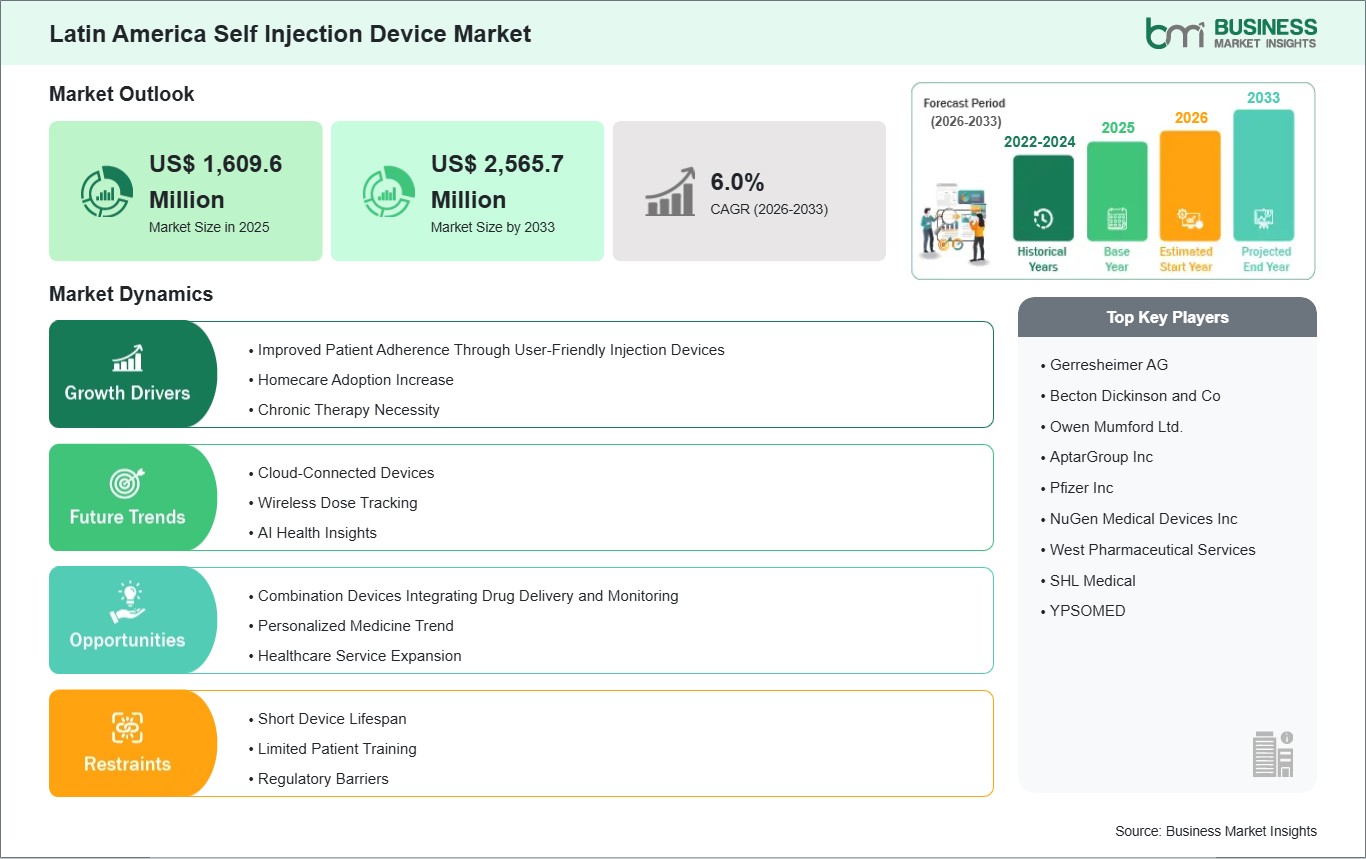
The Latin America Self Injection Device Market size is expected to reach US$ 2,565.7 million by 2033 from US$ 1,609.6 million in 2025. The market is estimated to record a CAGR of 6.0 % from 2026 to 2033.
The Latin America self-injection device market is driven by a convergence of demographic pressures, policy developments, and shifting clinical care models. Chronic disease prevalence—notably diabetes, rheumatoid arthritis, and inflammatory bowel disease—has risen consistently across key countries such as Brazil, Mexico, Argentina, Colombia, and Chile, prompting healthcare providers and payers to re-evaluate traditional care pathways in favor of decentralized treatment modalities. Self-injection devices, including autoinjectors, prefilled pens, and syringe systems, are increasingly recognized as pivotal tools in improving patient access, enhancing adherence, and reducing the burden on clinical infrastructure.
Brazil and Mexico boast relatively mature pharmaceutical and medtech networks. At the same time, other countries such as Peru and Colombia are characterized by rapid modernization efforts supported by public health reforms and expanding private sector participation. Regulatory frameworks across Latin America are concurrently undergoing harmonization efforts, particularly through regional collaboration forums that aim to align device approvals and quality standards with international best practices, thereby reducing time-to-market for self-injection solutions. Competitive dynamics reflect a blend of established global medical device manufacturers seeking to expand their regional footprints and agile local players offering cost-effective alternatives tailored to specific therapeutic niches.
Beyond traditional hospital and retail pharmacies, digital pharmacy platforms and value-added service providers are gaining traction, particularly in urban centers with high internet penetration. Market barriers include heterogeneous reimbursement policies, uneven patient awareness of self-administration benefits, and logistical challenges in rural supply chains. Manufacturers and healthcare stakeholders that adopt nuanced go-to-market strategies, emphasize clinician education, and invest in patient engagement programs are better positioned to capitalize on the region's long-term growth potential.

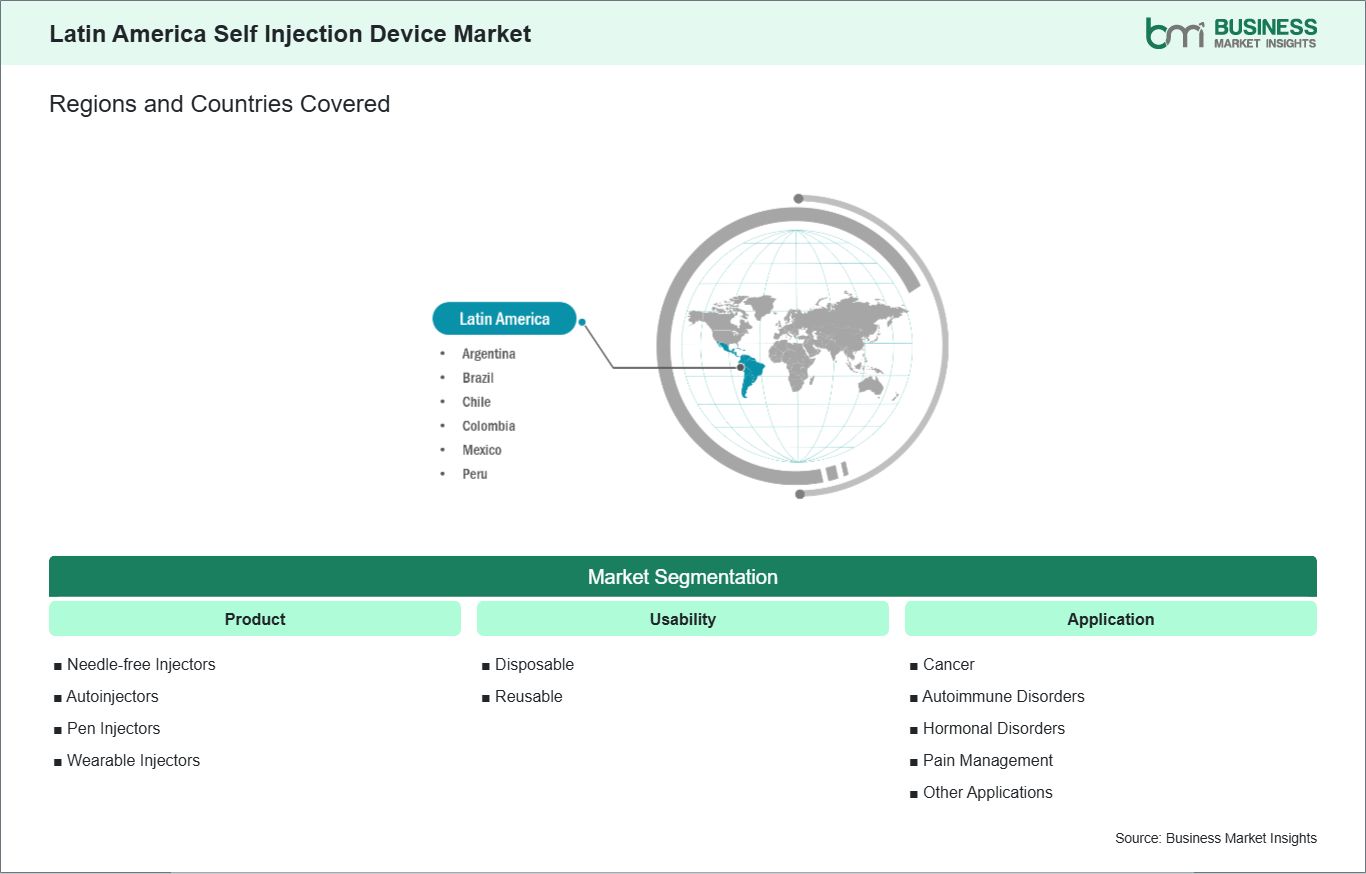
Key segments that contributed to the derivation of the Latin America self injection device market analysis are product, usability, and application.
In Latin America, patient adherence to injectable therapies has historically been challenged by long travel times to clinics, limited access to specialist care in rural areas, and inconsistent patient education. Devices such as autoinjectors and prefilled pens reduce the technical skill required for injection, making therapy easier for patients with low health literacy or limited experience. A high number of patients suffering from chronic diseases require long-term injections, and user-friendly devices help reduce missed doses by simplifying the process.
Pharmacies and primary care centers in Latin America are playing a key role in improving adherence through device training programs. Patients often receive hands-on guidance when picking up prescriptions, and several clinics are beginning to offer nurse-led sessions on proper injection technique and device handling. These training programs help reduce fear and uncertainty. As a result, patients are more likely to continue treatment long-term, improving outcomes and reducing the need for costly hospital interventions. The demand for easy-to-use devices is also growing among older patients who may experience reduced dexterity and vision challenges.
Patient-friendly device design is becoming a key market differentiator. Devices with features such as large dose displays, audible click feedback, and ergonomic grips are increasingly preferred. As healthcare systems in the region continue to modernize and patient education improves, self-injection devices that prioritize ease of use are expected to drive significant market growth.
A large number of patients are seeking connected devices that can track dose timing, record injection history, and send reminders. These features are particularly valuable in regions where patients may not have frequent access to healthcare providers. By enabling digital tracking, combination devices help patients manage complex treatment schedules and improve adherence, especially for chronic conditions such as diabetes and biologic therapies for inflammatory diseases.
Healthcare providers in Latin America are increasingly using digital platforms to monitor patients remotely. Remote monitoring enables clinicians to identify adherence gaps early and intervene through teleconsultations or pharmacist outreach. This is especially important in rural areas, where patients may face transportation barriers to clinic visits. Combination devices also support community health programs by providing accurate data for follow-up, helping care teams allocate resources more effectively. As telemedicine becomes more widespread, devices that integrate delivery and monitoring are becoming a critical component of chronic disease management in Latin America.
Combination devices are also valuable for patients managing multiple therapies simultaneously, which is common in Latin America due to high rates of metabolic syndrome and comorbidities. Patients benefit from platforms that consolidate dosing information and provide automatic reminders, reducing the risk of missed or incorrect injections. Manufacturers are increasingly designing devices that sync with mobile apps, allowing patients to share data with their care teams and receive personalized support.

The Latin America Self Injection Device Market demonstrates steady growth, with size and share analysis highlighting evolving trends and competitive dynamics among key players. The report examines subsegments categorized within product, usability, and application, offering insights into their contribution to overall market performance.
By product, the needle-free Injectors subsegment dominated the market in 2025, driven by increasing patient demand for painless and more comfortable drug delivery options.
Based on usability, the disposable subsegment dominated the market in 2025, driven by a strong preference for convenient single-use devices that improve hygiene and reduce contamination risk.
In terms of application, the autoimmune disorders subsegment dominated the market in 2025, driven by a growing burden of chronic autoimmune diseases requiring frequent self-administered injectable treatments.
| Report Attribute | Details |
|---|---|
| Market size in 2025 | US$ 1,609.6 Million |
| Market Size by 2033 | US$ 2,565.7 Million |
| CAGR (2026 - 2033) | 6.0% |
| Historical Data | 2022-2024 |
| Forecast period | 2026-2033 |
| Segments Covered | By Product
|
|
Regions and Countries Covered
| |
| Latin America | Mexico, Brazil, Argentina, Peru, Chile, Colombia |
| Market leaders and key company profiles |
|
The "Latin America Self Injection Device Market Size and Forecast (2026–2033)" report provides a detailed analysis of the market covering below areas:
The geographical scope of the Latin America Self Injection Device Market report is divided into Mexico, Brazil, Argentina, Peru, Chile, and Colombia. Brazil held the largest share in 2025.
Country-level insights within the Latin America self-injection device market highlight distinct adoption patterns, regulatory environments, and healthcare delivery frameworks that vary across the region's major economies. Brazil is one of the most advanced markets, underpinned by a robust pharmaceutical manufacturing base, structured public health programs, and proactive adoption of medtech innovations. In Brazil, self-injection devices for diabetes and autoimmune therapies are widely integrated into chronic care protocols, supported by strong clinician advocacy and well-established distribution networks.
Regulatory oversight from ANVISA has increasingly embraced harmonization with international standards, shortening approval cycles for innovative delivery platforms. Mexico exhibits similar momentum, where growing private insurance coverage and public sector reforms are expanding access to self-administration options, particularly in urban centers. Mexico's National Commission for Medical Arbitration (COFEPRIS) has been streamlining approval pathways to facilitate faster entry of combination drug-device products. Argentina is characterized by a dual public-private healthcare system where access disparities persist; however, there is rising demand for self-injection pens and autoinjectors among middle-income populations, supported by clinic-based training programs and pharmacy-led patient education.
Colombia and Chile are also witnessing growing uptake, with national health insurers evaluating reimbursement policies that support device adoption in chronic disease management, particularly for diabetes and rheumatologic conditions. In countries such as Peru and Ecuador, adoption rates are increasing more gradually, influenced by uneven payer coverage and supply chain limitations. Across the region, physician engagement, patient literacy initiatives, and alignment with local reimbursement formularies remain critical levers for stimulating sustained growth, making localized insights essential for effective market entry and competitive differentiation in the Latin America self-injection device landscape.

The Latin America Self Injection Device Market is evaluated by gathering qualitative and quantitative data post primary and secondary research, which includes important corporate publications, association data, and databases. A few of the key developments in the Latin America self injection device market are:
The Latin America Self Injection Device Market is valued at US$ 1,609.6 Million in 2025, it is projected to reach US$ 2,565.7 Million by 2033.
As per our report Latin America Self Injection Device Market, the market size is valued at US$ 1,609.6 Million in 2025, projecting it to reach US$ 2,565.7 Million by 2033. This translates to a CAGR of approximately 6.0% during the forecast period.
The Latin America Self Injection Device Market report typically cover these key segments-
The historic period, base year, and forecast period can vary slightly depending on the specific market research report. However, for the Latin America Self Injection Device Market report:
The Latin America Self Injection Device Market is populated by several key players, each contributing to its growth and innovation. Some of the major players include:
The Latin America Self Injection Device Market report is valuable for diverse stakeholders, including:
Essentially, anyone involved in or considering involvement in the Latin America Self Injection Device Market value chain can benefit from the information contained in a comprehensive market report.
Please tell us your area of interest
(Market Segments/ Regions and Countries/ Companies)