Market Summary
Executive Summary and Market Analysis
The North America self-injection device market is one of the most advanced and strategically important in the global medical technology landscape, shaped by a convergence of high chronic disease prevalence, rapid adoption of biologic therapies, and integrated healthcare delivery channels. Across the US and Canada, clinicians are increasingly prescribing self-injection devices, including autoinjectors, prefilled pens, wearable systems, and connected platforms to support patient autonomy while reducing reliance on clinic-based administration. This trend is particularly evident in therapeutic areas such as diabetes, rheumatoid arthritis, multiple sclerosis, and fertility treatments. Competitive dynamics in the region are defined by robust participation from multinational device manufacturers as well as innovative startups that emphasize ease-of-use, connectivity, ergonomic design, and safety mechanisms to minimize needle injuries. Smart injectors that pair with mobile applications, dose tracking systems, and cloud-based clinician interfaces are becoming standard offerings, enabling real-time adherence monitoring and richer longitudinal health data. The regulatory landscape in the US and Canada, while stringent, provides clear pathways for self-injection device approvals; the U.S. Food and Drug Administration (FDA) has refined guidance for combination drug-device products to reduce uncertainty in development timelines. Reimbursement environments in both countries support broad adoption, with public and private payers increasingly recognizing the long-term cost benefits of self-administration, such as reduced hospital visits and improved adherence outcomes. Distribution networks are highly diversified, spanning hospital procurement, specialty pharmacies, retail pharmacy chains, and fast-growing direct-to-patient digital channels. Barriers include complexity, pricing pressures, and clinician hesitancy in transitioning certain patient populations to at-home self-administration. Success in this market hinges on demonstrating real-world outcomes that align patient satisfaction with clinical efficacy and health system efficiency.
Segment Analysis
Western Europe Self Injection Device Market Segmentation
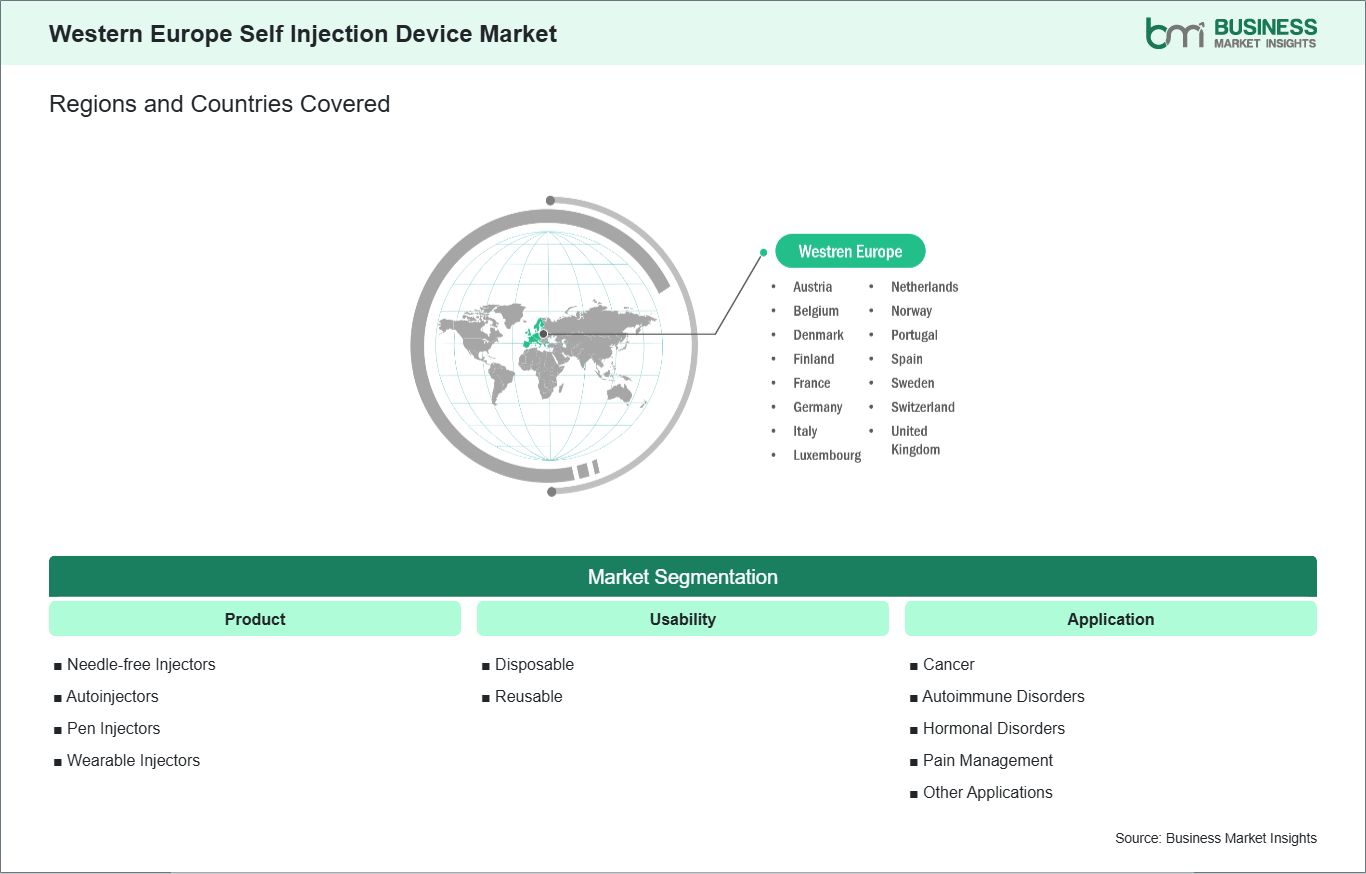
Key segments that contributed to the derivation of the Western Europe self injection device market analysis are product, usability, and application.
- By product, the self injection device market is segmented into needle-free Injectors, autoinjectors, pen Injectors, and wearable Injectors. The needle-free Injectors segment dominated the market in 2025.
- Based on usability, the self injection device market is categorized into disposable and reusable. The disposable segment dominated the market in 2025.
- In terms of application, the market is classified into cancer, autoimmune disorders, hormonal disorders, pain management, and other applications. The autoimmune disorders segment dominated the market in 2025
Market Forces
Western Europe Self Injection Device Market Drivers and Opportunities
Rising Demand for On-The-Go Chronic Care Management
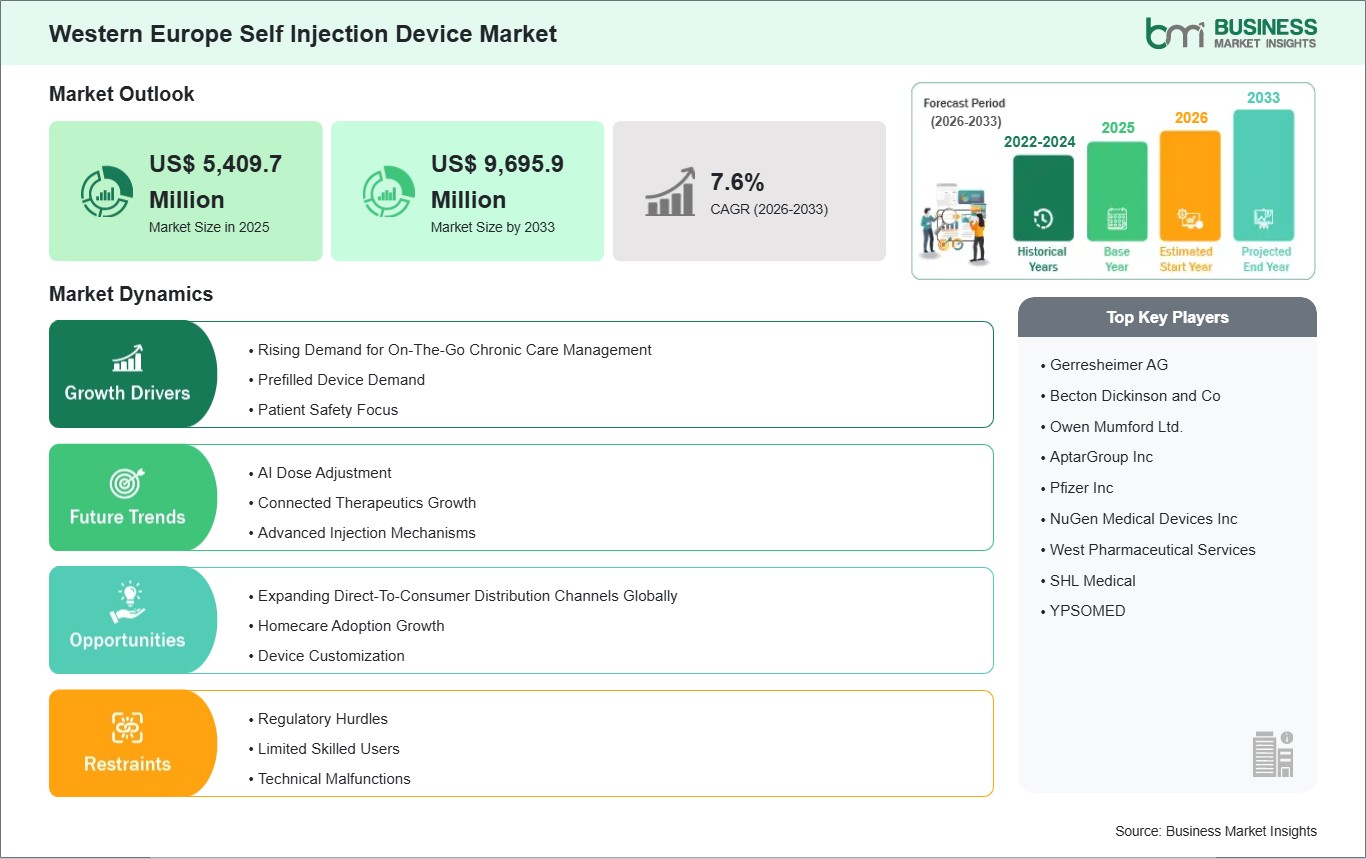
Western Europe is experiencing a major shift toward on-the-go chronic care management, driven by busy urban lifestyles and a strong preference for convenience. Patients managing long-term conditions such as diabetes, rheumatoid arthritis, and multiple sclerosis increasingly require treatment options that fit into work, travel, and daily routines. Self-injection devices that enable fast and discreet administration are becoming highly desirable. As a result, compact pen injectors and autoinjectors are becoming common in patient care plans, allowing individuals to administer therapy during daily activities without relying on clinic visits or specialized care centers. In Western Europe, patient mobility is also increasing due to commuting patterns and high rates of international travel. Patients are looking for self-injection solutions that are easy to carry, require minimal setup, and provide clear dose confirmation. Healthcare providers are supporting this trend by recommending devices with robust safety features and simple operation. Pharmacies and outpatient clinics increasingly offer training that emphasizes portable device use, proper storage during travel, and safe disposal when away from home. These efforts help improve adherence by reducing treatment interruptions caused by travel or busy schedules. Another key driver is the rising adoption of workplace health programs and employer-supported chronic disease management initiatives. Employers in Western Europe often provide wellness programs and support for chronic conditions, encouraging patients to manage therapies independently. Self-injection devices fit well into this model, enabling employees to maintain treatment schedules without taking time off work. As a result, the market is seeing higher demand for devices with discreet design, easy handling, and quick administration.
Expanding Direct-To-Consumer Distribution Channels Globally
The Western Europe self-injection device market is increasingly shaped by expanding direct-to-consumer (DTC) distribution channels, reflecting the region's high digital connectivity and strong e-commerce adoption. Manufacturers and pharmacies are increasingly using online platforms to sell self-injection devices, accessories, and patient support kits directly to consumers. This trend is especially pronounced in urban centers where patients are comfortable purchasing healthcare products online and expect fast delivery. DTC channels also allow manufacturers to offer bundled packages that include device training materials and replacement components, improving the overall patient experience. The rise of DTC distribution is also expanding the global reach of Western European device manufacturers. Many companies are leveraging online sales and international shipping to supply devices to patients in regions with limited local access. This global expansion is supported by strong regulatory compliance and quality standards that make Western European devices trusted options for international markets. DTC channels also enable manufacturers to gather direct patient feedback and usage data, which helps improve device design and patient support programs. In addition to online sales, subscription models are gaining popularity in Western Europe, where patients can receive regular device refills and replacement parts directly at home. This approach supports adherence by ensuring patients never run out of supplies and reduces the risk of treatment interruptions. Subscription services are often paired with digital platforms that provide reminders, dosing logs, and customer support. Thus, DTC channels are expected to make the market more patient-centric by providing direct access, personalized support, and seamless delivery.
Size and Share Analysis
Western Europe Self Injection Device Market Size and Share Analysis
The Western Europe Self Injection Device Market demonstrates steady growth, with size and share analysis highlighting evolving trends and competitive dynamics among key players. The report examines subsegments categorized within product, usability, and application, offering insights into their contribution to overall market performance.
By product, the needle-free Injectors subsegment dominated the market in 2025, driven by strong consumer demand for comfortable, less invasive administration experiences.
Based on usability, the disposable subsegment dominated the market in 2025, driven by strict hygiene standards and preference for single-use convenience in home care.
In terms of application, the autoimmune disorders subsegment dominated the market in 2025, driven by high utilization of self-administered biologic treatments for chronic immune-mediated diseases.
Report Coverage
Western Europe Self Injection Device Market Report Coverage and Deliverables
The "Western Europe Self Injection Device Market Size and Forecast (2022–2033)" report provides a detailed analysis of the market covering below areas:
- Western Europe Self Injection Device Market size and forecast at regional and country levels for all market segments covered under the scope
- Western Europe Self Injection Device Market trends, as well as drivers, restraints, and opportunities
- Western Europe Self Injection Device Market analysis covering key trends, regional framework, major players, regulations, and recent developments
- Industry landscape and competition analysis covering market concentration, heat map analysis, prominent players, and recent developments for the Western Europe Self Injection Device Market.
- Detailed company profiles, including SWOT analysis
Geographic Insights
Western Europe Self Injection Device Market Geographic Insights
The geographical scope of the Western Europe Self Injection Device Market report is divided into Belgium, the Netherlands, Luxembourg, Germany, France, Italy, Spain, Switzerland, Sweden, Austria, the UK, Denmark, Portugal, Norway, and Finland. Germany held the largest share in 2025.
Country-specific insights within Western Europe reveal variation in adoption dynamics, regulatory landscapes, and payer frameworks that influence competitive positioning and strategic market entry. Germany stands out for its early adoption of connected self-injection platforms and integrated care approaches that leverage electronic health records and digital monitoring tools, driven by statutory health insurance schemes that support advanced diabetes and autoimmune therapy delivery systems. Regulatory clarity and robust clinician engagement further enhance uptake. Adoption in the UK is shaped by the National Health Service (NHS) emphasis on cost-effectiveness and patient-centered chronic care pathways, with significant integration of self-injection devices in community care and specialist clinics, particularly for rheumatologic and endocrine therapies.
France exhibits strong penetration of ergonomic autoinjectors and prefilled pens across multiple therapeutic areas, underpinned by comprehensive reimbursement policies and collaborative pharmacist-led education programs that improve patient technique. In Italy, regional procurement variations influence adoption rates, with metropolitan centers showing higher uptake supported by specialist networks and public payer initiatives. At the same time, efforts continue to expand access in underserved regions. Spain demonstrates growing interest in digitally enabled delivery solutions, particularly in urban regions where telehealth pilots link self-injection devices with patient adherence platforms to reduce clinical visits.
Smaller markets such as the Netherlands and Belgium prioritize human factors and device usability data in reimbursement evaluations, reflecting payer expectations for measurable adherence gains and reduced downstream care utilization. Across all Western European markets, physician advocacy, patient education, and alignment with national chronic disease strategies are critical determinants of adoption. Manufacturers that tailor products to local regulatory requirements, reimbursement pathways, and healthcare delivery models while reinforcing digital support and value-based outcomes are best positioned to achieve sustainable growth and competitive differentiation in this diverse regional landscape.
Industry Activity
Recent Developments
The Western Europe Self Injection Device Market is evaluated by gathering qualitative and quantitative data post primary and secondary research, which includes important corporate publications, association data, and databases. A few of the key developments in the Western Europe self injection device market are:
- In May 2025, Sandoz launched the PYZCHIVA (ustekinumab) autoinjector, the first commercially available ustekinumab biosimilar in an autoinjector format across select Western European markets, including Spain, with further rollout planned across Europe. This prefilled autoinjector targets adults and pediatric patients with chronic inflammatory conditions such as plaque psoriasis, psoriatic arthritis, and Crohn's disease, offering a dose-accurate, easier self-administration option. The launch underscores the expanding role of biosimilar self-injection devices in Western Europe's chronic care landscape and patient-centric delivery models. Adoption of this autoinjector is expected to improve adherence and quality of life for long-term biologic therapies.
- In October 2025, SCHOTT Pharma introduced its large-volume (5.5 ml) prefillable staked-needle glass syringe compatible with YpsoMate 5.5 autoinjectors at CPHI Europe in Frankfurt, supporting next-generation self-injection delivery systems for high-dose biologics. While not a standalone device, this launch enhances the hardware ecosystem for self-injection platforms by enabling larger-volume administration outside clinical settings. The product's launch reinforces Western Europe's strategic position in innovating biologic administration technologies and paves the way for future large-volume at-home therapies.
Trust & Transparency
Research Methodology
The market analysis combines proprietary research with secondary data from government agencies, company disclosures, regulatory filings, industry databases and expert interviews. Market estimates are validated through data triangulation, cross-market benchmarking and analyst
review.
View Full Research Methodology
Key Sources Referred:
World Health Organization (WHO) Organisation for Economic Cooperation and Development (OECD) The World Bank Group Worldometer The Lancet International Bar Association International Trade Administration